PUBLISHER: Mordor Intelligence | PRODUCT CODE: 2124381

PUBLISHER: Mordor Intelligence | PRODUCT CODE: 2124381
Respiratory Disease Testing - Market Share Analysis, Industry Trends & Statistics, Growth Forecasts (2026 - 2031)
According to Mordor Intelligence, the respiratory disease testing market size is projected to expand from USD 6.04 billion in 2025 and USD 6.24 billion in 2026 to USD 7.48 billion by 2031, registering a CAGR of 3.69% between 2026 to 2031.
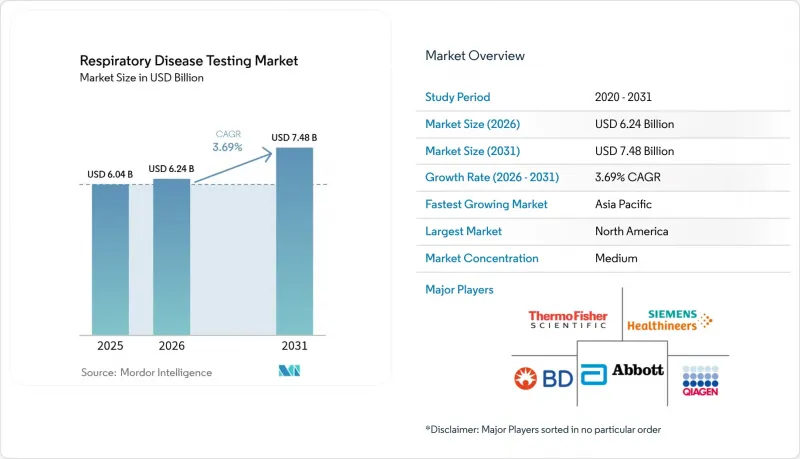
This report is Segmented by Test Type (Imaging Tests, Molecular Diagnostic Tests, Mechanical Tests, Blood-Gas & Electrolyte Tests), Disease (Asthma & COPD, Tuberculosis, Lung Cancer, and More), End User (Hospitals & Clinics, and More), and Geography (North America, Europe, Asia-Pacific, Middle East & Africa, South America). Market Forecasts are Provided in Terms of Value (USD).
Global Respiratory Disease Testing Market Trends and Insights
Air-Quality Regulation-Fuelled Demand Surge
Strengthening particulate-matter limits across China and India requires mandatory spirometry for industrial workers, driving bulk purchases of portable devices and associated disposables. Enterprises are choosing bundled contracts that include hardware, calibration services, and cloud dashboards, enabling vendors to lock in recurring revenue. Real-time AI coaching embedded in modern spirometers reduces dependence on scarce technicians and extends screening into tier-2 cities. This expansion is widening the footprint of the respiratory disease testing market among employer health programs. Device makers that localize manufacturing close to Asian hubs are capturing cost advantages and faster regulatory clearance.
Post-COVID Era Stockpiling of Multiplex Respiratory Panels
Hospital preparedness grants in the United States and bulk buys in Europe lifted molecular-panel shipments by nearly one-fifth during 2024 to early 2025. By mid-2025, consumption normalized to roughly two-thirds of installed capacity, triggering an abrupt drawdown of surplus inventory. Laboratories are now pivoting toward modular syndromic panels that combine respiratory, gastrointestinal, and central nervous system targets to retain capital utilization. The swing exposed supply-chain fragilities and prompted reagent makers to roll out auto-refill programs matched to real-time analyzer telemetry, a service model that is becoming table stakes in the respiratory disease testing market.
Reimbursement Headwinds for Advanced Molecular Panels
CMS lowered the 2025 national limitation amount for CPT 87631 respiratory panels by 12%, and private payers layered on prior-authorization hurdles, curbing uptake outside inpatient walls. Laboratories are downgrading to 3-to-5-target assays that fit tighter cost ceilings, eroding absolute revenue per sample. The margin squeeze is widening the gap between large hospital networks, which dilute overhead across higher volumes, and stand-alone clinics, which cannot amortize instrument investments as quickly. Tiered pricing tied to medical-necessity documentation is emerging as a short-term mitigation lever.
Other drivers and restraints analyzed in the detailed report include:
- Hospital Decanting to Home/POC Settings
- AI-Assisted Image & Spirometry Analytics Adoption
- Shortage of Trained Pulmonary-Lab Personnel
For complete list of drivers and restraints, kindly check the Table Of Contents.
Segment Analysis
Molecular diagnostics accounted for 48.82% of 2025 respiratory disease testing market revenue, underscoring decades of investment in automated PCR and isothermal platforms. Yet, mechanical tests are the fastest-growing slice, climbing 4.06% annually as primary-care providers bundle spirometry with routine checkups and employers meet new compliance rules. This upswing pushes the mechanical slice's respiratory disease testing market size toward an incremental USD 0.56 billion over the forecast horizon. Vendors capitalizing on integrated Bluetooth spirometers coupled with AI coaching stand to outpace peers on both unit volumes and SaaS margins.
Targeted reimbursement policies bolster the shift. A Grade B USPSTF endorsement for COPD screening mandates insurer coverage of spirometry without patient cost-sharing. In parallel, lower-priced pathogen-specific PCR assays are cannibalizing broad syndromic panels, compressing molecular average selling prices by roughly 4% to 6% each year. Imaging tests continue to benefit from AI-triaged CT workflows, drawing community centers into lung-cancer screening programs and expanding downstream biopsy referrals, but they trail mechanical modalities in absolute growth velocity within the respiratory disease testing market.
Complete Report Scope:
- By Test Type
- Imaging Tests
- Molecular Diagnostic Tests
- Mechanical Tests (PFT/Spirometry)
- Blood-Gas & Electrolyte Tests
- By Disease
- Asthma & COPD
- Tuberculosis
- Lung Cancer
- Influenza & RSV
- Other Respiratory Infections
- By End User
- Hospitals & Clinics
- Diagnostic Laboratories
- Home Care Settings
- Other End Users
- By Geography
- North America
- United States
- Canada
- Mexico
- Europe
- Germany
- United Kingdom
- France
- Italy
- Spain
- Rest of Europe
- Asia-Pacific
- China
- Japan
- India
- Australia
- South Korea
- Rest of Asia-Pacific
- Middle East & Africa
- GCC
- South Africa
- Rest of Middle East & Africa
- South America
- Brazil
- Argentina
- Rest of South America
- North America
Geography Analysis
North America commanded 43.08% of global revenue in 2025, underpinned by high insurance penetration, generous Medicare coding, and an FDA backlog-clearing spree that granted Breakthrough Device status to seven respiratory platforms over two years. While reimbursement reductions temper molecular margins, speed-to-market advantages keep innovation pipelines vibrant. Hospitals increasingly deploy rapid PCR analyzers at emergency-department triage stations, cutting antibiotic overuse and reinforcing demand for syndromic cartridges.
Europe contributes a mature yet innovation-friendly share of the respiratory disease testing market, navigating IVDR compliance turbulence to restore product breadth. Lung-cancer screening pilots in Germany and the United Kingdom are scaling to nationwide programs by 2028, promising steady CT and biomarker volumes. Conversely, national health payors enforce volume caps on high-plex PCR, driving labs toward algorithm-driven test utilization that maximizes clinical utility.
Asia-Pacific posts the quickest 7.27% CAGR, set to overtake Europe on absolute dollars by 2030. India's Ayushman Bharat scheme now reimburses molecular TB testing and spirometry, bringing diagnostics to tier-3 towns. China's National Healthcare Security Administration boosted syndromic-panel payment rates by 15% in 2025, unlocking provincial hospital budgets. Parallel air-pollution mandates increase COPD screening volumes, swelling the mechanical-test subset of the respiratory disease testing market.
Middle East & Africa and South America remain smaller but opportunity-rich. Gulf Cooperation Council members are funding flagship tertiary hospitals with on-site molecular labs, while Brazil's private insurer market fuels retail-clinic expansion stocked with rapid antigen tests. Both regions import the bulk of their kits, presenting scale economies for global OEMs that establish regional assembly nodes.
- Abbott Laboratories
- Beckton Dickinson
- bioMerieux
- Danaher
- Dragerwerk
- Roche
- GE HealthCare Technologies Inc.
- Hill-Rom (Baxter International)
- Hologic
- MGC Diagnostics
- NDD Medical Technologies
- PerkinElmer
- Koninklijke Philips
- QIAGEN
- Quidel-Ortho Corporation
- Resmed
- Seegene
- Siemens Healthineers
- Thermo Fisher Scientific
- Vitalograph Ltd.
- Vyaire Medical
Additional Benefits:
- The market estimate (ME) sheet in Excel format
- 3 months of analyst support
TABLE OF CONTENTS
1 Introduction
- 1.1 Study Assumptions & Market Definition
- 1.2 Scope of the Study
2 Research Methodology
3 Executive Summary
4 Market Landscape
- 4.1 Market Overview
- 4.2 Market Drivers
- 4.2.1 Air-Quality Regulation-Fuelled Demand Surge
- 4.2.2 Post-COVID Era Stockpiling of Multiplex Respiratory Panels
- 4.2.3 Hospital Decanting to Home/POC Settings
- 4.2.4 AI-Assisted Image & Spirometry Analytics Adoption
- 4.2.5 Digital-Diagnostic Data Mandates
- 4.2.6 Climate-Linked Pathogen Seasonality Shifts
- 4.3 Market Restraints
- 4.3.1 Reimbursement Headwinds for Advanced Molecular Panels
- 4.3.2 Shortage of Trained Pulmonary-Lab Personnel
- 4.3.3 Consumable-Grade Polysilicone Supply Bottlenecks
- 4.3.4 Antigen-Test Sensitivity Scrutiny by Regulators
- 4.4 Regulatory Landscape
- 4.5 Technological Outlook
- 4.6 Porter's Five Forces Analysis
- 4.6.1 Threat of New Entrants
- 4.6.2 Bargaining Power of Buyers
- 4.6.3 Bargaining Power of Suppliers
- 4.6.4 Threat of Substitute Products
- 4.6.5 Intensity of Competitive Rivalry
5 Market Size & Growth Forecasts
- 5.1 By Test Type
- 5.1.1 Imaging Tests
- 5.1.2 Molecular Diagnostic Tests
- 5.1.3 Mechanical Tests (PFT/Spirometry)
- 5.1.4 Blood-Gas & Electrolyte Tests
- 5.2 By Disease
- 5.2.1 Asthma & COPD
- 5.2.2 Tuberculosis
- 5.2.3 Lung Cancer
- 5.2.4 Influenza & RSV
- 5.2.5 Other Respiratory Infections
- 5.3 By End User
- 5.3.1 Hospitals & Clinics
- 5.3.2 Diagnostic Laboratories
- 5.3.3 Home Care Settings
- 5.3.4 Other End Users
- 5.4 By Geography
- 5.4.1 North America
- 5.4.1.1 United States
- 5.4.1.2 Canada
- 5.4.1.3 Mexico
- 5.4.2 Europe
- 5.4.2.1 Germany
- 5.4.2.2 United Kingdom
- 5.4.2.3 France
- 5.4.2.4 Italy
- 5.4.2.5 Spain
- 5.4.2.6 Rest of Europe
- 5.4.3 Asia-Pacific
- 5.4.3.1 China
- 5.4.3.2 Japan
- 5.4.3.3 India
- 5.4.3.4 Australia
- 5.4.3.5 South Korea
- 5.4.3.6 Rest of Asia-Pacific
- 5.4.4 Middle East & Africa
- 5.4.4.1 GCC
- 5.4.4.2 South Africa
- 5.4.4.3 Rest of Middle East & Africa
- 5.4.5 South America
- 5.4.5.1 Brazil
- 5.4.5.2 Argentina
- 5.4.5.3 Rest of South America
- 5.4.1 North America
6 Competitive Landscape
- 6.1 Market Concentration
- 6.2 Market Share Analysis
- 6.3 Company Profiles (includes Global Level Overview, Market Level Overview, Core Segments, Financials as Available, Strategic Information, Market Rank/Share for Key Companies, Products & Services, and Recent Developments)
- 6.3.1 Abbott Laboratories
- 6.3.2 Becton Dickinson & Company
- 6.3.3 bioMerieux SA
- 6.3.4 Danaher Corporation (Cepheid)
- 6.3.5 Dragerwerk AG & Co. KGaA
- 6.3.6 F. Hoffmann-La Roche AG
- 6.3.7 GE HealthCare Technologies Inc.
- 6.3.8 Hill-Rom (Baxter International)
- 6.3.9 Hologic Inc.
- 6.3.10 MGC Diagnostics Corporation
- 6.3.11 NDD Medical Technologies
- 6.3.12 PerkinElmer Inc.
- 6.3.13 Philips Healthcare
- 6.3.14 Qiagen N.V.
- 6.3.15 Quidel-Ortho Corporation
- 6.3.16 ResMed Inc.
- 6.3.17 Seegene Inc.
- 6.3.18 Siemens Healthineers AG
- 6.3.19 Thermo Fisher Scientific Inc.
- 6.3.20 Vitalograph Ltd.
- 6.3.21 Vyaire Medical Inc.
7 Market Opportunities & Future Outlook
- 7.1 White-space & Unmet-Need Assessment

