PUBLISHER: Mordor Intelligence | PRODUCT CODE: 2124385

PUBLISHER: Mordor Intelligence | PRODUCT CODE: 2124385
Voice Assistant Application - Market Share Analysis, Industry Trends & Statistics, Growth Forecasts (2026 - 2031)
According to Mordor Intelligence, the voice assistant application market size is projected to be at USD 8.55 billion in 2025, reached USD 9.02 billion in 2026 and is projected to climb to USD 18.36 billion by 2031, advancing at a 15.27% CAGR from 2026-2031.
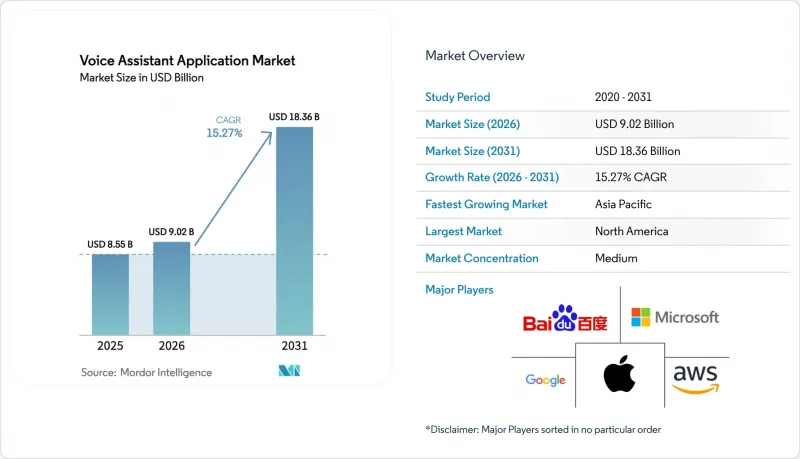
This report is Segmented by Component (Solutions, and Services), Technology (Natural Language Processor, Speech Recognition, and More), Deployment (On-Premise, Cloud, and Hybrid), Enterprise Size (Small and Medium Enterprises, and Large Enterprises), End-Use Vertical (IT and Telecom, BFSI, Healthcare, Automotive, and More), and Geography. The Market Forecasts are Provided in Terms of Value (USD).
Global Voice Assistant Application Market Trends and Insights
Surge In Smart-Speaker And Voice-Enabled Device Adoption
Smart-speaker shipments reached 150 million units in 2024, placing Alexa and Google Nest devices in 40% of U.S. homes and 28% of urban households in the Asia-Pacific region, creating a broad channel for third-party skills. Eighty-four percent of enterprises polled by Deepgram in 2025 planned budget increases for voice assistants, signaling a shift from proofs of concept to production roll-outs. Logistics operators using Alexa for Business reported a 15-20% error reduction in warehouse picking compared to handheld scanners, underscoring the labor-savings potential. Automakers embedded voice assistants as standard equipment, and Tesla logged a 40% year-over-year rise in voice commands during Full Self-Driving mode in 2024, reflecting safety appeal. The expanding installed base supplies usage data that improves model accuracy, establishing a virtuous cycle that reinforces adoption.
Rapid Cost Reduction In Real-Time LLM-Powered Speech Pipelines
Inference costs for large-language-model speech stacks have fallen roughly 60% since 2023 due to speculative decoding and model quantization, keeping intent accuracy above 95% while slashing compute needs. Microsoft Azure trimmed Cortana and Bot Service pricing by 35% for high-volume clients in 2025, a response to price pressure from Voiceflow and Rasa that lowered barriers for small enterprises. Streaming natural-language processing now returns partial intents within 200 milliseconds, eliminating latency that previously eroded customer-service satisfaction. OpenAI's Whisper v3 Turbo, released December 2025, delivered 15% faster inference across 99 languages while holding word-error rates below 3%, enabling affordable multilingual assistants. Collectively, cheaper, faster pipelines democratize voice deployments beyond large enterprises.
Persistent Privacy And Data-Security Concerns
Voice transcripts qualify as biometric data under GDPR Article 9 and the California Consumer Privacy Act (CCPA) rules, requiring firms to obtain explicit consent and minimize retention. A 2024 PwC poll showed 63% of consumers uneasy with always-on microphones, citing the 2023 Alexa breach that exposed 1.2 million transcripts. Hong Kong police documented the first deep-fake audio job-interview scam in February 2024, driving insurers to exclude voice-spoof losses without liveness checks. Illinois, Texas, and Washington biometric laws carry statutory damages up to USD 5,000 per violation, posing an existential risk for startups without compliance tooling. The U.S. Federal Trade Commission fined a telehealth provider USD 8 million in 2024 for unencrypted recordings, deterring investment in healthcare voice assistants.
Other drivers and restraints analyzed in the detailed report include:
- Enterprise Push To Automate Customer-Service And IVR Workflows
- Hybrid On-Device And Cloud Architectures Unlocking Regulated-Industry Demand
- Accuracy Gaps Across Accents, Dialects And Noisy Settings
For complete list of drivers and restraints, kindly check the Table Of Contents.
Segment Analysis
Solutions captured 61.27% of the voice assistant application market share in 2025, yet the services segment is forecast to post a 17.22% CAGR through 2031 as enterprises realize that embedding Alexa, Google Assistant, or Siri into business workflows involves continuous intent-mapping, dialogue-flow tuning, and compliance audits. Professional services encompass custom skill creation for regulated tasks, such as clinical documentation or shop-floor inventory checks, which require domain-specific vocabulary not available in generic marketplaces. Integration projects still span nine months on average, with nearly half the schedule spent labeling intents rather than writing code, which drives demand for outside linguists and conversation designers. Managed-services contracts are growing because they bundle uptime service-level agreements and periodic model retraining, freeing digital-transformation teams from the need to hire scarce conversational-AI engineers. IBM reported that 68% of its Watson Assistant customers in 2025 chose a managed model over self-service APIs, indicating a clear preference to outsource ongoing optimization.
The solutions segment is benefiting from no-code design tools that let non-developers draft flows, yet even these platforms require linguistic expertise to craft prompts and handle slot-filling errors. Vertical specialists, notably in healthcare, now preload vocabularies and HIPAA-compliant workflows, shrinking time-to-value for hospitals deploying ambient voice assistants. Small and medium enterprises gravitate toward predictable monthly service fees rather than variable cloud-API bills, a trend reinforced by white-label offerings that package hosting, monitoring, and analytics. Although automation will compress services margins over time, the complexity of multi-language deployments and the rise of code-switching use cases ensure that human-in-the-loop quality checks remain critical to the voice assistant application market size expansion over the forecast horizon.
Speech recognition commanded 46.63% of 2025 spending, yet edge computing is projected to advance at a 16.88% CAGR to 2031 as privacy-conscious users push wake-word detection and routine commands onto local silicon. The voice assistant application market size for speech recognition remains foundational because every conversational stack starts with audio-to-text conversion, but on-device neural processors now handle basic tasks under 2 W, trimming latency and cloud fees. Qualcomm's Snapdragon 8 Gen 3 demonstrated reliable wake-word detection in automotive dashboards without cellular connections, while Apple's iOS 19 moved 78% of common Siri queries on-device, reducing infrastructure costs by roughly 40%. Text-to-speech has gained momentum from generative models that add emotional inflection, although vendors now watermark synthetic audio to deter deepfake abuse.
Natural language processing still primarily runs in the cloud for complex queries because large language model inference strains mobile hardware; however, quantized variants, such as Llama 3.2 1B, are starting to power lightweight intent classification on smartphones. NVIDIA's Jetson Orin platform showed 30-frame-per-second command recognition in warehouse tests, bringing hands-free quality inspection to industrial clients. Regulatory pressure for data localization in healthcare and finance, combined with the economics of avoiding per-query cloud charges, underpins the strong outlook for edge nodes within the broader voice assistant application market.
Complete Report Scope:
- By Component
- Solutions
- Services
- By Technology
- Natural Language Processor (NLP)
- Speech Recognition
- Text-to-Speech Conversion
- Edge Computing
- By Deployment
- On- Premise
- Cloud
- Hybrid
- By Enterprise Size
- Small and Medium Enterprises (SMEs)
- Large Enterprises
- By End-Use Vertical
- IT and Telecom
- BFSI
- Healthcare
- Retail and E-commerce
- Automotive
- Media and Entertainment
- Education
- Manufacturing
- Government and Public Sector
- By Geography
- North America
- United States
- Canada
- Mexico
- South America
- Brazil
- Argentina
- Rest of South America
- Europe
- Germany
- United Kingdom
- France
- Italy
- Spain
- Rest of Europe
- Asia-Pacific
- China
- Japan
- India
- South Korea
- ASEAN
- Rest of Asia-Pacific
- Middle East
- Saudi Arabia
- United Arab Emirates
- Rest of Middle East
- Africa
- South Africa
- Nigeria
- Rest of Africa
- North America
Geography Analysis
North America accounted for 36.65% of the 2025 revenue, giving the region the largest voice assistant application market share. With Amazon Alexa and Google Assistant installed in 40% of households, and Section 508 mandates spurring retrofits across federal contractors, the region's dominance is expected to continue. Venture capital remained plentiful as startups raised USD 2.3 billion in 2024, and anchor customers in financial services and healthcare funded early pilots that are now moving toward full-scale roll-outs. Yet, tier-1 use cases, such as customer service, are approaching saturation, so vendors are pivoting toward niche deployments, including legal transcription, real-estate showings, and field-service diagnostics. Canada mirrors the United States' trends, but growth now hinges on bilingual English-French assistants that comply with the Official Languages Act. Mexico is emerging as a near-shore development hub for North American enterprises seeking Spanish voice skills, leveraging its talent pool of more than 650,000 software engineers.
Europe held an estimated 28% share in 2025 as GDPR data-localization rules favored regional providers and the European Accessibility Act of June 2025 mandated voice-enabled e-commerce by 2028. Germany's automotive giants Volkswagen, BMW, and Mercedes-Benz embed assistants in connected-vehicle platforms, while the United Kingdom's National Health Service tested ambient clinical assistants in 150 general-practitioner practices. France and Italy focus on smart-home assistants tuned for local dialects, and Spain's banks deploy voice biometrics in mobile apps to curb fraud. South America is led by Brazil and Argentina, which use Portuguese and Spanish natural-language processing for government and banking, although currency volatility and patchy broadband keep growth in mid-single digits. Chile and Colombia are trialing Spanish code-switching assistants for customer service, aided by regional telecom investments in low-latency fiber routes.
Asia-Pacific is projected to post a 18.02% CAGR through 2031 and drive the largest incremental voice assistant application market size gain, propelled by China's Baidu DuerOS, Alibaba Tmall Genie, and iFLYTEK Spark ecosystems, India's 22-language Bhashini platform, and Southeast Asia's mobile-first adoption curve. Baidu processed over 1 billion queries in 2024 after adding large-language-model capabilities. India's open-source Bhashini gives 400 million lower-literacy citizens voice access to digital services, while Grab and Gojek weave ordering assistants into super-apps across Indonesia, Singapore, and Vietnam. Japan's aging population favors elder-care robots powered by voice, with SoftBank's Pepper deployed in more than 2,000 nursing homes, and South Korea's Samsung Bixby plus LG ThinQ dominate appliance control. Middle East and Africa remain small today, yet Saudi Arabia's USD 500 million Vision 2030 budget for voice-enabled citizen services and United Arab Emirates research grants for Arabic dialect models are accelerating double-digit adoption. South Africa pilots voice biometrics that cut call-center fraud 41%, and Nigeria's mobile-money operators test assistants for low-literacy users, signaling untapped upside once infrastructure matures.
- Amazon.com Inc. (AWS)
- Google LLC (Alphabet Inc.)
- Apple Inc.
- Microsoft Corporation
- Baidu Inc.
- IBM Corporation
- Nuance Communications Inc.
- Samsung Electronics Co., Ltd.
- Oracle Corporation
- Salesforce Inc.
- SoundHound AI, Inc.
- iFLYTEK Co., Ltd.
- Sensory Inc.
- Verint Systems Inc.
- Cisco Systems Inc.
- Alibaba Group Holding Ltd.
- Xiaomi Corporation
- Huawei Technologies Co., Ltd.
- Yandex LLC
- LG Electronics Inc.
- Voiceflow Inc.
- OpenAI L.L.C.
Additional Benefits:
- The market estimate (ME) sheet in Excel format
- 3 months of analyst support
TABLE OF CONTENTS
1 INTRODUCTION
- 1.1 Study Assumptions and Market Definition
- 1.2 Scope of the Study
2 RESEARCH METHODOLOGY
3 EXECUTIVE SUMMARY
4 MARKET LANDSCAPE
- 4.1 Market Overview
- 4.2 Market Drivers
- 4.2.1 Surge in Smart-speaker and Voice-enabled Voice Adoption
- 4.2.2 Rapid Cost Reduction in Real-time LLM-powered Speech Pipelines
- 4.2.3 Enterprise Push to Automate Customer- Service and IVR Workflows
- 4.2.4 Hybrid On-device and Cloud Architectures Unlocking Regulated- Industry Demand
- 4.2.5 Accessibility Regulations (WCAG 3.0/ADA) Mandating Voice UIs
- 4.2.6 Conversational Commerce Add-ons Boosting Average Order Value
- 4.3 Market Restraints
- 4.3.1 Persistent Privacy and Data-Security Concerns
- 4.3.2 Accuracy Gaps Across Accents, Dialects and Noisy Settings
- 4.3.3 Integration Complexity and Specialised Talent Shortages
- 4.3.4 Rising Deep-fake or Voice-spoofing Threats Tightening Compliance
- 4.4 Industry Value Chain Analysis
- 4.5 Regulatory Landscape
- 4.6 Technological Outlook
- 4.7 Porter's Five Forces Analysis
- 4.7.1 Bargaining Power of Suppliers
- 4.7.2 Bargaining Power of Buyers
- 4.7.3 Threat of New Entrants
- 4.7.4 Threat of Substitutes
- 4.7.5 Intensity of Competitive Rivalry
5 MARKET SIZE AND GROWTH FORECASTS (VALUE)
- 5.1 By Component
- 5.1.1 Solutions
- 5.1.2 Services
- 5.2 By Technology
- 5.2.1 Natural Language Processor (NLP)
- 5.2.2 Speech Recognition
- 5.2.3 Text-to-Speech Conversion
- 5.2.4 Edge Computing
- 5.3 By Deployment
- 5.3.1 On- Premise
- 5.3.2 Cloud
- 5.3.3 Hybrid
- 5.4 By Enterprise Size
- 5.4.1 Small and Medium Enterprises (SMEs)
- 5.4.2 Large Enterprises
- 5.5 By End-Use Vertical
- 5.5.1 IT and Telecom
- 5.5.2 BFSI
- 5.5.3 Healthcare
- 5.5.4 Retail and E-commerce
- 5.5.5 Automotive
- 5.5.6 Media and Entertainment
- 5.5.7 Education
- 5.5.8 Manufacturing
- 5.5.9 Government and Public Sector
- 5.6 By Geography
- 5.6.1 North America
- 5.6.1.1 United States
- 5.6.1.2 Canada
- 5.6.1.3 Mexico
- 5.6.2 South America
- 5.6.2.1 Brazil
- 5.6.2.2 Argentina
- 5.6.2.3 Rest of South America
- 5.6.3 Europe
- 5.6.3.1 Germany
- 5.6.3.2 United Kingdom
- 5.6.3.3 France
- 5.6.3.4 Italy
- 5.6.3.5 Spain
- 5.6.3.6 Rest of Europe
- 5.6.4 Asia-Pacific
- 5.6.4.1 China
- 5.6.4.2 Japan
- 5.6.4.3 India
- 5.6.4.4 South Korea
- 5.6.4.5 ASEAN
- 5.6.4.6 Rest of Asia-Pacific
- 5.6.5 Middle East
- 5.6.5.1 Saudi Arabia
- 5.6.5.2 United Arab Emirates
- 5.6.5.3 Rest of Middle East
- 5.6.6 Africa
- 5.6.6.1 South Africa
- 5.6.6.2 Nigeria
- 5.6.6.3 Rest of Africa
- 5.6.1 North America
6 COMPETITIVE LANDSCAPE
- 6.1 Market Concentration
- 6.2 Strategic Moves
- 6.3 Market Share Analysis
- 6.4 Company Profiles (includes Global level Overview, Market Level Overview, Core Segments, Financials as Available, Strategic Information, Market Rank/Share for Key Companies, Products and Services, and Recent Developments)
- 6.4.1 Amazon.com Inc. (AWS)
- 6.4.2 Google LLC (Alphabet Inc.)
- 6.4.3 Apple Inc.
- 6.4.4 Microsoft Corporation
- 6.4.5 Baidu Inc.
- 6.4.6 IBM Corporation
- 6.4.7 Nuance Communications Inc.
- 6.4.8 Samsung Electronics Co., Ltd.
- 6.4.9 Oracle Corporation
- 6.4.10 Salesforce Inc.
- 6.4.11 SoundHound AI, Inc.
- 6.4.12 iFLYTEK Co., Ltd.
- 6.4.13 Sensory Inc.
- 6.4.14 Verint Systems Inc.
- 6.4.15 Cisco Systems Inc.
- 6.4.16 Alibaba Group Holding Ltd.
- 6.4.17 Xiaomi Corporation
- 6.4.18 Huawei Technologies Co., Ltd.
- 6.4.19 Yandex LLC
- 6.4.20 LG Electronics Inc.
- 6.4.21 Voiceflow Inc.
- 6.4.22 OpenAI L.L.C.
7 MARKET OPPORTUNITIES AND FUTURE OUTLOOK
- 7.1 White-space and Unmet-Need Assessment

