PUBLISHER: Mordor Intelligence | PRODUCT CODE: 2124389

PUBLISHER: Mordor Intelligence | PRODUCT CODE: 2124389
Automotive On-board Charger - Market Share Analysis, Industry Trends & Statistics, Growth Forecasts (2026 - 2031)
According to Mordor Intelligence, the automotive on-board charger market size is expected to grow from USD 7.17 billion in 2025 to USD 8.17 billion in 2026 and is forecast to reach USD 15.68 billion by 2031 at 13.93% CAGR over 2026-2031.
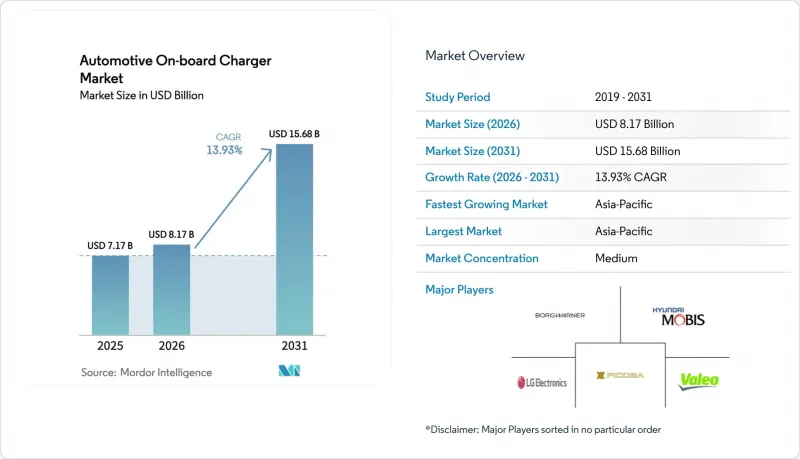
This report is Segmented by Vehicle Type (Passenger Cars and Commercial Vehicles), Powertrain Type (Battery Electric Vehicles and Plug-In Hybrid Electric Vehicles), Power Rating (Less Than 3. 3 KW, 3. 3-11 KW, and More), Sales Channel (OEM-Installed and Aftermarket), and Geography. Market Forecasts are Provided in Terms of Value (USD) and Volume (Units).
Global Automotive On-board Charger Market Trends and Insights
Aggressive Global EV Adoption Targets and Purchase Incentives
Governments are front-loading subsidy budgets and tightening fleet CO2 rules, forcing automakers to standardize 11 kW or higher chargers so vehicles qualify for evolving incentive tiers. The EU's 2035 internal-combustion ban spurred volume brands to future-proof models with bidirectional-ready hardware . China kept its New Energy Vehicle rebates through 2025 and excludes 3.3 kW designs from higher rebate brackets, while California's Advanced Clean Cars II regulation is nudging several other United States states toward a de facto nationwide zero-emission sales mandate. India's FAME-II extension channels significant investment into vehicles that embed domestic, bidirectional-capable chargers. Together, these policies compress product-cycle timelines and shift demand toward power-dense, protocol-rich chargers that accommodate future grid-services revenue streams.
Rapid Switch to 800 V Vehicle Architectures Enabling 11-22 kW OBCs
High-voltage platforms decouple AC charge time from battery size, letting 90 kWh packs add 22 kW home charging without oversizing cables or cooling loops. Porsche's Taycan validated consumer appetite for premium AC performance, and Hyundai's 2024 E-GMP rollout pushed 22 kW chargers into mid-segment sedans. GM's Ultium migration to 800 V from 2027 aligns pickup and SUV families around 19.2 kW AC capability, while BYD's e-Platform 3.0 integrates an 11 kW bidirectional charger inside the drive inverter, trimming underbody space and lowering parts count. Europe reaps the most benefit because three-phase 400 V home service is standard; North America's single-phase limits keep adoption to 11 kW, yet premium fleets still value the reduced thermal losses of 800 V silicon-carbide designs.
Persistently High Wide-Band-Gap Substrate Costs in 22 kW Three-Phase OBCs
In early 2026, six-inch SiC wafers were significantly more expensive than their silicon counterparts, leading to a notable cost premium for each 22 kW charger. While projections for 200 mm lines suggest a reduction in substrate costs by 2028, the current price gap confines high-power AC hardware to premium models. Meanwhile, Chinese Tier-2 suppliers explored low-frequency silicon solutions, but these resulted in a density drop below acceptable thresholds, making them unsuitable for compact platforms.
Other drivers and restraints analyzed in the detailed report include:
- Declining SIC/GAN Device Prices Lifting OBC Power Density
- Mandatory ISO 15118 / Plug-&-Charge and V2G Readiness Clauses in EU and US Funding Schemes
- OEM Hesitancy to Up-Spec AC Chargers as DC Ultra-Fast (>=350 kW) Roll-Outs Accelerate
For complete list of drivers and restraints, kindly check the Table Of Contents.
Segment Analysis
Passenger cars held 67.10% of 2025 shipments due to higher unit volumes, yet fleet procurement policies are tilting the momentum. Electric buses and last-mile vans equip 22 kW chargers to trim pack sizes by 100 kWh, saving significantly in battery cost per vehicle. Commercial vehicles are set to expand with the fastest growth at a 14.42% CAGR through 2031. Depot operators such as Amazon have validated 11 kW as their optimum trade-off between panel upgrade expense and overnight availability, influencing van OEMs to offer dual ratings. This interplay keeps the automotive on-board charger market diversified across duty cycles.
Ride-hail operators in Europe increasingly specify 11 kW-capable sedans so drivers can top up during shift changes; Tesla reports that a notable share of its 2025 European Model 3 sales went to such fleets. In heavy commercial, Proterra's 19.2 kW AC solution allows midday top-ups without megawatt-scale infrastructure, an approach now mirrored by BYD's eBus line in Latin America. These cases show how operational cost modeling, not just regulatory pressure, is reshaping charger choices.
Battery-electric vehicles represented 75.33% of 2025 revenue and will rise at 15.48% CAGR through 2031, underscoring their role as the core value pool of the automotive on-board charger market. Carmakers are converging on 11 kW as the baseline, with Tesla, Volkswagen, and GM overlaying software packages that later activate bidirectional functions for grid-services compensation. Plug-in hybrids retain a separate supply chain around 3.3-7.4 kW silicon designs that meet overnight charging needs for 20 kWh batteries, and updated EU CO2 credits now push plug-in hybrid electric vehicle packs toward 30 kWh, nudging charger ratings up to 7.4 kW. Yet the incremental cost of 11 kW hardware still outweighs fleet-tax incentives in many markets, so the automotive on-board charger industry maintains dual product tiers to balance affordability and regulatory compliance.
A second dynamic shaping this segment is residual-value retention. Leasing companies in Germany report that BEVs equipped with 22 kW chargers command higher resale than 11 kW peers after four years, accelerating adoption among corporate fleets that optimize total cost of ownership. In contrast, North American suburban buyers show price sensitivity above 11 kW because single-phase home circuits seldom benefit, reinforcing regional divergence in charger specifications. As a result, the automotive on-board charger market size for plug-in hybrids is forecast to expand by 2031, whereas BEVs could grow further, keeping program volumes high enough for suppliers to amortize SiC qualification costs across both sectors.
Complete Report Scope:
- By Vehicle Type
- Passenger Cars
- Commercial Vehicles
- By Powertrain Type
- Battery Electric Vehicles (BEVs)
- Plug-in Hybrid Electric Vehicles (PHEVs)
- By Power Rating
- Less than 3.3 kW
- 3.3-11 kW
- More than 11 kW
- By Sales Channel
- OEM-installed
- Aftermarket
- By Geography
- North America
- United States
- Canada
- Rest of North America
- South America
- Brazil
- Argentina
- Rest of South America
- Europe
- Germany
- United Kingdom
- France
- Italy
- Russia
- Rest of Europe
- Asia-Pacific
- China
- Japan
- India
- South Korea
- Rest of Asia-Pacific
- Middle East and Africa
- Saudi Arabia
- United Arab Emirates
- Turkey
- South Africa
- Egypt
- Rest of Middle East and Africa
- North America
Geography Analysis
Asia-Pacific captured 39.05% of 2025 revenue and will expand at 15.02% CAGR through 2031. China alone produced 16.6 million New Energy Vehicles in 2025, leveraging local SiC supply chains and "Made in China 2025" rules that keep domestic charger content above 50%. India's FAME-II ties per-vehicle payouts to indigenous OBC procurement, pushing Tata Motors and Mahindra to dual-source from Varroc and Sona BLW plants in Pune. Japan and South Korea remain cautious on home-wiring upgrades, capping chargers at 6 kW, which slows SiC diffusion despite subsidies. Southeast Asian rooftop-solar bundling, however, is opening a path for 7.4 kW bidirectional designs that store daytime generation for evening air-conditioning loads.
In 2025, Europe, led by three-phase residential grids in Germany, France, and the Nordics, captured a significant portion of the global turnover. By 2025, the Alternative Fuels Infrastructure Regulation mandates the integration of ISO 15118-20 into every public AC plug. This push has prompted Volkswagen to align its MEB platform with the 11 kW bidirectional hardware standard for the 2027 model year. In the Nordics, utilities are already compensating exported kilowatt-hours at spot prices. As a result, vehicle-to-grid trials are expanding beyond initial pilots, rewarding households with 22 kW chargers that can modulate their feed-in. The United Kingdom is echoing this sentiment with its 2025 smart-charging rule, promoting a similar demand-response approach and piquing supplier interest in mid-power OBCs rich in firmware.
North America, contributing significantly in 2025, sees its automotive on-board charger market driven by the Inflation Reduction Act's credit and investments from the National Electric Vehicle Infrastructure. Federal guidelines stipulate that hardware funded by grants must have bidirectional capabilities after 2026. Ford and GM have already pledged full compliance for their pickups and SUVs by 2027. In California, vehicle-to-grid pilots are incentivizing owners with reimbursements during peak stress events. This makes the bidirectional 11 kW chargers a financially appealing choice. On the other hand, Canada's colder climate leans towards block-heater circuits. Consequently, utilities are opting to subsidize 7.4 kW upgrades over the 11 kW, which is moderating the penetration rates of SiC. Latin America and the Middle East, while currently representing a smaller share, are witnessing significant growth. This surge is fueled by announcements of new plants in Brazil's Rota 2030 and the UAE's fee-waiver initiative. Both programs stipulate that to avail fiscal benefits, chargers above 7 kW must be locally assembled.
- BorgWarner Inc.
- Hyundai Mobis Co., Ltd.
- LG Electronics
- STMicroelectronics NV
- Ficosa International S.A
- Valeo SE
- Delta Energy Systems AG
- Toyota Industries Corporation
- Brusa Elektronik AG
- VisIC Technologies Ltd.
- Infineon Technologies AG
- Eaton Corporation plc
- DENSO Corporation
- Panasonic Industry Co., Ltd.
- TDK Corporation
- ON Semiconductor Corporation
- Stercom Power Solutions GmbH
- Delta-Q Technologies
Additional Benefits:
- The market estimate (ME) sheet in Excel format
- 3 months of analyst support
TABLE OF CONTENTS
1 Introduction
- 1.1 Study Assumptions and Market Definition
- 1.2 Scope of the Study
2 Research Methodology
3 Executive Summary
4 Market Landscape
- 4.1 Market Overview
- 4.2 Market Drivers
- 4.2.1 Aggressive Global EV Adoption Targets and Purchase Incentives
- 4.2.2 Rapid Switch to 800 V Vehicle Architectures Enabling 11-22 kW OBCs
- 4.2.3 Declining SIC/GAN Device Prices Lifting OBC Power Density
- 4.2.4 Mandatory ISO 15118 / Plug-&-Charge and V2G Readiness Clauses in EU and US Funding Schemes
- 4.2.5 Tier-1/OEM Migration to Traction-Integrated and Bidirectional OBCs (3-in-1 E-Axle)
- 4.2.6 PV-Integrator Channel in Emerging Markets Bundling Rooftop Solar + OBC-Ready EV Packages
- 4.3 Market Restraints
- 4.3.1 Persistently High Wide-Band-Gap Substrate Costs in 22 kW Three-Phase OBCs
- 4.3.2 OEM Hesitancy to Up-Spec AC Chargers as DC Ultra-Fast (>=350 kW) Roll-Outs Accelerate
- 4.3.3 Grid-Connection Bottlenecks for Residential 11 kW Upgrades in Dense Cities
- 4.3.4 Impending Scrap-Recycling Regulation in China Taxing Large OBC Aluminum Housings
- 4.4 Value / Supply-Chain Analysis
- 4.5 Regulatory Landscape
- 4.6 Technological Outlook
- 4.7 Porter's Five Forces
- 4.7.1 Threat of New Entrants
- 4.7.2 Bargaining Power of Buyers/Consumers
- 4.7.3 Bargaining Power of Suppliers
- 4.7.4 Threat of Substitute Products
- 4.7.5 Intensity of Competitive Rivalry
5 Market Size and Growth Forecasts (Value (USD) and Volume (Units))
- 5.1 By Vehicle Type
- 5.1.1 Passenger Cars
- 5.1.2 Commercial Vehicles
- 5.2 By Powertrain Type
- 5.2.1 Battery Electric Vehicles (BEVs)
- 5.2.2 Plug-in Hybrid Electric Vehicles (PHEVs)
- 5.3 By Power Rating
- 5.3.1 Less than 3.3 kW
- 5.3.2 3.3-11 kW
- 5.3.3 More than 11 kW
- 5.4 By Sales Channel
- 5.4.1 OEM-installed
- 5.4.2 Aftermarket
- 5.5 By Geography
- 5.5.1 North America
- 5.5.1.1 United States
- 5.5.1.2 Canada
- 5.5.1.3 Rest of North America
- 5.5.2 South America
- 5.5.2.1 Brazil
- 5.5.2.2 Argentina
- 5.5.2.3 Rest of South America
- 5.5.3 Europe
- 5.5.3.1 Germany
- 5.5.3.2 United Kingdom
- 5.5.3.3 France
- 5.5.3.4 Italy
- 5.5.3.5 Russia
- 5.5.3.6 Rest of Europe
- 5.5.4 Asia-Pacific
- 5.5.4.1 China
- 5.5.4.2 Japan
- 5.5.4.3 India
- 5.5.4.4 South Korea
- 5.5.4.5 Rest of Asia-Pacific
- 5.5.5 Middle East and Africa
- 5.5.5.1 Saudi Arabia
- 5.5.5.2 United Arab Emirates
- 5.5.5.3 Turkey
- 5.5.5.4 South Africa
- 5.5.5.5 Egypt
- 5.5.5.6 Rest of Middle East and Africa
- 5.5.1 North America
6 Competitive Landscape
- 6.1 Market Concentration
- 6.2 Strategic Moves
- 6.3 Market Share Analysis
- 6.4 Company Profiles (Includes Global Level Overview, Market Level Overview, Core Segments, Financials as Available, Strategic Information, Market Rank/Share for Key Companies, Products and Services, SWOT Analysis, and Recent Developments)
- 6.4.1 BorgWarner Inc.
- 6.4.2 Hyundai Mobis Co., Ltd.
- 6.4.3 LG Electronics
- 6.4.4 STMicroelectronics NV
- 6.4.5 Ficosa International S.A
- 6.4.6 Valeo SE
- 6.4.7 Delta Energy Systems AG
- 6.4.8 Toyota Industries Corporation
- 6.4.9 Brusa Elektronik AG
- 6.4.10 VisIC Technologies Ltd.
- 6.4.11 Infineon Technologies AG
- 6.4.12 Eaton Corporation plc
- 6.4.13 DENSO Corporation
- 6.4.14 Panasonic Industry Co., Ltd.
- 6.4.15 TDK Corporation
- 6.4.16 ON Semiconductor Corporation
- 6.4.17 Stercom Power Solutions GmbH
- 6.4.18 Delta-Q Technologies
7 Market Opportunities and Future Outlook
- 7.1 White-space and unmet-need assessment

