PUBLISHER: Mordor Intelligence | PRODUCT CODE: 2124397

PUBLISHER: Mordor Intelligence | PRODUCT CODE: 2124397
Crypto Asset Management - Market Share Analysis, Industry Trends & Statistics, Growth Forecasts (2026 - 2031)
According to Mordor Intelligence, the crypto asset management market size is projected to be USD 2.35 billion in 2025, USD 3.04 billion in 2026, and reach USD 8.47 billion by 2031, growing at a CAGR of 22.72% from 2026 to 2031.
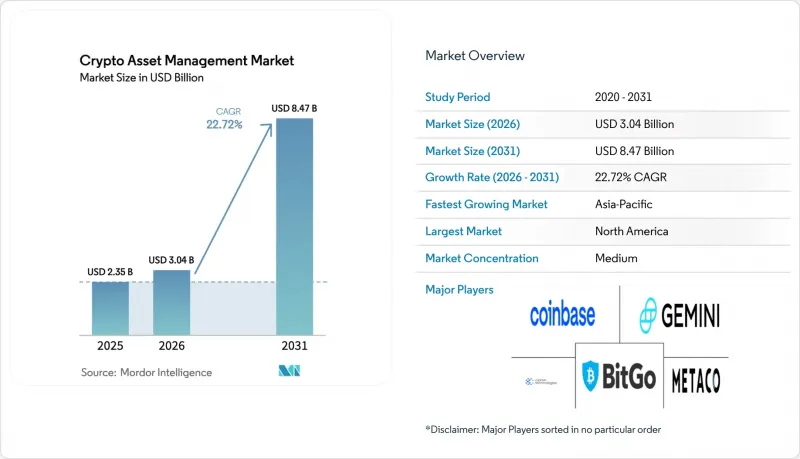
This report is Segmented by Type (Solutions, and Services), Deployment Mode (Cloud, On-Premise, and Hybrid), End-User Industry (BFSI, and More), User Type (Institutional Investors, and More), Investment Strategy (Passive Index Funds, Actively Managed Funds, and More), Asset Class (Bitcoin, Ethereum, and More), and Geography (Europe, and More). The Market Forecasts are Provided in Terms of Value (USD).
Global Crypto Asset Management Market Trends and Insights
Institutional Adoption by Traditional Financial Firms
Traditional financial institutions now position digital assets alongside equities and bonds. BlackRock captured USD 40 billion within 12 months of launching its iShares Bitcoin Trust, surpassing inflows to all earlier Bitcoin vehicles. Fidelity Digital Assets broadened its custody suite to include Ethereum staking in April 2025, enabling pension plans to earn protocol rewards without adding operational teams. JPMorgan's Onyx processed more than USD 1 trillion in tokenized repo trades during 2024, proving that blockchain rails handle high-value settlement volumes. The progress indicates that fiduciary-grade infrastructure is no longer a market bottleneck. As a result, the crypto asset management market increasingly competes head-to-head with traditional asset classes for long-term allocations.
Rising Focus on Custody Security and Insurance Solutions
Custody architecture has evolved from single-key cold storage to multiparty computation (MPC) and hardware security modules. Fireblocks secured over USD 4 trillion in transfers during 2024 without a single cryptographic breach. BitGo placed a USD 250 million insurance tower in partnership with Marsh in June 2024, addressing board-level concerns about balance-sheet protection. Gemini launched proof-of-reserves attestations audited by Deloitte in September 2024, giving clients real-time visibility into segregated holdings. These measures have moved custody security from a technical talking point to a mandatory compliance requirement, accelerating institutional inflows into the crypto asset management market.
Lack of a Centralised Regulatory Framework
Fragmented rules inflate compliance cost by 30-40% for cross-border managers, according to PwC estimates. U.S. providers juggle state money-transmitter licenses alongside federal enforcement actions, while MiCA still lacks reciprocity with non-EU jurisdictions. Singapore and the United Arab Emirates attract firms seeking clearer guidelines, but global players still face duplicate legal entities, audits, and reporting requirements. The uncertainty hampers rapid scaling in the crypto asset management market and slows capital formation until equivalent standards emerge across major hubs.
Other drivers and restraints analyzed in the detailed report include:
- Regulatory Clarity in Major Economies
- Integration of DeFi Protocols with CeFi Platforms
- High Market Volatility and Liquidity Risks
For complete list of drivers and restraints, kindly check the Table Of Contents.
Segment Analysis
Solutions captured 68.67% of revenue in 2025, reflecting the historical dominance of custody, tokenization, and trading software that underpins the crypto asset management market. Services, however, are expected to grow at a 24.22% CAGR through 2031, faster than the overall crypto asset management market. Consulting engagements now address MiCA licensing, U.S. transfer-pricing rules, and DeFi smart-contract audits. Managed offerings appeal to family offices that want staking rewards without validator oversight.
Competitive parity in core custody features is pushing differentiation toward integration expertise. Fidelity Digital Assets unveiled a managed staking service in April 2025 that handles validator operations, tax paperwork, and slashing-risk coverage. Deloitte notes that institutions migrating from legacy systems often require 12-18 months to re-architect audit trails in line with Sarbanes-Oxley, giving service integrators room to capture higher-margin work. As a result, service revenue will likely form the next profit pool, changing how suppliers price offerings inside the crypto asset management market.
Cloud deployments commanded an 82.04% share in 2025 because asset managers value elastic compute and pay-as-you-grow pricing. Yet hybrid architectures are projected to expand at a 23.83% CAGR through 2031, outpacing overall crypto asset management market growth. Regulatory requirements under the EU's Digital Operational Resilience Act (DORA) oblige financial firms to maintain on-premises failover plans. BitGo answered that need with a hybrid custody service in March 2025 that splits key storage on-premises while orchestrating transactions in the cloud, cutting latency by 40%.
Hybrid models also meet data sovereignty mandates in China and Russia that restrict cross-border transfers. For institutional clients, the approach combines regulatory assurance with the cloud's analytical horsepower. Consequently, hybrid solutions will become a default option, reshaping vendor roadmaps and spending patterns in the crypto asset management market.
Complete Report Scope:
- By Type
- Solutions
- Custody Solutions
- Tokenisation Solutions
- Transfer and Remittance Solutions
- Trading Solutions
- Reporting and Analytics Solutions
- Services
- Consulting Services
- Managed Services
- Integration and Implementation Services
- Solutions
- By Deployment Mode
- Cloud
- On-premise
- Hybrid
- By End-User Industry
- BFSI
- Retail and Ecommerce
- Media and Entertainment
- Healthcare
- Travel and Hospitality
- Government and Public Sector
- Other End-User Industries (Energy and Logistics)
- By User Type
- Institutional Investors
- High Net-Worth Individuals
- Crypto Funds
- Retail Investors
- Family Offices
- Corporate Treasuries
- By Investment Strategy
- Passive Index Funds
- Actively Managed Funds
- DeFi Yield Farming
- Staking and Lending
- Arbitrage Strategies
- By Asset Class
- Bitcoin (BTC)
- Ethereum (ETH)
- Stablecoins
- Altcoins (ex-BTC and ETH)
- Tokenised Securities
- By Geography
- North America
- United States
- Canada
- Mexico
- Europe
- United Kingdom
- Germany
- France
- Italy
- Rest of Europe
- Asia-Pacific
- China
- Japan
- India
- South Korea
- Rest of Asia
- Middle East
- Israel
- Saudi Arabia
- United Arab Emirates
- Turkey
- Rest of Middle East
- Africa
- South Africa
- Egypt
- Rest of Africa
- South America
- Brazil
- Argentina
- Rest of South America
- North America
Geography Analysis
North America accounted for 39.34% of 2025 revenue because spot Bitcoin and Ethereum ETF approvals funnelled USD 30 billion in new capital. Canadian and U.S. pension funds joined early, while custodians such as Anchorage won federal trust charters. As the Commodity Futures Trading Commission refines digital-asset risk rules, United States capital pools are expected to deepen further, anchoring liquidity for the crypto asset management market.
Asia Pacific is projected to grow at a 24.79% CAGR through 2031. Japan's Payment Services Act, effective April 2024, imposes segregated custody and 50% capital buffers for exchanges. South Korea's July 2024 Virtual Asset User Protection Act requires insurance coverage and independent audits. Hong Kong granted 12 platform licenses in 2024, permitting retail trading under market-surveillance conditions that match equities. Singapore remains a regional lighthouse by licensing 20-plus digital payment token providers under strict anti-money-laundering standards. These measures collectively underpin institutional and consumer trust, propelling the region's role in the crypto asset management market.
Europe benefits from MiCA's passporting regime, which cuts compliance costs by 40% for firms operating across multiple member states. The Middle East, led by the United Arab Emirates and Saudi Arabia, pulled in more than USD 5 billion in venture capital in 2024, establishing Dubai and Riyadh as crypto hubs. African adoption clusters around Nigeria, Kenya, and South Africa, where stablecoins stabilize cross-border payments. South American demand concentrates in Brazil and Argentina as citizens hedge inflation through stablecoin rails. Combined, these emerging regions diversify growth opportunities for the crypto asset management market.
- Coinbase Global Inc.
- Fidelity Digital Assets
- BitGo Inc.
- Binance Holdings Ltd.
- Gemini Trust Company LLC
- Anchorage Digital
- Fireblocks Ltd.
- Metaco SA
- Crypto Finance AG
- Paxos Trust Company LLC
- Bakkt Holdings Inc.
- Ledger Enterprise Solutions
- Cipher Technologies Management LP
- Amberdata Inc.
- ICONOMI Ltd.
- CoinShares International Ltd.
- Galaxy Digital Holdings Ltd.
- Bitwise Asset Management
- Copper Technologies Ltd.
- Hex Trust Ltd.
Additional Benefits:
- The market estimate (ME) sheet in Excel format
- 3 months of analyst support
TABLE OF CONTENTS
1 INTRODUCTION
- 1.1 Study Assumptions and Market Definition
- 1.2 Scope of the Study
2 RESEARCH METHODOLOGY
3 EXECUTIVE SUMMARY
4 MARKET LANDSCAPE
- 4.1 Market Overview
- 4.2 Market Drivers
- 4.2.1 Institutional Adoption by Traditional Financial Firms
- 4.2.2 Rising Focus on Custody Security and Insurance Solutions
- 4.2.3 Regulatory Clarity in Major Economies
- 4.2.4 Integration of DeFi Protocols with CeFi Platforms
- 4.2.5 Pension-Fund Allocation Experiments in OECD Countries
- 4.2.6 Emergence of Carbon-Neutral Crypto Funds
- 4.3 Market Restraints
- 4.3.1 Lack of a Centralised Regulatory Framework
- 4.3.2 High Market Volatility and Liquidity Risks
- 4.3.3 Shortage of Institutional-Grade Insurance Capacity
- 4.3.4 ESG Concerns over Energy Consumption
- 4.4 Industry Value-Chain Analysis
- 4.5 Regulatory Landscape
- 4.6 Technological Outlook
- 4.7 Impact of Macroeconomic Factors on the Market
- 4.8 Porter's Five Forces Analysis
- 4.8.1 Bargaining Power of Suppliers
- 4.8.2 Bargaining Power of Buyers
- 4.8.3 Threat of New Entrants
- 4.8.4 Threat of Substitute Products
- 4.8.5 Intensity of Competitive Rivalry
5 MARKET SIZE AND GROWTH FORECASTS (VALUE)
- 5.1 By Type
- 5.1.1 Solutions
- 5.1.1.1 Custody Solutions
- 5.1.1.2 Tokenisation Solutions
- 5.1.1.3 Transfer and Remittance Solutions
- 5.1.1.4 Trading Solutions
- 5.1.1.5 Reporting and Analytics Solutions
- 5.1.2 Services
- 5.1.2.1 Consulting Services
- 5.1.2.2 Managed Services
- 5.1.2.3 Integration and Implementation Services
- 5.1.1 Solutions
- 5.2 By Deployment Mode
- 5.2.1 Cloud
- 5.2.2 On-premise
- 5.2.3 Hybrid
- 5.3 By End-User Industry
- 5.3.1 BFSI
- 5.3.2 Retail and Ecommerce
- 5.3.3 Media and Entertainment
- 5.3.4 Healthcare
- 5.3.5 Travel and Hospitality
- 5.3.6 Government and Public Sector
- 5.3.7 Other End-User Industries (Energy and Logistics)
- 5.4 By User Type
- 5.4.1 Institutional Investors
- 5.4.2 High Net-Worth Individuals
- 5.4.3 Crypto Funds
- 5.4.4 Retail Investors
- 5.4.5 Family Offices
- 5.4.6 Corporate Treasuries
- 5.5 By Investment Strategy
- 5.5.1 Passive Index Funds
- 5.5.2 Actively Managed Funds
- 5.5.3 DeFi Yield Farming
- 5.5.4 Staking and Lending
- 5.5.5 Arbitrage Strategies
- 5.6 By Asset Class
- 5.6.1 Bitcoin (BTC)
- 5.6.2 Ethereum (ETH)
- 5.6.3 Stablecoins
- 5.6.4 Altcoins (ex-BTC and ETH)
- 5.6.5 Tokenised Securities
- 5.7 By Geography
- 5.7.1 North America
- 5.7.1.1 United States
- 5.7.1.2 Canada
- 5.7.1.3 Mexico
- 5.7.2 Europe
- 5.7.2.1 United Kingdom
- 5.7.2.2 Germany
- 5.7.2.3 France
- 5.7.2.4 Italy
- 5.7.2.5 Rest of Europe
- 5.7.3 Asia-Pacific
- 5.7.3.1 China
- 5.7.3.2 Japan
- 5.7.3.3 India
- 5.7.3.4 South Korea
- 5.7.3.5 Rest of Asia
- 5.7.4 Middle East
- 5.7.4.1 Israel
- 5.7.4.2 Saudi Arabia
- 5.7.4.3 United Arab Emirates
- 5.7.4.4 Turkey
- 5.7.4.5 Rest of Middle East
- 5.7.5 Africa
- 5.7.5.1 South Africa
- 5.7.5.2 Egypt
- 5.7.5.3 Rest of Africa
- 5.7.6 South America
- 5.7.6.1 Brazil
- 5.7.6.2 Argentina
- 5.7.6.3 Rest of South America
- 5.7.1 North America
6 COMPETITIVE LANDSCAPE
- 6.1 Market Concentration
- 6.2 Strategic Moves
- 6.3 Market Share Analysis
- 6.4 Company Profiles (includes Global Level Overview, Market Level Overview, Core Segments, Financials as available, Strategic Information, Market Rank/Share for key companies, Products and Services, and Recent Developments)
- 6.4.1 Coinbase Global Inc.
- 6.4.2 Fidelity Digital Assets
- 6.4.3 BitGo Inc.
- 6.4.4 Binance Holdings Ltd.
- 6.4.5 Gemini Trust Company LLC
- 6.4.6 Anchorage Digital
- 6.4.7 Fireblocks Ltd.
- 6.4.8 Metaco SA
- 6.4.9 Crypto Finance AG
- 6.4.10 Paxos Trust Company LLC
- 6.4.11 Bakkt Holdings Inc.
- 6.4.12 Ledger Enterprise Solutions
- 6.4.13 Cipher Technologies Management LP
- 6.4.14 Amberdata Inc.
- 6.4.15 ICONOMI Ltd.
- 6.4.16 CoinShares International Ltd.
- 6.4.17 Galaxy Digital Holdings Ltd.
- 6.4.18 Bitwise Asset Management
- 6.4.19 Copper Technologies Ltd.
- 6.4.20 Hex Trust Ltd.
7 MARKET OPPORTUNITIES AND FUTURE OUTLOOK
- 7.1 White-Space and Unmet-Need Assessment

