PUBLISHER: Mordor Intelligence | PRODUCT CODE: 2124401

PUBLISHER: Mordor Intelligence | PRODUCT CODE: 2124401
Application Release Automation - Market Share Analysis, Industry Trends & Statistics, Growth Forecasts (2026 - 2031)
According to Mordor Intelligence, application release automation market size in 2026 is estimated at USD 6.42 billion, growing from 2025 value of USD 5.42 billion with 2031 projections showing USD 14.97 billion, growing at 18.47% CAGR over 2026-2031.
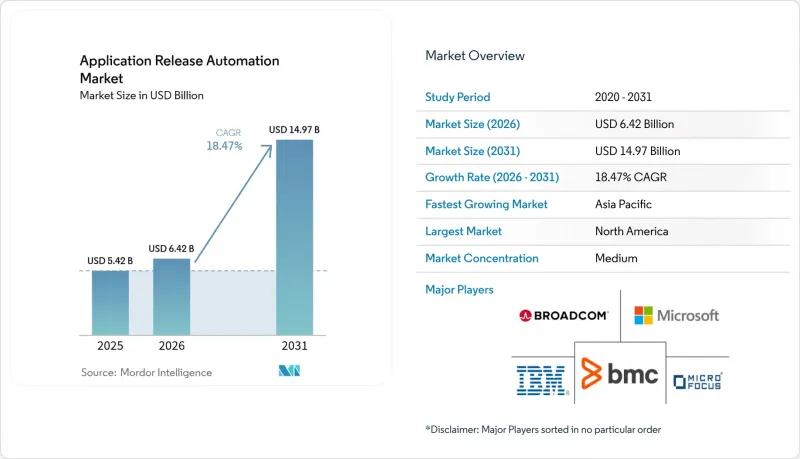
This report is Segmented by Component (Tools and Services), Deployment Mode (Cloud, On-Premises, Hybrid), Organization Size (Large Enterprises and Small and Medium Enterprises), End-User Industry (BFSI, IT and Telecommunications, Retail and E-Commerce, Media and Entertainment, and More), and Geography. The Market Forecasts are Provided in Terms of Value (USD).
Global Application Release Automation Market Trends and Insights
CIO Shift to Pipeline-as-Code and Platform Engineering
Three in four global corporations have instituted platform teams that standardize golden-path deployment templates and self-service infrastructure portals. BSH Home Appliances rebuilt its delivery stack around an internal developer platform and recorded substantial incident reduction because teams no longer hand-crafted infrastructure. The strategic shift removes toil, embeds governance in reusable modules, and boosts developer onboarding speed, reinforcing sustained growth in the application release automation market.
Surge in Multi-Cloud Microservices Driving Release Frequency
A microservices architecture often multiplies release events by 10-20X compared with monoliths, creating an operational imperative for automated gating, service mesh routing, and unified observability across disparate clouds. Airbnb's Kubernetes fleet processes more than 125,000 releases annually through multicluster pipelines, underscoring why enterprises invest in sophisticated release orchestration.
Legacy Monolith Dependencies in Regulated Sectors
Mainframes and tightly coupled transactional systems hinder automated pipelines because change windows remain restricted and interface adapters are scarce. GitLab and IBM now let CI/CD stages run natively on z/OS to alleviate this constraint, yet full modernization remains a decade-long journey for many banks.
Other drivers and restraints analyzed in the detailed report include:
- GenAI-Powered Release Orchestration Slashing Failure Rates
- Software Bill of Materials Compliance Mandates
- Tool-Chain Sprawl Inflating DevSecOps Complexity
For complete list of drivers and restraints, kindly check the Table Of Contents.
Segment Analysis
Tools accounted for 68.55% of 2025 revenue, illustrating that enterprises still rely on proven commercial platforms to automate deployment workflows. However, the services segment is forecast to grow at 21.12% CAGR, the highest across all components, as organizations realize that operating models, governance, and cultural change determine project success. The application release automation market size for services is projected to surge, especially within regulated industries that require specialized compliance expertise.Adoption trends show platform-as-a-service offerings that bundle managed services with orchestration software. Platform.sh's USD 140 million Series D provides capital to scale fully managed environments that abstract infrastructure complexities. As enterprises pursue end-to-end transformation, consulting, integration, and managed runbook services increasingly dominate new spending, reinforcing services' expanding share of the application release automation market.
Cloud deployments dominated with a 58.65% application release automation market share in 2025, but hybrid models are accelerating at 20.37% CAGR because enterprises need to safeguard sensitive workloads while exploiting public-cloud elasticity. The application release automation market size attached to hybrid deployments is predicted to double by 2031 as orchestration tools mature to provide consistent policy enforcement across environments.VMware Tanzu and similar platforms supply consistent Kubernetes runtimes across on-premises and public clouds, while Rundeck automates operational hand-offs for more than 400 critical applications at Standard Chartered Bank, cutting mean-time-to-repair by 25 minutes per incident. Demand for hybrid orchestration demonstrates that large enterprises prioritize risk mitigation and locality constraints but refuse to compromise on release velocity.
Complete Report Scope:
- By Component
- Tools
- Services
- By Deployment Mode
- Cloud
- On-Premises
- Hybrid
- By Organization Size
- Large Enterprises
- Small and Medium Enterprises (SMEs)
- By End-user Industry
- BFSI
- IT and Telecommunications
- Retail and E-commerce
- Media and Entertainment
- Healthcare and Life Sciences
- Manufacturing
- Government and Public Sector
- Other End-user Industries
- By Geography
- North America
- United States
- Canada
- Mexico
- South America
- Brazil
- Argentina
- Chile
- Rest of South America
- Europe
- Germany
- United Kingdom
- France
- Italy
- Spain
- Russia
- Rest of Europe
- Asia-Pacific
- China
- India
- Japan
- South Korea
- Singapore
- Malaysia
- Australia
- Rest of Asia-Pacific
- Middle East and Africa
- Middle East
- United Arab Emirates
- Saudi Arabia
- Turkey
- Rest of Middle East
- Africa
- South Africa
- Nigeria
- Egypt
- Rest of Africa
- Middle East
- North America
Geography Analysis
North America led with 38.15% revenue in 2025, owing to mature cloud adoption and an ecosystem of venture-backed DevOps platforms. Citi slashed release cycles from several days to seven minutes using AI-driven continuous deployment, illustrating best-in-class implementation maturity.Asia-Pacific posts the fastest 20.86% CAGR because governments invest aggressively in AI and data-center expansion. MetLife Asia integrated Azure DevOps to cut build times from eight hours to under one hour while raising code quality. DBS Bank used Puppet to shrink provisioning from days to minutes, proving that regional skill sets now match Western counterparts. Europe advances steadily as GDPR and SBOM mandates force modernization. Siemens achieved 90% touchless document processing with AI-powered automation, confirming industrial players' appetite for software-defined operations. Cross-border financial entities spearhead microservice adoption to remain regulatory-compliant yet agile, sustaining demand across the application release automation market.
- Broadcom Inc. (CA Automic)
- IBM Corporation
- Microsoft Corporation
- BMC Software Inc.
- Micro Focus International Plc
- Digital.ai Software Inc.
- GitLab Inc.
- CloudBees Inc.
- Red Hat Inc. (Ansible)
- Atlassian Corporation Plc
- Perforce Software Inc. (Puppet & Chef)
- Octopus Deploy Pty Ltd
- Harness Inc.
- JFrog Ltd.
- CircleCI Inc.
- JetBrains s.r.o.
- Amazon Web Services Inc. (CodeDeploy)
- Google LLC (Cloud Deploy)
- Oracle Corporation
- ServiceNow Inc.
- Flexagon LLC
- DeployHub Inc.
- Armory Inc. (Spinnaker)
- AutoRabit Holdings Inc.
- Copado Solutions S.L.
Additional Benefits:
- The market estimate (ME) sheet in Excel format
- 3 months of analyst support
TABLE OF CONTENTS
1 INTRODUCTION
- 1.1 Study Assumptions and Market Definition
- 1.2 Scope of the Study
2 RESEARCH METHODOLOGY
3 EXECUTIVE SUMMARY
4 MARKET LANDSCAPE
- 4.1 Market Overview
- 4.2 Market Drivers
- 4.2.1 CIO shift to pipeline-as-code and platform engineering
- 4.2.2 Surge in multi-cloud micro-services driving release frequency
- 4.2.3 GenAI-powered release orchestration slashing failure rates
- 4.2.4 Software Bill of Materials (SBOM) compliance mandates
- 4.2.5 Rise of "platform-as-a-product" culture in enterprises
- 4.3 Market Restraints
- 4.3.1 Legacy monolith dependencies in regulated sectors
- 4.3.2 Tool-chain sprawl inflating DevSecOps complexity
- 4.3.3 Shortage of platform-engineering talent
- 4.3.4 Security gaps in secrets management across pipelines
- 4.4 Industry Value Chain Analysis
- 4.5 Regulatory Landscape
- 4.6 Technological Outlook
- 4.7 Industry Attractiveness - Porter's Five Forces Analysis
- 4.7.1 Threat of New Entrants
- 4.7.2 Bargaining Power of Buyers
- 4.7.3 Bargaining Power of Suppliers
- 4.7.4 Threat of Substitutes
- 4.7.5 Intensity of Competitive Rivalry
- 4.8 Impact of Macroeconomic Factors on the Market
5 MARKET SIZE AND GROWTH FORECASTS (VALUES)
- 5.1 By Component
- 5.1.1 Tools
- 5.1.2 Services
- 5.2 By Deployment Mode
- 5.2.1 Cloud
- 5.2.2 On-Premises
- 5.2.3 Hybrid
- 5.3 By Organization Size
- 5.3.1 Large Enterprises
- 5.3.2 Small and Medium Enterprises (SMEs)
- 5.4 By End-user Industry
- 5.4.1 BFSI
- 5.4.2 IT and Telecommunications
- 5.4.3 Retail and E-commerce
- 5.4.4 Media and Entertainment
- 5.4.5 Healthcare and Life Sciences
- 5.4.6 Manufacturing
- 5.4.7 Government and Public Sector
- 5.4.8 Other End-user Industries
- 5.5 By Geography
- 5.5.1 North America
- 5.5.1.1 United States
- 5.5.1.2 Canada
- 5.5.1.3 Mexico
- 5.5.2 South America
- 5.5.2.1 Brazil
- 5.5.2.2 Argentina
- 5.5.2.3 Chile
- 5.5.2.4 Rest of South America
- 5.5.3 Europe
- 5.5.3.1 Germany
- 5.5.3.2 United Kingdom
- 5.5.3.3 France
- 5.5.3.4 Italy
- 5.5.3.5 Spain
- 5.5.3.6 Russia
- 5.5.3.7 Rest of Europe
- 5.5.4 Asia-Pacific
- 5.5.4.1 China
- 5.5.4.2 India
- 5.5.4.3 Japan
- 5.5.4.4 South Korea
- 5.5.4.5 Singapore
- 5.5.4.6 Malaysia
- 5.5.4.7 Australia
- 5.5.4.8 Rest of Asia-Pacific
- 5.5.5 Middle East and Africa
- 5.5.5.1 Middle East
- 5.5.5.1.1 United Arab Emirates
- 5.5.5.1.2 Saudi Arabia
- 5.5.5.1.3 Turkey
- 5.5.5.1.4 Rest of Middle East
- 5.5.5.2 Africa
- 5.5.5.2.1 South Africa
- 5.5.5.2.2 Nigeria
- 5.5.5.2.3 Egypt
- 5.5.5.2.4 Rest of Africa
- 5.5.5.1 Middle East
- 5.5.1 North America
6 COMPETITIVE LANDSCAPE
- 6.1 Market Concentration
- 6.2 Strategic Moves
- 6.3 Market Share Analysis
- 6.4 Company Profiles (includes Global level Overview, Market level overview, Core Segments, Financials as available, Strategic Information, Market Rank/Share for key companies, Products and Services, and Recent Developments)
- 6.4.1 Broadcom Inc. (CA Automic)
- 6.4.2 IBM Corporation
- 6.4.3 Microsoft Corporation
- 6.4.4 BMC Software Inc.
- 6.4.5 Micro Focus International Plc
- 6.4.6 Digital.ai Software Inc.
- 6.4.7 GitLab Inc.
- 6.4.8 CloudBees Inc.
- 6.4.9 Red Hat Inc. (Ansible)
- 6.4.10 Atlassian Corporation Plc
- 6.4.11 Perforce Software Inc. (Puppet & Chef)
- 6.4.12 Octopus Deploy Pty Ltd
- 6.4.13 Harness Inc.
- 6.4.14 JFrog Ltd.
- 6.4.15 CircleCI Inc.
- 6.4.16 JetBrains s.r.o.
- 6.4.17 Amazon Web Services Inc. (CodeDeploy)
- 6.4.18 Google LLC (Cloud Deploy)
- 6.4.19 Oracle Corporation
- 6.4.20 ServiceNow Inc.
- 6.4.21 Flexagon LLC
- 6.4.22 DeployHub Inc.
- 6.4.23 Armory Inc. (Spinnaker)
- 6.4.24 AutoRabit Holdings Inc.
- 6.4.25 Copado Solutions S.L.
7 MARKET OPPORTUNITIES AND FUTURE TRENDS
- 7.1 White-Space and Unmet-Need Assessment

