PUBLISHER: Mordor Intelligence | PRODUCT CODE: 2124403

PUBLISHER: Mordor Intelligence | PRODUCT CODE: 2124403
Service Integration And Management - Market Share Analysis, Industry Trends & Statistics, Growth Forecasts (2026 - 2031)
According to Mordor Intelligence, the global service integration and management market size in 2026 is estimated at USD 6.46 billion, growing from 2025 value of USD 6.11 billion with 2031 projections showing USD 8.49 billion, growing at 5.65% CAGR over 2026-2031.
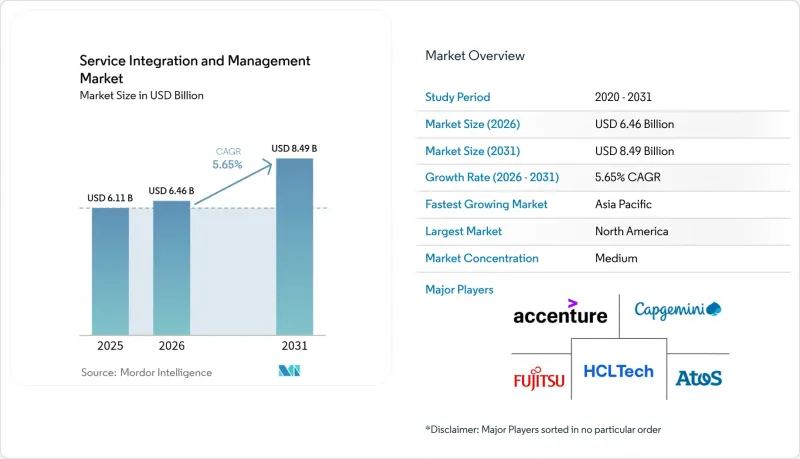
This report is Segmented by Component (Solutions and Services), Service Model (Single-Provider Model, Hybrid-Provider Model, and More), Deployment Mode (On-Premise, Public Cloud, and More), Organization Size (Small and Medium Enterprises and Large Enterprises), End-User Industry (BFSI, IT and Telecom, and More), and Geography. The Market Forecasts are Provided in Terms of Value (USD).
Global Service Integration And Management Market Trends and Insights
Rising Multi-Vendor IT Outsourcing Complexity
Enterprises typically manage 5-7 major IT providers plus multiple niche vendors, generating exponential integration touchpoints that legacy vendor management cannot control effectively. IBM's 2024 study reveals that organizations with four or more primary providers incur 40% higher operational overhead and 60-80% longer outage resolution times, underscoring the financial risks associated with fragmented governance. SIAM platforms establish single-pane visibility, standardized KPIs, and dispute-avoidance protocols that eliminate finger-pointing, accelerate root-cause isolation, and strengthen compliance audit trails across the vendor ecosystem.
Surge in Cloud-Native Microservices Architectures
Kubernetes penetration reached 96% in 2024, yet containerized workloads spawn transient service dependencies spanning on-premises clusters and multiple public clouds. Conventional ITSM catalogs become obsolete in this fluid landscape. Modern SIAM solutions embed real-time service discovery, automated dependency mapping, and policy-driven orchestration that dynamically recalibrates performance baselines as microservices scale, ensuring a consistent user experience despite frequent infrastructure changes.
Shortage of SIAM-Skilled Professionals
The demand for SIAM talent outstrips supply by roughly 40% in North America and Europe, resulting in extended implementation cycles of 18-24 months for many programs. Effective practitioners blend deep ITSM expertise, cloud architecture fluency, and vendor-negotiation acuity capabilities rarely found in a single resource. Enterprises are establishing internal academies and sponsoring external certifications to close the gap, yet near-term capacity constraints inflate cost structures and slow time-to-value.
Other drivers and restraints analyzed in the detailed report include:
- Growing Demand for Unified SLA Governance Platforms
- Acceleration of Digital Transformation in Regulated Industries
- Absence of Global Standardized SLA Frameworks
For complete list of drivers and restraints, kindly check the Table Of Contents.
Segment Analysis
The services tranche accounted for 58.92% of 2025 revenue, thanks to consulting-heavy change-management engagements. However, platform-centric solutions are scaling faster at a 6.42% CAGR, signaling an enterprise pivot toward automation as multi-vendor ecosystems expand. The service integration and management market size for solutions is forecast to hit USD 3.64 billion by 2031, reflecting a strong appetite for pre-built governance engines that lower dependency on scarce human expertise. AI-driven orchestration modules, API-first architectures, and out-of-the-box compliance packs cut configuration time and support self-service onboarding, making technology investments more attractive than ongoing consultancy fees.
Enterprises are increasingly combining lightweight advisory engagements with subscription platforms, thereby blending knowledge transfer and repeatable automation. This hybrid spend pattern underpins sustained growth for system integrators offering solution accelerators rather than pure consulting hours.
As maturity rises, the service integration and management market share of solutions is poised to overtake services in the longer term if current adoption curves persist.
Hybrid-provider arrangements accounted for 39.20% of 2025 revenue, striking a balance between internal stewardship and selective outsourcing for niche skills. Yet the internal service integrator model is outpacing all peers, advancing at a 7.29% CAGR as organizations formalize in-house SIAM centers of excellence. Catalysts include increased access to certified training, declining tooling complexity, and executive recognition that service integration constitutes a strategic core competence.
External service integrator contracts still flourish where budget constraints or talent shortages prevail, particularly among mid-market firms in highly regulated sectors. Nevertheless, continuous investment in workforce upskilling and automation may tilt the mix toward internal governance over the forecast period, aligning with board-level mandates for tighter oversight of third-party risk.
Complete Report Scope:
- By Component
- Solutions
- Business Solutions
- Technology Solutions
- Services
- Solutions
- By Service Model
- Single-Provider Model
- Hybrid-Provider Model
- Internal Service Integrator Model
- External Service Integrator Model
- By Deployment Mode
- On-Premise
- Public Cloud
- Private Cloud
- Hybrid Cloud
- By Organization Size
- Small and Medium Enterprises
- Large Enterprises
- By End-User Industry
- Banking, Financial Services and Insurance (BFSI)
- Information Technology and Telecom
- Healthcare
- Retail
- Manufacturing
- Government and Public Sector
- Other End-User Industries
- By Geography
- North America
- United States
- Canada
- Mexico
- South America
- Brazil
- Argentina
- Rest of South America
- Europe
- Germany
- United Kingdom
- France
- Italy
- Spain
- Rest of Europe
- Asia Pacific
- China
- Japan
- India
- South Korea
- South-East Asia
- Rest of Asia Pacific
- Middle East
- Saudi Arabia
- United Arab Emirates
- Turkey
- Rest of Middle East
- Africa
- South Africa
- Nigeria
- Rest of Africa
- North America
Geography Analysis
North America maintained its leadership position with a 35.91% share in 2025, driven by early-mover enterprise adoption, an abundance of SIAM talent, and stringent regulatory requirements such as SOX and HIPAA. Growth at a 5.14% CAGR indicates sustained investment as companies modernize legacy estates and integrate multi-cloud strategies. Mature consultancy ecosystems and favorable procurement budgets support sophisticated, large-scale rollouts, reinforcing the region's status as an innovation hub.
The Asia Pacific is the fastest-growing region, with a 6.98% CAGR through 2031. National digital economy programs in India, China, and key ASEAN nations are driving multi-vendor transformation projects that overwhelm traditional ITSM processes. Foreign direct investment and hyperscaler data-center expansions further complicate service chains, catalyzing demand for SIAM. Enterprises in Japan and South Korea, already steeped in lean operations, are now layering SIAM on top of DevOps pipelines to enhance cross-provider accountability.
Europe demonstrates consistent annual growth of 5.71%, propelled by the GDPR, emerging AI regulations, and tightening third-party risk requirements. ISO 20000 certification drives baseline alignment across providers, while Brexit-driven data-flow uncertainties heighten the need for transparent governance. Germany and the United Kingdom spearhead adoption, whereas Eastern European enterprises accelerate uptake to meet EU harmonization goals. Sustainability directives are adding an environmental-performance dimension to vendor scorecards, extending SIAM KPIs beyond cost and uptime.
- Accenture plc
- AtoS SE
- Capgemini SE
- Fujitsu Limited
- HCL Technologies Limited
- Hewlett Packard Enterprise Company
- International Business Machines Corporation
- Infosys Limited
- Mindtree Limited
- Tata Consultancy Services Limited
- Wipro Limited
- CGI Inc.
- DXC Technology Company
- NTT Data Corporation
- ServiceNow Inc.
- Sopra Steria Group SA
- Tech Mahindra Limited
- Unisys Corporation
- Rackspace Technology Inc.
- Orange Business Services SA
- Cognizant Technology Solutions Corporation
Additional Benefits:
- The market estimate (ME) sheet in Excel format
- 3 months of analyst support
TABLE OF CONTENTS
1 INTRODUCTION
- 1.1 Study Assumptions and Market Definition
- 1.2 Scope of the Study
2 RESEARCH METHODOLOGY
3 EXECUTIVE SUMMARY
4 MARKET LANDSCAPE
- 4.1 Market Overview
- 4.2 Market Drivers
- 4.2.1 Rising multi-vendor IT outsourcing complexity
- 4.2.2 Surge in cloud-native microservices architectures
- 4.2.3 Growing demand for unified SLA governance platforms
- 4.2.4 Acceleration of digital transformation in regulated industries
- 4.2.5 Hybrid-work operating model adoption
- 4.2.6 Adoption of AIOps for proactive service orchestration
- 4.3 Market Restraints
- 4.3.1 Shortage of SIAM-skilled professionals
- 4.3.2 Absence of global standardised SLA frameworks
- 4.3.3 Legacy toolchain interoperability challenges
- 4.3.4 Perceived loss of direct vendor control by enterprises
- 4.4 Industry Value Chain Analysis
- 4.5 Regulatory Landscape
- 4.6 Technological Outlook
- 4.7 Porter's Five Forces Analysis
- 4.7.1 Bargaining Power of Suppliers
- 4.7.2 Bargaining Power of Consumers
- 4.7.3 Threat of New Entrants
- 4.7.4 Intensity of Competitive Rivalry
- 4.7.5 Threat of Substitutes
- 4.8 Impact of Macroeconomic Factors
5 MARKET SIZE AND GROWTH FORECASTS (VALUE)
- 5.1 By Component
- 5.1.1 Solutions
- 5.1.1.1 Business Solutions
- 5.1.1.2 Technology Solutions
- 5.1.2 Services
- 5.1.1 Solutions
- 5.2 By Service Model
- 5.2.1 Single-Provider Model
- 5.2.2 Hybrid-Provider Model
- 5.2.3 Internal Service Integrator Model
- 5.2.4 External Service Integrator Model
- 5.3 By Deployment Mode
- 5.3.1 On-Premise
- 5.3.2 Public Cloud
- 5.3.3 Private Cloud
- 5.3.4 Hybrid Cloud
- 5.4 By Organization Size
- 5.4.1 Small and Medium Enterprises
- 5.4.2 Large Enterprises
- 5.5 By End-User Industry
- 5.5.1 Banking, Financial Services and Insurance (BFSI)
- 5.5.2 Information Technology and Telecom
- 5.5.3 Healthcare
- 5.5.4 Retail
- 5.5.5 Manufacturing
- 5.5.6 Government and Public Sector
- 5.5.7 Other End-User Industries
- 5.6 By Geography
- 5.6.1 North America
- 5.6.1.1 United States
- 5.6.1.2 Canada
- 5.6.1.3 Mexico
- 5.6.2 South America
- 5.6.2.1 Brazil
- 5.6.2.2 Argentina
- 5.6.2.3 Rest of South America
- 5.6.3 Europe
- 5.6.3.1 Germany
- 5.6.3.2 United Kingdom
- 5.6.3.3 France
- 5.6.3.4 Italy
- 5.6.3.5 Spain
- 5.6.3.6 Rest of Europe
- 5.6.4 Asia Pacific
- 5.6.4.1 China
- 5.6.4.2 Japan
- 5.6.4.3 India
- 5.6.4.4 South Korea
- 5.6.4.5 South-East Asia
- 5.6.4.6 Rest of Asia Pacific
- 5.6.5 Middle East
- 5.6.5.1 Saudi Arabia
- 5.6.5.2 United Arab Emirates
- 5.6.5.3 Turkey
- 5.6.5.4 Rest of Middle East
- 5.6.6 Africa
- 5.6.6.1 South Africa
- 5.6.6.2 Nigeria
- 5.6.6.3 Rest of Africa
- 5.6.1 North America
6 COMPETITIVE LANDSCAPE
- 6.1 Market Concentration
- 6.2 Strategic Moves
- 6.3 Market Share Analysis
- 6.4 Company Profiles (includes Global level Overview, Market level overview, Core Segments, Financials as available, Strategic Information, Market Rank/Share for key companies, Products and Services, and Recent Developments)
- 6.4.1 Accenture plc
- 6.4.2 AtoS SE
- 6.4.3 Capgemini SE
- 6.4.4 Fujitsu Limited
- 6.4.5 HCL Technologies Limited
- 6.4.6 Hewlett Packard Enterprise Company
- 6.4.7 International Business Machines Corporation
- 6.4.8 Infosys Limited
- 6.4.9 Mindtree Limited
- 6.4.10 Tata Consultancy Services Limited
- 6.4.11 Wipro Limited
- 6.4.12 CGI Inc.
- 6.4.13 DXC Technology Company
- 6.4.14 NTT Data Corporation
- 6.4.15 ServiceNow Inc.
- 6.4.16 Sopra Steria Group SA
- 6.4.17 Tech Mahindra Limited
- 6.4.18 Unisys Corporation
- 6.4.19 Rackspace Technology Inc.
- 6.4.20 Orange Business Services SA
- 6.4.21 Cognizant Technology Solutions Corporation
7 MARKET OPPORTUNITIES AND FUTURE OUTLOOK
- 7.1 White-space and Unmet-Need Assessment

