PUBLISHER: Mordor Intelligence | PRODUCT CODE: 2124405

PUBLISHER: Mordor Intelligence | PRODUCT CODE: 2124405
Voice Cloning - Market Share Analysis, Industry Trends & Statistics, Growth Forecasts (2026 - 2031)
According to Mordor Intelligence, the voice cloning market size was valued at USD 2.40 billion in 2025 and estimated to grow from USD 3.02 billion in 2026 to reach USD 9.53 billion by 2031, at a CAGR of 25.84% during the forecast period (2026-2031).
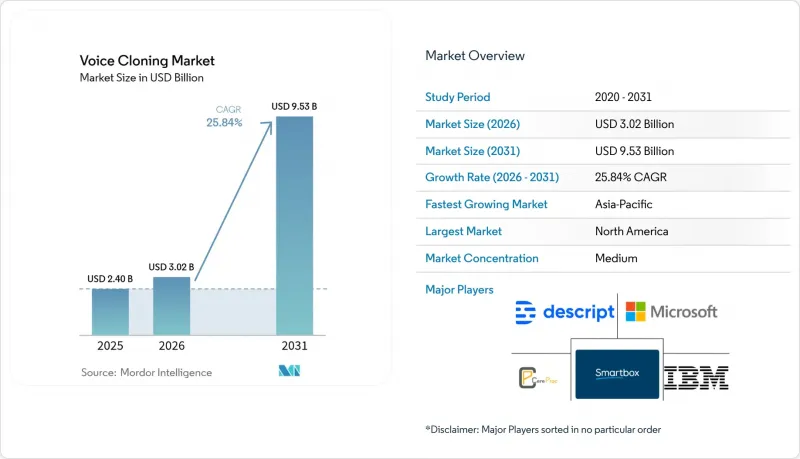
This report is Segmented by Deployment Type (On-Premise, Cloud), Component (Solution, Service), Voice-Cloning Method (Concatenative TTS, Neural and Deep-Learning-Based TTS, and More), Application (Chatbots and Voice Assistants and More), End-User Vertical (IT and Telecommunications, BFSI, and More), and Geography.
Global Voice Cloning Market Trends and Insights
Adoption of AI-generated Personal Voices for Media Localization by North-American Streaming Platforms
Major streaming studios now release multi-language premieres simultaneously by rendering localized dialogue with neural voice clones that preserve the original actor's vocal fingerprint. Production teams report 40% cost savings and 60% faster dubbing cycles after switching from traditional voice-over workflows. The new economics allow smaller catalog titles to secure high-quality localization, widening global reach. As international viewers contributed more than 60% of new subscriptions in 2024, investing in premium yet scalable voice workflows became a board-level priority. Competitive pressure is forcing late adopters to modernize rapidly, sustaining double-digit momentum in the voice cloning market.
Rapid Integration of Voice Cloning in Conversational Commerce across Asian Retail
Chinese, Japanese, and Korean retailers embed branded voice personalities inside shopping apps to guide purchasing journeys. Pilot projects boosted conversion rates by 23% on flagship e-commerce platforms. Voice cloning restores the advisory element of brick-and-mortar retail, yet scales to millions of concurrent sessions. Mobile shoppers benefit from hands-free navigation, reducing friction on small screens. With Asia Pacific already accounting for more than 60% of global mobile commerce revenue, conversational voice is evolving from novelty to necessity. This regional lead will ripple outward as global brands mimic proven templates.
Deepfake Voice Fraud Escalating KYC Compliance Costs for BFS
Voice fraud attempts surged 138% in 2024, exposing gaps in first-generation voice biometric systems used by banks and insurers. Financial institutions now layer liveness checks, behavioral analytics, and stepped-up manual reviews onto every high-risk call. These countermeasures raise per-transaction verification costs and prolong customer wait times, eroding some of the efficiency gains that voice cloning promised. Regulators in the United States and Europe have responded by updating KYC guidelines to include explicit controls for synthetic speech, adding more compliance tasks. Several global banks report that voice-specific security upgrades have lifted overall compliance spending by 27% in the past year. Until detection and watermarking tools mature, many firms will defer or limit new voice cloning deployments in customer-facing workflows.
Other drivers and restraints analyzed in the detailed report include:
- Accessibility Mandates Driving Synthetic Speech in European Public Digital Services
- SaaS Voice-API Monetization Accelerating Cloud Deployments Worldwide
- High GPU Compute Costs Hindering SME Adoption of Real-time Neural Synthesis
For complete list of drivers and restraints, kindly check the Table Of Contents.
Segment Analysis
Cloud-hosted platforms represented USD 1.03 billion of the voice cloning market size in 2025, equal to 42.80% revenue share, and are advancing at a 29.82% CAGR to 2031 Flexible resource scaling, global edge nodes, and pay-as-you-go billing make cloud the default choice for new pilots. Vendor roadmaps now prioritize real-time streaming quality at sub-100 ms round-trip, dissolving historical latency concerns. Service level agreements offer 99.9% uptime, reassuring critical use cases in contact centers and live broadcasts. Cloud ecosystems also simplify access to adjacent AI services like translation and sentiment analysis, lowering integration friction for product managers. On-premise installations still command 57.20% revenue share owing to data residency mandates in financial services and healthcare. These buyers require airtight control of biometric data and often pair internal GPU clusters with hybrid orchestration to tap burst cloud capacity for peak demand. Leading suppliers are shipping Docker-ready voice engines and Kubernetes Helm charts, letting DevOps teams integrate voice cloning into existing CI/CD workflows. Edge computing further blurs boundaries by placing inference modules on customer-owned gateways for latency-sensitive tasks while centralizing training in the cloud. As privacy preserving federated learning matures, migration paths from strictly on-premise to hybrid footprints will continue, shrinking pure on-prem holdings over time within the voice cloning market.
Solutions captured 71.10% of 2025 revenue, yet services are climbing at 28.93% CAGR versus 22.61% for software licences Enterprises now emphasize deployment governance, model fine-tuning, and compliance policy design, all of which demand specialized consulting. Implementation partners staff multidisciplinary teams of linguists, ethicists, and DevSecOps engineers to align voice cloning strategies with brand and legal requirements. New service offerings include voice DNA audits that catalog speaker rights for future disputes. Meanwhile, platform vendors keep pushing the envelope on neural fidelity. Transformer-based engines can build a viable clone from under 30 s of reference audio, streamlining onboarding for talent agencies and medical use cases. Low-bit-rate codec optimization cuts bandwidth by 60% without clipping harmonic detail, enabling over-the-air delivery in automotive infotainment. Governance modules now log every synthesis request with cryptographic hashes, creating immutable trails that satisfy emerging AI audit laws. These advances reinforce the solutions segment's revenue floor even as service billings expand, maintaining balance inside the voice cloning market.
Complete Report Scope:
- By Deployment Type
- On-Premise
- Cloud
- By Component
- Solution
- Service
- By Voice-Cloning Method
- Concatenative TTS
- Parametric/Statistical TTS
- NeuralandDeep-Learning-based TTS
- By Application
- ChatbotsandVoice Assistants
- AccessibilityandAssistive Technologies
- DigitalandInteractive Games
- DubbingandLocalization
- Customer ServiceandIVR
- Voice ProstheticsandPersonalized Speech
- By End-user Vertical
- ITandTelecommunications
- BFSI
- HealthcareandLife Sciences
- MediaandEntertainment
- Education
- TravelandTourism
- RetailandE-commerce
- GovernmentandDefense
- By Geography
- North America
- United States
- Canada
- South America
- Brazil
- Argentina
- Rest of South America
- Europe
- Germany
- United Kingdom
- France
- Spain
- Italy
- Rest of Europe
- Asia Pacific
- China
- Japan
- India
- South Korea
- Australia
- Rest of Asia Pacific
- Middle East and Africa
- Saudi Arabia
- United Arab Emirates
- South Africa
- Rest of Middle East and Africa
- North America
Geography Analysis
North America commanded 38.70% of 2025 revenue, anchored by Silicon Valley research clusters and Hollywood media demand. Streaming platforms standardize neural dubbing workflows, setting de facto quality bars that ripple through global production houses. Regulatory scrutiny is palpable: the Federal Trade Commission's Voice Cloning Challenge invites technologists to propose content authentication solutions, a move that pressures vendors to embed watermarking natively.Despite tighter oversight, venture funding remains buoyant, sustaining a vibrant startup pipeline that feeds enterprise procurement pipelines. Asia Pacific is the growth engine, posting a 27.42% CAGR through 2031. China spearheads multilingual cloning research, driven by its vast e-commerce ecosystems, which require dialect agility. Japanese health-tech firms are deploying synthetic voices tailored for senior citizens, addressing the communication gaps of an aging population. South Korean game publishers experiment with real-time character voice morphing, spotlighting new engagement mechanics. India presents a fertile, linguistically complex market where regional language support can unlock hundreds of millions of new users. Together, these dynamics position Asia Pacific as the fastest-advancing region in the voice cloning market. Europe's narrative centers on governance and accessibility. The EU AI Act introduces transparency clauses that obligate disclosures when synthetic voices are used, compelling vendors to ship audit dashboards. The European Accessibility Act further entrenches demand within public digital services. Germany's industrial sector explores voice-enabled robotics on factory floors, while the United Kingdom pilots cloned-voice customer reps across leading banks. Although compliance hurdles extend sales cycles, they ultimately elevate trust, ensuring sustained uptake across continental markets.
- Microsoft Corporation
- Amazon Web Services, Inc.
- Google LLC
- IBM Corporation
- Apple Inc.
- Baidu, Inc.
- Descript, Inc.
- Acapela Group SA
- CereProc Ltd.
- Resemble AI, Inc.
- VocaliD, Inc.
- ElevenLabs, Inc.
- LumenVox LLC
- iSpeech, Inc.
- Smartbox Assistive Technology Ltd.
- WellSaid Labs, Inc.
- ReadSpeaker Holding BV
- NeoSpeech, Inc.
- Sonantic Ltd.
- rSpeak Technologies Ltd.
Additional Benefits:
- The market estimate (ME) sheet in Excel format
- 3 months of analyst support
TABLE OF CONTENTS
1 INTRODUCTION
- 1.1 Study AssumptionsandMarket Definition
- 1.2 Scope of the Study
2 RESEARCH METHODOLOGY
3 EXECUTIVE SUMMARY
4 MARKET LANDSCAPE
- 4.1 Market Overview
- 4.2 Market Drivers
- 4.2.1 Adoption of AI-generated Personal Voices for Media Localization by North-American Streaming Platforms
- 4.2.2 Rapid Integration of Voice Cloning in Conversational Commerce across Asian Retail
- 4.2.3 Accessibility Mandates Driving Synthetic Speech in European Public Digital Services
- 4.2.4 SaaS Voice-API Monetization Accelerating Cloud Deployments Worldwide
- 4.2.5 Growing Adoption of Multilingual Digital Advertising
- 4.2.6 The Emergence of Digital Avatars
- 4.3 Market Restraints
- 4.3.1 Deepfake Voice Fraud Escalating KYC Compliance Costs for BFSI
- 4.3.2 High GPU Compute Costs Hindering SME Adoption of Real-time Neural Synthesis
- 4.3.3 Fragmented Regulation Across Regions is Restraining the Growth
- 4.3.4 Ethical Consent Hurdles Raising Concerns Over Unauthorized Use of Personal Voice Data and Complicating Adoption
- 4.4 Value/Supply-Chain Analysis
- 4.5 Regulatory or Technological Outlook
- 4.6 Porter's Five Forces Analysis
- 4.6.1 Threat of New Entrants
- 4.6.2 Bargaining Power of Buyers/Consumers
- 4.6.3 Bargaining Power of Suppliers
- 4.6.4 Threat of Substitute Products
- 4.6.5 Intensity of Competitive Rivalry
- 4.7 Impact of COVID-19 on the Voice Cloning Market
5 MARKET SIZE AND GROWTH FORECASTS (VALUE)
- 5.1 By Deployment Type
- 5.1.1 On-Premise
- 5.1.2 Cloud
- 5.2 By Component
- 5.2.1 Solution
- 5.2.2 Service
- 5.3 By Voice-Cloning Method
- 5.3.1 Concatenative TTS
- 5.3.2 Parametric/Statistical TTS
- 5.3.3 NeuralandDeep-Learning-based TTS
- 5.4 By Application
- 5.4.1 ChatbotsandVoice Assistants
- 5.4.2 AccessibilityandAssistive Technologies
- 5.4.3 DigitalandInteractive Games
- 5.4.4 DubbingandLocalization
- 5.4.5 Customer ServiceandIVR
- 5.4.6 Voice ProstheticsandPersonalized Speech
- 5.5 By End-user Vertical
- 5.5.1 ITandTelecommunications
- 5.5.2 BFSI
- 5.5.3 HealthcareandLife Sciences
- 5.5.4 MediaandEntertainment
- 5.5.5 Education
- 5.5.6 TravelandTourism
- 5.5.7 RetailandE-commerce
- 5.5.8 GovernmentandDefense
- 5.6 By Geography
- 5.6.1 North America
- 5.6.1.1 United States
- 5.6.1.2 Canada
- 5.6.2 South America
- 5.6.2.1 Brazil
- 5.6.2.2 Argentina
- 5.6.2.3 Rest of South America
- 5.6.3 Europe
- 5.6.3.1 Germany
- 5.6.3.2 United Kingdom
- 5.6.3.3 France
- 5.6.3.4 Spain
- 5.6.3.5 Italy
- 5.6.3.6 Rest of Europe
- 5.6.4 Asia Pacific
- 5.6.4.1 China
- 5.6.4.2 Japan
- 5.6.4.3 India
- 5.6.4.4 South Korea
- 5.6.4.5 Australia
- 5.6.4.6 Rest of Asia Pacific
- 5.6.5 Middle East and Africa
- 5.6.5.1 Saudi Arabia
- 5.6.5.2 United Arab Emirates
- 5.6.5.3 South Africa
- 5.6.5.4 Rest of Middle East and Africa
- 5.6.1 North America
6 COMPETITIVE LANDSCAPE
- 6.1 Market Concentration
- 6.2 Strategic Moves
- 6.3 Market Share Analysis
- 6.4 Company Profiles (includes Global Level Overview, Market Level Overview, Core Segments, Financials as available, Strategic Information, Market Rank/Share for key companies, ProductsandServices, and Recent Developments)
- 6.4.1 Microsoft Corporation
- 6.4.2 Amazon Web Services, Inc.
- 6.4.3 Google LLC
- 6.4.4 IBM Corporation
- 6.4.5 Apple Inc.
- 6.4.6 Baidu, Inc.
- 6.4.7 Descript, Inc.
- 6.4.8 Acapela Group SA
- 6.4.9 CereProc Ltd.
- 6.4.10 Resemble AI, Inc.
- 6.4.11 VocaliD, Inc.
- 6.4.12 ElevenLabs, Inc.
- 6.4.13 LumenVox LLC
- 6.4.14 iSpeech, Inc.
- 6.4.15 Smartbox Assistive Technology Ltd.
- 6.4.16 WellSaid Labs, Inc.
- 6.4.17 ReadSpeaker Holding BV
- 6.4.18 NeoSpeech, Inc.
- 6.4.19 Sonantic Ltd.
- 6.4.20 rSpeak Technologies Ltd.
7 MARKET OPPORTUNITIES AND FUTURE OUTLOOK
- 7.1 White-spaceandUnmet-need Assessment

