PUBLISHER: Mordor Intelligence | PRODUCT CODE: 2124408

PUBLISHER: Mordor Intelligence | PRODUCT CODE: 2124408
Business Rules Management Systems - Market Share Analysis, Industry Trends & Statistics, Growth Forecasts (2026 - 2031)
According to Mordor Intelligence, the business rules management systems market size is expected to grow from USD 2.29 billion in 2025 to USD 2.48 billion in 2026 and is forecast to reach USD 3.66 billion by 2031 at 8.15% CAGR over 2026-2031.
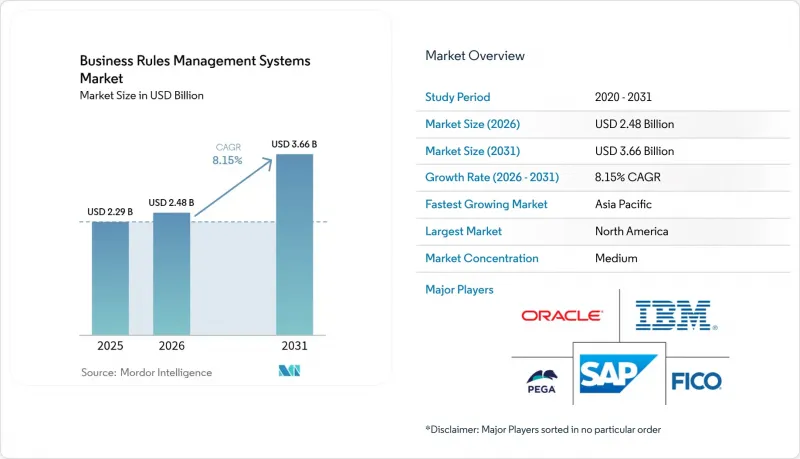
This report is Segmented by Offering (Software and Services), Organization Size (Small and Medium Enterprises and Large Enterprises), Deployment Type (Cloud and On-Premise), End-User Vertical (BFSI, Telecommunication and IT, Retail and E-Commerce, and More), Business Function (Finance and Accounting, Operations and Supply Chain, and More), and Geography.
Global Business Rules Management Systems Market Trends and Insights
Reduced Dependency on IT Teams for Writing Rules
Business units now insist on changing rules without queuing requests for developers, shrinking policy deployment cycles, and cutting compliance lag. Federal Bank, for instance, halved its Know Your Customer update timeline after adopting an automation layer that lets analysts adjust customer identification logic directly. Visual rule designers and natural-language authoring portals in today's platforms give non-technical staff direct control, which frees scarce IT resources for core engineering tasks. In regulated sectors, this agility neutralizes the risk of late policy rollouts whenever a regulator issues fresh guidance. The shift also builds institutional resilience because business logic no longer sits hard-coded inside legacy applications.
Increased Need to Manage Regulatory and Compliance Policy
Financial institutions absorb more than 500 rule changes a year, and manual mapping of statutes to workflows strains budgets and staff. Automated rule engines translate legal text into executable policies, cutting both interpretation errors and update latency. Regology's platform monitors global statutes, flags potential impacts, and feeds structured obligations into rule repositories, allowing firms to stay current across multiple jurisdictions. Fines topping billions of USD have proved that non-compliance outweighs system costs, pushing boards to prioritize automated governance. Healthcare providers follow a similar path by converting treatment guidelines into machine-readable logic for clinical decision support.
Resistance to Modern Technology in Legacy-System-Heavy Firms
Enterprises that rely on decades-old core platforms often distrust rule externalization because existing logic seems stable and well understood. Change management challenges mount when staff worry that automation will devalue institutional knowledge. Integration projects can be costly if legacy code lacks clear documentation, and senior executives may resist risking production stability. Manufacturing plants that run on embedded programmable logic controls illustrate this hesitation, preferring incremental tweaks to wholesale rule extraction.
Other drivers and restraints analyzed in the detailed report include:
- Rise of Low-Code/No-Code Platforms Accelerating BRMS Adoption
- Integration with Hyper-Automation and RPA Suites
- Perceived High TCO for Enterprise-Wide Roll-Outs
For complete list of drivers and restraints, kindly check the Table Of Contents.
Segment Analysis
Services revenue is expanding at a 9.85% CAGR because enterprises recognize that domain expertise is vital for rule harvesting, testing, and governance. The business rules management systems market relies on consulting partners to translate policy into logic, integrate rule engines with existing applications, and coach citizen developers. Implementation engagements command premium pricing when mistakes could trigger regulatory fines. Continuous optimization retainers are also growing as firms refine rule performance after deployment.Software still represented 61.60% of 2025 revenue, but its growth is modest relative to services. Vendors increasingly bundle low-code design tools and AI-based rule analyzers to retain license value. Yet many buyers view software as a foundation and channel investments toward managed services that ensure uptime, security, and version upgrades. This pattern underscores that the business rules management systems market values outcomes over ownership.
Small and medium enterprises are registering an 11.05% CAGR, reflecting falling entry barriers linked to SaaS delivery. Cloud subscription tiers permit incremental adoption without hardware investments, letting SMEs achieve compliance parity with larger rivals. Vendor marketplaces now offer pre-built rule packs tailored to common use cases such as invoice matching or credit scoring, further simplifying uptake.Large enterprises held 63.10% revenue share in 2025, yet now focus on refining existing deployments. Their priorities include embedding machine learning predictors inside rule flows and applying decision analytics to monitor drift. Multi-region conglomerates demand sophisticated metadata management to govern thousands of rules across jurisdictions. These requirements fuel collaboration with specialized integrators and justify the business rules management systems industry's consulting expansion.
Complete Report Scope:
- By Offering
- Software
- Services
- By Organization Size
- Small and Medium Enterprises (SMEs)
- Large Enterprises
- By Deployment Type
- Cloud
- On-Premise
- By End-user Vertical
- BFSI
- Telecommunication and IT
- Retail and E-Commerce
- Manufacturing
- Healthcare and Life Sciences
- Government and Public Sector
- Other End-user Verticals
- By Business Function
- Finance and Accounting
- Operations and Supply Chain
- Sales and Marketing
- Risk and Compliance
- Customer Service
- By Geography
- North America
- United States
- Canada
- Mexico
- South America
- Brazil
- Argentina
- Chile
- Rest of South America
- Europe
- Germany
- United Kingdom
- France
- Italy
- Spain
- Russia
- Rest of Europe
- Asia-Pacific
- China
- India
- Japan
- South Korea
- Singapore
- Malaysia
- Australia
- Rest of Asia-Pacific
- Middle East and Africa
- Middle East
- United Arab Emirates
- Saudi Arabia
- Turkey
- Rest of Middle East
- Africa
- South Africa
- Nigeria
- Egypt
- Rest of Africa
- Middle East
- North America
Geography Analysis
North America led the business rules management systems market with 37.40% revenue share in 2025. Deep regulatory obligations in sectors such as finance and healthcare, combined with a mature culture of process automation, sustain demand. Institutions like NatWest compressed product governance lead times from 4.5 days to under 20 minutes using automated risk oversight. Vendors headquartered in the region provide extensive partner ecosystems and professional services that accelerate adoption.
Asia-Pacific is the fastest-growing territory, posting an 10.62% CAGR through 2031. Government digitalization programs and cloud-first strategies among SMEs drive the uptake of subscription-based rule engines. The Asia-Pacific Trade Facilitation Report projected 11% cost savings from digitized trade procedures, a catalyst for automating customs and logistics decisions. Banks in markets such as Indonesia and the Philippines embed rules to accelerate credit processing, while manufacturers in Vietnam automate supplier qualification.Europe maintains steady expansion as cross-border commerce and stringent data-protection law require transparent, auditable decision systems. Firms adopt explainable AI layered on rule engines to meet audit mandates. Manufacturing clusters implement rules for environmental compliance. Meanwhile, the Middle East and Africa represent emerging whitespace. Energy producers and public agencies modernize workflows through cloud platforms that minimize infrastructure hurdles, indicating long-term upside for the business rules management systems market.
- IBM Corporation
- Fair Isaac Corporation (FICO)
- Pegasystems Inc.
- Oracle Corporation
- SAP SE
- Red Hat, Inc.
- Progress Software Corporation
- ACTICO GmbH
- TIBCO Software Inc.
- Software AG
- InRule Technology, Inc.
- Experian plc
- Sapiens International Corporation NV
- Bosch Software Innovations GmbH
- AgilePoint, Inc.
- Decision Management Solutions
- FlexRule Pty Ltd
- Sparkling Logic, Inc.
- OpenRules, Inc.
- Fujitsu Limited
- Newgen Software Technologies Ltd.
- HCL Technologies Ltd.
- Intellileap Solutions
- Signavio GmbH
- BOC Group
- SS&C Technologies (d/b/a DST Systems)
Additional Benefits:
- The market estimate (ME) sheet in Excel format
- 3 months of analyst support
TABLE OF CONTENTS
1 INTRODUCTION
- 1.1 Study Assumptions and Market Definition
- 1.2 Scope of the Study
2 RESEARCH METHODOLOGY
3 EXECUTIVE SUMMARY
4 MARKET LANDSCAPE
- 4.1 Market Overview
- 4.2 Market Drivers
- 4.2.1 Reduced dependency on IT teams for writing rules
- 4.2.2 Increased need to manage regulatory and compliance policy
- 4.2.3 Rise of low-code/no-code platforms accelerating BRMS adoption
- 4.2.4 Integration with hyper-automation and RPA suites
- 4.2.5 Demand for explainable AI in decisioning
- 4.2.6 Growing cloud-native micro-services architectures
- 4.3 Market Restraints
- 4.3.1 Resistance to modern technology in legacy-system-heavy firms
- 4.3.2 Perceived high TCO for enterprise-wide roll-outs
- 4.3.3 Shortage of skilled decision-management architects
- 4.3.4 Vendor lock-in concerns limiting long-term flexibility
- 4.4 Industry Value Chain Analysis
- 4.5 Regulatory Landscape
- 4.6 Technological Outlook
- 4.7 Industry Attractiveness - Porter's Five Forces Analysis
- 4.7.1 Bargaining Power of Suppliers
- 4.7.2 Bargaining Power of Buyers/Consumers
- 4.7.3 Threat of New Entrants
- 4.7.4 Threat of Substitute Products
- 4.7.5 Intensity of Competitive Rivalry
- 4.8 Impact of Macroeconomic Factors on the Market
5 MARKET SIZE AND GROWTH FORECASTS (VALUES)
- 5.1 By Offering
- 5.1.1 Software
- 5.1.2 Services
- 5.2 By Organization Size
- 5.2.1 Small and Medium Enterprises (SMEs)
- 5.2.2 Large Enterprises
- 5.3 By Deployment Type
- 5.3.1 Cloud
- 5.3.2 On-Premise
- 5.4 By End-user Vertical
- 5.4.1 BFSI
- 5.4.2 Telecommunication and IT
- 5.4.3 Retail and E-Commerce
- 5.4.4 Manufacturing
- 5.4.5 Healthcare and Life Sciences
- 5.4.6 Government and Public Sector
- 5.4.7 Other End-user Verticals
- 5.5 By Business Function
- 5.5.1 Finance and Accounting
- 5.5.2 Operations and Supply Chain
- 5.5.3 Sales and Marketing
- 5.5.4 Risk and Compliance
- 5.5.5 Customer Service
- 5.6 By Geography
- 5.6.1 North America
- 5.6.1.1 United States
- 5.6.1.2 Canada
- 5.6.1.3 Mexico
- 5.6.2 South America
- 5.6.2.1 Brazil
- 5.6.2.2 Argentina
- 5.6.2.3 Chile
- 5.6.2.4 Rest of South America
- 5.6.3 Europe
- 5.6.3.1 Germany
- 5.6.3.2 United Kingdom
- 5.6.3.3 France
- 5.6.3.4 Italy
- 5.6.3.5 Spain
- 5.6.3.6 Russia
- 5.6.3.7 Rest of Europe
- 5.6.4 Asia-Pacific
- 5.6.4.1 China
- 5.6.4.2 India
- 5.6.4.3 Japan
- 5.6.4.4 South Korea
- 5.6.4.5 Singapore
- 5.6.4.6 Malaysia
- 5.6.4.7 Australia
- 5.6.4.8 Rest of Asia-Pacific
- 5.6.5 Middle East and Africa
- 5.6.5.1 Middle East
- 5.6.5.1.1 United Arab Emirates
- 5.6.5.1.2 Saudi Arabia
- 5.6.5.1.3 Turkey
- 5.6.5.1.4 Rest of Middle East
- 5.6.5.2 Africa
- 5.6.5.2.1 South Africa
- 5.6.5.2.2 Nigeria
- 5.6.5.2.3 Egypt
- 5.6.5.2.4 Rest of Africa
- 5.6.5.1 Middle East
- 5.6.1 North America
6 COMPETITIVE LANDSCAPE
- 6.1 Market Concentration
- 6.2 Strategic Moves
- 6.3 Market Share Analysis
- 6.4 Company Profiles (includes Global level Overview, Market level overview, Core Segments, Financials as available, Strategic Information, Market Rank/Share for key companies, Products and Services, and Recent Developments)
- 6.4.1 IBM Corporation
- 6.4.2 Fair Isaac Corporation (FICO)
- 6.4.3 Pegasystems Inc.
- 6.4.4 Oracle Corporation
- 6.4.5 SAP SE
- 6.4.6 Red Hat, Inc.
- 6.4.7 Progress Software Corporation
- 6.4.8 ACTICO GmbH
- 6.4.9 TIBCO Software Inc.
- 6.4.10 Software AG
- 6.4.11 InRule Technology, Inc.
- 6.4.12 Experian plc
- 6.4.13 Sapiens International Corporation NV
- 6.4.14 Bosch Software Innovations GmbH
- 6.4.15 AgilePoint, Inc.
- 6.4.16 Decision Management Solutions
- 6.4.17 FlexRule Pty Ltd
- 6.4.18 Sparkling Logic, Inc.
- 6.4.19 OpenRules, Inc.
- 6.4.20 Fujitsu Limited
- 6.4.21 Newgen Software Technologies Ltd.
- 6.4.22 HCL Technologies Ltd.
- 6.4.23 Intellileap Solutions
- 6.4.24 Signavio GmbH
- 6.4.25 BOC Group
- 6.4.26 SS&C Technologies (d/b/a DST Systems)
7 MARKET OPPORTUNITIES AND FUTURE TRENDS
- 7.1 White-Space and Unmet-Need Assessment

