PUBLISHER: Mordor Intelligence | PRODUCT CODE: 2124421

PUBLISHER: Mordor Intelligence | PRODUCT CODE: 2124421
PET Preform - Market Share Analysis, Industry Trends & Statistics, Growth Forecasts (2026 - 2031)
According to Mordor Intelligence, the PET preform market size is projected to be USD 23.81 billion in 2025, USD 24.33 billion in 2026, and reach USD 27.08 billion by 2031, growing at a CAGR of 2.17% from 2026 to 2031.
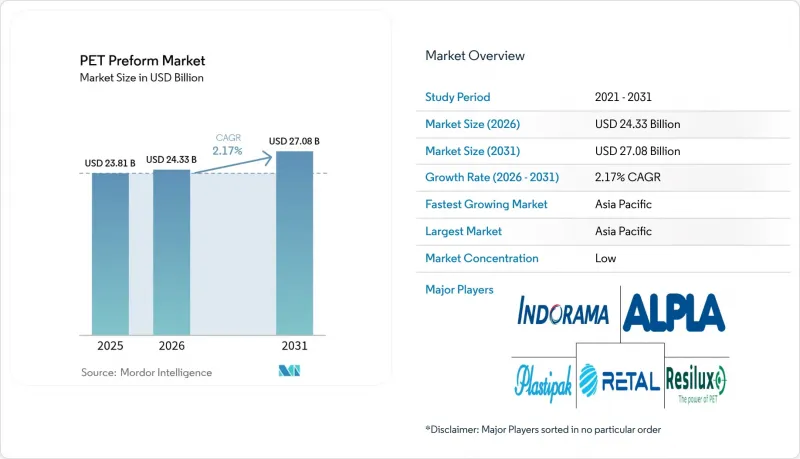
This report is Segmented by Material Type (Virgin PET, Recycled PET (rPET), and Bio-Based PET), Application (Carbonated Soft Drinks and Water, Food and Dairy, Personal Care and Cosmetics, Alcoholic Beverages, and Other Applications), and Geography (Asia-Pacific, North America, Europe, South America, and Middle-East and Africa). The Market Forecasts are Provided in Terms of Value (USD).
Global PET Preform Market Trends and Insights
Growing Demand from Beverage Industry
Beverage brand owners continue to consolidate SKU portfolios around PET because consumers favor resealable, shatter-resistant packs and retailers value formats that lower cold-chain costs. India recorded 13-15% bottled-water growth in 2024, and Coca-Cola Andina is spending more than USD 500 million through 2026 to expand PET capacity in Brazil and Chile, underscoring how brand owners vertically integrate preform conversion to secure supply. The shift of niche alcoholic drinks and premium teas into PET adds incremental volume, although reusable PET programs in Germany demonstrate that circular schemes can temper single-use demand while raising durability standards for refillable preforms.
Surge in Bottled-Water Consumption in Emerging Economies
Per-capita bottled-water use in China reached 39 liters in 2024 versus 118 liters in Western Europe, signaling ample runway for PET preform market growth as rising incomes meet sub-optimal tap-water infrastructure. Indonesia and Vietnam exhibit double-digit expansion as multinational fillers localize preform production to hedge logistics costs, while GCC nations view bottled water as essential due to arid climates, supporting 4.5% regional growth through 2032. Lower regulatory maturity in Cambodia and Laos keeps growth uneven and highlights payment-risk and logistics challenges for converters targeting frontier markets.
Volatile PTA and MEG Prices Disrupting Converter Margins
PTA fell from USD 800-900/t in early 2024 to USD 600-700/t by year-end, while MEG slid to USD 500-600/t, causing inventory-loss headaches for converters locked into 60-day cost-pass-through clauses. Southeast Asian naphtha crackers ran negative margins, prompting shutdowns at complexes in Vietnam and Malaysia and tightening regional PET supply. Large integrated players such as Indorama Ventures mitigated risk by buying upstream polyester assets, but independent converters absorb the volatility unless they diversify resin sourcing.
Other drivers and restraints analyzed in the detailed report include:
- Sustainability Push for Recycled Content
- Mandatory tethered-cap EU Directive Boosting Preform Redesign Volumes
- Plastic-Tax Legislation and EPR Fees Tightening Profit Pools
For complete list of drivers and restraints, kindly check the Table Of Contents.
Segment Analysis
Virgin PET held 75.38% of 2025 value, yet rPET is set to grow at 3.18% CAGR through 2031as PPWR mandates prompt brand owners to lock in recycled content. The PET preform market size for virgin resin in carbonated soft drinks remains resilient because 0.80-0.84 dL/g IV grades deliver the CO2 retention needed for 12-month shelf life, while rPET's lower IV constrains its use above 50% inclusion without blending.
Converters with captive recycling enjoy feedstock surety, whereas independents pay 20-30% premiums for third-party flakes, exposing them to allocation risk during supply squeezes. EFSA's lengthy approval queue reinforces entry barriers, and bio-based PET trails due to 30-50% cost premiums that only niche cosmetic brands absorb, leaving policy-driven rPET and ultralight virgin blends as the decisive growth levers.
Complete Report Scope:
- By Material Type
- Virgin PET
- Recycled PET (rPET)
- Bio-based PET
- By Application
- Carbonated Soft Drinks and Water
- Food and Dairy
- Personal Care and Cosmetics
- Alcoholic Beverages
- Other Applications (Household Cleaning)
- By Geography
- Asia-Pacific
- China
- India
- Japan
- South Korea
- Indonesia
- Vietnam
- Thailand
- Malaysia
- Rest of Asia-Pacific
- North America
- United States
- Canada
- Mexico
- Europe
- Germany
- United Kingdom
- France
- Italy
- Spain
- NORDIC Countries
- Turkey
- Russia
- Rest of Europe
- South America
- Brazil
- Argentina
- Colombia
- Rest of South America
- Middle-East and Africa
- Saudi Arabia
- United Arab Emirates
- Qatar
- South Africa
- Nigeria
- Egypt
- Rest of Middle-East and Africa
- Asia-Pacific
Geography Analysis
Asia-Pacific captured 46.20% of the 2025 value, and the PET preform market is forecast to post a 2.78% CAGR through 2031 as surging bottled-water demand in India, Indonesia, and Vietnam intersects with large-scale resin imports from Middle-Eastern suppliers. China's per-capita consumption nears urban saturation, but tier-2 cities still offer upside, and India is evolving into a recycling hub as Revalyu Resources lifts Nashik capacity to over 35 million bottles per day by 2026.
Europe grows below average because deposit return schemes decrease single-use unit volumes even as tethered caps and recycled-content rules lift complexity. ALPLA's EUR 500 million outlay on new recycling plants and RESILUX's 70% stake in Greentech illustrate how continental converters trade volume for value by embedding rPET premiums. The PPWR-mandated 90% DRS collection rate by 2029 could cut virgin-resin demand per liter by double digits, amplifying the strategic shift toward heavier, refillable preforms.
In North America, with growth tied to functional-beverage and e-commerce requirements, Plastipak's Clean Tech site supplies closed-loop bottles for Coca-Cola. California's potential tethered-cap bill may ignite another redesign wave in 2027-2028. Mexico is rising as a near-shoring base under USMCA, aided by UFlex's PCR PET line investment, while Brazil and Colombia deploy over USD 650 million in virgin and recycled PET capacity to meet rising regional drink consumption.
- ALPLA
- CAIBA
- Chemco
- Doloop
- Duy Tan Plastic Company
- Esterform Ltd
- Indorama Ventures Public Company Limited
- KOKSAN PET VE PLASTIK AMBALAJ SANAYI VE TICARET AS
- NOVAPET SA
- Pet Star
- Petainer Ltd
- PGD PLASTIQUES
- Plastipak Holdings Inc.
- Polisan Hellas
- RESILUX NV
- Retal Industries LTD.
- Schwarz Produktion Stiftung & Co. KG
- SGT
- TPAC
- Valgroup Italia Srl
- Varioform PET
- Wiegand-Glas Holding GmbH
Additional Benefits:
- The market estimate (ME) sheet in Excel format
- 3 months of analyst support
TABLE OF CONTENTS
1 Introduction
- 1.1 Study Assumptions and Market Definition
- 1.2 Scope of the Study
2 Research Methodology
3 Executive Summary
4 Market Landscape
- 4.1 Market Overview
- 4.2 Market Drivers
- 4.2.1 Growing demand from beverage industry
- 4.2.2 Surge in bottled water consumption in emerging economies
- 4.2.3 Sustainability push for recycled (rPET) content
- 4.2.4 Mandatory tethered-cap EU directive boosting preform redesign volumes
- 4.2.5 Advent of low-viscosity PET resins enabling ultra-lightweight preforms
- 4.3 Market Restraints
- 4.3.1 Volatile PTA and MEG prices disrupting converter margins
- 4.3.2 Plastic-tax legislation and EPR fees tightening profit pools
- 4.3.3 Supply-chain competition for food-grade rPET flakes
- 4.4 Value Chain Analysis
- 4.5 Porter's Five Forces
- 4.5.1 Bargaining Power of Suppliers
- 4.5.2 Bargaining Power of Buyers
- 4.5.3 Threat of New Entrants
- 4.5.4 Threat of Substitutes
- 4.5.5 Degree of Competition
5 Market Size and Growth Forecasts (Value)
- 5.1 By Material Type
- 5.1.1 Virgin PET
- 5.1.2 Recycled PET (rPET)
- 5.1.3 Bio-based PET
- 5.2 By Application
- 5.2.1 Carbonated Soft Drinks and Water
- 5.2.2 Food and Dairy
- 5.2.3 Personal Care and Cosmetics
- 5.2.4 Alcoholic Beverages
- 5.2.5 Other Applications (Household Cleaning)
- 5.3 By Geography
- 5.3.1 Asia-Pacific
- 5.3.1.1 China
- 5.3.1.2 India
- 5.3.1.3 Japan
- 5.3.1.4 South Korea
- 5.3.1.5 Indonesia
- 5.3.1.6 Vietnam
- 5.3.1.7 Thailand
- 5.3.1.8 Malaysia
- 5.3.1.9 Rest of Asia-Pacific
- 5.3.2 North America
- 5.3.2.1 United States
- 5.3.2.2 Canada
- 5.3.2.3 Mexico
- 5.3.3 Europe
- 5.3.3.1 Germany
- 5.3.3.2 United Kingdom
- 5.3.3.3 France
- 5.3.3.4 Italy
- 5.3.3.5 Spain
- 5.3.3.6 NORDIC Countries
- 5.3.3.7 Turkey
- 5.3.3.8 Russia
- 5.3.3.9 Rest of Europe
- 5.3.4 South America
- 5.3.4.1 Brazil
- 5.3.4.2 Argentina
- 5.3.4.3 Colombia
- 5.3.4.4 Rest of South America
- 5.3.5 Middle-East and Africa
- 5.3.5.1 Saudi Arabia
- 5.3.5.2 United Arab Emirates
- 5.3.5.3 Qatar
- 5.3.5.4 South Africa
- 5.3.5.5 Nigeria
- 5.3.5.6 Egypt
- 5.3.5.7 Rest of Middle-East and Africa
- 5.3.1 Asia-Pacific
6 Competitive Landscape
- 6.1 Market Concentration
- 6.2 Strategic Moves
- 6.3 Market Share(%)/Ranking Analysis
- 6.4 Company Profiles (includes Global Overview, Market Overview, Core Segments, Financials, Strategic Information, Products and Services, Recent Developments)
- 6.4.1 ALPLA
- 6.4.2 CAIBA
- 6.4.3 Chemco
- 6.4.4 Doloop
- 6.4.5 Duy Tan Plastic Company
- 6.4.6 Esterform Ltd
- 6.4.7 Indorama Ventures Public Company Limited
- 6.4.8 KOKSAN PET VE PLASTIK AMBALAJ SANAYI VE TICARET AS
- 6.4.9 NOVAPET SA
- 6.4.10 Pet Star
- 6.4.11 Petainer Ltd
- 6.4.12 PGD PLASTIQUES
- 6.4.13 Plastipak Holdings Inc.
- 6.4.14 Polisan Hellas
- 6.4.15 RESILUX NV
- 6.4.16 Retal Industries LTD.
- 6.4.17 Schwarz Produktion Stiftung & Co. KG
- 6.4.18 SGT
- 6.4.19 TPAC
- 6.4.20 Valgroup Italia Srl
- 6.4.21 Varioform PET
- 6.4.22 Wiegand-Glas Holding GmbH
7 Market Opportunities and Future Outlook
- 7.1 White-space and Unmet-Need Assessment

