PUBLISHER: Mordor Intelligence | PRODUCT CODE: 2124424

PUBLISHER: Mordor Intelligence | PRODUCT CODE: 2124424
European Roof Tiles - Market Share Analysis, Industry Trends & Statistics, Growth Forecasts (2026 - 2031)
According to Mordor Intelligence, european roof tiles market size in 2026 is estimated at USD 8.19 billion, growing from 2025 value of USD 7.85 billion with 2031 projections showing USD 10.12 billion, growing at 4.33% CAGR over 2026-2031.
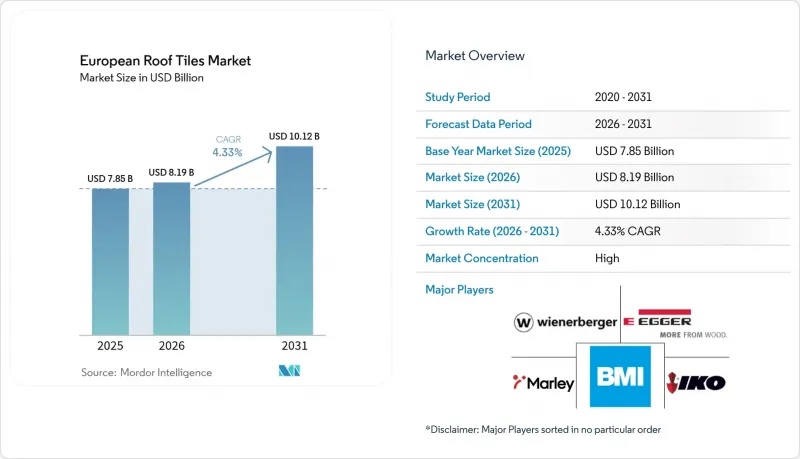
This report is Segmented by Product Type (Clay Tiles, Concrete Tiles, Solar Roof Tiles), End-User Industry (Residential, Commercial, Infrastructure, Industrial and Institutional), Construction Type (New Construction, Re-roofing/Renovation), and Geography (Germany, United Kingdom, France, Italy, Spain, Russia, Nordics, Turkey, Rest of Europe). The Market Forecasts are Provided in Terms of Value (USD).
European Roof Tiles Market Trends and Insights
EU Green-Building Mandates Accelerate Tile Adoption
The recast Energy Performance of Buildings Directive compels buildings consuming more than 290 kWh/m2 annually to undergo energy renovations by 2030. Consequently, procurement specifications now emphasize roof systems that offer high insulation values and integrate solar generation capacity. Concrete and clay tiles that meet emerging U-value thresholds are becoming default choices in public tenders as local governments align with the Renovation Wave strategy. Early-mover manufacturers roll out tiles pre-certified for BIPV compatibility, positioning themselves ahead of phased compliance deadlines. Late adopters risk exclusion from project shortlists once national transpositions of the directive are fully in force.
Renovation Wave Across Aging European Housing Stock
Three out of every four European dwellings were built before 1990 and fall short of present-day efficiency norms. Brussels targets 35 million renovations by 2030, and roofs top retrofit priority lists because they deliver immediate heat-loss reductions. Concrete tiles remain the default choice for budget-sensitive owners because familiar installation practices limit labor hours and project disruption. Manufacturers leverage predictable replacement cycles to synchronize capacity additions with regional renovation funding programs. Distributors expand just-in-time inventory services, ensuring installers can meet tight subsidy-linked project timelines.
Premium Pricing Versus Asphalt and Sheet-Metal Roofs
Clay and concrete solutions remain 40-60% pricier than asphalt alternatives, limiting penetration in price-sensitive Eastern European markets. Inflationary spikes in gas and cement during 2024-2025 widened this gap, forcing manufacturers to choose between absorbing costs or raising prices at the risk of volume losses. Nevertheless, where labor costs exceed material costs, owners increasingly value tiles' extended lifespans, shifting the affordability discussion from upfront expense to lifecycle economics.
Other drivers and restraints analyzed in the detailed report include:
- Durability and Life-Cycle Sustainability Advantages of Clay/Concrete Tiles
- Integrated Solar Roof Tiles Boosted by Rooftop-PV Rules
- Skilled-Labor Shortages in Specialist Tile Installation
For complete list of drivers and restraints, kindly check the Table Of Contents.
Segment Analysis
Solar tiles expanded at a 6.85% CAGR, outpacing all other formats as rooftop-PV obligations proliferated. Concrete maintained a 47.62% share of the European roof tile market in 2025, reflecting its cost advantages and logistical reach into renovation-heavy zones. Clay tiles have captured the heritage restoration market due to their authentic aesthetics and 100-year durability claims. Manufacturers merge traditional lines with BIPV variants to capture adjacency sales, while curved solar formats erase earlier aesthetic objections.
The European roof tiles market increasingly maps to a three-tier value hierarchy: solar tiles at premium price points but limited volume, concrete as a mainstream workhorse, and clay for design-driven or conservation contexts. Plant modernization focuses on digital kiln control to cut gas usage, aligning with corporate net-zero roadmaps. Cross-border acquisitions accelerate, creating platforms that balance commodity concrete capacity with patent-protected solar portfolios, further consolidating the European roof tiles industry.
Complete Report Scope:
- By Product Type
- Clay Tiles
- Concrete Tiles
- Solar Roof Tiles (BIPV)
- By End-user Industry
- Residential
- Commercial
- Infrastructure
- Industrial and Institutional
- By Construction Type
- New Construction
- Re-roofing / Renovation
- By Geography
- Germany
- United Kingdom
- France
- Italy
- Spain
- Russia
- Nordics
- Turkey
- Rest of Europe
List of Companies Covered in this Report:
- BMI Group
- Crown Roof Tiles
- Edilians
- EGGER
- Eurocell Plc
- IKO Industries Ltd
- INDUSTRIE COTTO POSSAGNO SpA
- Marley
- Sika AG
- Solarstone OU
- Tegola Canadese S.r.l.
- Vortex Hydra SRL
- Wienerberger AG
Additional Benefits:
- The market estimate (ME) sheet in Excel format
- 3 months of analyst support
TABLE OF CONTENTS
1 Introduction
- 1.1 Study Assumptions and Market Definition
- 1.2 Scope of the Study
2 Research Methodology
3 Executive Summary
4 Market Landscape
- 4.1 Market Overview
- 4.2 Market Drivers
- 4.2.1 EU green-building mandates accelerate tile adoption
- 4.2.2 Renovation wave across aging European housing stock
- 4.2.3 Durability and life-cycle sustainability advantages of clay/concrete tiles
- 4.2.4 Climate-driven re-roofing after extreme weather events
- 4.2.5 Integrated solar roof-tiles boosted by mandatory rooftop-PV rules
- 4.3 Market Restraints
- 4.3.1 Premium pricing versus asphalt and sheet-metal roofs
- 4.3.2 Skilled-labour shortages in specialist tile installation
- 4.3.3 Volatile energy and raw-material costs (clay, cement, gas)
- 4.4 Value Chain Analysis
- 4.5 Porter's Five Forces
- 4.5.1 Bargaining Power of Suppliers
- 4.5.2 Bargaining Power of Buyers
- 4.5.3 Threat of New Entrants
- 4.5.4 Threat of Substitute Products and Services
- 4.5.5 Degree of Competition
5 Market Size and Growth Forecasts (Value)
- 5.1 By Product Type
- 5.1.1 Clay Tiles
- 5.1.2 Concrete Tiles
- 5.1.3 Solar Roof Tiles (BIPV)
- 5.2 By End-user Industry
- 5.2.1 Residential
- 5.2.2 Commercial
- 5.2.3 Infrastructure
- 5.2.4 Industrial and Institutional
- 5.3 By Construction Type
- 5.3.1 New Construction
- 5.3.2 Re-roofing / Renovation
- 5.4 By Geography
- 5.4.1 Germany
- 5.4.2 United Kingdom
- 5.4.3 France
- 5.4.4 Italy
- 5.4.5 Spain
- 5.4.6 Russia
- 5.4.7 Nordics
- 5.4.8 Turkey
- 5.4.9 Rest of Europe
6 Competitive Landscape
- 6.1 Market Concentration
- 6.2 Strategic Moves
- 6.3 Market Share**/Ranking Analysis
- 6.4 Company Profiles (includes Global level Overview, Market level overview, Core Segments, Financials as available, Strategic Information, Market Rank/Share, Products and Services, Recent Developments)
- 6.4.1 BMI Group
- 6.4.2 Crown Roof Tiles
- 6.4.3 Edilians
- 6.4.4 EGGER
- 6.4.5 Eurocell Plc
- 6.4.6 IKO Industries Ltd
- 6.4.7 INDUSTRIE COTTO POSSAGNO SpA
- 6.4.8 Marley
- 6.4.9 Sika AG
- 6.4.10 Solarstone OU
- 6.4.11 Tegola Canadese S.r.l.
- 6.4.12 Vortex Hydra SRL
- 6.4.13 Wienerberger AG
7 Market Opportunities and Future Outlook
- 7.1 White-space and Unmet-need Assessment

