PUBLISHER: Mordor Intelligence | PRODUCT CODE: 2124434

PUBLISHER: Mordor Intelligence | PRODUCT CODE: 2124434
Asia-Pacific Compressor - Market Share Analysis, Industry Trends & Statistics, Growth Forecasts (2026 - 2031)
According to Mordor Intelligence, the Asia-Pacific compressor market size is estimated at USD 14.23 billion in 2026, and is expected to reach USD 19.16 billion by 2031, at a CAGR of 6.13% during the forecast period (2026-2031).
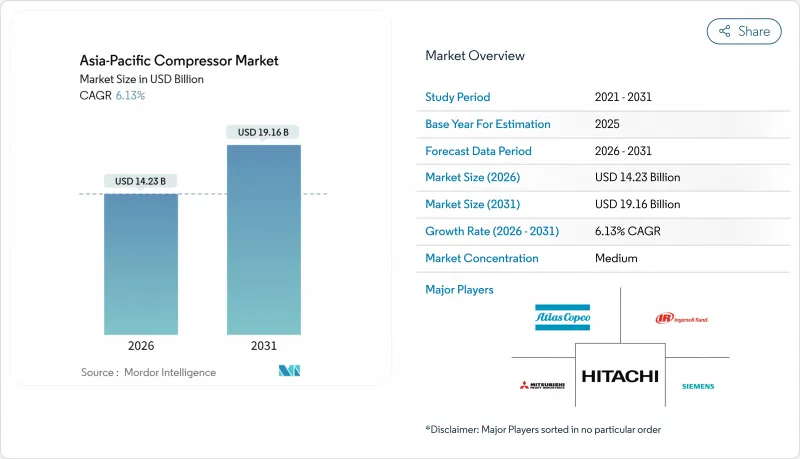
This report is Segmented by Type (Positive Displacement and Dynamic), Portability (Stationary and Portable), Pressure Rating (Low, Medium, High, and Ultra-High), End-User (Oil and Gas, Manufacturing and Industrial, HVAC-R and Building Services, Automotive and Transportation, and More), and Geography (China, India, Japan, South Korea, ASEAN Countries, Australia and New Zealand, and Rest of Asia-Pacific)
Asia-Pacific Compressor Market Trends and Insights
Rapid Industrialization & Manufacturing Expansion
China delivered about 30% of global manufacturing value-added in 2025, while India's production-linked incentive program earmarked INR 6,940 crore (USD 830 million) for air-conditioner and LED lines, spurring orders for rotary-screw and reciprocating units. ASEAN economies attracted USD 224 billion in foreign direct investment in 2024, with Vietnam and Thailand commissioning new electronics and automotive parks that require compressed-air networks. India's Delhi-Mumbai and Chennai-Bengaluru corridors embed VSD standards that trigger a replacement cycle away from fixed-speed machines. Higher-value manufacturing, semiconductors, EV batteries, and biologics demand oil-free and centrifugal designs with tighter tolerances. Stabilizing steel output but rising aluminum and copper smelting in Indonesia and India further lift multi-megawatt centrifugal demand.
Stringent Energy-Efficiency Regulations Favouring Rotary-Screw & VSD Units
Singapore enforced Minimum Energy Performance Standards for industrial compressors in 2024, mandating efficiency labels and phasing out low-performance models. Vietnam's 2025 building-code revision requires heat-recovery HVAC systems built around VSD compressors. Australia's Safeguard Mechanism penalizes high-emission facilities, accelerating rotary-screw upgrades that cut electricity use 20-30%. Japan's Top Runner program and South Korea's Green New Deal keep tightening benchmarks, while Malaysia's energy-efficiency plan targets a 10% cut in industrial intensity by 2030. Across the Asia-Pacific compressor market, payback periods of 18-24 months for VSD retrofits are catalyzing small- and mid-size enterprise adoption.
High Upfront Cost of Oil-Free & VSD Compressors
Oil-free rotary-screw machines command a 40-60% premium over lubricated alternatives, while VSD packages add 15-25%, deterring small enterprises in India, Indonesia, and Vietnam. Total cost of ownership favors premium units in contamination-sensitive settings, yet many users defer upgrades until failures occur. Kirloskar Pneumatic reported that 60% of oil-free inquiries did not convert within 12 months, citing budget constraints. Entry-level oil-free 50-hp screws list at USD 25,000 against USD 15,000 for lubricated peers, a delta many small workshops struggle to justify. "Air-as-a-service" leasing softens capex but remains under 10% penetration across the Asia-Pacific compressor market.
Other drivers and restraints analyzed in the detailed report include:
- LNG & Gas-Pipeline Build-Out Boosting High-Pressure Gas Compressors
- Hydrogen Infrastructure Roll-Out Requiring Specialty H2 Compressors
- Raw-Material Price Volatility Squeezing OEM Margins
For complete list of drivers and restraints, kindly check the Table Of Contents.
Segment Analysis
Positive displacement machines controlled 67.8% of the Asia-Pacific compressor market in 2025, buoyed by rotary-screw and reciprocating uptake across factory floors and gas-gathering fields. Dynamic compressors, led by centrifugal designs, are forecast to grow at a 6.5% CAGR as petrochemical and LNG investments proliferate. The Asia-Pacific compressor market size for dynamic units is projected to widen alongside ethylene crackers and ammonia loops that favor multi-megawatt centrifugal trains. Magnetic-bearing systems from Mitsubishi Heavy Industries and Siemens trim operating costs up to 40% over two decades. Variable-speed screws are narrowing the efficiency gap with dynamics, while rotary-vane machines find cleanroom niches where ISO 8573-1 Class 0 purity is mandatory.
Digital twins lengthen service intervals for reciprocating models, and Hitachi's hybrid screw with embedded sensors cuts automotive paint-shop energy by 15%. Collectively, these innovations underscore how the Asia-Pacific compressor market continues to blur traditional boundaries between displacement and dynamic classes.
Stationary equipment represented 74.1% of 2025 demand, integrated into centralized factory and refinery grids. Portable units, however, are expanding at a 7.2% CAGR, leveraged by expressways, rail, and mining sites across India, Vietnam, and Australia. Contractors increasingly rent compressors to avoid capex, accelerating fleet turnover at rental houses and lifting service-parts revenue. The Asia-Pacific compressor market share for stationary units will remain dominant, yet incremental gains accrue to battery-electric portables, which address urban noise and emission curbs. Kaeser's lithium-ion model, launched in 2024, targets CBD projects in Singapore and Hong Kong with 4-6 hours of runtime.
Complete Report Scope:
- By Type
- Positive Displacement
- Reciprocating
- Rotary Screw
- Rotary Vane
- Dynamic
- Centrifugal
- Axial
- Positive Displacement
- By Portability
- Stationary
- Portable
- By Pressure Rating
- Low (Up to 20 bar)
- Medium (20 to 100 bar)
- High (100 to 300 bar)
- Ultra-High (Above 300 bar)
- By End-User
- Oil and Gas
- Power Generation
- Manufacturing and Industrial
- Chemicals and Petrochemicals
- HVAC-R and Building Services
- Automotive and Transportation
- Food and Beverage
- Healthcare and Pharmaceuticals
- By Geography
- China
- India
- Japan
- South Korea
- ASEAN Countries
- Australia and New Zealand
- Rest of Asia-Pacific
List of Companies Covered in this Report:
- Atlas Copco AB
- Ingersoll Rand Inc.
- Mitsubishi Heavy Industries Ltd
- Siemens AG
- Hitachi Industrial Equipment Systems Co Ltd
- Kobelco Compressors (Kobe Steel Ltd)
- Gardner Denver Holdings
- Kaeser Kompressoren SE
- ELGi Equipments Ltd
- Kirloskar Pneumatic Co Ltd
- Baker Hughes Co
- Ariel Corporation
- Doosan Corporation
- Trane Technologies plc
- Aerzener Maschinenfabrik GmbH
- Sullair LLC
- Howden Group
- Burckhardt Compression AG
- Fusheng Group
- Kaishan Compressor Co Ltd
Additional Benefits:
- The market estimate (ME) sheet in Excel format
- 3 months of analyst support
TABLE OF CONTENTS
1 Introduction
- 1.1 Study Assumptions & Market Definition
- 1.2 Scope of the Study
2 Research Methodology
3 Executive Summary
4 Market Landscape
- 4.1 Market Overview
- 4.2 Market Drivers
- 4.2.1 Rapid industrialisation & manufacturing expansion
- 4.2.2 Stringent energy-efficiency regulations favouring rotary-screw & VSD units
- 4.2.3 LNG & gas-pipeline build-out boosting high-pressure gas compressors
- 4.2.4 Hydrogen infrastructure roll-out requiring specialty H2 compressors
- 4.2.5 Digital service contracts & predictive-maintenance platforms
- 4.2.6 Surging HVAC & cold-chain demand among APAC middle class
- 4.3 Market Restraints
- 4.3.1 High upfront cost of oil-free & VSD compressors
- 4.3.2 Raw-material price volatility squeezing OEM margins
- 4.3.3 Shortage of skilled technicians for advanced systems
- 4.3.4 Rising rental penetration dampening new-unit sales
- 4.4 Supply-Chain Analysis
- 4.5 Regulatory Landscape
- 4.6 Technological Outlook
- 4.7 Porter's Five Forces
- 4.7.1 Bargaining Power of Suppliers
- 4.7.2 Bargaining Power of Consumers
- 4.7.3 Threat of New Entrants
- 4.7.4 Threat of Substitutes
- 4.7.5 Intensity of Rivalry
5 Market Size & Growth Forecasts
- 5.1 By Type
- 5.1.1 Positive Displacement
- 5.1.1.1 Reciprocating
- 5.1.1.2 Rotary Screw
- 5.1.1.3 Rotary Vane
- 5.1.2 Dynamic
- 5.1.2.1 Centrifugal
- 5.1.2.2 Axial
- 5.1.1 Positive Displacement
- 5.2 By Portability
- 5.2.1 Stationary
- 5.2.2 Portable
- 5.3 By Pressure Rating
- 5.3.1 Low (Up to 20 bar)
- 5.3.2 Medium (20 to 100 bar)
- 5.3.3 High (100 to 300 bar)
- 5.3.4 Ultra-High (Above 300 bar)
- 5.4 By End-User
- 5.4.1 Oil and Gas
- 5.4.2 Power Generation
- 5.4.3 Manufacturing and Industrial
- 5.4.4 Chemicals and Petrochemicals
- 5.4.5 HVAC-R and Building Services
- 5.4.6 Automotive and Transportation
- 5.4.7 Food and Beverage
- 5.4.8 Healthcare and Pharmaceuticals
- 5.5 By Geography
- 5.5.1 China
- 5.5.2 India
- 5.5.3 Japan
- 5.5.4 South Korea
- 5.5.5 ASEAN Countries
- 5.5.6 Australia and New Zealand
- 5.5.7 Rest of Asia-Pacific
6 Competitive Landscape
- 6.1 Market Concentration
- 6.2 Strategic Moves (M&A, Partnerships, PPAs)
- 6.3 Market Share Analysis (Market Rank/Share for key companies)
- 6.4 Company Profiles (includes Global level Overview, Market level overview, Core Segments, Financials as available, Strategic Information, Products & Services, and Recent Developments)
- 6.4.1 Atlas Copco AB
- 6.4.2 Ingersoll Rand Inc.
- 6.4.3 Mitsubishi Heavy Industries Ltd
- 6.4.4 Siemens AG
- 6.4.5 Hitachi Industrial Equipment Systems Co Ltd
- 6.4.6 Kobelco Compressors (Kobe Steel Ltd)
- 6.4.7 Gardner Denver Holdings
- 6.4.8 Kaeser Kompressoren SE
- 6.4.9 ELGi Equipments Ltd
- 6.4.10 Kirloskar Pneumatic Co Ltd
- 6.4.11 Baker Hughes Co
- 6.4.12 Ariel Corporation
- 6.4.13 Doosan Corporation
- 6.4.14 Trane Technologies plc
- 6.4.15 Aerzener Maschinenfabrik GmbH
- 6.4.16 Sullair LLC
- 6.4.17 Howden Group
- 6.4.18 Burckhardt Compression AG
- 6.4.19 Fusheng Group
- 6.4.20 Kaishan Compressor Co Ltd
7 Market Opportunities & Future Outlook
- 7.1 White-space & Unmet-need Assessment

