PUBLISHER: Mordor Intelligence | PRODUCT CODE: 2124448

PUBLISHER: Mordor Intelligence | PRODUCT CODE: 2124448
United States Wall Covering And Wall Decor - Market Share Analysis, Industry Trends & Statistics, Growth Forecasts (2026 - 2031)
According to Mordor Intelligence, the United States wall covering and wall decor market size is expected to increase from USD 14.93 billion in 2025 to USD 15.63 billion in 2026 and reach USD 19.98 billion by 2031, growing at a CAGR of 5.04% over 2026-2031.
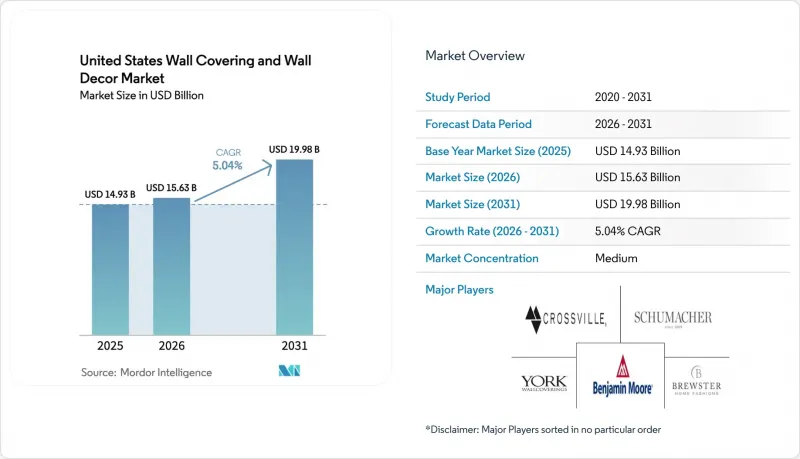
This report is Segmented by Product Type (Wall Covering and Wall Decor), Material (Paper-Based, Fabric/Textile, and More), End-Use Industry (Hospitality, Healthcare, Retail, Corporate Offices, and More), and Distribution Channel (Specialty Store, Franchise Store, and More). The Market Forecasts are Provided in Terms of Value (USD).
United States Wall Covering And Wall Decor Market Trends and Insights
Rebounding Residential Construction Activity
Housing starts climbed to 1.43 million units in 2025, an uptick that is filtering into finish-material demand as projects move from framing to interiors. Single-family construction again dominates but multifamily projects supply concentrated volumes that often specify Type II commercial wallcoverings. Remodel spending touched USD 509 billion in 2025, an incremental lift driven by equity-rich homeowners reinvesting in properties. Sun Belt states add extra momentum through favorable migration and employment patterns. The United States wall covering and wall decor market therefore scales with housing completions, making construction starts a leading indicator of unit shipments.
Growing Demand for Digitally Printed Solutions and Online Procurement of Wall Arts
Advances in large-format inkjet systems allow brands to print bespoke runs within days, enabling mass customization at consumer-level price points. Wayfair's USD 2.728 billion domestic revenue in Q3 2025, with 63% of orders placed via mobile, underscores how digital channels redefine purchase behavior.Mobile augmented-reality tools reduce style uncertainty, nudging buyers to higher basket values. Manufacturers able to integrate API-driven ordering portals now reach the long-tail of design preferences that specialty stores struggled to stock. As a result, the United States wall covering and wall decor market finds incremental volume online without widening brick-and-mortar footprints.
Strong Competition from the Paint Segment
Paint maintains dominance in volume terms because it costs roughly one-third of an entry-level wallpaper installation and requires no specialty skills for application. Budget-conscious renovators often opt for a fresh coat over a patterned wallcovering when inflation stretches project budgets. Paint brands have also launched textured finishes and online visualization tools that narrow wallcovering's aesthetic gap. This rivalry is acutest in rural counties where per-capita income trails coastal averages, creating a steady drag on the United States wall covering and wall decor market.
Other drivers and restraints analyzed in the detailed report include:
- Rising Disposable Incomes and Home Remodeling Spending
- Surge in Short-Term Rentals Fueling Rapid Refresh Cycles of Interior Aesthetics
- Impact of Recent Macro-Economic Volatility on Customer Spending
For complete list of drivers and restraints, kindly check the Table Of Contents.
Segment Analysis
Wall covering held 78.42% of 2025 revenue, anchored by vinyl wallpaper, laminated panels, and ceramic tile that meet stringent durability codes for hospitality and healthcare installations. Wallpaper's breadth of print libraries and growing availability in low-VOC inks continue to secure repeat specifications for high-traffic spaces. In contrast, wall decor is forecast to expand at a 6.42% CAGR through 2031, propelled by custom canvas art, framed mirrors, and removable decals that appeal to design-savvy renters. E-commerce brands increasingly bundle wall art with visualization apps, lowering decision friction and lifting basket sizes. The United States wall covering and wall decor market thus shows a volume-heavy core segment coupled with a faster-moving ancillary category.
Growth in digital interiors also fuels demand for peel-and-stick murals, allowing homeowners to trial bold motifs without permanent commitment. Hybrid rooms where a statement wall pairs with coordinating artwork illustrate how cross-category sales converge. Suppliers that curate coordinated collections gain share because they simplify style coherence for consumers ordering online. As these bundles proliferate, the United States wall covering and wall decor market tightens the link between covering and decor, increasing total addressable value per project.
Vinyl represented 38.43% of 2025 material revenue, benefiting from decades of installed base across corridors, guest rooms, and public areas that require scrubbable surfaces. Innovations in phthalate-free plasticizers aim to preserve this leadership while meeting California CDPH 01350 thresholds.Paper and non-woven substrates gain popularity in residential makeovers where breathability offsets lower abrasion resistance. Metal wall coverings, though a smaller slice today, are forecast to achieve a 6.64% CAGR through 2031 as architects specify copper or aluminum panels with acoustic backings to satisfy WELL v2 sound criteria.
Noise reduction coefficients between 0.75 and 0.95 position products like Symphony panels as turnkey solutions for open-plan offices. Simultaneously, antimicrobial copper tiles demonstrating 99.9% bacterial reduction within two hours expand uptake in hospitals and long-term care. These performance overlays help manufacturers defend margins against paint substitutions and underpin premiumization inside the United States wall covering and wall decor market.
Complete Report Scope:
- By Product Type
- Wall Covering
- Wall Panel
- Wallpaper
- Vinyl Wallpaper
- Non-woven Wallpaper
- Paper-based Wallpaper
- Fabric Wallpaper
- Other Wallpaper Types
- Tile
- Metal Wall Covering
- Other Product Types
- Wall Decor
- Wall Art
- Wall Decal
- Wall Frames (Mirrors, etc.)
- Other Wall Decors
- Wall Covering
- By Material
- Paper-Based
- Fabric/Textile
- Wood-Based
- Vinyl
- Metal
- Plastic
- Other Materials
- By End-use Industry
- Hospitality
- Healthcare
- Retail
- Corporate Offices
- Education
- Domestic Housing
- Industrial Facilities
- Other End-use Industries
- By Distribution Channel
- Specialty Store
- Franchise store
- E-commerce
- Other Distribution Channels
List of Companies Covered in this Report:
- Brewster Home Fashions LLC
- Benjamin Moore & Co.
- York Wallcoverings, Inc.
- F. Schumacher & Co.
- Crossville Inc.
- J. Josephson Inc.
- Wallquest Inc.
- The Sherwin-Williams Company
- Koroseal Interior Products, LLC
- Len-Tex Corporation
- Graham & Brown Ltd.
- Tempaper, LLC
- Chasing Paper, LLC
- Spoonflower, Inc.
- Walls Need Love, LLC
- Astek Wallcoverings, Inc.
- Mohawk Industries, Inc.
- Walls Republic
- Saint-Gobain S.A.
Additional Benefits:
- The market estimate (ME) sheet in Excel format
- 3 months of analyst support
TABLE OF CONTENTS
1 INTRODUCTION
- 1.1 Study Assumptions and Market Definition
- 1.2 Scope of the Study
2 RESEARCH METHODOLOGY
3 EXECUTIVE SUMMARY
4 MARKET LANDSCAPE
- 4.1 Market Overview
- 4.2 Market Drivers
- 4.2.1 Rebounding Residential Construction Activity
- 4.2.2 Growing Demand for Digitally Printed Solutions and Online Procurement of Wall Arts
- 4.2.3 Rising Disposable Incomes and Home Remodeling Spending
- 4.2.4 Surge in Short-Term Rentals Fueling Rapid Refresh Cycles of Interior Aesthetics
- 4.2.5 Growth of Peel-and-Stick, Low-VOC Substrates Meeting Renter-Friendly and Sustainability Rules
- 4.2.6 Integration of Antimicrobial and Acoustic Functionalities into Wall Coverings for Post-Pandemic Healthy Buildings
- 4.3 Market Restraints
- 4.3.1 Strong Competition from the Paint Segment
- 4.3.2 Impact of Recent Macro-Economic Volatility on Customer Spending
- 4.3.3 US Tariff Expansion on Specialty Pigments and Vinyl Compounds Elevating Input Costs
- 4.3.4 Skilled Installer Shortage Escalating Total Cost and Delaying Commercial Projects
- 4.4 Industry Value Chain Analysis
- 4.5 Regulatory Landscape
- 4.6 Technological Outlook
- 4.7 Porter's Five Forces Analysis
- 4.7.1 Bargaining Power of Suppliers
- 4.7.2 Bargaining Power of Buyers
- 4.7.3 Threat of New Entrants
- 4.7.4 Threat of Substitute Products
- 4.7.5 Intensity of Competitive Rivalry
- 4.8 Impact of Macroeconomic Factors on the Market
- 4.9 Investment Analysis
5 MARKET SIZE AND GROWTH FORECASTS (VALUE)
- 5.1 By Product Type
- 5.1.1 Wall Covering
- 5.1.1.1 Wall Panel
- 5.1.1.2 Wallpaper
- 5.1.1.2.1 Vinyl Wallpaper
- 5.1.1.2.2 Non-woven Wallpaper
- 5.1.1.2.3 Paper-based Wallpaper
- 5.1.1.2.4 Fabric Wallpaper
- 5.1.1.2.5 Other Wallpaper Types
- 5.1.1.3 Tile
- 5.1.1.4 Metal Wall Covering
- 5.1.1.5 Other Product Types
- 5.1.2 Wall Decor
- 5.1.2.1 Wall Art
- 5.1.2.2 Wall Decal
- 5.1.2.3 Wall Frames (Mirrors, etc.)
- 5.1.2.4 Other Wall Decors
- 5.1.1 Wall Covering
- 5.2 By Material
- 5.2.1 Paper-Based
- 5.2.2 Fabric/Textile
- 5.2.3 Wood-Based
- 5.2.4 Vinyl
- 5.2.5 Metal
- 5.2.6 Plastic
- 5.2.7 Other Materials
- 5.3 By End-use Industry
- 5.3.1 Hospitality
- 5.3.2 Healthcare
- 5.3.3 Retail
- 5.3.4 Corporate Offices
- 5.3.5 Education
- 5.3.6 Domestic Housing
- 5.3.7 Industrial Facilities
- 5.3.8 Other End-use Industries
- 5.4 By Distribution Channel
- 5.4.1 Specialty Store
- 5.4.2 Franchise store
- 5.4.3 E-commerce
- 5.4.4 Other Distribution Channels
6 COMPETITIVE LANDSCAPE
- 6.1 Market Concentration
- 6.2 Strategic Moves
- 6.3 Market Share Analysis
- 6.4 Company Profiles (Includes Global Level Overview, Market Level Overview, Core Segments, Financials as Available, Strategic Information, Market Rank/Share, Products and Services, and Recent Developments)
- 6.4.1 Brewster Home Fashions LLC
- 6.4.2 Benjamin Moore & Co.
- 6.4.3 York Wallcoverings, Inc.
- 6.4.4 F. Schumacher & Co.
- 6.4.5 Crossville Inc.
- 6.4.6 J. Josephson Inc.
- 6.4.7 Wallquest Inc.
- 6.4.8 The Sherwin-Williams Company
- 6.4.9 Koroseal Interior Products, LLC
- 6.4.10 Len-Tex Corporation
- 6.4.11 Graham & Brown Ltd.
- 6.4.12 Tempaper, LLC
- 6.4.13 Chasing Paper, LLC
- 6.4.14 Spoonflower, Inc.
- 6.4.15 Walls Need Love, LLC
- 6.4.16 Astek Wallcoverings, Inc.
- 6.4.17 Mohawk Industries, Inc.
- 6.4.18 Walls Republic
- 6.4.19 Saint-Gobain S.A.
7 MARKET OPPORTUNITIES AND FUTURE OUTLOOK
- 7.1 White-Space and Unmet-Need Assessment

