PUBLISHER: Mordor Intelligence | PRODUCT CODE: 2124472

PUBLISHER: Mordor Intelligence | PRODUCT CODE: 2124472
School Information Management System - Market Share Analysis, Industry Trends & Statistics, Growth Forecasts (2026 - 2031)
According to Mordor Intelligence, the school information management system market size is valued at USD 13.57 billion in 2026 and is projected to reach USD 21.79 billion by 2031, reflecting a 9.93% CAGR.
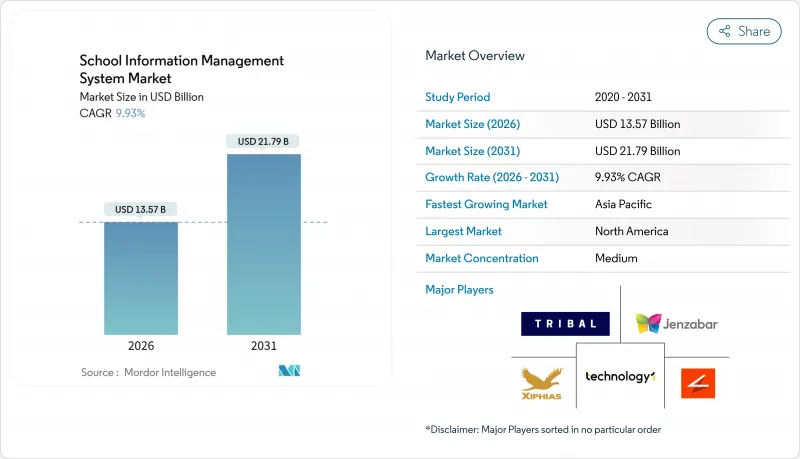
This report is Segmented by Deployment Model (On-Premise, and Cloud), Application (Administration, Finance, Academics, Other Applications), Component (Software, and Services), End User (K-12 Schools, Higher Education Institutions, Other End Users), and Geography (North America, Europe, Asia-Pacific, Middle East and Africa, South America). The Market Forecasts are Provided in Terms of Value (USD).
Global School Information Management System Market Trends and Insights
Greater Emphasis on Digital Tools to Track Student Activity
Litigation risk, rather than pedagogy, is driving demand for platforms that record attendance, behavior, and interventions in real-time. United States districts faced 47% more student-safety lawsuits in 2024 than in 2019, compelling administrators to secure audit trails that stand up in court. California's AB 1432 mandates early-warning analytics for chronic absenteeism across 420 districts, triggering immediate procurement of interoperable SIS modules. At the post-secondary level, new Title IX rules require electronic case-management workflows, so 1,800 colleges have retrofitted their existing systems or transitioned to cloud suites with embedded compliance templates. Vendors offering out-of-the-box regulatory workflows capture a disproportionate share because institutions lack the bandwidth to code bespoke solutions.
Growing Government Investments in School Digitization
Public-sector capital has pivoted decisively toward software. India directed INR 32 billion (USD 384 million) in 2024-2025 to equip 650,000 schools with interoperable SIS and learning platforms. The United Arab Emirates earmarked AED 1.2 billion (USD 327 million) through 2025 to unify emirate-level student records, replacing seven legacy systems. Australia's AUD 500 million (USD 335 million) Digital Education Revolution Phase 2 hinges on adopting SIS that comply with a national unique-identifier framework. Lengthy multiyear contracts create lock-in, favoring incumbent vendors once initial deployments conclude.
Limited IT Budgets in Public Schools
Flat nominal spending since 2019, coupled with 18% inflation, has slashed real technology purchasing power by 15% in U.S. districts. Rural systems spend 38% less per student on IT than their urban peers, which hampers vendor traction where cloud migration costs are highest. European austerity after energy-price shocks forced France to delay EUR 180 million (USD 203 million) in SIS upgrades to 2026. Subscription fatigue compounds the squeeze, with 17% of districts evaluating reversion to on-premise installations to cap recurring fees.
Other drivers and restraints analyzed in the detailed report include:
- Rising Adoption of Cloud-Based Solutions
- Increasing Need for Centralized Administrative Automation
- Data Privacy and Security Concerns
For complete list of drivers and restraints, kindly check the Table Of Contents.
Segment Analysis
Cloud platforms commanded a 62.73% market share of the School Information Management System market in 2025 and are projected to grow at a 10.16% CAGR, driven by districts eager to offload infrastructure and cyber-risk. The School Information Management System market size tied to cloud subscriptions is projected to more than double by 2031, despite the five-year total cost often surpassing legacy ownership costs. Mandatory incident-reporting rules under the European NIS2 directive further tilt adoption toward vendors that operate managed security centers.
Yet on-premise deployments persist where data-sovereignty laws prohibit foreign cloud storage, particularly in China, Russia, and parts of the Middle East. Chinese K-12 institutions must house student records domestically, so global suppliers either concede the market or partner with local providers. A 2024 survey across 200 U.S. districts showed that on-premise installations older than a decade yielded 23% lower annual IT costs because subscription fees were absent and data-egress charges were negligible. Hybrid architectures, where core records remain on-site, and parent portals run in the cloud, are gaining traction but introduce integration complexity that fuels demand for services.
Administration modules still held the largest 39.26% revenue share in 2025, reflecting long-standing needs for scheduling, grading, and enrollment workflows. However, the academic segment is expanding at 10.67% CAGR, the fastest among all use cases, as universities deploy learning analytics to cut attrition. The School Information Management System market size attached to academic analytics is therefore growing faster than any other module family, underscoring a shift from compliance to student success outcomes.
Case evidence is compelling: Georgia State University shaved first-year dropout rates by 11 percentage points after embedding predictive alerts into its SIS. Similar results from the University of California system triggered a USD 25 million expansion in 2025. Finance and ancillary applications remain strategic for audit compliance, yet their growth trails as districts redirect funds toward AI-enabled coursework recommendations and competency mapping that promise direct revenue or grant upside.
Complete Report Scope:
- By Deployment Model
- On-Premise
- Cloud
- By Application
- Administration
- Finance
- Academics
- Other Applications
- By Component
- Software
- Services
- By End User
- K-12 Schools
- Higher Education Institutions
- Other End Users
- By Geography
- North America
- United States
- Canada
- Mexico
- Europe
- Germany
- United Kingdom
- France
- Russia
- Rest of Europe
- Asia-Pacific
- China
- Japan
- India
- South Korea
- Australia
- Rest of Asia-Pacific
- Middle East and Africa
- Middle East
- Saudi Arabia
- United Arab Emirates
- Rest of Middle East
- Africa
- South Africa
- Egypt
- Rest of Africa
- Middle East
- South America
- Brazil
- Argentina
- Rest of South America
- North America
Geography Analysis
North America retained a 37.89% revenue share in 2025, as refresh cycles and federal standards continued to maintain steady replacement momentum. Yet, funding gaps pose growth ceilings; implementation grants under the 2024 National Education Technology Plan cover only a fraction of the projected SIS upgrade costs. Canada exhibits provincial divergence: Ontario centralized procurement across seventy-two school boards in 2024, whereas Alberta continues to let 379 schools choose independently.
Asia Pacific leads in growth, advancing at a 10.89% CAGR as governments mandate smart-campus infrastructure. China's sweeping 2025 deadline affects 210,000 K-12 schools. India is channeling INR 57 billion (USD 685 million) into state-level SIS rollouts. Japan's GIGA program equips 10 million students with cloud devices, all tethered to an interoperable SIS for usage monitoring. Data-localization statutes, however, splinter the landscape, forcing globally active vendors to invest in costly, country-specific infrastructure.
Europe shows moderated prospects because austerity budgets collide with complex procurement. Germany's sixteen federal states operate forty-seven separate platforms, which limits scale economies. GDPR-driven impact assessments add six- to nine-month delays for two-thirds of new projects. Meanwhile, gains in the Middle East and Africa emanate from the United Arab Emirates' AED 1.2 billion consolidation program, while those in South America hinge on Brazil's multi-year municipal rollout, which now stretches into 2027.
- XIPHIAS Software Technologies
- Foradian Technologies
- Tribal Group PLC
- Technology One Corporation
- Jenzabar Inc.
- Ellucian Company LP
- Frontline Education
- Open Solution for Education Inc.
- Workday Inc.
- Engage MIS
- Blackboard Inc.
- PowerSchool Holdings Inc.
- Infinite Campus Inc.
- Skyward Inc.
- FACTS Management (Nelnet)
- Oracle Corporation
- SAP SE
- Capita plc (SIMS)
- Illuminate Education
- Alma SIS
- Veracross LLC
Additional Benefits:
- The market estimate (ME) sheet in Excel format
- 3 months of analyst support
TABLE OF CONTENTS
1 INTRODUCTION
- 1.1 Study Assumptions and Market Definition
- 1.2 Scope of the Study
2 RESEARCH METHODOLOGY
3 EXECUTIVE SUMMARY
4 MARKET LANDSCAPE
- 4.1 Market Overview
- 4.2 Market Drivers
- 4.2.1 Greater Emphasis on Digital Tools to Track Student Activity
- 4.2.2 Growing Government Investments in School Digitization
- 4.2.3 Rising Adoption of Cloud-Based Solutions
- 4.2.4 Increasing Need for Centralized Administrative Automation
- 4.2.5 Integration of AI-Driven Predictive Analytics for Student Retention
- 4.2.6 Emergence of EdTech Ecosystems Requiring Open APIs with SIS
- 4.3 Market Restraints
- 4.3.1 Limited IT Budgets in Public Schools
- 4.3.2 Data Privacy and Security Concerns
- 4.3.3 Resistance from Faculty Due to UX Complexity
- 4.3.4 Regulatory Restrictions on Student Data Export Across Borders
- 4.4 Industry Value Chain Analysis
- 4.5 Regulatory Landscape
- 4.6 Technological Outlook
- 4.7 COVID-19 Impact on the Market
- 4.8 Impact of Macroeconomic Factors on the Market
- 4.9 Porter's Five Forces Analysis
- 4.9.1 Bargaining Power of Suppliers
- 4.9.2 Bargaining Power of Buyers
- 4.9.3 Threat of New Entrants
- 4.9.4 Threat of Substitutes
- 4.9.5 Intensity of Competitive Rivalry
5 MARKET SIZE AND GROWTH FORECASTS (VALUE)
- 5.1 By Deployment Model
- 5.1.1 On-Premise
- 5.1.2 Cloud
- 5.2 By Application
- 5.2.1 Administration
- 5.2.2 Finance
- 5.2.3 Academics
- 5.2.4 Other Applications
- 5.3 By Component
- 5.3.1 Software
- 5.3.2 Services
- 5.4 By End User
- 5.4.1 K-12 Schools
- 5.4.2 Higher Education Institutions
- 5.4.3 Other End Users
- 5.5 By Geography
- 5.5.1 North America
- 5.5.1.1 United States
- 5.5.1.2 Canada
- 5.5.1.3 Mexico
- 5.5.2 Europe
- 5.5.2.1 Germany
- 5.5.2.2 United Kingdom
- 5.5.2.3 France
- 5.5.2.4 Russia
- 5.5.2.5 Rest of Europe
- 5.5.3 Asia-Pacific
- 5.5.3.1 China
- 5.5.3.2 Japan
- 5.5.3.3 India
- 5.5.3.4 South Korea
- 5.5.3.5 Australia
- 5.5.3.6 Rest of Asia-Pacific
- 5.5.4 Middle East and Africa
- 5.5.4.1 Middle East
- 5.5.4.1.1 Saudi Arabia
- 5.5.4.1.2 United Arab Emirates
- 5.5.4.1.3 Rest of Middle East
- 5.5.4.2 Africa
- 5.5.4.2.1 South Africa
- 5.5.4.2.2 Egypt
- 5.5.4.2.3 Rest of Africa
- 5.5.4.1 Middle East
- 5.5.5 South America
- 5.5.5.1 Brazil
- 5.5.5.2 Argentina
- 5.5.5.3 Rest of South America
- 5.5.1 North America
6 COMPETITIVE LANDSCAPE
- 6.1 Market Concentration
- 6.2 Strategic Moves
- 6.3 Market Share Analysis
- 6.4 Company Profiles (includes Global Level Overview, Market Level Overview, Core Segments, Financials as available, Strategic Information, Market Rank/Share for key companies, Products and Services, and Recent Developments)
- 6.4.1 XIPHIAS Software Technologies
- 6.4.2 Foradian Technologies
- 6.4.3 Tribal Group PLC
- 6.4.4 Technology One Corporation
- 6.4.5 Jenzabar Inc.
- 6.4.6 Ellucian Company LP
- 6.4.7 Frontline Education
- 6.4.8 Open Solution for Education Inc.
- 6.4.9 Workday Inc.
- 6.4.10 Engage MIS
- 6.4.11 Blackboard Inc.
- 6.4.12 PowerSchool Holdings Inc.
- 6.4.13 Infinite Campus Inc.
- 6.4.14 Skyward Inc.
- 6.4.15 FACTS Management (Nelnet)
- 6.4.16 Oracle Corporation
- 6.4.17 SAP SE
- 6.4.18 Capita plc (SIMS)
- 6.4.19 Illuminate Education
- 6.4.20 Alma SIS
- 6.4.21 Veracross LLC
7 MARKET OPPORTUNITIES AND FUTURE OUTLOOK
- 7.1 White-Space and Unmet-Need Assessment

