PUBLISHER: Mordor Intelligence | PRODUCT CODE: 2124481

PUBLISHER: Mordor Intelligence | PRODUCT CODE: 2124481
Mining Laboratory Automation - Market Share Analysis, Industry Trends & Statistics, Growth Forecasts (2026 - 2031)
According to Mordor Intelligence, mining laboratory automation market size in 2026 is estimated at USD 7.95 billion, growing from 2025 value of USD 7.22 billion with 2031 projections showing USD 12.88 billion, growing at 10.13% CAGR over 2026-2031.
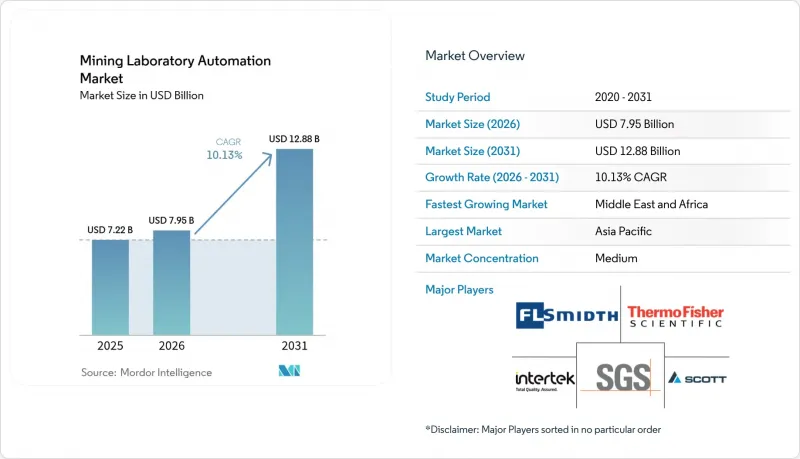
This report is Segmented by Product (Robotics, LIMS, Container Labs, and More), Automation Level (Total Lab, Modular), Mining Phase (Exploration, Production, Closure, and More), Commodity (Iron Ore, Copper, Gold, Battery Minerals), End User (Large Mining Enterprises, Mid-Tier and Junior Miners), and Geography. The Market Forecasts are Provided in Terms of Value (USD).
Global Mining Laboratory Automation Market Trends and Insights
Digital-first "Pit-to-Port" Sampling Initiatives in Australia
Mining majors now integrate autonomous drills, automated crushers, and robotic fire-assay lines into unified data backbones that push geochemical results into planning software within minutes. Rio Tinto reports annual savings of USD 200 million after deploying predictive maintenance on robotic lab assets, while BHP's Spence mine in Chile logged three months of full autonomy with zero safety incidents in 2024. Continuous data flow removes manual choke points, cuts contamination risk by 40%, and lifts ore recovery 3-5% in large iron-ore operations.
Mandatory On-site Assay Turn-around in Chilean Copper Mines
Four-hour regulatory limits for grade-control assays have forced Chilean sites to adopt automated sample preparation and portable XRF units capable of 90-minute results. Codelco's USD 2.5 billion agreement with ABB bundles electrification and laboratory automation, giving early movers 2-3-point boosts in copper recovery and shaping similar mandates in Peru.
CAPEX Pay-back > 3 Years for Mid-Tier Mines
Mid-tier mining operations face significant financial constraints when evaluating laboratory automation investments, as extended payback periods often exceed acceptable risk thresholds for companies with limited capital resources. SRK Consulting's analysis of mining operational costs reveals that automation projects requiring initial investments above USD 5 million typically face scrutiny from boards when payback periods extend beyond 36 months. The challenge is compounded by volatile commodity prices that make long-term ROI calculations unreliable, particularly for gold and base metal operations where price fluctuations can exceed 20% annually. Teck Resources' Quebrada Blanca II project exemplifies this challenge, with development costs escalating to USD 8.5-9 billion significantly above initial estimates, highlighting the risk of cost overruns in major automation initiatives. Equipment financing options and leasing arrangements are emerging as potential solutions, but adoption remains limited due to concerns about technology obsolescence and maintenance responsibilities.
Other drivers and restraints analyzed in the detailed report include:
- Rapid Grade-Control Needs in West African Gold Super-Pits
- AI-Enabled Predictive Maintenance for Robotic Sample Prep
- Limited Inter-operability Between Legacy Assay Hardware
For complete list of drivers and restraints, kindly check the Table Of Contents.
Segment Analysis
Robotics generated the largest 33.60% slice of the Mining Laboratory Automation market in 2025, underpinned by the need to shield personnel from high-temperature furnaces and carcinogenic dust. Scott Automation's turnkey cells now deliver crushing, milling, weighing, and fire-assay pouring in sealed environments, lifting throughput and repeatability. LIMS, while smaller, is the fastest climber at 12.15% CAGR, as executives value data integrity and regulatory traceability more than incremental hardware speed. Container labs meet exploration campaigns that require rapid mobilization; one 40-foot module can be on-line within three weeks. Automated analyzers adopt AI-assisted calibration, trimming reagent use and boosting precision.
Firms prefer modular islands that replace discrete tasks-crushing, splitting, or fusion-without destabilizing whole workflows. Such systems accounted for 50.20% of the Mining Laboratory Automation market share in 2025. As payback proof accumulates, total lab automation grows 14.51% per year, particularly in iron-ore and copper hubs where sample volumes are extreme. ABB's alliance with Agilent to provide integrated robotic-chemistry islands signals a shift toward vendor ecosystems that deliver cradle-to-gate solutions.
Complete Report Scope:
- By Product
- Robotics
- Laboratory Information Management Systems (LIMS)
- Container Laboratory
- Automated Analyzers and Sample Preparation Equipment
- By Automation Level
- Total Lab Automation (TLA)
- Modular / Island Automation
- By Mining Phase
- Exploration and Grade Control
- Mine Development and Planning
- Production and Beneficiation
- Closure and Environmental Monitoring
- By Commodity Processed
- Iron Ore
- Copper
- Gold
- Coal and Battery Minerals (Ni, Li, Co)
- By Geography
- North America
- United States
- Canada
- Mexico
- Europe
- United Kingdom
- Germany
- France
- Italy
- Rest of Europe
- Asia-Pacific
- China
- Japan
- India
- South Korea
- Rest of Asia-Pacific
- Middle East
- Israel
- Saudi Arabia
- United Arab Emirates
- Turkey
- Rest of Middle East
- Africa
- South Africa
- Egypt
- Rest of Africa
- South America
- Brazil
- Argentina
- Rest of South America
- North America
Geography Analysis
Asia-Pacific anchored 31.20% of global revenue in 2025, with Australia's autonomous iron-ore chain and China's vast base-metal capacity driving demand. Australian robotics spending in mining stood at USD 63 billion in 2022 and is projected to jump to USD 218 billion by 2030, a trend mirrored in laboratory settings. Japan and South Korea supply precision sensors and AI chips that sharpen assay accuracy.
Middle East & Africa records the quickest 14.86% CAGR, catalyzed by sovereign funds. Saudi miner Ma'aden's tie-up with Hexagon to open the region's first digital mine-budgeted at USD 2 billion-sets a template for lab automation across phosphate, gold, and copper assets. African deployments lean heavily on container labs and remote monitoring to sidestep weak infrastructure and scarce technicians.
North America shows steady replacement demand as legacy uranium, potash, and precious-metal labs age. Vendors must navigate inter-operability retrofits and unionized labor environments. Europe's picture is mixed: Nordic iron-ore producers pioneer hub-and-spoke automated labs that support numerous satellite mines, but the wider EU struggles with data-sovereignty hurdles that complicate cloud-based LIMS models. South America benefits from Chile's assay-turn-around law and Peru's lithium boom.
- FLSmidth A/S
- Bruker Corporation
- Thermo Fisher Scientific Inc.
- Intertek Group PLC
- SGS SA
- ALS Limited
- Bureau Veritas SA
- Rocklabs (SCOTT Technology)
- HERZOG Automation Corp.
- Malvern Panalytical Ltd.
- Nucomat
- PerkinElmer Inc.
- Agilent Technologies Inc.
- Metso Outotec Oyj
- CEM Corporation
- Element Materials Technology
- Online LIMS Canada Ltd.
- QMetrix Group
- Sentry Equipment Corp.
- CITIC Heavy Industries Robotic Lab Systems
Additional Benefits:
- The market estimate (ME) sheet in Excel format
- 3 months of analyst support
TABLE OF CONTENTS
1 INTRODUCTION
- 1.1 Study Assumptions and Market Definition
- 1.2 Scope of the Study
2 RESEARCH METHODOLOGY
3 EXECUTIVE SUMMARY
4 MARKET LANDSCAPE
- 4.1 Market Overview
- 4.2 Market Drivers
- 4.2.1 Digital-first "Pit-to-Port" Sampling Initiatives in Australia
- 4.2.2 Mandatory On-site Assay Turn-around in Chilean Copper Mines
- 4.2.3 Rapid Grade-Control Needs in West African Gold Super-Pits
- 4.2.4 Stricter Tailings-Dam Monitoring Rules in Brazil
- 4.2.5 Rise of Containerized "Hub-and-Spoke" Labs Across the Nordics
- 4.2.6 AI-Enabled Predictive Maintenance for Robotic Sample Prep
- 4.3 Market Restraints
- 4.3.1 CAPEX Pay-back to 3 Years for Mid-Tier Mines
- 4.3.2 Limited Inter-operability Between Legacy Assay Hardware
- 4.3.3 Scarcity of Robotics Technicians in Africa and Caribbeans
- 4.3.4 Data-sovereignty Barriers to Cloud-Hosted LIMS in EU
- 4.4 Value / Supply-Chain Analysis
- 4.5 Regulatory Outlook
- 4.6 Technological Outlook
- 4.7 Porter's Five Forces Analysis
- 4.7.1 Bargaining Power of Suppliers
- 4.7.2 Bargaining Power of Buyers
- 4.7.3 Threat of New Entrants
- 4.7.4 Threat of Substitutes
- 4.7.5 Competitive Rivalry
- 4.8 Key Applications
- 4.8.1 Laboratories
- 4.8.2 Mine-site In-Pit Labs
- 4.9 Major Use-Cases
- 4.9.1 Automated Shift-Based Blast-Hole QA/QC
- 4.9.2 Environmental Baseline and ESG Reporting
5 MARKET SIZE AND GROWTH FORECASTS (VALUE)
- 5.1 By Product
- 5.1.1 Robotics
- 5.1.2 Laboratory Information Management Systems (LIMS)
- 5.1.3 Container Laboratory
- 5.1.4 Automated Analyzers and Sample Preparation Equipment
- 5.2 By Automation Level
- 5.2.1 Total Lab Automation (TLA)
- 5.2.2 Modular / Island Automation
- 5.3 By Mining Phase
- 5.3.1 Exploration and Grade Control
- 5.3.2 Mine Development and Planning
- 5.3.3 Production and Beneficiation
- 5.3.4 Closure and Environmental Monitoring
- 5.4 By Commodity Processed
- 5.4.1 Iron Ore
- 5.4.2 Copper
- 5.4.3 Gold
- 5.4.4 Coal and Battery Minerals (Ni, Li, Co)
- 5.5 By Geography
- 5.5.1 North America
- 5.5.1.1 United States
- 5.5.1.2 Canada
- 5.5.1.3 Mexico
- 5.5.2 Europe
- 5.5.2.1 United Kingdom
- 5.5.2.2 Germany
- 5.5.2.3 France
- 5.5.2.4 Italy
- 5.5.2.5 Rest of Europe
- 5.5.3 Asia-Pacific
- 5.5.3.1 China
- 5.5.3.2 Japan
- 5.5.3.3 India
- 5.5.3.4 South Korea
- 5.5.3.5 Rest of Asia-Pacific
- 5.5.4 Middle East
- 5.5.4.1 Israel
- 5.5.4.2 Saudi Arabia
- 5.5.4.3 United Arab Emirates
- 5.5.4.4 Turkey
- 5.5.4.5 Rest of Middle East
- 5.5.5 Africa
- 5.5.5.1 South Africa
- 5.5.5.2 Egypt
- 5.5.5.3 Rest of Africa
- 5.5.6 South America
- 5.5.6.1 Brazil
- 5.5.6.2 Argentina
- 5.5.6.3 Rest of South America
- 5.5.1 North America
6 COMPETITIVE LANDSCAPE
- 6.1 Strategic Moves
- 6.2 Market Share Analysis
- 6.3 Company Profiles (includes Global Level Overview, Market Level Overview, Core Segments, Financials as available, Strategic Information, Market Rank/Share for key companies, Products and Services, and Recent Developments)
- 6.3.1 FLSmidth A/S
- 6.3.2 Bruker Corporation
- 6.3.3 Thermo Fisher Scientific Inc.
- 6.3.4 Intertek Group PLC
- 6.3.5 SGS SA
- 6.3.6 ALS Limited
- 6.3.7 Bureau Veritas SA
- 6.3.8 Rocklabs (SCOTT Technology)
- 6.3.9 HERZOG Automation Corp.
- 6.3.10 Malvern Panalytical Ltd.
- 6.3.11 Nucomat
- 6.3.12 PerkinElmer Inc.
- 6.3.13 Agilent Technologies Inc.
- 6.3.14 Metso Outotec Oyj
- 6.3.15 CEM Corporation
- 6.3.16 Element Materials Technology
- 6.3.17 Online LIMS Canada Ltd.
- 6.3.18 QMetrix Group
- 6.3.19 Sentry Equipment Corp.
- 6.3.20 CITIC Heavy Industries Robotic Lab Systems
7 MARKET OPPORTUNITIES AND FUTURE OUTLOOK
- 7.1 White-space and Unmet-Need Assessment

