PUBLISHER: Mordor Intelligence | PRODUCT CODE: 2124486

PUBLISHER: Mordor Intelligence | PRODUCT CODE: 2124486
Fiber Bragg Grating Sensor - Market Share Analysis, Industry Trends & Statistics, Growth Forecasts (2026 - 2031)
According to Mordor Intelligence, the fiber bragg grating sensor market size is projected to expand from USD 0.83 billion in 2025 and USD 0.91 billion in 2026 to USD 1.34 billion by 2031, registering a CAGR of 8.12% between 2026 to 2031.
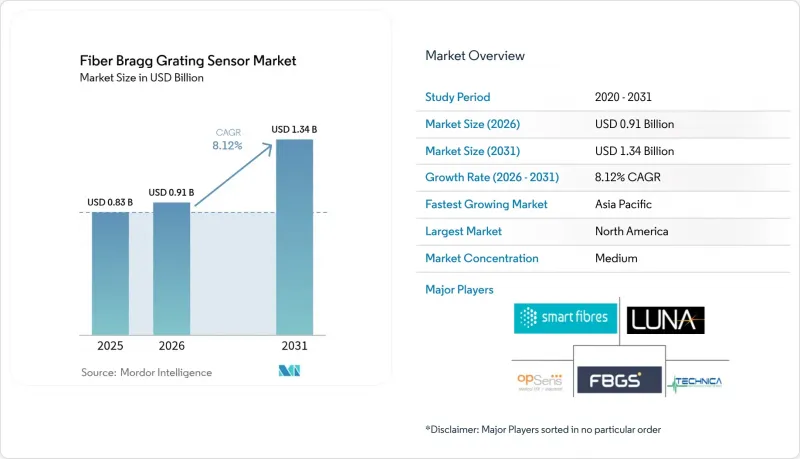
This report is Segmented by Type (Temperature Sensor, Strain Sensor, and More), Grating Wavelength Range (C-Band, L-Band, and More), End-User Industry (Telecommunication, Aerospace and Defense, and More), Application (Structural Health Monitoring, Temperature Monitoring, Vibration and Acoustic Monitoring, and More), and Geography. The Market Forecasts are Provided in Terms of Value (USD).
Global Fiber Bragg Grating Sensor Market Trends and Insights
Growing Demand for Real-Time Structural Health Monitoring
Bridge and tunnel owners retrofit embedded fiber Bragg gratings to continuously measure strain and temperature, replacing manual inspections with 24-hour data streams that extend asset life by up to 20 years. Wind farm operators add arrays inside turbine blades, capturing micro-crack initiation after millions of fatigue cycles and scheduling blade swaps only when analytics flag risk. Fusion-energy laboratories and aerospace test stands select technologies that are immune to magnetic fields and cryogenic temperatures, thereby broadening credibility among high-reliability users. Cloud dashboards and machine-learning anomaly detection convert sensor data into maintenance work orders, shifting revenue toward software subscriptions. Collectively, these dynamics secure a multi-year volume pipeline for the fiber Bragg grating sensor market.
Expansion of 5G Fiber Backhaul Infrastructure
Mobile operators string dense fiber networks to connect more than three million 5G base stations across China, India, South Korea, Europe, and North America. Apodized gratings spliced at distribution nodes detect bending, temperature spikes, and micro-vibrations that jeopardize latency targets, enabling field crews to repair lines before service degradation. Operators increasingly favor L-band gratings for rural backhaul stretches exceeding 80 km, where lower attenuation cuts amplifier count and capital cost. Pilot projects that reuse installed communications fiber for both data and sensing reduce per-kilometer deployment expense by nearly half, accelerating adoption among railways and power utilities . The telecom footprint therefore anchors near-term revenue for the fiber Bragg grating sensor market.
Cross-Sensitivity to Temperature and Strain
A 1 °C thermal change produces a wavelength shift equal to roughly 10 microstrain, forcing installers to pair each active grating with a strain-isolated reference device. Dual-channel configurations raise sensor counts and interrogator complexity by up to 40%, a premium many industrial owners resist. Attempts to solve the issue using software models require historical data that new users rarely have, delaying deployment. Although compensation hardware from leading vendors narrows errors to +-2 microstrain, cross-talk remains a design hurdle that tempers the expansion rate of the fiber Bragg grating sensor market.
Other drivers and restraints analyzed in the detailed report include:
- Rapid Deployment of Distributed Acoustic Sensing in Oil and Gas Pipelines
- Increasing Use in High-Voltage Direct Current Cables
- High Upfront Installation Cost versus Electrical Gauges
For complete list of drivers and restraints, kindly check the Table Of Contents.
Segment Analysis
2025 sales show strain devices controlling 42.21% of the fiber Bragg grating sensor market size, reflecting their role in bridges, wind turbines, and aircraft structures that demand continuous load tracking. Volume remains steady as infrastructure owners mandate embedded monitoring to stretch service life. Acoustic formats, however, will chart a 9.14% CAGR to 2031, outpacing every other category as pipeline and perimeter-security buyers adopt distributed acoustic sensing that turns fiber into a kilometer-scale microphone grid.
Dual-FBG temperature-compensated strain designs push accuracy toward +-2 microstrain, satisfying nuclear, aerospace, and HVDC projects that cannot accommodate calibration shut-downs. Meanwhile, acoustic interrogators now sample at rates beyond 1 MS/s, capturing microseismic precursors in mines and high-frequency crack emissions in composites. This technical leap converts long-tail niche opportunities into scale shipments, lifting the fiber Bragg grating sensor market share of acoustic devices by the end of the forecast window.
C-band sensors accounted for 39.13% of 2025 revenue thanks to compatibility with legacy erbium-doped amplifiers in telecom backbones. Installed gear lowers procurement friction, keeping C-band a staple for operators that already own matching optics. L-band models, however, promise longer reach and greater multiplex density, enabling 600-plus gratings on a single fiber where C-band supports roughly half that figure. The result is an 8.89% CAGR for the L-band slice through 2031.
Greenfield pipeline, railway, and HVDC projects now specify hybrid interrogators capable of reading both C- and L-band, future-proofing investments while easing migration. As unit volumes rise, component prices drop, opening opportunities for mid-tier suppliers and expanding total addressable demand across the fiber Bragg grating sensor market.
Complete Report Scope:
- By Type
- Temperature Sensor
- Strain Sensor
- Pressure Sensor
- Acoustic Sensor
- Other Types
- By Grating Wavelength Range
- C-Band (1530 to 1565 nm)
- L-Band (1565 to1625 nm)
- O-Band (1260 to 1360 nm)
- Other Grating Wavelength Ranges
- By End-User Industry
- Telecommunication
- Aerospace and Defense
- Construction and Infrastructure
- Energy and Power
- Oil and Gas
- Mining
- Other End-User Industries
- By Application
- Structural Health Monitoring
- Temperature Monitoring
- Vibration and Acoustic Monitoring
- Pressure Monitoring
- Load and Weight Monitoring
- Other Applications
- By Geography
- North America
- United States
- Canada
- Mexico
- Europe
- Germany
- United Kingdom
- France
- Russia
- Rest of Europe
- Asia-Pacific
- China
- Japan
- India
- South Korea
- Australia
- Rest of Asia-Pacific
- Middle East
- Saudi Arabia
- United Arab Emirates
- Rest of Middle East
- Africa
- South Africa
- Egypt
- Rest of Africa
- South America
- Brazil
- Argentina
- Rest of South America
- North America
Geography Analysis
North America contributed 34.79% of 2025 sales as defense aircraft, shale pipelines, and aging highway bridges embedded gratings for condition-based oversight. Federal infrastructure grants financed structural retrofits, and the United States Air Force advanced full-fleet sensor integration on composite fighters. Canada's research funding boosted domestic interrogator capability, while Mexican offshore platforms adopted optical arrays to avoid electromagnetic interference from high-voltage equipment.
Asia-Pacific will record the swiftest 9.07% CAGR to 2031. China's multiyear 5G rollout attaches inline fiber monitoring to every new base station, India's metro rail projects hard-wire gratings into tunnels for continuous deformation alerts, and Japan's November 2025 railway pilot showcases cost-saving reuse of existing telecom fiber for vibration surveillance. Technician shortages remain the lone bottleneck, prompting vendors to bundle installation services and remote diagnostic support.
Europe balances mature bridge-monitoring portfolios with forward-looking hydrogen and offshore wind investments. Germany and the Netherlands are laying 1,200 km of hydrogen corridors that specify all-dielectric leak detection, and the North Sea Wind Power Hub will demand thousands of kilometers of HVDC cable carrying embedded gratings for lifetime thermal management. Middle East and African growth clusters around oil and gas, highlighted by Algeria's 14,000 km acoustic pipeline rollout, while South America trails but shows pockets of uptake in Brazilian offshore fields and Argentine shale plays.
- FBGS International NV
- Smart Fibres Ltd
- Luna Innovations Inc. (Micron Optics)
- Technica Optical Components LLC
- Opsens Inc
- Timbercon Inc
- National Instruments Corporation
- Hottinger Bruel & Kjaer HBM Inc
- Broptics Technology Inc
- ITF Technologies Inc
- Advanced Optics Solutions GmbH
- TeraXion Inc
- FISO Technologies Inc
- Optromix Inc
- Shenzhen Fibersail Technology Co Ltd
- Neoptix Inc
- Lightwave Logic Inc
- Smart Sensing Solutions GmbH
- Blue Road Research
- Cinogy Technologies GmbH
Additional Benefits:
- The market estimate (ME) sheet in Excel format
- 3 months of analyst support
TABLE OF CONTENTS
1 INTRODUCTION
- 1.1 Study Assumptions and Market Definition
- 1.2 Scope of the Study
2 RESEARCH METHODOLOGY
3 EXECUTIVE SUMMARY
4 MARKET LANDSCAPE
- 4.1 Market Overview
- 4.2 Market Drivers
- 4.2.1 Growing Demand for Real-Time Structural Health Monitoring
- 4.2.2 Expansion of 5G Fiber Backhaul Infrastructure
- 4.2.3 Rapid Deployment of Distributed Acoustic Sensing in Oil and Gas Pipelines
- 4.2.4 Increasing Use in High-Voltage Direct Current (HVDC) Cables
- 4.2.5 Adoption in Hydrogen Pipeline Networks
- 4.2.6 Defense Focus on Condition-Based Aircraft Maintenance
- 4.3 Market Restraints
- 4.3.1 Cross-Sensitivity to Temperature and Strain
- 4.3.2 High Upfront Installation Cost versus Electrical Gauges
- 4.3.3 Limited Dynamic Range in Ultra-Fast Events
- 4.3.4 Scarcity of Skilled Fiber-Optic Technicians
- 4.4 Industry Value Chain Analysis
- 4.5 Regulatory Landscape
- 4.6 Technological Outlook
- 4.7 Impact of Macroeconomic Factors
- 4.8 Porter's Five Forces Analysis
- 4.8.1 Threat of New Entrants
- 4.8.2 Bargaining Power of Buyers
- 4.8.3 Bargaining Power of Suppliers
- 4.8.4 Threat of Substitute Products
- 4.8.5 Intensity of Competitive Rivalry
5 MARKET SIZE AND GROWTH FORECASTS (VALUE)
- 5.1 By Type
- 5.1.1 Temperature Sensor
- 5.1.2 Strain Sensor
- 5.1.3 Pressure Sensor
- 5.1.4 Acoustic Sensor
- 5.1.5 Other Types
- 5.2 By Grating Wavelength Range
- 5.2.1 C-Band (1530 to 1565 nm)
- 5.2.2 L-Band (1565 to1625 nm)
- 5.2.3 O-Band (1260 to 1360 nm)
- 5.2.4 Other Grating Wavelength Ranges
- 5.3 By End-User Industry
- 5.3.1 Telecommunication
- 5.3.2 Aerospace and Defense
- 5.3.3 Construction and Infrastructure
- 5.3.4 Energy and Power
- 5.3.5 Oil and Gas
- 5.3.6 Mining
- 5.3.7 Other End-User Industries
- 5.4 By Application
- 5.4.1 Structural Health Monitoring
- 5.4.2 Temperature Monitoring
- 5.4.3 Vibration and Acoustic Monitoring
- 5.4.4 Pressure Monitoring
- 5.4.5 Load and Weight Monitoring
- 5.4.6 Other Applications
- 5.5 By Geography
- 5.5.1 North America
- 5.5.1.1 United States
- 5.5.1.2 Canada
- 5.5.1.3 Mexico
- 5.5.2 Europe
- 5.5.2.1 Germany
- 5.5.2.2 United Kingdom
- 5.5.2.3 France
- 5.5.2.4 Russia
- 5.5.2.5 Rest of Europe
- 5.5.3 Asia-Pacific
- 5.5.3.1 China
- 5.5.3.2 Japan
- 5.5.3.3 India
- 5.5.3.4 South Korea
- 5.5.3.5 Australia
- 5.5.3.6 Rest of Asia-Pacific
- 5.5.4 Middle East
- 5.5.4.1 Saudi Arabia
- 5.5.4.2 United Arab Emirates
- 5.5.4.3 Rest of Middle East
- 5.5.5 Africa
- 5.5.5.1 South Africa
- 5.5.5.2 Egypt
- 5.5.5.3 Rest of Africa
- 5.5.6 South America
- 5.5.6.1 Brazil
- 5.5.6.2 Argentina
- 5.5.6.3 Rest of South America
- 5.5.1 North America
6 COMPETITIVE LANDSCAPE
- 6.1 Market Concentration
- 6.2 Strategic Moves
- 6.3 Market Share Analysis
- 6.4 Company Profiles (includes Global level Overview, Market level overview, Core Segments, Financials as available, Strategic Information, Market Rank/Share for key companies, Products and Services, and Recent Developments)
- 6.4.1 FBGS International NV
- 6.4.2 Smart Fibres Ltd
- 6.4.3 Luna Innovations Inc. (Micron Optics)
- 6.4.4 Technica Optical Components LLC
- 6.4.5 Opsens Inc
- 6.4.6 Timbercon Inc
- 6.4.7 National Instruments Corporation
- 6.4.8 Hottinger Bruel & Kjaer HBM Inc
- 6.4.9 Broptics Technology Inc
- 6.4.10 ITF Technologies Inc
- 6.4.11 Advanced Optics Solutions GmbH
- 6.4.12 TeraXion Inc
- 6.4.13 FISO Technologies Inc
- 6.4.14 Optromix Inc
- 6.4.15 Shenzhen Fibersail Technology Co Ltd
- 6.4.16 Neoptix Inc
- 6.4.17 Lightwave Logic Inc
- 6.4.18 Smart Sensing Solutions GmbH
- 6.4.19 Blue Road Research
- 6.4.20 Cinogy Technologies GmbH
7 MARKET OPPORTUNITIES AND FUTURE OUTLOOK
- 7.1 White-Space and Unmet-Need Assessment

