PUBLISHER: Mordor Intelligence | PRODUCT CODE: 2124489

PUBLISHER: Mordor Intelligence | PRODUCT CODE: 2124489
Contact Center Outsourcing - Market Share Analysis, Industry Trends & Statistics, Growth Forecasts (2026 - 2031)
According to Mordor Intelligence, the contact center outsourcing market size is expected to grow from USD 114.98 billion in 2025 to USD 125.73 billion in 2026 and is forecast to reach USD 189.49 billion by 2031 at 8.55% CAGR over 2026-2031.
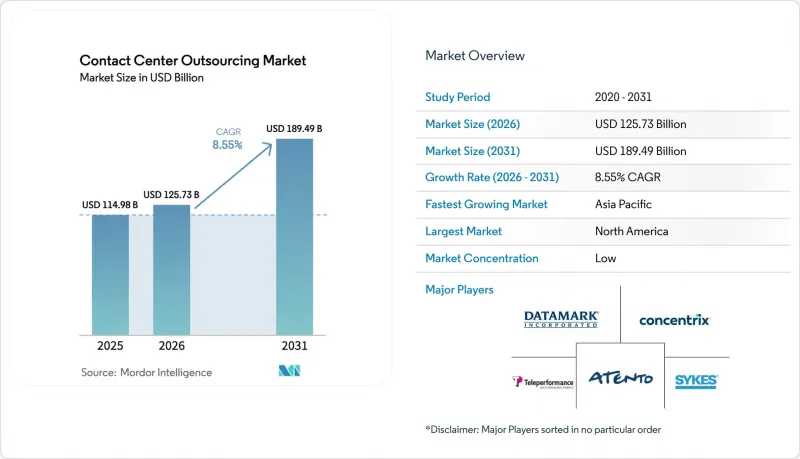
This report is Segmented by Service Type (Voice Onshore, Voice Offshore, and More), End-User Industry (BFSI, Retail, and More), Delivery Model (Onshore, Nearshore, Offshore, and Virtual), Deployment Model (Cloud, On-Premise, Hybrid, and AI-Driven), Interaction Flow (Inbound, Outbound, Omnichannel, and Self-Service), and Geography. The Market Forecasts are Provided in Terms of Value (USD).
Global Contact Center Outsourcing Market Trends and Insights
Cloud Migration and CCaaS Adoption Surge
Contact-center-as-a-service platforms provide elastic capacity, seamless CRM integrations, and out-of-the-box AI components, making them the default architecture for new outsourcing contracts. Multi-year on-premises refresh cycles are giving way to subscription models that cut implementation time from months to weeks. Shorter switching costs intensify competition, so providers respond by embedding proprietary analytics, vertical templates, and outcome-based pricing. As a result, the contact center outsourcing market increasingly rewards technology leadership over seat-count scale.
Digital-First Omni-Channel CX Mandates
Consumers expect effortless transitions across chat, email, voice, and social channels, forcing enterprises to collapse siloed systems into unified customer timelines. Vendors offering pre-integrated omnichannel stacks alleviate the heavy lift of multi-year IT programs, securing stickier contracts in retail, e-commerce, and media. Success is judged on first-contact resolution and customer-effort scores, not channel breadth alone. Providers unable to prove quantifiable gains risk relegation to commodity overflow tasks.
Chronic Agent Attrition and Wage Inflation
Global turnover rates that spiked to near-80% in the immediate post-pandemic period have moderated but remain well above the 30-45% norm, driving up rehiring and training costs. Experienced agents leverage scarcity to negotiate higher pay, squeezing the labour-arbitrage margin that underpinned the first wave of outsourcing. Providers counter with AI-led coaching, flexible scheduling, and career pathways, but these require upfront investment that erodes short-term profitability, especially for thin-margin voice portfolios.
Other drivers and restraints analyzed in the detailed report include:
- Gen-AI Copilots Elevate Agent Productivity
- Near-Shore Talent Scalability in Latin America and Eastern Europe
- Cyber-Security and Privacy Breach Risk
For complete list of drivers and restraints, kindly check the Table Of Contents.
Segment Analysis
Voice support retained 44.01% of the contact center outsourcing market share in 2025 as complex disputes and high-value sales still favour real-time dialogue. The contact center outsourcing market size linked to social-media and messaging channels, however, is projected to post the fastest 8.99% CAGR to 2031 as digital-native customers embrace asynchronous chat that AI bots can resolve without queuing. Vendors integrate chatbots for tier-1 issues and escalate nuanced cases to human agents, blending cost control with empathy.
Email remains a cost-effective workhorse for non-urgent issues, while emerging video and co-browse use cases flourish in wealth management and telehealth. Providers now package unified agent desktops so staff can pivot among voice, chat, and messaging without losing context, a capability that boosts first-contact resolution and earns premium rates. Those still running siloed service lines struggle to win omnichannel bids.
BFSI commanded 21.34% of 2025 revenue, reflecting its long outsourcing history, stringent compliance needs, and high transaction volumes. Growth decelerates as large banks have already externalized most simple interactions, shifting deals toward niche fraud management and wealth-advisory support. In contrast, healthcare and life sciences are forecast for an 8.71% CAGR through 2031 as telehealth, electronic prior authorization, and patient-engagement mandates generate new outsourcing waves.
Vendors invest in HIPAA-compliant infrastructure and nurse-practitioner talent pools to manage triage, scheduling, and benefits verification, unlocking higher margins than voice-only BFSI work. Retail, e-commerce, and technology remain sizeable but competitive, encouraging providers to differentiate through AI-assisted sales enablement and data-driven personalization.
Complete Report Scope:
- By Service Type
- Voice (On-Shore)
- Voice (Off-Shore)
- Email Support
- Chat / Live-Chat Support
- Social-Media and Messaging
- Video and Co-Browse Support
- Self-Service / Bots
- By End-User Industry
- BFSI
- Retail and E-Commerce
- Healthcare and Life Sciences
- IT and Telecom
- Government and Public Sector
- Travel and Hospitality
- Utilities and Energy
- Media and Entertainment
- By Delivery Model (Location)
- On-Shore Outsourcing
- Near-Shore Outsourcing
- Off-Shore Outsourcing
- Virtual / Remote Contact Centers
- By Deployment Model (Technology)
- Cloud-Based Contact Centers
- On-Premise Contact Centers
- Hybrid Contact Centers
- AI-Driven Contact Centers
- By Interaction Flow
- Inbound Services
- Outbound Services
- Omnichannel Communication
- Self-Service and Automation
- By Geography
- North America
- United States
- Canada
- Mexico
- South America
- Brazil
- Colombia
- Europe
- United Kingdom
- Germany
- France
- Spain
- Italy
- Russia
- Asia Pacific
- China
- India
- Japan
- South Korea
- ASEAN
- Rest of Asia Pacific
- Middle East
- Turkey
- UAE
- Saudi Arabia
- Africa
- South Africa
- Rest of Africa
- North America
Geography Analysis
North America generated 37.42% of 2025 revenue, anchored by mature BFSI, healthcare, and technology buyers that insist on multi-site redundancy, ISO certifications, and AI-supported quality assurance. Wage inflation and high turnover encourage nearshoring to Mexico and Colombia, both offering bilingual talent and overlapping time zones. Vendors that weave those nodes into existing Philippine and Indian networks mitigate currency and political risk while accelerating contract wins.
Europe presents a mixed landscape: GDPR drives in-country delivery in Germany and France, whereas nearshore hubs in Poland and Romania satisfy language and compliance needs for U.K. and Nordic buyers at lower cost. Regional cloud-sovereignty initiatives spur investments in local data centers, favouring providers with capital to build or lease secure infrastructure.
Asia Pacific posts the fastest 9.12% CAGR to 2031. India and the Philippines retain scale leadership, adding AI labs and vertical domain academies to defend share. Emerging ASEAN markets such as Vietnam, Thailand, and Malaysia are pulling pilot projects but grapple with infrastructure gaps. China's vast domestic opportunity remains largely closed to foreign vendors, yet multinational clients seek Mandarin support from offshore Thailand and Malaysia operations, hedging geopolitical exposure.
Middle East and Africa grow off a smaller base. Egypt stands out with large-scale trilingual talent and pro-BPO incentives. Concentrix, Foundever, and Alorica have each commissioned multithousand-seat Cairo campuses, citing cost parity with major Indian metros and three-hour proximity to European capitals. South Africa services U.K. and Australian accounts, though power-grid instability limits round-the-clock reliability. Gulf Cooperation Council countries outsource selective citizen-services but often require onshore hosting within national borders.
South America beyond Colombia sees Brazil commanding Portuguese programs for regional banks and e-commerce giants, while Chile and Guatemala court specialized Spanish contact flows. Macroeconomic volatility prompts clients to diversify among at least two Latin American sites, a trend favouring networked providers over single-country specialists.
- Teleperformance SA
- Concentrix Corporation
- Foundever Group SAS
- Alorica Inc.
- TTEC Holdings Inc.
- Atento SA
- Startek Inc.
- Hinduja Global Solutions Ltd.
- Firstsource Solutions Limited
- Datamark Inc.
- TaskUs Inc.
- Wipro Business Process Services Limited
- Tech Mahindra BPS
- Cognizant Digital Operations
- Genpact CX
- Capita PLC
- Comdata Inc.
- Webhelp (Concentrix)
- Alight Solutions, LLC
Additional Benefits:
- The market estimate (ME) sheet in Excel format
- 3 months of analyst support
TABLE OF CONTENTS
1 INTRODUCTION
- 1.1 Study Assumptions and Market Definition
- 1.2 Scope of the Study
2 RESEARCH METHODOLOGY
3 EXECUTIVE SUMMARY
4 MARKET LANDSCAPE
- 4.1 Market Overview
- 4.2 Market Drivers
- 4.2.1 Cloud Migration and CCaaS Adoption Surge
- 4.2.2 Digital-First Omni-Channel CX Mandates
- 4.2.3 Post-Pandemic Cost-to-Serve Pressure
- 4.2.4 Near-Shore Talent Scalability in N. LATAM and E. Europe
- 4.2.5 Gen-AI Copilots Elevate Agent Productivity
- 4.2.6 Sovereign-Cloud and Data-Residency Incentives
- 4.3 Market Restraints
- 4.3.1 Persistent Data-Sovereignty Regulations
- 4.3.2 Cyber-Security and Privacy Breach Risk
- 4.3.3 Chronic Agent Attrition and Wage Inflation
- 4.3.4 Gen-AI Bias, Regulatory and Compliance Liabilities
- 4.4 Impact of Macroeconomic Factors on the Market
- 4.5 Industry Value Chain Analysis
- 4.6 Regulatory Landscape
- 4.7 Technological Outlook
- 4.8 Porter's Five Forces Analysis
- 4.8.1 Threat of New Entrants
- 4.8.2 Bargaining Power of Suppliers
- 4.8.3 Bargaining Power of Buyers
- 4.8.4 Threat of Substitutes
- 4.8.5 Competitive Rivalry
5 MARKET SIZE AND GROWTH FORECASTS (VALUE)
- 5.1 By Service Type
- 5.1.1 Voice (On-Shore)
- 5.1.2 Voice (Off-Shore)
- 5.1.3 Email Support
- 5.1.4 Chat / Live-Chat Support
- 5.1.5 Social-Media and Messaging
- 5.1.6 Video and Co-Browse Support
- 5.1.7 Self-Service / Bots
- 5.2 By End-User Industry
- 5.2.1 BFSI
- 5.2.2 Retail and E-Commerce
- 5.2.3 Healthcare and Life Sciences
- 5.2.4 IT and Telecom
- 5.2.5 Government and Public Sector
- 5.2.6 Travel and Hospitality
- 5.2.7 Utilities and Energy
- 5.2.8 Media and Entertainment
- 5.3 By Delivery Model (Location)
- 5.3.1 On-Shore Outsourcing
- 5.3.2 Near-Shore Outsourcing
- 5.3.3 Off-Shore Outsourcing
- 5.3.4 Virtual / Remote Contact Centers
- 5.4 By Deployment Model (Technology)
- 5.4.1 Cloud-Based Contact Centers
- 5.4.2 On-Premise Contact Centers
- 5.4.3 Hybrid Contact Centers
- 5.4.4 AI-Driven Contact Centers
- 5.5 By Interaction Flow
- 5.5.1 Inbound Services
- 5.5.2 Outbound Services
- 5.5.3 Omnichannel Communication
- 5.5.4 Self-Service and Automation
- 5.6 By Geography
- 5.6.1 North America
- 5.6.1.1 United States
- 5.6.1.2 Canada
- 5.6.1.3 Mexico
- 5.6.2 South America
- 5.6.2.1 Brazil
- 5.6.2.2 Colombia
- 5.6.3 Europe
- 5.6.3.1 United Kingdom
- 5.6.3.2 Germany
- 5.6.3.3 France
- 5.6.3.4 Spain
- 5.6.3.5 Italy
- 5.6.3.6 Russia
- 5.6.4 Asia Pacific
- 5.6.4.1 China
- 5.6.4.2 India
- 5.6.4.3 Japan
- 5.6.4.4 South Korea
- 5.6.4.5 ASEAN
- 5.6.4.6 Rest of Asia Pacific
- 5.6.5 Middle East
- 5.6.5.1 Turkey
- 5.6.5.2 UAE
- 5.6.5.3 Saudi Arabia
- 5.6.6 Africa
- 5.6.6.1 South Africa
- 5.6.6.2 Rest of Africa
- 5.6.1 North America
6 COMPETITIVE LANDSCAPE
- 6.1 Market Concentration
- 6.2 Strategic Moves
- 6.3 Market Share Analysis
- 6.4 Company Profiles (includes Global Level Overview, Market Level Overview, Core Segments, Financials as Available, Strategic Information, Market Rank/Share for Key Companies, Products and Services, and Recent Developments)
- 6.4.1 Teleperformance SA
- 6.4.2 Concentrix Corporation
- 6.4.3 Foundever Group SAS
- 6.4.4 Alorica Inc.
- 6.4.5 TTEC Holdings Inc.
- 6.4.6 Atento SA
- 6.4.7 Startek Inc.
- 6.4.8 Hinduja Global Solutions Ltd.
- 6.4.9 Firstsource Solutions Limited
- 6.4.10 Datamark Inc.
- 6.4.11 TaskUs Inc.
- 6.4.12 Wipro Business Process Services Limited
- 6.4.13 Tech Mahindra BPS
- 6.4.14 Cognizant Digital Operations
- 6.4.15 Genpact CX
- 6.4.16 Capita PLC
- 6.4.17 Comdata Inc.
- 6.4.18 Webhelp (Concentrix)
- 6.4.19 Alight Solutions, LLC
7 MARKET OPPORTUNITIES AND FUTURE OUTLOOK
- 7.1 White-Space and Unmet-Need Assessment

