PUBLISHER: Mordor Intelligence | PRODUCT CODE: 2124505

PUBLISHER: Mordor Intelligence | PRODUCT CODE: 2124505
Cloud Communication Platform - Market Share Analysis, Industry Trends & Statistics, Growth Forecasts (2026 - 2031)
According to Mordor Intelligence, the cloud communication platform market reached USD 23.47 billion in 2026 and, at a 14.22% CAGR, is projected to attain USD 45.63 billion by 2031.
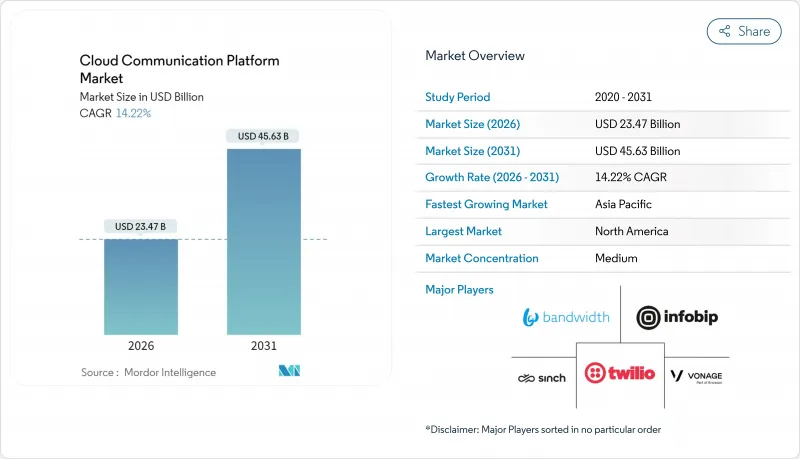
This report is Segmented by Component (Solutions (CPaaS, Ucaas, Webrtc Gateways, Contact-Center APIs), Services (Professional, and Managed Services)), Deployment Type (Public, Private, and Hybrid Cloud), Industry Vertical (IT and Telecom, BFSI, Healthcare, Retail, and More), Enterprise Size (Large Enterprises, and SMEs), and Geography. The Market Forecasts are Provided in Terms of Value (USD).
Global Cloud Communication Platform Market Trends and Insights
Proliferation of CPaaS and Omni-Channel APIs
Enterprises are decomposing legacy contact centers into microservices that orchestrate SMS, WhatsApp, voice, and video through unified APIs, enabling marketing teams to launch campaigns without requiring IT support. No-code workflow builders shorten idea-to-launch cycles from months to days, and retail brands embed click-to-call buttons tied to live inventory feeds, boosting conversion rates. Adoption is highest where pre-built connectors to Salesforce, Shopify, and SAP eliminate the need for custom coding, giving platforms with large integration marketplaces a structural advantage. These omni-channel APIs shift vendor differentiation from raw telephony features toward ecosystem breadth. As a result, the cloud communication platform market rewards providers who cultivate robust developer communities that accelerate time-to-value.
Rapid Adoption of Hybrid and Remote Work Models
Permanent hybrid work policies at 68% of Fortune 500 firms in 2025 fueled migration from VPN-bound softphones to browser-based WebRTC clients that provision voice and video on demand. Microsoft Teams Phone has surpassed 15 million seats by bundling PSTN calling within collaboration workflows, and enterprises are increasingly negotiating usage-based contracts that shift idle-capacity risk to vendors. Security frameworks such as ISO 27001 are now baseline requirements for platforms that must defend home-network endpoints outside corporate firewalls. In turn, platform roadmaps emphasize zero-trust network access and continuous device posture checks. This trend enlarges the cloud communication platform market by converting erstwhile hardware refresh budgets into recurring API consumption.
Data-Security and Privacy Vulnerabilities
The 2024 Snowflake incident exposed call detail records and payment data, driving a 23% spike in cyber-insurance premiums for SaaS providers. Enterprises now demand encryption-at-rest, customer-managed keys, and 24-hour breach notification clauses before signing multi-year API contracts. Microsoft Teams vulnerabilities publicized in 2024 accelerated zero-trust adoption and FedRAMP High certification pursuits among vendors courting U.S. public sector buyers. The result is a flight to platforms that can display third-party attestations, such as SOC 2 Type II and FIPS 140-2 validation, pushing smaller providers toward consolidation.
Other drivers and restraints analyzed in the detailed report include:
- Edge Computing-Enabled Ultra-Low-Latency Experiences
- 5G Stand-Alone Network Slicing for QoS-Critical Traffic
- Fragmented Cross-Border Telecommunications Regulation
For complete list of drivers and restraints, kindly check the Table Of Contents.
Segment Analysis
Solutions controlled 66.78% of 2025 revenue, yet Professional and Managed Services are growing at a 15.80% CAGR, as migrating legacy PBX estates and integrating communication APIs into CRM workflows demand specialist skills. Financial institutions complying with MiFID II call-recording rules and healthcare providers adhering to HIPAA increasingly outsource architecture design and uptime monitoring. CPaaS usage minutes surpassed 1.2 trillion in 2025, marking a significant shift from desk phones to event-driven communications. Contact-center APIs that unify transcribed voice, chat, and email streams lower average handle time, attracting enterprises seeking operational efficiencies.
The consumption-based pricing inherent to CPaaS reduces capex yet raises integration workload, so vendors bundle consulting, migration, and optimization into recurring packages. Mid-market firms lacking DevOps staff lean on managed services partners that monitor API latency and handle carrier interconnects. Consequently, service providers that certify engineers on multiple ecosystems, such as Salesforce, SAP, and Epic, differentiate themselves in the cloud communication platform market, while pure software margins compress as functionality becomes commoditized.
Public Cloud accounted for 72.59% of 2025 deployment revenue as enterprises prized agility and limitless scaling. However, Hybrid Cloud is advancing at a 15.30% CAGR because BFSI workloads demand sub-10 millisecond round-trip times that public regions cannot always guarantee. Hybrid setups keep signaling servers on-premises while routing analytics and storage to the cloud, blending control with elasticity. Microsoft's Sovereign Cloud regions promise EU residency for recordings and transcripts, exemplifying localization tactics that win public-sector deals.
Private Cloud persists in defense agencies requiring air-gapped environments, yet its share diminishes as zero-trust overlays prove adequate for many confidential workloads. Smaller CPaaS vendors strike alliances with regional infrastructure providers to deliver local hosting without building data centers, trading gross margin for geographic reach. Hybrid adoption is therefore a permanent posture rather than a migration waypoint, expanding the cloud communication platform market size for orchestration and observability tools that span mixed estates.
Complete Report Scope:
- By Component
- Solutions
- Communications Platform as a Service (CPaaS)
- Unified Communications as a Service (UCaaS)
- WebRTC Gateways
- Contact-Center APIs
- Services
- Professional Services
- Managed Services
- Solutions
- By Deployment Type
- Public Cloud
- Private Cloud
- Hybrid Cloud
- By Industry Vertical
- Information Technology and Telecommunications
- Banking, Financial Services and Insurance
- Healthcare
- Retail and E-Commerce
- Government and Public Sector
- Manufacturing
- Travel and Hospitality
- Education
- By Enterprise Size
- Large Enterprises
- Small and Medium-Sized Enterprises
- By Geography
- North America
- United States
- Canada
- Mexico
- South America
- Brazil
- Argentina
- Rest of South America
- Europe
- United Kingdom
- Germany
- France
- Italy
- Spain
- Benelux
- Nordics
- Russia
- Rest of Europe
- Asia-Pacific
- China
- Japan
- India
- South Korea
- Australia and New Zealand
- Southeast Asian Nations
- Rest of Asia-Pacific
- Middle East
- Saudi Arabia
- United Arab Emirates
- Qatar
- Kuwait
- Turkey
- Rest of Middle East
- Africa
- South Africa
- Nigeria
- Kenya
- Egypt
- Rest of Africa
- North America
Geography Analysis
North America accounted for 38.47% of the 2025 global revenue, driven by Fortune 500 UCaaS migrations and substantial venture funding for contact-center-as-a-service startups. U.S. enterprises retired Avaya and Cisco PBXs to cut capex and accommodate remote workers, while Canada's bilingual mandates spurred demand for dual-language IVR and agent routing. Mexico's nearshore BPO sector captured Spanish-language traffic from U.S. retailers seeking cost-effective yet culturally aligned support, further enlarging the regional cloud communication platform market.
The Asia-Pacific region is forecast to grow at a 15.00% CAGR through 2031, driven by India's USD 1.2 billion Digital India broadband program and China's data localization statutes, which bifurcate domestic and multinational platform choices. India's blockchain-based call authentication mandate pushed vendors to integrate distributed ledgers, lengthening time-to-market but raising trust. Southeast Asia leapfrogged fixed telephony by transacting directly over WhatsApp Business APIs, with conversational commerce normalizing end-to-end ordering inside chat threads. Japan and South Korea are leading 5G slicing pilots that ensure call quality for telemedicine and factory automation, expanding the cloud communication platform market into latency-critical scenarios.
Europe's uptake is moderated by fragmented numbering and lawful-intercept rules that force country-specific deployments. Post-Brexit divergence introduced a separate UK data-protection regime, complicating the rollouts of transatlantic platforms. Germany's strict GDPR interpretation initially slowed the adoption of AI voice analytics until vendors implemented explicit dual-party consent flows. France and Italy are digitizing their citizen hotlines, while Saudi Arabia and the United Arab Emirates are mandating omnichannel government services under their national digital agendas. Africa's growth centers on SMS and USSD engagement in markets with sporadic broadband, whereas Brazil's interconnection fee hike favored domestic carriers, tilting South American market economics toward local providers.
- Twilio Inc.
- Vonage Holdings Corp.
- Cisco Systems Inc.
- 8x8 Inc.
- Sinch AB
- Infobip Ltd.
- Bandwidth Inc.
- RingCentral Inc.
- Amazon Web Services Inc.
- Microsoft Corp.
- Google LLC
- Mitel Networks Corp.
- Avaya Holdings Corp.
- NetFortris Inc.
- West IP Communications Inc.
- Telestax Inc.
- Plivo Inc.
- CallFire Inc.
- Ozonetel Communications Pvt. Ltd.
- MessageBird B.V.
- Telnyx LLC
Additional Benefits:
- The market estimate (ME) sheet in Excel format
- 3 months of analyst support
TABLE OF CONTENTS
1 INTRODUCTION
- 1.1 Study Assumptions and Market Definition
- 1.2 Scope of the Study
2 RESEARCH METHODOLOGY
3 EXECUTIVE SUMMARY
4 MARKET LANDSCAPE
- 4.1 Market Overview
- 4.2 Market Drivers
- 4.2.1 Proliferation of CPaaS and Omni-Channel APIs
- 4.2.2 Rapid Adoption of Hybrid and Remote Work Models
- 4.2.3 Growing Bring-Your-Own-Device Culture in Enterprises
- 4.2.4 Edge Computing-Enabled Ultra-Low-Latency Customer Experiences
- 4.2.5 5G Stand-Alone Network Slicing for QoS-Critical Traffic
- 4.2.6 Artificial Intelligence-Driven Voice Biometrics for Compliance
- 4.3 Market Restraints
- 4.3.1 Data-Security and Privacy Vulnerabilities
- 4.3.2 Fragmented Cross-Border Telecommunications Regulation
- 4.3.3 Emergence of Private 5G Networks Diluting Cloud Reliance
- 4.3.4 Carbon-Footprint Scrutiny on Hyperscale Data Centers
- 4.4 Industry Value Chain Analysis
- 4.5 Regulatory Landscape
- 4.6 Technological Outlook
- 4.7 Impact of Macroeconomic Factors on the Market
- 4.8 Porter's Five Forces Analysis
- 4.8.1 Bargaining Power of Suppliers
- 4.8.2 Bargaining Power of Buyers
- 4.8.3 Threat of New Entrants
- 4.8.4 Threat of Substitutes
- 4.8.5 Intensity of Competitive Rivalry
5 MARKET SIZE AND GROWTH FORECASTS (VALUE)
- 5.1 By Component
- 5.1.1 Solutions
- 5.1.1.1 Communications Platform as a Service (CPaaS)
- 5.1.1.2 Unified Communications as a Service (UCaaS)
- 5.1.1.3 WebRTC Gateways
- 5.1.1.4 Contact-Center APIs
- 5.1.2 Services
- 5.1.2.1 Professional Services
- 5.1.2.2 Managed Services
- 5.1.1 Solutions
- 5.2 By Deployment Type
- 5.2.1 Public Cloud
- 5.2.2 Private Cloud
- 5.2.3 Hybrid Cloud
- 5.3 By Industry Vertical
- 5.3.1 Information Technology and Telecommunications
- 5.3.2 Banking, Financial Services and Insurance
- 5.3.3 Healthcare
- 5.3.4 Retail and E-Commerce
- 5.3.5 Government and Public Sector
- 5.3.6 Manufacturing
- 5.3.7 Travel and Hospitality
- 5.3.8 Education
- 5.4 By Enterprise Size
- 5.4.1 Large Enterprises
- 5.4.2 Small and Medium-Sized Enterprises
- 5.5 By Geography
- 5.5.1 North America
- 5.5.1.1 United States
- 5.5.1.2 Canada
- 5.5.1.3 Mexico
- 5.5.2 South America
- 5.5.2.1 Brazil
- 5.5.2.2 Argentina
- 5.5.2.3 Rest of South America
- 5.5.3 Europe
- 5.5.3.1 United Kingdom
- 5.5.3.2 Germany
- 5.5.3.3 France
- 5.5.3.4 Italy
- 5.5.3.5 Spain
- 5.5.3.6 Benelux
- 5.5.3.7 Nordics
- 5.5.3.8 Russia
- 5.5.3.9 Rest of Europe
- 5.5.4 Asia-Pacific
- 5.5.4.1 China
- 5.5.4.2 Japan
- 5.5.4.3 India
- 5.5.4.4 South Korea
- 5.5.4.5 Australia and New Zealand
- 5.5.4.6 Southeast Asian Nations
- 5.5.4.7 Rest of Asia-Pacific
- 5.5.5 Middle East
- 5.5.5.1 Saudi Arabia
- 5.5.5.2 United Arab Emirates
- 5.5.5.3 Qatar
- 5.5.5.4 Kuwait
- 5.5.5.5 Turkey
- 5.5.5.6 Rest of Middle East
- 5.5.6 Africa
- 5.5.6.1 South Africa
- 5.5.6.2 Nigeria
- 5.5.6.3 Kenya
- 5.5.6.4 Egypt
- 5.5.6.5 Rest of Africa
- 5.5.1 North America
6 COMPETITIVE LANDSCAPE
- 6.1 Market Concentration
- 6.2 Strategic Moves and Funding Landscape
- 6.3 Market Share Analysis
- 6.4 Company Profiles (Includes Global Level Overview, Market Level Overview, Core Segments, Financials as Available, Strategic Information, Market Rank/Share for Key Companies, Products and Services, and Recent Developments)
- 6.4.1 Twilio Inc.
- 6.4.2 Vonage Holdings Corp.
- 6.4.3 Cisco Systems Inc.
- 6.4.4 8x8 Inc.
- 6.4.5 Sinch AB
- 6.4.6 Infobip Ltd.
- 6.4.7 Bandwidth Inc.
- 6.4.8 RingCentral Inc.
- 6.4.9 Amazon Web Services Inc.
- 6.4.10 Microsoft Corp.
- 6.4.11 Google LLC
- 6.4.12 Mitel Networks Corp.
- 6.4.13 Avaya Holdings Corp.
- 6.4.14 NetFortris Inc.
- 6.4.15 West IP Communications Inc.
- 6.4.16 Telestax Inc.
- 6.4.17 Plivo Inc.
- 6.4.18 CallFire Inc.
- 6.4.19 Ozonetel Communications Pvt. Ltd.
- 6.4.20 MessageBird B.V.
- 6.4.21 Telnyx LLC
7 MARKET OPPORTUNITIES AND FUTURE OUTLOOK
- 7.1 White-Space and Unmet-Need Assessment

