PUBLISHER: Mordor Intelligence | PRODUCT CODE: 2124512

PUBLISHER: Mordor Intelligence | PRODUCT CODE: 2124512
Digital Assurance - Market Share Analysis, Industry Trends & Statistics, Growth Forecasts (2026 - 2031)
According to Mordor Intelligence, the digital assurance market size is expected to grow from USD 5.46 billion in 2025 to USD 6.14 billion in 2026 and is forecast to reach USD 11.04 billion by 2031 at 12.46% CAGR over 2026-2031.
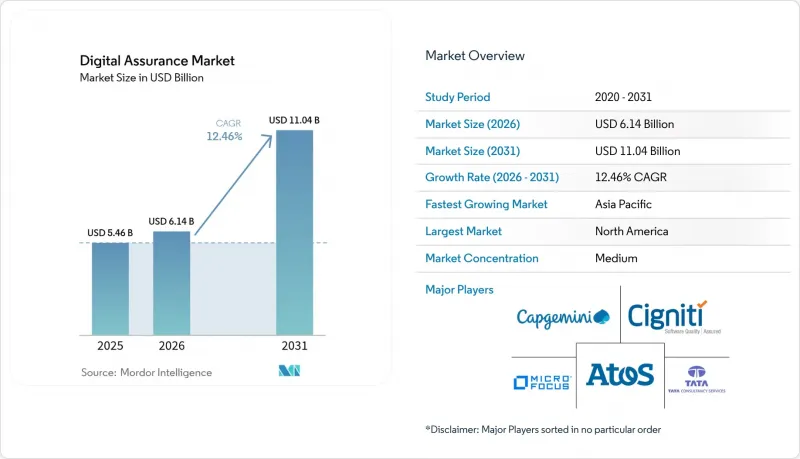
This report is Segmented by Testing Type (Functional Testing, AI-Augmented Testing and More), Testing Mode (Manual Testing Deployment, Test Automation Deployment), Service Model (Managed Testing Services, and More), End-User Vertical (BFSI, and More), Organization Size (Small and Mid-Sized Enterprises, and Large Enterprises), and Geography. The Market Forecasts are Provided in Terms of Value (USD).
Global Digital Assurance Market Trends and Insights
Surging Adoption of AI-Augmented Test Frameworks
Enterprises are embracing AI-enhanced testing suites that generate cases from user stories, self-heal scripts and surface defect probability scores in real time. Commercial platforms report AI functions trimming execution time by 40% and boosting defect discovery in early-stage builds. Adoption accelerated once generative models matured enough to translate plain-language requirements into runnable scripts, replacing days of manual authoring. Early movers accumulate proprietary training data that improves pattern recognition, raising a competitive barrier for late adopters. The scaling effect is most visible in regulated sectors where predictive analytics prevent outages that might trigger fines or brand damage. Vendors also bundle visual-comparison AI and autonomous accessibility checks, broadening use cases without inflating tool count for clients.
Rising DevOps and CI/CD Penetration Across All Verticals
Continuous integration and delivery pipelines are now mainstream, with 89% of medium-to-large organisations using CI tooling; however, nearly half still launch tests manually, revealing a sizeable automation headroom. Embedding test suites directly into the commit-to-deploy flow collapses feedback loops and curtails rework, which in turn compresses release cycles. Highly regulated industries adopt DevOps to capture granular audit trails automatically rather than through laborious documentation. Tool vendors consequently add security-scan, performance-baseline and compliance-evidence modules that activate at each pipeline stage. The convergence of development and operations thus extends assurance beyond pre-production into live observability, stimulating demand for unified dashboards that correlate defects, logs and user experience metrics.
Scarcity of SDET and QE Talent, Wage Inflation
Demand for hybrid testers who understand coding, pipelines and machine-learning is outstripping supply, pushing total compensation for senior SDETs beyond USD 225,000 in major US metros. Smaller firms struggle to match packages that include retention bonuses and dedicated upskilling budgets. The gap forces project delays, narrows test coverage and occasionally shifts release strategies toward feature flagging and incremental rollouts to limit exposure. Several providers respond by embedding low-code scripting engines that let domain experts craft tests without deep coding, but complex scenarios still need seasoned engineers.
Other drivers and restraints analyzed in the detailed report include:
- Mandatory API-Level Monitoring for Digital-Economy Platforms
- Budget re-allocation from legacy QA to autonomous testing bots
- Escalating Test-Tool License Costs for Gen-AI Add-ons
For complete list of drivers and restraints, kindly check the Table Of Contents.
Segment Analysis
Functional testing retained a 33.40% revenue contribution in 2025, underscoring its centrality in verifying base business logic across web, mobile and API layers. Within that same year, AI-augmented testing carved out the fastest path forward at an 17.98% projected CAGR, fuelled by self-learning algorithms that repair object locators and prioritise high-risk paths automatically. Consequently, the digital assurance market size attributed to AI-augmented testing is set to surpass USD 3.08 billion by 2031. Performance and usability testing is also in demand as milliseconds of latency routinely translate into conversion gains or churn in consumer apps. Security testing climbs due to broader vulnerability mandates, while API testing rides the microservices wave, expanding coverage from REST to GraphQL and gRPC.
Network testing gains strategic weight where edge computing dictates sub-10 ms round-trip time. The segment now incorporates traffic-shaping bots that emulate 5G handovers and satellite links in real time. Hybrid frameworks blur historical silos: functional suites absorb AI analytics, and performance harnesses neural network models that forecast capacity thresholds. This convergence reshapes hiring profiles toward T-shaped engineers comfortable with Python, Kubernetes and data science. Despite skill headwinds, vendors that provide intuitive IDE-style interfaces lower entry barriers, expanding total addressable testers beyond traditional QA departments.
Manual testing deployment still accounts for 57.20% of 2025 revenue because exploratory scenarios require human intuition, especially around visual aesthetics and accessibility nuances. Yet test-automation deployment rises at a 17.05% CAGR and is projected to command over 50% of the digital assurance market by 2029. Automation thrives where CI/CD maturation obliges every commit to trigger suites across browser matrices and device farms. AI bolsters the trend through self-healing scripts that cut maintenance labour and by clustering flaky tests for rapid triage.
Organisations, however, seldom pursue a zero-manual ideal. Instead, they orchestrate hybrid pipelines where bots cover regression and smoke tests while experienced analysts examine edge cases, compliance narratives and user empathy paths. The shift reshapes talent planning: junior manual testers transition to automation engineering, while domain experts become "quality advocates" embedded within product squads. Vendors differentiate through low-code record-and-playback augmented by AI-generated assertions, giving non-programmers a route to automation without steep learning curves.
Complete Report Scope:
- By Testing Type
- Performance and Usability Testing
- Security Testing
- API Testing
- Network Testing
- By Testing Mode
- Manual Testing Deployment
- Test Automation Deployment
- By Service Model
- Consulting and Advisory
- Managed Testing Services
- Platform-based QA-as-a-Service
- Crowd-sourced Testing
- By End-user Vertical
- Government
- Banking, Financial Services and Insurance
- Healthcare and Life Sciences
- Manufacturing
- IT and Telecommunications
- Media and Entertainment
- Other End-user Vertical
- By Organisation Size
- Small and Mid-sized Enterprises
- Large Enterprises
- By Geography
- North America
- United States
- Canada
- Europe
- Germany
- United Kingdom
- France
- Russia
- Asia-Pacific
- China
- Japan
- India
- South Korea
- South America
- Brazil
- Argentina
- Middle East and Africa
- Middle East
- Saudi Arabia
- United Arab Emirates
- Rest of Middle East
- Africa
- South Africa
- Egypt
- Rest of Africa
- Middle East
- North America
Geography Analysis
North America contributed 40.40% of 2025 revenue thanks to early AI-test framework adoption, PCI DSS 4.0 enforcement and an ecosystem of hyperscale cloud providers that embed testing marketplaces in their consoles. Regulatory expectations around auditability in healthcare and finance magnify spending, while venture capital clustering in Silicon Valley spawns AI-native testing start-ups that push innovation cycles faster. Talent shortages, however, inflate wage bills and limit capacity expansion in Tier-1 cities.
Asia-Pacific is the clear growth engine at 17.40% CAGR through 2031. Massive 5G roll-out in South Korea and Japan, India's Digital Public Infrastructure stack and aggressive mobile-first commerce in Southeast Asia all compound demand. Enterprises favour cloud region local-isation to respect data-sovereignty rules such as India's DPDP Act, which in turn prompts localised test clouds. The region also benefits from a deep STEM talent pool, enabling service providers to scale automation practices at costs 20-30% lower than US benchmarks.
Europe observes steady momentum under the twin pillars of GDPR and the Digital Operational Resilience Act. These regulations oblige continuous validation of data-handling controls and operational continuity, steering budgets toward traceable, risk-based testing. Fragmented national rules, however, mean vendors must tailor artefacts to multiple regulators, raising compliance overhead. Edge cases such as Brexit further complicate cross-border data flows, requiring geo-fencing and synthetic-data techniques for UK-EU deployments.
South America and the Middle East and Africa exhibit selective growth, led by Brazil's e-commerce boom and Gulf smart-city programmes, respectively. While smaller in absolute dollars, these regions represent greenfield opportunities where cloud leapfrogging bypasses legacy QA tooling in favour of modern SaaS stacks. Providers that calibrate price points and language support for local realities gain early-mover advantage.
- Accenture plc
- Tata Consultancy Services Ltd.
- Capgemini SE
- Cognizant Technology Solutions Corp.
- Wipro Ltd.
- Atos SE
- DXC Technology Co.
- Hexaware Technologies Ltd.
- Cigniti Technologies Ltd.
- Software Quality Systems AG
- OpenText Corp. (Micro Focus UFT)
- EPAM Systems Inc.
- Qualitest Group Ltd.
- Infosys Ltd.
- HCL Tech Ltd.
- IBM Consulting
- Keysight Technologies Inc.
- Tricentis GmbH
- Katalon Inc.
- Applause App Quality Inc.
Additional Benefits:
- The market estimate (ME) sheet in Excel format
- 3 months of analyst support
TABLE OF CONTENTS
1 INTRODUCTION
- 1.1 Study Assumptions and Market Definition
- 1.2 Scope of the Study
2 RESEARCH METHODOLOGY
3 EXECUTIVE SUMMARY
4 MARKET LANDSCAPE
- 4.1 Market Overview
- 4.2 Market Drivers
- 4.2.1 Surging Adoption Of AI-Augmented Test Frameworks
- 4.2.2 Rising DevOps and CI/CD Penetration Across All Verticals
- 4.2.3 Mandatory API-Level Monitoring for Digital Economy Platforms
- 4.2.4 Budget Re-Allocation from Legacy QA to Autonomous Testing Bots
- 4.2.5 Edge and 5G Rollouts Demanding Ultra-Low-Latency Assurance
- 4.2.6 "Shift-Left" Security Mandates in Regulated Industries
- 4.3 Market Restraints
- 4.3.1 Scarcity Of SDET And QE Talent, Wage Inflation
- 4.3.2 Escalating Test-Tool Licence Costs for Gen-AI Add-Ons
- 4.3.3 Data-Sovereignty Limits on Offshore Test Centres
- 4.3.4 AI-Generated Code Unpredictability Increases Defect Noise
- 4.4 Industry Value/Supply-Chain Analysis
- 4.5 Regulatory Landscape
- 4.6 Technological Outlook
- 4.7 Porter's Five Forces Analysis
- 4.7.1 Threat of New Entrants
- 4.7.2 Bargaining Power of Consumers
- 4.7.3 Bargaining Power of Suppliers
- 4.7.4 Threat of Substitutes
- 4.7.5 Intensity of Competitive Rivalry
5 MARKET SIZE AND GROWTH FORECASTS (VALUE)
- 5.1 By Testing Type
- 5.1.1 Performance and Usability Testing
- 5.1.2 Security Testing
- 5.1.3 API Testing
- 5.1.4 Network Testing
- 5.2 By Testing Mode
- 5.2.1 Manual Testing Deployment
- 5.2.2 Test Automation Deployment
- 5.3 By Service Model
- 5.3.1 Consulting and Advisory
- 5.3.2 Managed Testing Services
- 5.3.3 Platform-based QA-as-a-Service
- 5.3.4 Crowd-sourced Testing
- 5.4 By End-user Vertical
- 5.4.1 Government
- 5.4.2 Banking, Financial Services and Insurance
- 5.4.3 Healthcare and Life Sciences
- 5.4.4 Manufacturing
- 5.4.5 IT and Telecommunications
- 5.4.6 Media and Entertainment
- 5.4.7 Other End-user Vertical
- 5.5 By Organisation Size
- 5.5.1 Small and Mid-sized Enterprises
- 5.5.2 Large Enterprises
- 5.6 By Geography
- 5.6.1 North America
- 5.6.1.1 United States
- 5.6.1.2 Canada
- 5.6.2 Europe
- 5.6.2.1 Germany
- 5.6.2.2 United Kingdom
- 5.6.2.3 France
- 5.6.2.4 Russia
- 5.6.3 Asia-Pacific
- 5.6.3.1 China
- 5.6.3.2 Japan
- 5.6.3.3 India
- 5.6.3.4 South Korea
- 5.6.4 South America
- 5.6.4.1 Brazil
- 5.6.4.2 Argentina
- 5.6.5 Middle East and Africa
- 5.6.5.1 Middle East
- 5.6.5.1.1 Saudi Arabia
- 5.6.5.1.2 United Arab Emirates
- 5.6.5.1.3 Rest of Middle East
- 5.6.5.2 Africa
- 5.6.5.2.1 South Africa
- 5.6.5.2.2 Egypt
- 5.6.5.2.3 Rest of Africa
- 5.6.5.1 Middle East
- 5.6.1 North America
6 COMPETITIVE LANDSCAPE
- 6.1 Strategic Moves
- 6.2 Market Share Analysis
- 6.3 Company Profiles (includes Global level Overview, Market level overview, Core Segments, Financials as available, Strategic Information, Market Rank/Share for key companies, Products and Services, and Recent Developments)
- 6.3.1 Accenture plc
- 6.3.2 Tata Consultancy Services Ltd.
- 6.3.3 Capgemini SE
- 6.3.4 Cognizant Technology Solutions Corp.
- 6.3.5 Wipro Ltd.
- 6.3.6 Atos SE
- 6.3.7 DXC Technology Co.
- 6.3.8 Hexaware Technologies Ltd.
- 6.3.9 Cigniti Technologies Ltd.
- 6.3.10 Software Quality Systems AG
- 6.3.11 OpenText Corp. (Micro Focus UFT)
- 6.3.12 EPAM Systems Inc.
- 6.3.13 Qualitest Group Ltd.
- 6.3.14 Infosys Ltd.
- 6.3.15 HCL Tech Ltd.
- 6.3.16 IBM Consulting
- 6.3.17 Keysight Technologies Inc.
- 6.3.18 Tricentis GmbH
- 6.3.19 Katalon Inc.
- 6.3.20 Applause App Quality Inc.
7 MARKET OPPORTUNITIES AND FUTURE OUTLOOK
- 7.1 White-space and Unmet-need Assessment

