PUBLISHER: Mordor Intelligence | PRODUCT CODE: 2124516

PUBLISHER: Mordor Intelligence | PRODUCT CODE: 2124516
Continuous Integration Tools - Market Share Analysis, Industry Trends & Statistics, Growth Forecasts (2026 - 2031)
According to Mordor Intelligence, the continuous integration tools market size was valued at USD 1.73 billion in 2025 and estimated to grow from USD 2.09 billion in 2026 to reach USD 5.36 billion by 2031, at a CAGR of 20.72% during the forecast period (2026-2031).
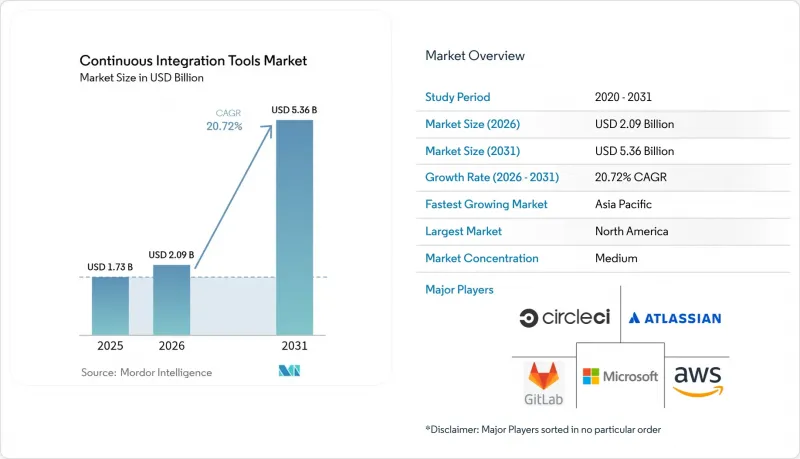
This report is Segmented by Deployment Type (On-Premise, Cloud-Native SaaS, and Hybrid), Organization Size (Large Enterprise, and Small and Medium Enterprise), End-User Industry (IT and Telecom, BFSI, Retail and E-Commerce, and More), Application Stage (Build Automation, Testing Automation, Release and Deployment, and More), and Geography. The Market Forecasts are Provided in Terms of Value (USD).
Global Continuous Integration Tools Market Trends and Insights
Growing DevOps adoption and need for shorter release cycles
Enterprises are rearchitecting their delivery pipelines to match cloud-native competitors that deploy dozens of times a day. An IBM 2024 survey reveals that 83% of executives rank modernization as a top priority, yet only 27% have completed the transition . That execution gap fuels sustained investment in platforms that collapse build, test, and deploy into a single automated workflow. Integrated tool chains also reduce handoffs, eliminating latency caused by point solutions. Consequently, vendors offering consolidated suites are steadily displacing standard-built servers in the continuous integration tools market.
Rising cloud-native software development
The global stock of cloud-native applications is expected to hit 750 million by 2025. Containerized microservices require CI/CD pipelines that can orchestrate concurrent builds, dynamic test environments, and GitOps-style deployments. Legacy solutions, such as self-hosted Jenkins, rely on plugins to meet those needs, creating additional maintenance overhead. Enterprises therefore gravitate toward offerings with native Kubernetes integration and multi-cloud support, reinforcing hybrid and SaaS models inside the continuous integration tools market.
Skill shortages in CI/CD platform engineering
The demand for personnel who can script pipelines, secure Kubernetes clusters, and manage GitOps deployments exceeds the supply, driving hiring delays and increased consulting fees. The scarcity elevates the total cost of ownership and slows adoption timelines. Vendors respond with low-code pipeline designers and managed services that reduce the need for in-house expertise. Still, the talent gap hinders the adoption velocity of continuous integration tools in complex enterprise environments.
Other drivers and restraints analyzed in the detailed report include:
- AI-assisted coding increases build frequency
- Expansion of remote/hybrid work models
- Legacy toolchain complexity and migration costs
For complete list of drivers and restraints, kindly check the Table Of Contents.
Segment Analysis
Cloud-native SaaS deployment retained revenue as it removes infrastructure maintenance and accelerates onboarding. Hybrid deployment, however, is forecast to log the highest 15.52% CAGR, underscoring that regulated buyers want local control over sensitive workloads. The continuous integration tools market size for hybrid implementations is projected to expand sharply as vendors roll out flexible deployment blueprints that mirror zero-trust recommendations from NIST.SP 800-204D. SaaS providers that incorporate private-agent execution or customer-managed encryption keys address compliance barriers without compromising the usability edge that originally drove cloud adoption.
Enterprises increasingly adopt a "best of both" stance, hosting build workers on-premise while leveraging cloud dashboards for visibility and analytics. This architecture limits data egress yet preserves elastic scaling for burst workloads, a balance that resonates within the continuous integration tools market. Vendors able to synchronize artifact stores, secrets management, and policy enforcement across environments are emerging as preferred partners.
Large enterprises currently hold 60.58% revenue share, reflecting their historical lead in DevOps maturity and resource availability. Nonetheless, the continuous integration tools market size attributed to small and medium enterprises is rising quickly due to the affordability of consumption-based pricing and freemium tiers. CircleCI's entry-level plans at USD 360 per seat illustrate low barriers for start-ups. As SMEs scale, they naturally grow usage hours, boosting vendor recurring revenue.
The democratization trend broadens the customer base and pushes vendors to streamline onboarding with opinionated templates, automated governance, and embedded security scanning. Those improvements also benefit large organizations seeking to reduce internal overhead, creating a virtuous cycle that underpins the expansion of the continuous integration tools market.
Complete Report Scope:
- By Deployment Type
- On-premise
- Cloud-native SaaS
- Hybrid
- By End-user Enterprise Size
- Large Enterprises
- Small and Medium Enterprises (SMEs)
- By Application Stage
- Build Automation
- Testing Automation
- Release and Deployment
- Monitoring and Feedback
- By End-User Industry
- IT and Telecom
- BFSI
- Retail and E-commerce
- Healthcare and Life Sciences
- Media and Entertainment
- Education
- Manufacturing
- Government and Public Sector
- By Geography
- North America
- United States
- Canada
- Mexico
- Europe
- Germany
- United Kingdom
- France
- Russia
- Rest of Europe
- Asia-Pacific
- China
- Japan
- India
- South Korea
- Australia
- Rest of Asia-Pacific
- Middle East and Africa
- Middle East
- Saudi Arabia
- United Arab Emirates
- Rest of Middle East
- Africa
- South Africa
- Egypt
- Rest of Africa
- Middle East
- South America
- Brazil
- Argentina
- Rest of South America
- North America
Geography Analysis
North America contributes 36.05% revenue, fueled by deep DevOps penetration, venture capital, and defense procurement that now requires SBOM reporting. U.S. enterprises prefer comprehensive suites that combine CI, CD, security scanning, and infrastructure provisioning, reinforcing platform consolidation in the continuous integration tools market. Canada and Mexico provide supplemental growth through near-shoring initiatives and cloud adoption among mid-sized manufacturers.
The Asia-Pacific region is projected to experience the fastest growth, with a 14.32% CAGR. Government incentives in India, South Korea, and Singapore subsidize cloud migration; however, data-localization laws prompt buyers to opt for hybrid deployments. China's preference for private-cloud AI models aligns with on-premise runners managed from hosted control planes, opening an avenue for flexible vendors. CERT-In's 2024 SBOM mandate likewise drives demand for compliance automation across India.
Europe maintains steady momentum underpinned by GDPR and the forthcoming EU Cyber Resilience Act, both of which elevate supply-chain security requirements. Buyers validate solutions that can guarantee data residency and produce automated audit trails, steering budget toward providers with regional hosting and encryption certificates. Germany, France, and the United Kingdom remain the largest contributors, while Scandinavian and Eastern European countries represent expanding greenfield demand in the continuous integration tools market.
- Atlassian Corporation Plc
- Amazon Web Services, Inc. (AWS)
- Microsoft Corporation (Azure DevOps and GitHub)
- GitLab Inc.
- Circle Internet Services, Inc. (CircleCI)
- CloudBees, Inc.
- JetBrains s.r.o.
- IBM Corporation
- Micro Focus International Plc (OpenText)
- Buddy Works sp. z o.o. sp. k.
- Thoughtworks, Inc.
- Travis CI GmbH
- CodeShip GmbH
- Bitrise Ltd.
- Harness Inc.
- Buildkite Pty Ltd.
- Semaphore (Rendered Text d.o.o.)
- Drone.io (Harness)
- AppVeyor Systems Inc.
- SUSE LLC (Rancher Pipelines)
Additional Benefits:
- The market estimate (ME) sheet in Excel format
- 3 months of analyst support
TABLE OF CONTENTS
1 INTRODUCTION
- 1.1 Study Assumptions and Market Definition
- 1.2 Scope of the Study
2 RESEARCH METHODOLOGY
3 EXECUTIVE SUMMARY
4 MARKET LANDSCAPE
- 4.1 Market Overview
- 4.2 Market Drivers
- 4.2.1 Growing DevOps adoption and need for shorter release cycles
- 4.2.2 Rising cloud-native software development
- 4.2.3 Expansion of remote/hybrid work models
- 4.2.4 Integration of AI-assisted coding increasing build frequenc
- 4.2.5 Shift-left security (DevSecOps) mandates
- 4.2.6 Supply-chain security concerns around open-source components
- 4.3 Market Restraints
- 4.3.1 Skill shortages in CI/CD platform engineering
- 4.3.2 Legacy toolchain complexity and migration costs
- 4.3.3 Escalating cloud expenditure scrutiny (FinOps)
- 4.3.4 Regulatory data-sovereignty hurdles for SaaS CI
- 4.4 Industry Ecosystem Analysis
- 4.5 Regulatory Landscape
- 4.6 Technological Outlook
- 4.7 Porter's Five Forces Analysis
- 4.7.1 Threat of New Entrants
- 4.7.2 Bargaining Power of Buyers
- 4.7.3 Bargaining Power of Suppliers
- 4.7.4 Threat of Substitutes
- 4.7.5 Intensity of Competitive Rivalry
5 MARKET SIZE AND GROWTH FORECASTS (VALUE)
- 5.1 By Deployment Type
- 5.1.1 On-premise
- 5.1.2 Cloud-native SaaS
- 5.1.3 Hybrid
- 5.2 By End-user Enterprise Size
- 5.2.1 Large Enterprises
- 5.2.2 Small and Medium Enterprises (SMEs)
- 5.3 By Application Stage
- 5.3.1 Build Automation
- 5.3.2 Testing Automation
- 5.3.3 Release and Deployment
- 5.3.4 Monitoring and Feedback
- 5.4 By End-User Industry
- 5.4.1 IT and Telecom
- 5.4.2 BFSI
- 5.4.3 Retail and E-commerce
- 5.4.4 Healthcare and Life Sciences
- 5.4.5 Media and Entertainment
- 5.4.6 Education
- 5.4.7 Manufacturing
- 5.4.8 Government and Public Sector
- 5.5 By Geography
- 5.5.1 North America
- 5.5.1.1 United States
- 5.5.1.2 Canada
- 5.5.1.3 Mexico
- 5.5.2 Europe
- 5.5.2.1 Germany
- 5.5.2.2 United Kingdom
- 5.5.2.3 France
- 5.5.2.4 Russia
- 5.5.2.5 Rest of Europe
- 5.5.3 Asia-Pacific
- 5.5.3.1 China
- 5.5.3.2 Japan
- 5.5.3.3 India
- 5.5.3.4 South Korea
- 5.5.3.5 Australia
- 5.5.3.6 Rest of Asia-Pacific
- 5.5.4 Middle East and Africa
- 5.5.4.1 Middle East
- 5.5.4.1.1 Saudi Arabia
- 5.5.4.1.2 United Arab Emirates
- 5.5.4.1.3 Rest of Middle East
- 5.5.4.2 Africa
- 5.5.4.2.1 South Africa
- 5.5.4.2.2 Egypt
- 5.5.4.2.3 Rest of Africa
- 5.5.4.1 Middle East
- 5.5.5 South America
- 5.5.5.1 Brazil
- 5.5.5.2 Argentina
- 5.5.5.3 Rest of South America
- 5.5.1 North America
6 COMPETITIVE LANDSCAPE
- 6.1 Market Concentration
- 6.2 Strategic Moves
- 6.3 Market Share Analysis
- 6.4 Company Profiles {(includes Global level Overview, Market level overview, Core Segments, Financials as available, Strategic Information, Market Rank/Share for key companies, Products and Services, and Recent Developments)}
- 6.4.1 Atlassian Corporation Plc
- 6.4.2 Amazon Web Services, Inc. (AWS)
- 6.4.3 Microsoft Corporation (Azure DevOps and GitHub)
- 6.4.4 GitLab Inc.
- 6.4.5 Circle Internet Services, Inc. (CircleCI)
- 6.4.6 CloudBees, Inc.
- 6.4.7 JetBrains s.r.o.
- 6.4.8 IBM Corporation
- 6.4.9 Micro Focus International Plc (OpenText)
- 6.4.10 Buddy Works sp. z o.o. sp. k.
- 6.4.11 Thoughtworks, Inc.
- 6.4.12 Travis CI GmbH
- 6.4.13 CodeShip GmbH
- 6.4.14 Bitrise Ltd.
- 6.4.15 Harness Inc.
- 6.4.16 Buildkite Pty Ltd.
- 6.4.17 Semaphore (Rendered Text d.o.o.)
- 6.4.18 Drone.io (Harness)
- 6.4.19 AppVeyor Systems Inc.
- 6.4.20 SUSE LLC (Rancher Pipelines)
7 MARKET OPPORTUNITIES and FUTURE OUTLOOK
- 7.1 White-space and Unmet-need Assessment

