PUBLISHER: Mordor Intelligence | PRODUCT CODE: 2124535

PUBLISHER: Mordor Intelligence | PRODUCT CODE: 2124535
North America Fantasy Sports - Market Share Analysis, Industry Trends & Statistics, Growth Forecasts (2026 - 2031)
According to Mordor Intelligence, the North America fantasy sports market size was valued at USD 13.09 billion in 2025 and estimated to grow from USD 14.77 billion in 2026 to reach USD 27.01 billion by 2031, at a CAGR of 12.84% during the forecast period (2026-2031).
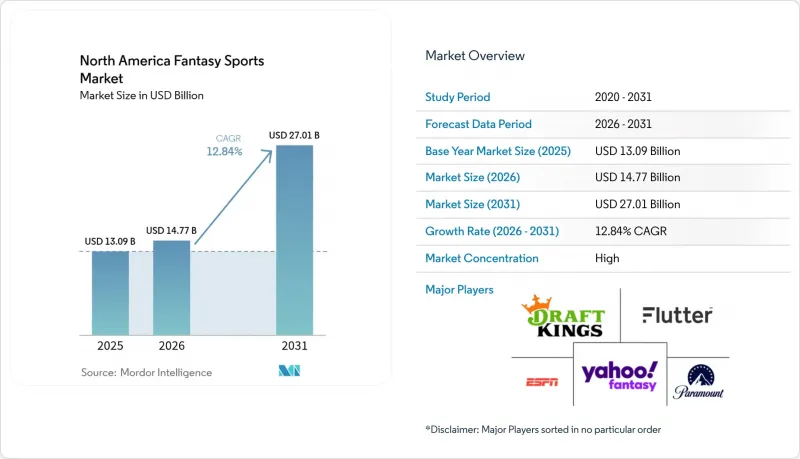
This report is Segmented by Fantasy Sports Type (Traditional Season-Long and Daily/Weekly Fantasy and Ancillaries), Sporting Type (American Football, and More), Platform (Mobile Application and Web/Desktop), Revenue Model (Entry-Fee Rake Contests, and More), User Demographic (Age 18-24, Age 25-34, and More), and Country. The Market Forecasts are Provided in Terms of Value (USD).
North America Fantasy Sports Market Trends and Insights
Regulatory Expansion to >90% of North American Population by 2027
State-level legalization is accelerating network effects that lower marginal compliance cost and unlock broader ad inventory on search and social channels. Newly enabled states increase lifetime value because operators can standardize product features across a larger contiguous user base. Unified compliance modules let leading platforms redirect spending from legal vetting to high-yield marketing and product R&D. The trend also encourages strategic partnerships with payment gateways, reducing friction in onboarding. Altogether, wider legality contributes a 3.2% additive lift to forecast CAGR as remaining holdout jurisdictions move toward enabling frameworks.
Smart-phone and 5G Penetration Lifts Mobile DFS Traffic
5G networks bring sub-20 millisecond latency, enabling push-based player-prop updates that were impractical on 4G. Real-time data improves lineup optimization and reinforces the daily engagement loop. Operators report a 40% gain in average session length once users migrate to 5G-capable devices. The technology also facilitates biometric login and instant withdrawals, lowering abandonment at key friction points. In parallel, device manufacturers preload sports-betting widgets, shortening the funnel between media consumption and fantasy entry. These shifts collectively add 2.8% to the expected CAGR across the North America fantasy sports market.
State-by-state Regulatory Fragmentation and Fee Burden
Each jurisdiction sets unique fee structures ranging from USD 50,000 up to USD 600,000 per license forcing operators to replicate compliance workflows. Maintaining discrete reporting systems elevates fixed costs, curbing smaller entrants' ability to reach scale. Spot audits and sudden rule reinterpretations have already removed ten operators from Massachusetts in 2024, underscoring headline risk. Capital tied up in bonding requirements and legal contingencies delays feature rollouts, slowing innovation cadence and shaving 2.1% off long-run CAGR.
Other drivers and restraints analyzed in the detailed report include:
- Major-League Schedule Growth and Cross-Media Tie-ins
- AI-Driven Personalization Raises Session Length and ARPU
- Rising CAC Amid Duopoly-scale Ad Spend
For complete list of drivers and restraints, kindly check the Table Of Contents.
Segment Analysis
Daily/Weekly Fantasy and Ancillaries captured 60.55% of 2025 revenue, underscoring the shift to instant-gratification experiences that sync with mobile alerts and social feeds. The format's 13.82% CAGR outpaces season-long contests as operators embed micro-bet props inside lineups, further widening engagement. Transaction frequency aligns earnings with media moments, letting platforms monetize peaks in live viewership. High fill rates also enhance liquidity, supporting larger guaranteed prize pools that attract casual and high-volume users alike. These dynamics cement the daily segment as the cornerstone of the North America fantasy sports market.
Season-long formats still retain legacy users who prize community leagues and deeper research cycles. However, younger cohorts gravitate toward dynamic payout structures and lower commitment windows. Operators reply by automating draft assistance, adding weekly cash-based challenges, and cross-selling season subscribers into daily contests mid-year. The convergence widens average user value, though it increases classification scrutiny as regulatory bodies debate the line between skill and chance.
American Football delivered 58.25% of 2025 revenue and benefits from a compact weekly cadence that drives concentrated user activity. Statistical depth and cultural ubiquity ensure top-of-mind positioning every fall weekend. Operators lock in user retention through cross-promotions that roll football players into basketball or baseball slates once the Super Bowl concludes. Baseball remains steady due to its near-daily schedule, offering volume traders multiple entries and consistent ARPU. Basketball enjoys both college and pro seasons, extending contest availability into spring.
Ice Hockey is the fastest-growing sub-segment at 14.38% CAGR as streaming reach improves and younger Canadian audiences adopt daily formats. Operators leverage real-time shift data and player tracking to develop premium stat feeds that mirror football's depth. Growth in niche sports such as golf, soccer, and eSports diversifies revenue, protecting platforms from over-reliance on a single league cycle. Genius Sports' BetVision expansion into global soccer underscores the wider opportunity set beyond the core four U.S. leagues.
Complete Report Scope:
- By Fantasy Sports Type
- Traditional Season-long
- Daily/Weekly Fantasy and Ancillaries
- By Sporting Type
- American Football
- Baseball
- Basketball
- Ice Hockey
- Other Sports (Golf, Soccer, eSports)
- By Platform
- Mobile Application
- Web/Desktop
- By Revenue Model
- Entry-fee Rake Contests
- Subscription/Premium Tools
- Advertising-supported Free Play
- Hybrid/Ancillary Micro-Betting
- By User Demographic
- Age 18-24
- Age 25-34
- Age 35-44
- Age 45+
- By Country
- United States
- Canada
- Mexico
List of Companies Covered in this Report:
- DraftKings Inc.
- Flutter Entertainment plc (FanDuel)
- Yahoo Inc. (Yahoo Fantasy)
- Paramount Global (CBS Sports Digital)
- ESPN Enterprises, Inc.
- Underdog Sports, LLC
- Performance Predictions, Inc. (PrizePicks)
- Boom Shakalaka Inc.
- Monkey Knife Fight, LLC
- StatHero, Inc.
- Fantrax Systems, Inc.
- Sleeper Labs, Inc.
- OwnersBox Inc.
- SportsHub Games Network, Inc.
- Fleaflicker LLC
- RealTime Fantasy Sports, Inc.
- A2C Solutions Inc. (ThriveFantasy)
- Roto Sports, Inc. (RotoWire)
- Marzen Media LLC (FantasyPros)
- Sideline Software, Inc. (MyFantasyLeague)
- FanUp Inc.
- PredictionStrike Inc.
Additional Benefits:
- The market estimate (ME) sheet in Excel format
- 3 months of analyst support
TABLE OF CONTENTS
1 INTRODUCTION
- 1.1 Study Assumptions and Market Definition
- 1.2 Scope of the Study
2 RESEARCH METHODOLOGY
3 EXECUTIVE SUMMARY
4 MARKET LANDSCAPE
- 4.1 Market Overview
- 4.2 Market Drivers
- 4.2.1 Regulatory expansion to >90 % of NA population by 2027
- 4.2.2 Smart-phone and 5G penetration lifts mobile DFS traffic
- 4.2.3 Major-league schedule growth and cross-media tie-ins
- 4.2.4 AI-driven personalization raises session length and ARPU
- 4.2.5 Micro-bet "pick-em" formats attract Gen-Z users
- 4.2.6 Streaming of Sunday-Ticket and NHL/MLB packages widens TAM
- 4.3 Market Restraints
- 4.3.1 State-by-state regulatory fragmentation and fee burden
- 4.3.2 Rising CAC amid duopoly-scale ad spend
- 4.3.3 KYC/AML compliance and payments-network surcharges
- 4.3.4 User shift to straight sports-betting substitutes
- 4.4 Industry Value Chain Analysis
- 4.5 Regulatory Landscape (US and Canada)
- 4.6 Technological Outlook (AI, AR/VR, Blockchain)
- 4.7 Porter's Five Forces Analysis
- 4.7.1 Bargaining Power of Suppliers
- 4.7.2 Bargaining Power of Consumers
- 4.7.3 Threat of New Entrants
- 4.7.4 Threat of Substitutes
- 4.7.5 Intensity of Competitive Rivalry
- 4.8 Investment Analysis
- 4.9 Demographic Analysis (US)
- 4.10 Impact of Macroeconomic Trends on the Market
- 4.11 Emergence of Sports Betting and Synergies
5 MARKET SIZE AND GROWTH FORECASTS (VALUES)
- 5.1 By Fantasy Sports Type
- 5.1.1 Traditional Season-long
- 5.1.2 Daily/Weekly Fantasy and Ancillaries
- 5.2 By Sporting Type
- 5.2.1 American Football
- 5.2.2 Baseball
- 5.2.3 Basketball
- 5.2.4 Ice Hockey
- 5.2.5 Other Sports (Golf, Soccer, eSports)
- 5.3 By Platform
- 5.3.1 Mobile Application
- 5.3.2 Web/Desktop
- 5.4 By Revenue Model
- 5.4.1 Entry-fee Rake Contests
- 5.4.2 Subscription/Premium Tools
- 5.4.3 Advertising-supported Free Play
- 5.4.4 Hybrid/Ancillary Micro-Betting
- 5.5 By User Demographic
- 5.5.1 Age 18-24
- 5.5.2 Age 25-34
- 5.5.3 Age 35-44
- 5.5.4 Age 45+
- 5.6 By Country
- 5.6.1 United States
- 5.6.2 Canada
- 5.6.3 Mexico
6 COMPETITIVE LANDSCAPE
- 6.1 Market Concentration
- 6.2 Strategic Moves
- 6.3 Market Share Analysis
- 6.4 Company Profiles (includes Global level Overview, Market level overview, Core Segments, Financials as available, Strategic Information, Market Rank/Share, Products and Services, Recent Developments)
- 6.4.1 DraftKings Inc.
- 6.4.2 Flutter Entertainment plc (FanDuel)
- 6.4.3 Yahoo Inc. (Yahoo Fantasy)
- 6.4.4 Paramount Global (CBS Sports Digital)
- 6.4.5 ESPN Enterprises, Inc.
- 6.4.6 Underdog Sports, LLC
- 6.4.7 Performance Predictions, Inc. (PrizePicks)
- 6.4.8 Boom Shakalaka Inc.
- 6.4.9 Monkey Knife Fight, LLC
- 6.4.10 StatHero, Inc.
- 6.4.11 Fantrax Systems, Inc.
- 6.4.12 Sleeper Labs, Inc.
- 6.4.13 OwnersBox Inc.
- 6.4.14 SportsHub Games Network, Inc.
- 6.4.15 Fleaflicker LLC
- 6.4.16 RealTime Fantasy Sports, Inc.
- 6.4.17 A2C Solutions Inc. (ThriveFantasy)
- 6.4.18 Roto Sports, Inc. (RotoWire)
- 6.4.19 Marzen Media LLC (FantasyPros)
- 6.4.20 Sideline Software, Inc. (MyFantasyLeague)
- 6.4.21 FanUp Inc.
- 6.4.22 PredictionStrike Inc.
7 MARKET OPPORTUNITIES AND FUTURE OUTLOOK
- 7.1 White-space and Unmet-need Assessment

