PUBLISHER: Mordor Intelligence | PRODUCT CODE: 2124549

PUBLISHER: Mordor Intelligence | PRODUCT CODE: 2124549
Management Decision - Market Share Analysis, Industry Trends & Statistics, Growth Forecasts (2026 - 2031)
According to Mordor Intelligence, the management decision market size in 2026 is estimated at USD 8.05 billion, growing from 2025 value of USD 6.70 billion with 2031 projections showing USD 20.19 billion, growing at 20.18% CAGR over 2026-2031.
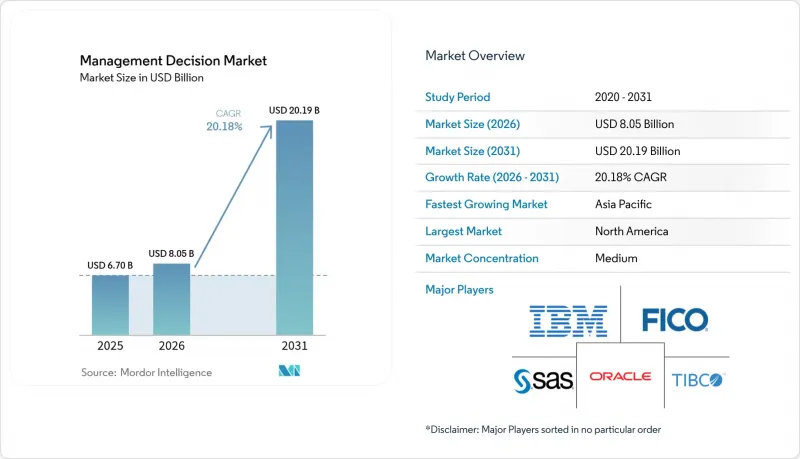
This report is Segmented by Component (Software and Services), by Deployment Type (On-Premises and Cloud), by Organization Size (Large Enterprises and Small and Medium-Size Enterprises (SMEs)), by Function (Risk and Compliance Management, and More), by End-User Industry (Banking, Financial Services, and Insurance (BFSI), and More), and Geography. The Market Forecasts are Provided in Terms of Value (USD).
Global Management Decision Market Trends and Insights
Increasing Need for Business Agility and Real-Time Insights
Market turbulence has turned real-time decisioning into a survival requirement. Modern platforms now fuse predictive analytics with rule engines, enabling organizations to act on signals before they disrupt performance. Enterprises are automating high-volume operational decisions such as pricing and routing through multi-agent systems that coordinate workflows without human delay. Decision flows span departments to keep execution aligned with evolving market conditions while preserving consistent policy enforcement.
Surge in Decision Analytics Adoption in Banking, Financial Services, and Insurance (BFSI)
Banks and insurers are embedding decision engines in credit approval, claims processing and customer interaction journeys. Automated credit decisioning processes loan applications within seconds and enforces uniform compliance checks. Firms are combining internal records with digital behavior to craft individualized financial offerings, extending services to previously underserved borrowers. End-to-end orchestration tools adjust product terms in real time when customer risk factors or market data shift, improving both portfolio quality and user experience.
High Implementation and Integration Cost
Comprehensive decision programs demand sizable outlays for platform licenses, process redesign and change management. Integration can be complex where legacy systems lack standard Application Programming Interfaces (APIs), forcing middleware development and prolonged testing. Smaller firms bear a higher cost burden relative to their budgets, which slows adoption. A phased approach that first targets a few high-value use cases helps generate quick wins and funds expansion while building internal expertise.
Other drivers and restraints analyzed in the detailed report include:
- Compliance-Driven Demand for Explainable Artificial Intelligence (AI)
- Low-Code/No-Code Platforms Widening User Base
- Shortage of Domain-Specific Data for Model Training
For complete list of drivers and restraints, kindly check the Table Of Contents.
Segment Analysis
Software accounted for a commanding 67.20% management decision market share in 2025, underpinned by engines that merge rule management with analytics and natural-language interfaces. Vendors increasingly embed generative AI that suggests rule optimizations and flags compliance gaps. Services, though smaller, are on a 21.95% CAGR path as organizations seek advisory, deployment, and continuous optimization expertise. Providers are evolving industry accelerators that compress rollout timelines by packaging proven decision templates.
Implementation partners redesign processes, create governance playbooks, and run managed optimization programs that keep decision performance aligned with changing regulations and business goals. Firms lacking in-house data science tap these offerings to maintain decision quality. As AI scaling tops executive agendas, demand for continuous model monitoring and recalibration services is rising, supporting sustained expansion for service specialists.
Cloud captured 79.30% of the management decision market in 2025 and is growing at 21.56% CAGR through 2031 as organizations favor elastic capacity and consumption-based pricing. Cloud platforms allow instant scaling to meet volatile decision workloads, important for seasonal transaction spikes. Even regulated sectors adopt virtual private clouds to meet sovereignty requirements. Some enterprises, however, repatriate sensitive workloads to private environments, creating hybrid estates that blend cloud flexibility with on-premise control.
Decision architects now evaluate each workload along criteria such as latency, data locality, and licensing commitments rather than choosing a single hosting model. Multi-cloud adoption is rising to avoid lock-in and to exploit specialized capabilities from different providers. Vendors respond with portable services built on container technology so clients can shift deployments without rewriting decision logic.
Complete Report Scope:
- By Component
- Software
- Services
- By Deployment Type
- On-premises
- Cloud
- By Organization Size
- Large Enterprises
- Small and Medium-size Enterprises (SMEs)
- By Function
- Risk and Compliance Management
- Customer Experience and Personalization
- Fraud Detection and Prevention
- Pricing and Revenue Optimization
- Other Function
- By End-User Industry
- Banking, Financial Services, and Insurance (BFSI)
- Information Technology (IT) and Telecom
- Healthcare
- Retail and E-commerce
- Manufacturing
- Government and Public Sector
- Other End-User Industry
- By Geography
- North America
- United States
- Canada
- South America
- Brazil
- Argentina
- Rest of South America
- Europe
- Germany
- United Kingdom
- France
- Spain
- Russia
- Rest of Europe
- Asia-Pacific
- China
- Japan
- India
- South Korea
- Australia and New Zealand
- Rest of Asia-Pacific
- Middle East and Africa
- Middle East
- Saudi Arabia
- United Arab Emirates
- Rest of Middle East
- Africa
- South Africa
- Egypt
- Rest of Africa
- Middle East
- North America
Geography Analysis
North America dominated the management decision market with 36.50% revenue in 2025. Early adoption of AI, deep cloud infrastructure, and a concentration of leading vendors underpin leadership. Financial institutions use decision engines to refine credit scoring and fraud controls, while hospitals apply them to clinical pathways and billing. Regulatory focus on algorithmic fairness reinforces demand for transparent, governable decision platforms. Business specialists increasingly adopt low-code tools, broadening the user community beyond IT and amplifying regional growth momentum.
Asia-Pacific is the fastest-growing region, set to advance at a 23.95% CAGR from 2026 to 2031. Governments across China, Japan, and India invest heavily in AI infrastructure and skills, fostering an environment conducive to large-scale decision deployments. Banks deploy real-time credit and fraud engines to expand financial inclusion, manufacturers embed decision logic in digital production lines, and public agencies roll out citizen-facing services powered by automated decisions. Diverse regulatory regimes spur the adoption of configurable governance modules that adapt to local compliance mandates without fragmenting enterprise standards.
Europe retains a significant share on the back of stringent regulatory frameworks that prioritize explainability. The EU AI Act imposes rigorous obligations for high-risk systems, prompting financial and healthcare organizations to adopt platforms capable of detailed audit trails and natural-language rationale. Multinational firms require cross-border decision consistency, driving demand for centralized rule repositories and language-agnostic governance. Strong implementation partner ecosystems with domain and compliance expertise support steady growth across the region.
- IBM Corporation
- Oracle Corporation
- SAS Institute Inc.
- SAP SE
- FICO (Fair Isaac Corporation)
- Pegasystems Inc.
- TIBCO Software Inc.
- Actico GmbH
- Sapiens International Corp.
- Equifax Inc.
- Experian plc
- Scorto Inc.
- Sparkling Logic Inc.
- InRule Technology Inc.
- RapidMiner Inc.
- Teradata Corp.
- Alteryx Inc.
- DataRobot Inc.
- Decision Management Solutions
Additional Benefits:
- The market estimate (ME) sheet in Excel format
- 3 months of analyst support
TABLE OF CONTENTS
1 INTRODUCTION
- 1.1 Study Assumptions and Market Definition
- 1.2 Scope of the Study
2 RESEARCH METHODOLOGY
3 EXECUTIVE SUMMARY
4 MARKET LANDSCAPE
- 4.1 Market Overview
- 4.2 Market Drivers
- 4.2.1 Increasing Need for Business Agility and Real-Time Insights
- 4.2.2 Surge In Decision Analytics Adoption in Banking, Financial Services, And Insurance (BFSI)
- 4.2.3 Compliance-Driven Demand for Explainable Artificial Intelligence (AI)
- 4.2.4 Low-Code/No-Code Platforms Widening User Base
- 4.2.5 Embedded Decisioning in Edge and Internet of Things (IoT) Devices
- 4.3 Market Restraints
- 4.3.1 High Implementation and Integration Cost
- 4.3.2 Shortage Of Domain-Specific Data for Model Training
- 4.3.3 Vendor Lock-In Concerns with Cloud-Native Stacks
- 4.3.4 Regulatory Uncertainty Around Automated Decisions
- 4.4 Industry Supply Chain Analysis
- 4.5 Regulatory Landscape
- 4.6 Technological Outlook
- 4.7 Porter's Five Forces Analysis
- 4.7.1 Threat of New Entrants
- 4.7.2 Bargaining Power of Suppliers
- 4.7.3 Bargaining Power of Buyers
- 4.7.4 Threat of Substitutes
- 4.7.5 Competitive Rivalry
- 4.8 Assessment of the Impact of Macroeconomic Trends on the Market
5 MARKET SIZE AND GROWTH FORECASTS (VALUE)
- 5.1 By Component
- 5.1.1 Software
- 5.1.2 Services
- 5.2 By Deployment Type
- 5.2.1 On-premises
- 5.2.2 Cloud
- 5.3 By Organization Size
- 5.3.1 Large Enterprises
- 5.3.2 Small and Medium-size Enterprises (SMEs)
- 5.4 By Function
- 5.4.1 Risk and Compliance Management
- 5.4.2 Customer Experience and Personalization
- 5.4.3 Fraud Detection and Prevention
- 5.4.4 Pricing and Revenue Optimization
- 5.4.5 Other Function
- 5.5 By End-User Industry
- 5.5.1 Banking, Financial Services, and Insurance (BFSI)
- 5.5.2 Information Technology (IT) and Telecom
- 5.5.3 Healthcare
- 5.5.4 Retail and E-commerce
- 5.5.5 Manufacturing
- 5.5.6 Government and Public Sector
- 5.5.7 Other End-User Industry
- 5.6 By Geography
- 5.6.1 North America
- 5.6.1.1 United States
- 5.6.1.2 Canada
- 5.6.2 South America
- 5.6.2.1 Brazil
- 5.6.2.2 Argentina
- 5.6.2.3 Rest of South America
- 5.6.3 Europe
- 5.6.3.1 Germany
- 5.6.3.2 United Kingdom
- 5.6.3.3 France
- 5.6.3.4 Spain
- 5.6.3.5 Russia
- 5.6.3.6 Rest of Europe
- 5.6.4 Asia-Pacific
- 5.6.4.1 China
- 5.6.4.2 Japan
- 5.6.4.3 India
- 5.6.4.4 South Korea
- 5.6.4.5 Australia and New Zealand
- 5.6.4.6 Rest of Asia-Pacific
- 5.6.5 Middle East and Africa
- 5.6.5.1 Middle East
- 5.6.5.1.1 Saudi Arabia
- 5.6.5.1.2 United Arab Emirates
- 5.6.5.1.3 Rest of Middle East
- 5.6.5.2 Africa
- 5.6.5.2.1 South Africa
- 5.6.5.2.2 Egypt
- 5.6.5.2.3 Rest of Africa
- 5.6.5.1 Middle East
- 5.6.1 North America
6 COMPETITIVE LANDSCAPE
- 6.1 Market Concentration
- 6.2 Strategic Moves
- 6.3 Market Share Analysis
- 6.4 Company Profiles (includes Global level Overview, Market level overview, Core Segments, Financials as available, Strategic Information, Market Rank/Share for key companies, Products and Services, and Recent Developments)
- 6.4.1 IBM Corporation
- 6.4.2 Oracle Corporation
- 6.4.3 SAS Institute Inc.
- 6.4.4 SAP SE
- 6.4.5 FICO (Fair Isaac Corporation)
- 6.4.6 Pegasystems Inc.
- 6.4.7 TIBCO Software Inc.
- 6.4.8 Actico GmbH
- 6.4.9 Sapiens International Corp.
- 6.4.10 Equifax Inc.
- 6.4.11 Experian plc
- 6.4.12 Scorto Inc.
- 6.4.13 Sparkling Logic Inc.
- 6.4.14 InRule Technology Inc.
- 6.4.15 RapidMiner Inc.
- 6.4.16 Teradata Corp.
- 6.4.17 Alteryx Inc.
- 6.4.18 DataRobot Inc.
- 6.4.19 Decision Management Solutions
7 MARKET OPPORTUNITIES AND FUTURE OUTLOOK
- 7.1 White-Space and Unmet-Need Assessment

