PUBLISHER: Mordor Intelligence | PRODUCT CODE: 2124555

PUBLISHER: Mordor Intelligence | PRODUCT CODE: 2124555
EMEA Corrugated Board Packaging - Market Share Analysis, Industry Trends & Statistics, Growth Forecasts (2026 - 2031)
According to Mordor Intelligence, EMEA corrugated board packaging market size in 2026 is estimated at USD 7.21 billion, growing from 2025 value of USD 7.02 billion with 2031 projections showing USD 8.26 billion, growing at 2.75% CAGR over 2026-2031.
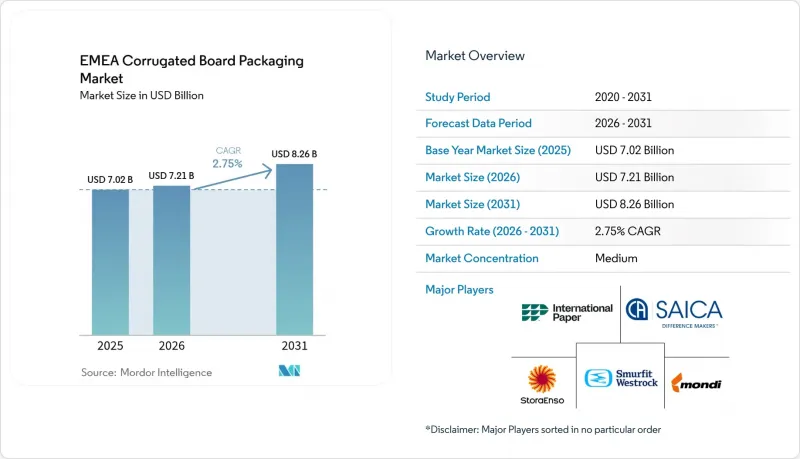
This report is Segmented by End-User Industry (Food, Beverages, E-Commerce, Electrical and Electronics, and More), Flute Type (A-Flute, B-Flute, C-Flute, and More), Board Type (Single Face, Single Wall, and More), Printing Technology (Flexography, Digital Printing, and More), and Geography (Europe, Middle East, and Africa). The Market Forecasts are Provided in Terms of Value (USD).
EMEA Corrugated Board Packaging Market Trends and Insights
Exploding e-commerce parcel volumes
Online retail added new corrugated demand streams as cross-border transactions in the EU climbed 23% in 2024. Parcel formats favor protective designs, extra branding space, and fit-to-product geometry, all of which command premium unit prices. Urban fulfillment hubs now prefer agile sheet plants over large suburban complexes, pushing converters to deploy modular corrugators with rapid changeovers. Brands such as Zalando demonstrated 15% material savings and improved print aesthetics after switching to custom-sized water-based coated boxes in 2024. Steady growth in same-day delivery further accelerates the EMEA corrugated board packaging market, translating parcel velocity into reliable order backlogs for local plants.
EU PPWR-driven demand for recyclable packaging
The 2024 regulation mandates 90% recycling rates for corrugated formats by 2030 and elevates average recycled fiber content benchmarks to 85%. Corrugated already delivers 88%, giving it a compliance head-start over plastic substrates. Producers with advanced de-inking systems are locking in price premiums for high-whiteness recycled liner. The policy also nudges Middle Eastern and African subsidiaries of European brands toward fiber adoption to maintain uniform sustainability claims. As a result, the EMEA corrugated board packaging market embeds regulatory pull rather than subsidy push, curbing risk profiles for new investments.
OCC and kraftliner price volatility
OCC prices swung 35% in 2024, compressing gross margins for converters locked into annual contracts. Hedging mechanisms have limited liquidity, forcing mid-tier box plants to renegotiate pass-through clauses or risk solvency. Kraftliner also tracks pulp and energy costs, injecting unpredictability into input budgets. The turbulence intensifies consolidation as scaled integrators leverage broader fiber baskets and currency hedges, while smaller independents exit or specialize. Such swings subtract 0.5 percentage points from the projected CAGR for the EMEA corrugated board packaging market.
Other drivers and restraints analyzed in the detailed report include:
- Fresh produce cold-chain shift to fiber-based crates
- AI-enabled right-size packaging adoption
- Energy-price shock hitting corrugator OPEX
For complete list of drivers and restraints, kindly check the Table Of Contents.
Segment Analysis
The food segment generated a dominant 34.92% share of the EMEA corrugated board packaging market in 2025, anchored in agricultural exports, ambient grocery, and chilled ready-meals. Producers value corrugated's capacity to absorb condensation without losing compressive strength, fulfilling stringent hygiene standards while supporting brand visibility through high-resolution graphics. Lightweight crates with water-based coatings now penetrate deli and bakery aisles, displacing PET clamshells. The e-commerce channel exhibits the fastest 4.12% CAGR to 2031, driven by direct-to-consumer grocery boxes, fashion returns logistics, and electronics deliveries. Packaging needs here skew toward quick-set locks, rip-tabs, and integrated returns tape that shrink fulfillment labor costs. Synergies arise when food brands cross-list on online marketplaces, requiring dual-purpose SKUs that protect perishables and present attractively on the doorstep, thereby reinforcing share gains for the EMEA corrugated board packaging market.
A stable beverage sub-segment demands reinforced section dividers to shield glass and aluminum multipacks, with inventory switching toward post-consumer recycled liner to meet corporate carbon pledges. Personal care and cosmetics lines select microflute boxes that blend structural integrity with near-offset print quality, uplifting unboxing theatrics. Industrial parts now adopt fold-to-fit die-cuts that replace plywood, lowering weight and easing customs clearance. Electrification in automotive components invites antistatic coatings for battery modules, adding premium value layers without heavy material additions.
C-Flute maintained 31.95% share in 2025 for its all-round cushioning and stacking competencies, making it a default choice for case-ready foods and durable goods. However, microflute variants (F and N) are growing 3.82% annually on the strength of superior print registration and slimmer wall thickness that cuts freight costs. Specialty converters pair microflute with high-white liners, targeting luxury chocolates, personal electronics, and point-of-sale trays. A-Flute persists in heavy-duty agriculture bins for melons and root vegetables that face vertical stacking in cold stores. B-Flute wins when precise die-cut scoring is needed for shelf-ready displays. E-Flute straddles cartonboard and corrugated territories, servicing small appliances and specialty teas that crave tactile stiffness. This diversification of flute profiles diversifies SKUs and spreads capex across corrugators, sustaining innovation momentum in the EMEA corrugated board packaging market.
Material science developments allow hybrid flute combinations where an E/B double wall mates print surface with crush resistance, giving converters modular setups to serve both e-commerce apparel and industrial spares without switching board suppliers. The approach elevates customer retention, especially when paired with AI pattern libraries that recommend flute mixes from product weight databases.
Complete Report Scope:
- By End-User Industry
- Food
- Processed Foods
- Fresh Food and Produce
- Beverages
- E-commerce
- Electrical and Electronics
- Personal Care and Cosmetics
- Other End-User Industries
- Food
- By Flute Type
- A-Flute
- B-Flute
- C-Flute
- E-Flute
- F/N Microflute
- Other Flute Types
- By Board Type
- Single Face
- Single Wall
- Double Wall
- Triple Wall
- By Printing Technology
- Flexography
- Digital Printing
- Litho-lamination
- Screen Printing
- Other Printing Technologies
- BY Geography
- Europe
- United Kingdom
- Germany
- France
- Spain
- Italy
- Rest of Europe
- Middle East
- Saudi Arabia
- United Arab Emirates
- Turkey
- Rest of Middle East
- Africa
- South Africa
- Egypt
- Nigeria
- Rest of Africa
- Europe
List of Companies Covered in this Report:
- Smurfit WestRock
- Mondi plc
- International Paper Company
- Saica S.A.
- Stora Enso Oyj
- Svenska Cellulosa Aktiebolaget (SCA)
- Prinzhorn Holding GmbH
- VPK Group NV
- Palm Gruppe GmbH & Co KG
- Dunapack Packaging (Prinzhorn)
- Mayr-Melnhof Karton AG
- Rengo Co. Ltd.
- Nine Dragons Paper (Holdings) Ltd.
- Packaging Corporation of America
- Georgia-Pacific LLC
- Amcor plc
- Pratt Industries, Inc.
- Cascades Inc.
- Arabian Packaging LLC
Additional Benefits:
- The market estimate (ME) sheet in Excel format
- 3 months of analyst support
TABLE OF CONTENTS
1 INTRODUCTION
- 1.1 Study Assumptions and Market Definition
- 1.2 Scope of the Study
2 RESEARCH METHODOLOGY
3 EXECUTIVE SUMMARY
4 MARKET LANDSCAPE
- 4.1 Market Overview
- 4.2 Market Drivers
- 4.2.1 Exploding e-commerce parcel volumes
- 4.2.2 EU PPWR-driven demand for recyclable packaging
- 4.2.3 Fresh produce cold-chain shift to fiber-based crates
- 4.2.4 AI-enabled right-size packaging adoption
- 4.2.5 Water-based barrier coatings replacing plastic trays
- 4.2.6 EU CBAM incentives for local recycled liner
- 4.3 Market Restraints
- 4.3.1 OCC and kraftliner price volatility
- 4.3.2 Substitution by reusable/flexible packaging
- 4.3.3 Energy-price shock hitting corrugator OPEX
- 4.3.4 War-related mill outages in Eastern Europe
- 4.4 Industry Value Chain Analysis
- 4.5 Regulatory Landscape
- 4.6 Technological Outlook
- 4.7 Impact of Macroeconomic Factors on the Market
- 4.8 Porter's Five Forces
- 4.8.1 Threat of New Entrants
- 4.8.2 Bargaining Power of Buyers
- 4.8.3 Bargaining Power of Suppliers
- 4.8.4 Threat of Substitute Products
- 4.8.5 Intensity of Competitive Rivalry
5 MARKET SIZE AND GROWTH FORECASTS (VALUE)
- 5.1 By End-User Industry
- 5.1.1 Food
- 5.1.1.1 Processed Foods
- 5.1.1.2 Fresh Food and Produce
- 5.1.2 Beverages
- 5.1.3 E-commerce
- 5.1.4 Electrical and Electronics
- 5.1.5 Personal Care and Cosmetics
- 5.1.6 Other End-User Industries
- 5.1.1 Food
- 5.2 By Flute Type
- 5.2.1 A-Flute
- 5.2.2 B-Flute
- 5.2.3 C-Flute
- 5.2.4 E-Flute
- 5.2.5 F/N Microflute
- 5.2.6 Other Flute Types
- 5.3 By Board Type
- 5.3.1 Single Face
- 5.3.2 Single Wall
- 5.3.3 Double Wall
- 5.3.4 Triple Wall
- 5.4 By Printing Technology
- 5.4.1 Flexography
- 5.4.2 Digital Printing
- 5.4.3 Litho-lamination
- 5.4.4 Screen Printing
- 5.4.5 Other Printing Technologies
- 5.5 BY Geography
- 5.5.1 Europe
- 5.5.1.1 United Kingdom
- 5.5.1.2 Germany
- 5.5.1.3 France
- 5.5.1.4 Spain
- 5.5.1.5 Italy
- 5.5.1.6 Rest of Europe
- 5.5.2 Middle East
- 5.5.2.1 Saudi Arabia
- 5.5.2.2 United Arab Emirates
- 5.5.2.3 Turkey
- 5.5.2.4 Rest of Middle East
- 5.5.3 Africa
- 5.5.3.1 South Africa
- 5.5.3.2 Egypt
- 5.5.3.3 Nigeria
- 5.5.3.4 Rest of Africa
- 5.5.1 Europe
6 COMPETITIVE LANDSCAPE
- 6.1 Market Concentration
- 6.2 Strategic Moves
- 6.3 Market Share Analysis
- 6.4 Company Profiles (includes Global level Overview, Market level overview, Core Segments, Financials as available, Strategic Information, Market Rank/Share for key companies, Products and Services, and Recent Developments)
- 6.4.1 Smurfit WestRock
- 6.4.2 Mondi plc
- 6.4.3 International Paper Company
- 6.4.4 Saica S.A.
- 6.4.5 Stora Enso Oyj
- 6.4.6 Svenska Cellulosa Aktiebolaget (SCA)
- 6.4.7 Prinzhorn Holding GmbH
- 6.4.8 VPK Group NV
- 6.4.9 Palm Gruppe GmbH & Co KG
- 6.4.10 Dunapack Packaging (Prinzhorn)
- 6.4.11 Mayr-Melnhof Karton AG
- 6.4.12 Rengo Co. Ltd.
- 6.4.13 Nine Dragons Paper (Holdings) Ltd.
- 6.4.14 Packaging Corporation of America
- 6.4.15 Georgia-Pacific LLC
- 6.4.16 Amcor plc
- 6.4.17 Pratt Industries, Inc.
- 6.4.18 Cascades Inc.
- 6.4.19 Arabian Packaging LLC
7 MARKET OPPORTUNITIES AND FUTURE OUTLOOK
- 7.1 White-space and Unmet-need Assessment

