PUBLISHER: Mordor Intelligence | PRODUCT CODE: 2124567

PUBLISHER: Mordor Intelligence | PRODUCT CODE: 2124567
Smart Window - Market Share Analysis, Industry Trends & Statistics, Growth Forecasts (2026 - 2031)
According to Mordor Intelligence, the smart window market size is expected to grow from USD 6.12 billion in 2025 to USD 6.68 billion in 2026 and is forecast to reach USD 10.33 billion by 2031 at 9.12% CAGR over 2026-2031.
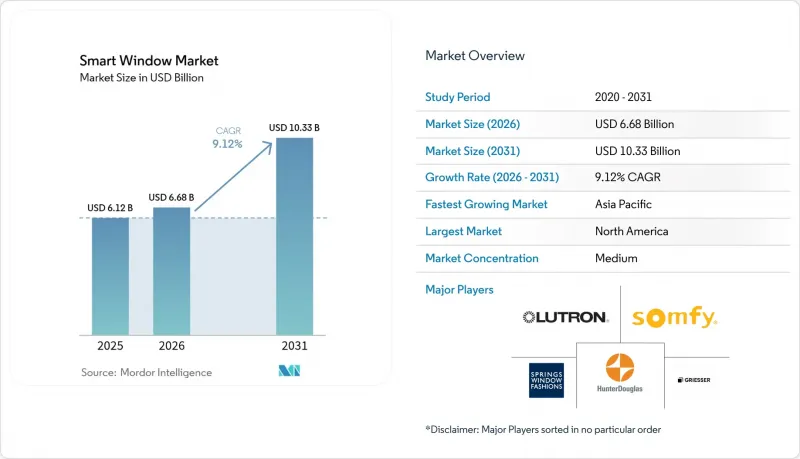
This report is Segmented by Product Type (Motorized Roller Shades, Motorized Zebra Shades, Motorized Drapery Systems, Motorized Venetian Blinds, Other Product Types), Power Source (Hard-Wired, Battery-Powered, Solar-Powered), Installation Type (New Construction, Retrofit), Application (Residential, Commercial, Industrial), and Geography. The Market Forecasts are Provided in Terms of Value (USD).
Global Smart Window Market Trends and Insights
Growing prominence of smart homes
Smart-home penetration reached 15.2% of households in 2024, transforming consumer expectations for shading from simple motorization to predictive automation. Matter and Thread protocols now enable multi-vendor interoperability, while voice assistant links allow windows to respond automatically to occupancy schedules and tariff changes. Edge processors inside shade motors cut cloud latency and support localized decision logic. Channel partners in North America report attachment rates above 45% when smart windows are bundled with security and HVAC packages. Suppliers that expose open APIs are gaining integrator loyalty, reducing reliance on proprietary hubs.
Energy-efficiency regulations and green-building codes
California's Title 24 mandates dynamic glazing or motorized shading for commercial spaces above 10,000 square feet. The 2024 IECC introduced automated daylight controls for sidelighting zones, while the EU's EPBD recast compels member states to elevate building automation standards. Because compliance spend is non-discretionary, vendors see higher margins in code-driven projects than in purely aesthetic residential upgrades. Certifications such as LEED v4.1 and BREEAM award points for automated glare and solar-heat-gain mitigation, positioning smart windows as a cost-effective route to rating thresholds.
Lack of interoperability standards
Despite Matter's 2024 launch, legacy devices run on Zigbee, Z-Wave, or proprietary RF, forcing integrators to juggle bridges that raise cost and complexity . Surveys show compatibility headaches trigger 35% of commercial installation delays. Enterprise buyers hesitate to lock into closed ecosystems that risk obsolescence. Manufacturers that still guard APIs face channel pushback, prompting an industry shift toward software-defined gateways capable of translating multiple protocols in real time.
Other drivers and restraints analyzed in the detailed report include:
- Integration with voice assistants and wider IoT ecosystems
- Demand for daylighting and circadian-lighting solutions
- High upfront costs for retrofit installations
For complete list of drivers and restraints, kindly check the Table Of Contents.
Segment Analysis
Motorized roller shades accounted for 34.02% of the smart window market share in 2025 on the strength of proven reliability and installer familiarity. Their fabric versatility suits both residential decor changes and commercial glare-control requirements. Smart window market growth within this segment is reinforced by cost-optimized tubular motors that can lift wider spans while drawing less than 0.5 amps. In contrast, electrochromic smart glass panels capture media attention and post an 10.88% CAGR yet remain capital-intensive. Controllers now ship with quad-core processors, supporting on-device scene orchestration and over-the-air security patches.
The convergence of mechanical shading and dynamic glazing suggests hybrid facades in future projects. Manufacturers bundle integration hubs that stitch roller shades, blinds, and glass together under a single BACnet object, letting facility managers tune solar-heat gain precisely. Vendors like SageGlass showcase 20-30% HVAC savings in post-occupancy audits, bolstering the smart window market narrative around operational payback. Niche categories such as motorized venetian blinds serve laboratories where doctors calibrate light angles to avoid reflective glare on monitors. Motorized drapery systems continue in hospitality suites, though growth lags due to fabric cost and longer installation times.
Hard-wired solutions contributed 40.65% to the smart window market size in 2025, owing to uninterrupted power and direct integration to building management systems. They draw from low-voltage DC buses, simplifying compliance with electrical codes that restrict line-voltage wiring by non-electricians. However, solar-powered units are expanding at a 12.05% CAGR as panel efficiency breaches 22% and lithium-iron-phosphate packs retain 80% capacity beyond 3,000 cycles.
Transparent photovoltaic strips embedded in glazing promise a dual benefit: daylight modulation and renewable energy harvesting. Battery-powered kits occupy retrofit niches where drill paths or conduit runs are impractical. Manufacturers embed super-capacitors to buffer intermittent sunlight in cloudy regions. Energy-harvesting motors that recycle kinetic energy from shade motion remain experimental but illustrate how the smart window market pursues autonomy from grid power.
Complete Report Scope:
- By Product Type
- Motorized Roller Shades
- Motorized Zebra Shades
- Motorized Drapery Systems
- Motorized Venetian Blinds
- Other Product Types (Smart Glass Panels, Controllers and Integration Hubs, etc.)
- By Power Source
- Hard-wired
- Battery-powered
- Solar-powered
- By Installation Type
- New Construction
- Retrofit
- By Application
- Residential
- Commercial
- Offices
- Hospitality
- Healthcare
- Education
- Retail
- Industrial
- By Geography
- North America
- United States
- Canada
- Mexico
- South America
- Brazil
- Argentina
- Rest of South America
- Europe
- Germany
- United Kingdom
- France
- Italy
- Spain
- Russia
- Rest of Europe
- Asia Pacific
- China
- Japan
- South Korea
- India
- Australia and New Zealand
- Rest of Asia Pacific
- Middle East
- Saudi Arabia
- United Arab Emirates
- Turkey
- Rest of Middle East
- Africa
- South Africa
- Nigeria
- Rest of Africa
- North America
Geography Analysis
North America maintained a 32.12% revenue share in 2025 due to stringent codes and a 46% smart-home penetration rate. The US federal leasing policies stipulate energy-efficient envelopes, ensuring baseline demand even when discretionary budgets tighten. Canada's cold climate sharpens heating-savings payback, and Mexico's factory boom under the USMCA trade pact pushes commercial adoption despite tighter budgets.
Asia Pacific is the fastest-growing region at 12.31% CAGR. China's smart-city pilots in Shenzhen and Shanghai embed intelligent shading in high-rise clusters, while Japan equips senior housing blocks with automated blinds to aid occupants with limited mobility. South Korea integrates Matter-compatible facades in Seoul's premium apartments. India's Smart Cities Mission names automated daylight control as an eligible EMS investment, though uptake concentrates in Grade-A offices. Europe sustains mid-single-digit growth on the back of its Renovation Wave program, with Germany funding low-interest loans for building automation. UAE and Saudi Arabia install electrochromic glass in megaprojects to battle peak-time cooling costs.
- Lutron Electronics Co. Inc.
- Somfy Systems Inc.
- Hunter Douglas N.V.
- Inter IKEA Systems B.V.
- The Shade Store LLC
- Springs Window Fashions LLC
- Griesser AG
- Smartwings Home (Springblinds)
- Alta Window Fashions (Custom Brands Group LLC)
- Coulisse B.V. (MotionBlinds)
- Pella Corporation
- View Inc.
- Saint-Gobain (SageGlass)
- AGC Inc. (Halio)
- Velux Group
Additional Benefits:
- The market estimate (ME) sheet in Excel format
- 3 months of analyst support
TABLE OF CONTENTS
1 INTRODUCTION
- 1.1 Study Assumptions and Market Definition
- 1.2 Scope of the Study
2 RESEARCH METHODOLOGY
3 EXECUTIVE SUMMARY
4 MARKET LANDSCAPE
- 4.1 Market Overview
- 4.2 Market Drivers
- 4.2.1 Growing prominence of smart homes
- 4.2.2 Energy-efficiency regulations and green-building codes
- 4.2.3 Integration with voice assistants and wider IoT ecosystems
- 4.2.4 Demand for daylighting and circadian-lighting solutions
- 4.2.5 Aging-in-place and accessibility retrofits
- 4.2.6 Smart-building certifications pushing automation
- 4.3 Market Restraints
- 4.3.1 Lack of interoperability standards
- 4.3.2 High upfront costs for retrofit installations
- 4.3.3 Cyber-security and data-privacy concerns
- 4.3.4 Supply-chain volatility for electronics and semiconductors
- 4.4 Value Chain Analysis
- 4.5 Regulatory Landscape
- 4.6 Technological Outlook
- 4.7 Porter's Five Forces Analysis
- 4.7.1 Bargaining Power of Suppliers
- 4.7.2 Bargaining Power of Buyers
- 4.7.3 Threat of New Entrants
- 4.7.4 Intensity of Competitive Rivalry
- 4.7.5 Threat of Substitutes
- 4.8 An Assessment of Macroeconomic Impact on the Market
5 MARKET SIZE AND GROWTH FORECASTS (VALUE)
- 5.1 By Product Type
- 5.1.1 Motorized Roller Shades
- 5.1.2 Motorized Zebra Shades
- 5.1.3 Motorized Drapery Systems
- 5.1.4 Motorized Venetian Blinds
- 5.1.5 Other Product Types (Smart Glass Panels, Controllers and Integration Hubs, etc.)
- 5.2 By Power Source
- 5.2.1 Hard-wired
- 5.2.2 Battery-powered
- 5.2.3 Solar-powered
- 5.3 By Installation Type
- 5.3.1 New Construction
- 5.3.2 Retrofit
- 5.4 By Application
- 5.4.1 Residential
- 5.4.2 Commercial
- 5.4.2.1 Offices
- 5.4.2.2 Hospitality
- 5.4.2.3 Healthcare
- 5.4.2.4 Education
- 5.4.2.5 Retail
- 5.4.3 Industrial
- 5.5 By Geography
- 5.5.1 North America
- 5.5.1.1 United States
- 5.5.1.2 Canada
- 5.5.1.3 Mexico
- 5.5.2 South America
- 5.5.2.1 Brazil
- 5.5.2.2 Argentina
- 5.5.2.3 Rest of South America
- 5.5.3 Europe
- 5.5.3.1 Germany
- 5.5.3.2 United Kingdom
- 5.5.3.3 France
- 5.5.3.4 Italy
- 5.5.3.5 Spain
- 5.5.3.6 Russia
- 5.5.3.7 Rest of Europe
- 5.5.4 Asia Pacific
- 5.5.4.1 China
- 5.5.4.2 Japan
- 5.5.4.3 South Korea
- 5.5.4.4 India
- 5.5.4.5 Australia and New Zealand
- 5.5.4.6 Rest of Asia Pacific
- 5.5.5 Middle East
- 5.5.5.1 Saudi Arabia
- 5.5.5.2 United Arab Emirates
- 5.5.5.3 Turkey
- 5.5.5.4 Rest of Middle East
- 5.5.6 Africa
- 5.5.6.1 South Africa
- 5.5.6.2 Nigeria
- 5.5.6.3 Rest of Africa
- 5.5.1 North America
6 COMPETITIVE LANDSCAPE
- 6.1 Market Concentration
- 6.2 Strategic Moves
- 6.3 Market Share Analysis
- 6.4 Company Profiles (includes Global level Overview, Market level overview, Core Segments, Financials as available, Strategic Information, Market Rank/Share for key companies, Products and Services, and Recent Developments)
- 6.4.1 Lutron Electronics Co. Inc.
- 6.4.2 Somfy Systems Inc.
- 6.4.3 Hunter Douglas N.V.
- 6.4.4 Inter IKEA Systems B.V.
- 6.4.5 The Shade Store LLC
- 6.4.6 Springs Window Fashions LLC
- 6.4.7 Griesser AG
- 6.4.8 Smartwings Home (Springblinds)
- 6.4.9 Alta Window Fashions (Custom Brands Group LLC)
- 6.4.10 Coulisse B.V. (MotionBlinds)
- 6.4.11 Pella Corporation
- 6.4.12 View Inc.
- 6.4.13 Saint-Gobain (SageGlass)
- 6.4.14 AGC Inc. (Halio)
- 6.4.15 Velux Group
7 MARKET OPPORTUNITIES AND FUTURE OUTLOOK
- 7.1 White-space and Unmet-Need Assessment

