PUBLISHER: Mordor Intelligence | PRODUCT CODE: 2124586

PUBLISHER: Mordor Intelligence | PRODUCT CODE: 2124586
Veterinary Eye Care - Market Share Analysis, Industry Trends & Statistics, Growth Forecasts (2026 - 2031)
According to Mordor Intelligence, the veterinary eye care market size was valued at USD 8.20 billion in 2025 and estimated to grow from USD 8.65 billion in 2026 to reach USD 11.32 billion by 2031, at a CAGR of 5.53% during 2026-2031.
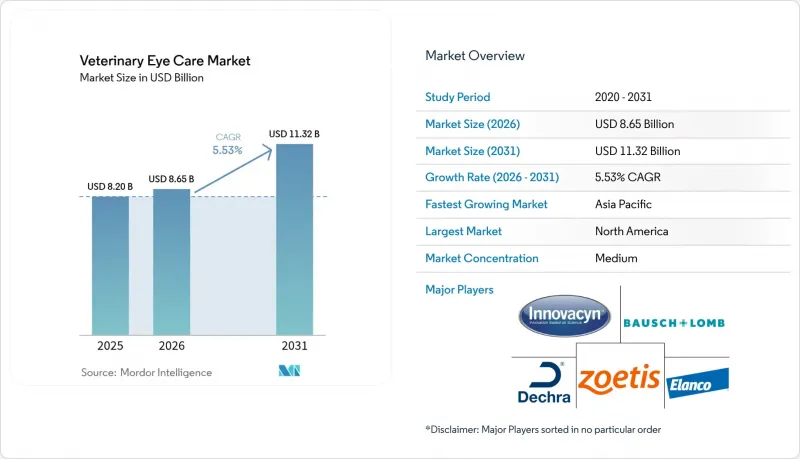
This report is Segmented by Products & Services (Products and Services), Application (Dog, Cat, Horses, and Other Animals), Application (Keratoconjunctivitis Sicca, Conjunctivitis, and More), End-User (Veterinary Hospitals, Veterinary Clinics, and Academic & Research Institutes) and Geography (North America, Europe, Asia-Pacific, and More). The Market Forecasts are Provided in Terms of Value (USD).
Global Veterinary Eye Care Market Trends and Insights
Growing Pet Ownership & Spend on Advanced Veterinary Care
United States households kept 87.3 million dogs and 76.3 million cats in 2025, and the average annual spend per dog and per cat reached USD 598 and USD 529, respectively. Routine wellness traffic fell, yet ophthalmology referrals rose, revealing a shift toward interventions that deliver a visible quality-of-life lift. Surveyed owners cite affordability and appointment scarcity as primary barriers, yet 37% still prioritize eye surgery when vision loss threatens activity levels. Millennials and Generation Z over-index on specialty procedures because they view pets as family. Although total veterinary expenditures dipped 4% between 2023 and 2024, clinics that prove rapid clinical gains continue to defend premium fees.
Rising Prevalence of Ocular Disorders in Companion Animals
A multi-year study covering 2021-2024 found ocular disease in 2.77% of dogs, led by cataracts, corneal ulcers, and conjunctivitis. Breed selection amplifies risk as French Bulldogs and Pinschers share narrow gene pools that magnify hereditary problems. The ACVO Blue Book now tracks more than 200 breed-linked eye defects, helping breeders test early, yet commercial incentives still favor popular brachycephalic lines. Equine recurrent uveitis affects up to 25% of horses in some regions, creating new demand for long-acting implants. Wider use of genetic screens uncovers subclinical lesions sooner, so the addressable population keeps rising.
Other drivers and restraints analyzed in the detailed report include:
- Expanding Portfolio of Topical Ophthalmic Drugs & Ointments
- Demand for Minimally Invasive Ophthalmic Surgeries
- High Cost of Advanced Ocular Equipment & Surgery
- Limited Insurance Reimbursement for Veterinary Eye Care
For complete list of drivers and restraints, kindly check the Table Of Contents.
Segment Analysis
Services generated rapid momentum, increasing at a 6.85% CAGR for 2026-2031, while products preserved a 75.55% revenue lead in 2025. Clinics increasingly unbundle diagnostics, surgery, and follow-up care from product sales, creating recurring service revenue. Tele-ophthalmology sessions let general practitioners triage conjunctivitis or dry eye before escalating complex ulcers. Even though no AI platform meets validation standards today, remote guidance already reduces referral wait times. The trajectory suggests that the Veterinary Eye Care market will continue to shift toward bundled procedure-plus-monitoring packages.
Drugs remain the backbone of revenue, anchored by cyclosporine ointment and triple-antibiotic gels registered under 21 CFR Part 524. Dechra's 2024 regenerative gel added a premium tier that accelerates corneal recovery and lowers surgery rates. Instruments and implants remain niche but command high prices due to precision engineering. Diagnostic devices such as rebound tonometers now occupy reception desks in mainstream clinics, narrowing the referral funnel and lifting procedure capture rates inside primary practices.
Dogs accounted for 50.53% of 2025 revenue, reflecting both population dominance and a genetic predisposition to cataracts and KCS. Yet the fastest growth lies in equine cases, where suprachoroidal cyclosporine implants fetch above USD 2,000 per eye. Owners of performance horses accept these costs to preserve their sport careers. Cats add volume with viral conjunctivitis and corneal sequestrum, but lower price points limit category value. Niche exotic rabbits and birds grow slowly as urban clinics add small-mammal service lines.
Dogs will retain mass-market importance, yet horses add disproportionate dollars per procedure. As stem-cell research matures, premium therapies may first migrate to equine referrals, then trickle into canine practice. Clinics that build mixed-animal expertise gain a hedge against demand swings inside any single species pool.
Complete Report Scope:
- By Products & Services
- Product
- Ophthalmic Drugs
- Surgical Instruments
- Diagnostic Devices & Imaging
- Ocular Implants & Disposables
- Services
- Ophthalmic Surgical Services
- Diagnostic Imaging Services
- Tele-Ophthalmology & Consultation
- Post-operative Care Services
- Product
- By Animal Type
- Dogs
- Cats
- Horses
- Other Animals
- By Application
- Keratoconjunctivitis Sicca (Dry Eye)
- Conjunctivitis
- Corneal Ulcers & Injuries
- Glaucoma
- Uveitis & Retinal Disorders
- Others
- By End-user
- Veterinary Hospitals
- Veterinary Clinics
- Academic & Research Institutes
- By Geography
- North America
- United States
- Canada
- Mexico
- Europe
- Germany
- United Kingdom
- France
- Italy
- Spain
- Rest of Europe
- Asia-Pacific
- China
- India
- Japan
- Australia
- South Korea
- Rest of Asia-Pacific
- Middle East and Africa
- GCC
- South Africa
- Rest of Middle East and Africa
- South America
- Brazil
- Argentina
- Rest of South America
- North America
Geography Analysis
North America retained 38.62% of 2025 global revenue, driven by dense specialty networks and 25%-plus pet insurance penetration. Average U.S. spend per dog touched USD 598 while overall vet spending slipped 4% as owners skipped routine checks but not sight-saving surgery. FDA sterility rules rolled out in 2024 give U.S. drug standards outsized global influence. Canada and Mexico expand steadily, though rural shortages of specialists mirror those in the U.S. farm belt.
Asia-Pacific records the quickest 6.22% CAGR through 2031. China's urban singles and seniors drive companion adoption, yet care remains city-centric. Japan's aging society values pet companionship, channeling spending into advanced surgery. Australia benefits from high insurance uptake and seamless EU-aligned regulation for imported devices. India and South Korea attract private equity to build multi-location chains that embed ophthalmology suites. Board-certified ophthalmologists remain rare, so simplified lasers and remote mentoring gain traction.
Europe offers mature demand, with Germany, the United Kingdom, and France leading specialty density. The EMA streamlines cross-border approvals, yet Eastern Europe faces staffing gaps. The United Kingdom's mix of lifetime and time-limited insurance plans affects reimbursement consistency. In the Middle East and Africa, only the United Arab Emirates and South Africa host sizeable referral centers, while Latin America's Brazil and Argentina grow but wrestle with currency and import duty volatility.
- Alcon
- Bausch + Lomb Corporation
- BOVA UK
- Ceva Sante Animale S.A.
- Covetrus
- Dechra Pharmaceuticals
- Eickemeyer Veterinary Equipment
- Elanco Animal Health Inc.
- Epicur Pharma
- I-Med Animal Health
- Innovacyn
- Merck & Co., Inc. (MSD Animal Health)
- Neogen
- OCuSOFT Inc.
- Santicare LLC
- Tarsus Pharmaceuticals Inc.
- Topcon
- Vetoquinol S.A.
- Zoetis
Additional Benefits:
- The market estimate (ME) sheet in Excel format
- 3 months of analyst support
TABLE OF CONTENTS
1 Introduction
- 1.1 Study Assumptions & Market Definition
- 1.2 Scope of the Study
2 Research Methodology
3 Executive Summary
4 Market Landscape
- 4.1 Market Overview
- 4.2 Market Drivers
- 4.2.1 Growing Pet Ownership & Spend on Advanced Veterinary Care
- 4.2.2 Rising Prevalence of Ocular Disorders in Companion Animals
- 4.2.3 Expanding Portfolio of Topical Ophthalmic Drugs & Ointments
- 4.2.4 Demand for Minimally Invasive Ophthalmic Surgeries
- 4.2.5 AI-Enabled Imaging & Tele-Ophthalmology Adoption
- 4.2.6 Stem-Cell and Other Regenerative Corneal-Repair Therapies
- 4.3 Market Restraints
- 4.3.1 High Cost of Advanced Ocular Equipment & Surgery
- 4.3.2 Limited Insurance Reimbursement for Veterinary Eye Care
- 4.3.3 Stringent Regulatory Approval Timelines for Veterinary Drugs
- 4.3.4 Shortage of Board-Certified Veterinary Ophthalmologists
- 4.4 Supply-Chain Analysis
- 4.5 Regulatory Landscape
- 4.6 Technological Outlook
- 4.7 Porter's Five Forces
- 4.7.1 Threat of New Entrants
- 4.7.2 Bargaining Power of Suppliers
- 4.7.3 Bargaining Power of Buyers
- 4.7.4 Threat of Substitutes
- 4.7.5 Competitive Rivalry
5 Market Size & Growth Forecasts (Value, USD)
- 5.1 By Products & Services
- 5.1.1 Product
- 5.1.1.1 Ophthalmic Drugs
- 5.1.1.2 Surgical Instruments
- 5.1.1.3 Diagnostic Devices & Imaging
- 5.1.1.4 Ocular Implants & Disposables
- 5.1.2 Services
- 5.1.2.1 Ophthalmic Surgical Services
- 5.1.2.2 Diagnostic Imaging Services
- 5.1.2.3 Tele-Ophthalmology & Consultation
- 5.1.2.4 Post-operative Care Services
- 5.1.1 Product
- 5.2 By Animal Type
- 5.2.1 Dogs
- 5.2.2 Cats
- 5.2.3 Horses
- 5.2.4 Other Animals
- 5.3 By Application
- 5.3.1 Keratoconjunctivitis Sicca (Dry Eye)
- 5.3.2 Conjunctivitis
- 5.3.3 Corneal Ulcers & Injuries
- 5.3.4 Glaucoma
- 5.3.5 Uveitis & Retinal Disorders
- 5.3.6 Others
- 5.4 By End-user
- 5.4.1 Veterinary Hospitals
- 5.4.2 Veterinary Clinics
- 5.4.3 Academic & Research Institutes
- 5.5 By Geography
- 5.5.1 North America
- 5.5.1.1 United States
- 5.5.1.2 Canada
- 5.5.1.3 Mexico
- 5.5.2 Europe
- 5.5.2.1 Germany
- 5.5.2.2 United Kingdom
- 5.5.2.3 France
- 5.5.2.4 Italy
- 5.5.2.5 Spain
- 5.5.2.6 Rest of Europe
- 5.5.3 Asia-Pacific
- 5.5.3.1 China
- 5.5.3.2 India
- 5.5.3.3 Japan
- 5.5.3.4 Australia
- 5.5.3.5 South Korea
- 5.5.3.6 Rest of Asia-Pacific
- 5.5.4 Middle East and Africa
- 5.5.4.1 GCC
- 5.5.4.2 South Africa
- 5.5.4.3 Rest of Middle East and Africa
- 5.5.5 South America
- 5.5.5.1 Brazil
- 5.5.5.2 Argentina
- 5.5.5.3 Rest of South America
- 5.5.1 North America
6 Competitive Landscape
- 6.1 Market Concentration
- 6.2 Market Share Analysis
- 6.3 Company Profiles (includes Global level Overview, Market level overview, Core Segments, Financials as available, Strategic Information, Market Rank/Share for key companies, Products & Services, and Recent Developments)
- 6.3.1 Alcon Inc.
- 6.3.2 Bausch + Lomb Corporation
- 6.3.3 BOVA UK
- 6.3.4 Ceva Sante Animale S.A.
- 6.3.5 Covetrus, Inc.
- 6.3.6 Dechra Pharmaceuticals PLC
- 6.3.7 Eickemeyer Veterinary Equipment
- 6.3.8 Elanco Animal Health Inc.
- 6.3.9 Epicur Pharma
- 6.3.10 I-Med Animal Health
- 6.3.11 Innovacyn Inc.
- 6.3.12 Merck & Co., Inc. (MSD Animal Health)
- 6.3.13 Neogen Corporation
- 6.3.14 OCuSOFT Inc.
- 6.3.15 Santicare LLC
- 6.3.16 Tarsus Pharmaceuticals Inc.
- 6.3.17 Topcon Corporation
- 6.3.18 Vetoquinol S.A.
- 6.3.19 Zoetis Inc.
7 Market Opportunities & Future Outlook
- 7.1 White-space & Unmet-need Assessment

