PUBLISHER: Mordor Intelligence | PRODUCT CODE: 2124605

PUBLISHER: Mordor Intelligence | PRODUCT CODE: 2124605
North America Liquid Hand Soap - Market Share Analysis, Industry Trends & Statistics, Growth Forecasts (2026 - 2031)
According to Mordor Intelligence, the North America liquid hand soap market size is expected to grow from USD 4.8 billion in 2025 to USD 5.07 billion in 2026 and is forecast to reach USD 6.63 billion by 2031 at 5.53% CAGR over 2026-2031.
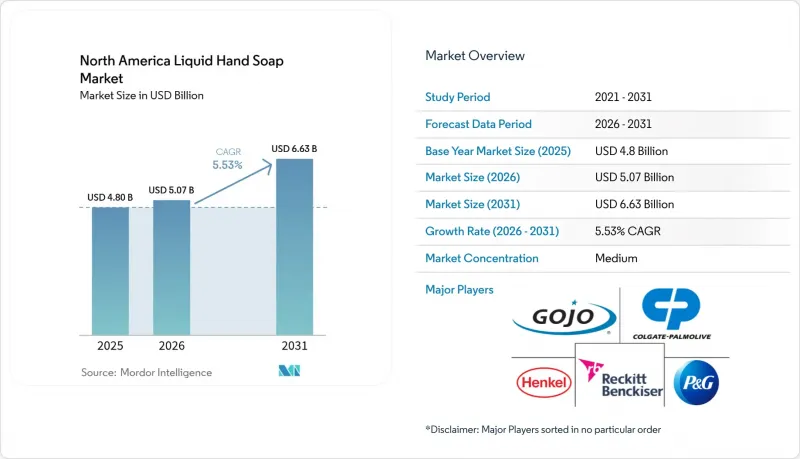
This report is Segmented by Packaging Type (Pump Dispensers, Bottles/Containers Refill, Pouches Refill, Wall-Mount Cartridges, and Others), End-User (Residential, Commercial), Category (Regular/Conventional, Natural/Organic), Product Type (Foaming, Gel-Based, Others), and Geography (United States, Canada, Mexico, Rest of North America). The Market Forecasts are Provided in Terms of Value (USD).
North America Liquid Hand Soap Market Trends and Insights
Sustainability-Led Shift to Refill and Recyclable Packs
California's SB 54 mandates that all packaging be recyclable or compostable by 2032, driving manufacturers toward mono-material pouches and closed-loop cartridges that cut plastic tonnage and freight costs. Henkel's Dial brand now employs 100% post-consumer recycled bottles, earning third-party GreenCircle certification while maintaining high production volumes at its Pennsylvania facility. Federal buyers accelerate this momentum through the GSA's listing program for single-use plastic-free packaging, granting visibility to compliant suppliers. Together, regulatory pressure and procurement incentives add roughly 1.2% to the market CAGR as converters re-tool lines for pouch laminates and refill systems.
SKU Premiumisation Through Skin-Care and Fragrance Cross-Over
Premium positioning through skin-care and fragrance integration transforms liquid hand soap from a commodity to an experiential product category, capturing higher margins and consumer loyalty. This premiumization strategy leverages the beauty industry's expertise in sensory formulation and ingredient storytelling. Ulta Beauty's Conscious Beauty program, encompassing over 300 participating brands with criteria including clean ingredients, sustainable packaging, and cruelty-free formulations, demonstrates retailer support for premium positioning. L'Oreal's commitment to 95% biobased ingredients and 100% recyclable plastic packaging by 2030 exemplifies how beauty conglomerates apply premium innovation capabilities to adjacent categories. The crossover strategy succeeds by addressing consumers' desire for multifunctional products that deliver cleansing efficacy alongside skin conditioning benefits. GOJO's PURELL HEALTHY SOAP incorporates natural moisturizers, skin conditioners, and spa-inspired formulations while maintaining hypoallergenic properties and excluding phthalates, parabens, and triclosan.
Regulatory and Retailer Pressure on Single-use Plastics
Escalating regulatory restrictions on single-use plastics create compliance costs and operational complexity that constrain market growth, particularly affecting traditional packaging formats. The Retail Industry Leaders Association documents heightened regulatory attention driven by ocean plastics concerns and recycling disruptions, with state regulations expanding beyond plastic bags to include containers, straws, and expanded polystyrene foodservice ware. California's SB 54 imposes civil penalties up to USD 50,000 per day per violation for non-compliance with recyclability and plastic reduction targets, creating significant financial exposure for manufacturers. The EU's Regulation 2025/40 on Packaging and Packaging Waste, effective August 2026, sets binding reduction targets of 5% by 2030, 10% by 2035, and 15% by 2040, influencing global suppliers who serve multiple markets, such as SGS. Compliance requires substantial investment in alternative packaging materials, redesigned dispensing systems, and supply chain modifications. The regulatory pressure reduces market CAGR by 0.8% as manufacturers absorb transition costs and navigate complex compliance requirements across multiple jurisdictions.
Other drivers and restraints analyzed in the detailed report include:
- Touchless Dispenser Adoption in Commercial Spaces
- Biosurfactant and Hypoallergenic Formulations Uptake
- Contamination Risk in Bulk-refill Dispensers
For complete list of drivers and restraints, kindly check the Table Of Contents.
Segment Analysis
Pump dispensers retained 38.56% of the North America liquid hand soap market in 2025, supported by entrenched household habits and widespread fixture compatibility. Yet pouches are adding 5.17% CAGR, capturing buyers focused on reduced plastic and lower logistics costs. Brands such as Diversey supply monolayer polyethylene pouches that refill multiple trigger bottles, cutting virgin resin weight per use. This momentum positions pouches as the headline growth story within the North America liquid hand soap market.
Wall-mount cartridges and bulk gallon jugs continue serving institutional environments, but contamination concerns reinforce sealed formats. Bottles designed for in-store refill stations bridge the transition, appealing to eco-minded shoppers without demanding fixture changes. Regulatory clauses in 21 CFR 117.37 on sanitary facilities encourage operators to invest in proven dispensing integrity, indirectly benefiting high-grade packaging suppliers.
Residential buyers accounted for 53.12% of the North America liquid hand soap market size in 2025, reflecting daily household hygiene routines. However, commercial demand is scaling faster at 5.86% CAGR, led by hospitals, restaurants, and schools compelled to sustain stringent wash standards. CDC guidance elevates soap-and-water efficacy over sanitizers when hands are visibly soiled, reinforcing unit volume growth in large venues.
Federal agencies prioritize domestically made options under Buy American provisions, funneling volumes toward U.S. manufacturers able to demonstrate local content. Corporate campuses and travel hubs also deploy sensor-activated dispensers that favor higher-margin proprietary refill cartridges, sharpening commercial segment profitability across the North America liquid hand soap market.
Complete Report Scope:
- By Packaging Type
- Pump Dispensers
- Bottles/Containers (Refill)
- Pouches (Refill)
- Wall-Mount Cartridges
- Bulk Gallon Jugs
- Others
- By End-user
- Residential
- Commercial
- By Category
- Regular/ Conventional
- Natural/ Organic
- By Product Type
- Foaming
- Gel-based
- Others
- Geography
- United States
- Canada
- Mexico
- Rest of North America
List of Companies Covered in this Report:
- Colgate-Palmolive Company (Softsoap)
- GOJO Industries Inc.
- Henkel AG & Co. KGaA (Dial)
- Reckitt Benckiser Group PLC (Dettol)
- Unilever PLC (Seventh Generation)
- Procter & Gamble Co. (Safeguard)
- S. C. Johnson & Son Inc.
- Kao Corporation
- Vi-Jon LLC
- 3M Company
- Ecolab Inc.
- The Hain Celestial Group Inc.
- The J. R. Watkins Co.
- Dr. Bronner's Magic Soaps
- Honest Company Inc.
- Church & Dwight Co. Inc.
- Kimberly-Clark Corporation
- Blyth Inc. (Method)
- Seventh Generation Inc.
- L'Occitane en Provence
Additional Benefits:
- The market estimate (ME) sheet in Excel format
- 3 months of analyst support
TABLE OF CONTENTS
1 Introduction
- 1.1 Study Assumptions and Market Definition
- 1.2 Scope of the Study
2 Research Methodology
3 Executive Summary
4 Market Landscape
- 4.1 Market Overview
- 4.2 Market Drivers
- 4.2.1 Sustainability-led shift to refill and recyclable packs
- 4.2.2 SKU premiumisation through skin-care and fragrance cross-over
- 4.2.3 Touchless dispenser adoption in commercial spaces
- 4.2.4 Biosurfactant and hypoallergenic formulations uptake
- 4.2.5 Federal -Buy-American- hygiene procurement clauses
- 4.2.6 Technology advancements in manufacturing
- 4.3 Market Restraints
- 4.3.1 Regulatory and retailer pressure on single-use plastics
- 4.3.2 Price war versus bar-soap & tablet concentrates
- 4.3.3 Contamination risk in bulk-refill dispensers
- 4.3.4 Shrinkflation scrutiny limiting pack-size tactics
- 4.4 Value / Supply-Chain Analysis
- 4.5 Regulatory Landscape
- 4.6 Porter's Five Forces
- 4.6.1 Threat of New Entrants
- 4.6.2 Bargaining Power of Buyers/Consumers
- 4.6.3 Bargaining Power of Suppliers
- 4.6.4 Threat of Substitute Products
- 4.6.5 Intensity of Competitive Rivalry
5 Market Size and Growth Forecasts
- 5.1 By Packaging Type
- 5.1.1 Pump Dispensers
- 5.1.2 Bottles/Containers (Refill)
- 5.1.3 Pouches (Refill)
- 5.1.4 Wall-Mount Cartridges
- 5.1.5 Bulk Gallon Jugs
- 5.1.6 Others
- 5.2 By End-user
- 5.2.1 Residential
- 5.2.2 Commercial
- 5.3 By Category
- 5.3.1 Regular/ Conventional
- 5.3.2 Natural/ Organic
- 5.4 By Product Type
- 5.4.1 Foaming
- 5.4.2 Gel-based
- 5.4.3 Others
- 5.5 Geography
- 5.5.1 United States
- 5.5.2 Canada
- 5.5.3 Mexico
- 5.5.4 Rest of North America
6 Competitive Landscape
- 6.1 Market Concentration
- 6.2 Strategic Moves
- 6.3 Market Share Analysis
- 6.4 Company Profiles (includes Global level Overview, Market level overview, Core Segments, Financials as available, Strategic Information, Market Rank/Share for key companies, Products & Services, and Recent Developments)
- 6.4.1 Colgate-Palmolive Company (Softsoap)
- 6.4.2 GOJO Industries Inc.
- 6.4.3 Henkel AG & Co. KGaA (Dial)
- 6.4.4 Reckitt Benckiser Group PLC (Dettol)
- 6.4.5 Unilever PLC (Seventh Generation)
- 6.4.6 Procter & Gamble Co. (Safeguard)
- 6.4.7 S. C. Johnson & Son Inc.
- 6.4.8 Kao Corporation
- 6.4.9 Vi-Jon LLC
- 6.4.10 3M Company
- 6.4.11 Ecolab Inc.
- 6.4.12 The Hain Celestial Group Inc.
- 6.4.13 The J. R. Watkins Co.
- 6.4.14 Dr. Bronner's Magic Soaps
- 6.4.15 Honest Company Inc.
- 6.4.16 Church & Dwight Co. Inc.
- 6.4.17 Kimberly-Clark Corporation
- 6.4.18 Blyth Inc. (Method)
- 6.4.19 Seventh Generation Inc.
- 6.4.20 L'Occitane en Provence
7 Market Opportunities and Future Outlook

