PUBLISHER: Mordor Intelligence | PRODUCT CODE: 2124611

PUBLISHER: Mordor Intelligence | PRODUCT CODE: 2124611
United States And Europe Reusable Plastic Returnable Transport Packaging - Market Share Analysis, Industry Trends & Statistics, Growth Forecasts (2026 - 2031)
According to Mordor Intelligence, United States and Europe reusable plastic returnable transport packaging market size in 2026 is estimated at USD 24 billion, growing from 2025 value of USD 23.25 billion with 2031 projections showing USD 28.14 billion, growing at 3.21% CAGR over 2026-2031.
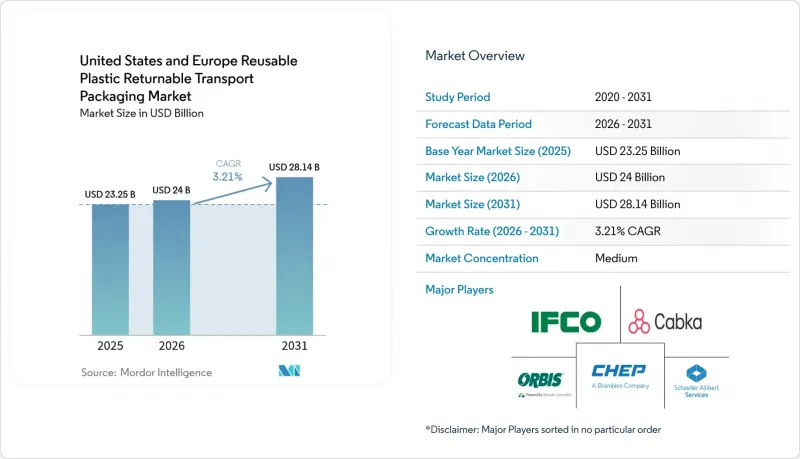
This report is Segmented by Material (HDPE, PP and More), Product Type (RPCs, Pallets, Crates, Ibcs and More), End-User (Food and Beverage, Automotive, Electronics, Chemicals and More), Distribution Model (Pooled, Captive) and Geography the Market Forecasts are Provided in Terms of Value (USD).
United States And Europe Reusable Plastic Returnable Transport Packaging Market Trends and Insights
Favorable Governmental Regulations on Circular Packaging
Royal Decree 1055/2022 in Spain imposes a EUR 0.45 per kilogram (USD 0.50 per kilogram) tax on non-reusable plastic and mandates 65% reuse by 2030, prompting rapid container conversion. California's Senate Bill 54 requires a 25% cut in single-use formats by 2032, influencing procurement across the state's USD 3.6 trillion economy. The EU Packaging and Packaging Waste Regulation sets a 10% reuse goal for transport packaging by 2030, reinforcing investments by multinational shippers. Federal procurement rules under the U.S. Environmental Protection Agency now prioritize reusable options, expanding demand from public-sector contractors. Collectively, these policies supply a durable tailwind for the reusable plastic returnable transport packaging market.
Warehouse and Distribution-Center Automation Accelerating RTP Uptake
Automated storage and retrieval systems prefer uniform containers with RFID tags, pushing enterprises toward reusable units. General Motors achieved a 23% drop in material-handling expense after standardizing containers across 15 plants in 2024. IEEE guidelines for IoT sensor installation in containers have lifted 98.5% asset visibility, enabling lights-out warehouse shifts. Multichannel fulfillment centers that ship 10,000 SKUs or more have reported 15-20% efficiency gains from reusable container use. Amazon fulfillment case work shows 40% higher robotic throughput with standardized totes, underscoring automation's multiplier effect.
Stakeholder Resistance to Process Change
Switching to reusable systems requires cross-enterprise coordination, and plants often endure 8-12% temporary productivity dips during the 6-18-month ramp-up. Many warehouse-management solutions cannot natively track reusable pools, forcing costly upgrades. Small and midsized companies struggle with minimum-volume thresholds imposed by pooling operators. Training expenses further dampen adoption, as staff must learn inspection and return protocols unfamiliar in single-use workflows. Mid-tier automotive suppliers have spent USD 150,000-300,000 on warehouse retrofits and training for reusable rollouts, illustrating the transition hurdle
Other drivers and restraints analyzed in the detailed report include:
- E-Grocery and Meal-Kit Boom Driving Crate Demand
- ESG-Linked Retailer Financing Programs
- Competition from Fibre-Based Alternatives
For complete list of drivers and restraints, kindly check the Table Of Contents.
Segment Analysis
HDPE accounts for 53.88% of the reusable plastic returnable transport packaging market. Its proven ruggedness across -40 °C to +60 °C keeps it the default for automotive and food logistics, even as price swings of 18% in 2024 triggered scrutiny of lifecycle cost spreads. Polypropylene claims the fastest 4.23% CAGR on the back of lightweighting and tight chemical-resistance needs. Ford cut container weight 23% by switching engine-part carriers to PP in 2024. Recycled-content mandates tilt in HDPE's favor because established streams can meet 25-30% content without property loss, shielding users from virgin-resin volatility.
Second-order trends include rising clarity requirements for pharmaceutical lines that give polycarbonate a toehold. Silver-ion antimicrobial mandates lift resin costs by 15-20%, yet users accept premiums when food-contact rules tighten. Overall, material choice now weighs total-cost-per-trip, recyclability, and regulatory compliance rather than resin sticker price alone, ensuring HDPE retains leadership while PP builds share in high-performance niches.
Pallets supplied 37.74% of sector revenue in 2025 and remain the bedrock of fast-moving consumer goods flows. Standard footprint, automated handling compatibility, and global pooling coverage cement their dominant position. The reusable plastic returnable transport packaging market size tied to pallets will keep pace with industrial-production growth rather than outpace it, reflecting a near-saturation environment.
Intermediate bulk containers show the highest 4.66% CAGR as chemical and food-ingredient shippers abandon steel due to corrosion and weight. Dow Chemical trimmed container mass by 35% and saved EUR 1.8 million (USD 2.0 million) annually in 2024 after switching to plastic IBCs. UN performance tests and hazardous-goods mandates favor certified suppliers, raising barriers for late entrants but supporting premium pricing for incumbents. Totes and crates continue to benefit from e-commerce automation but remain subscale relative to pallets and IBCs.
Complete Report Scope:
- By Material
- High-Density Polyethylene
- Polypropylene
- Other Materials
- By Product Type
- Reusable Plastic Containers (RPCs)
- Pallets
- Crates and Totes
- Intermediate Bulk Containers (IBCs)
- Other Product Types
- By End-User Industry
- Food and Beverage
- Automotive
- Consumer Durables and Electronics
- Industrial and Chemicals
- Other End-user Industries
- By Distribution Model
- Pooled / Rental
- Captive Ownership
- By Geography
- United States
- Europe
- United Kingdom
- Germany
- France
- Spain
- Rest of Europe
List of Companies Covered in this Report:
- IFCO Systems N.V.
- Brambles Limited (CHEP)
- Schoeller Allibert Services B.V.
- Orbis Corporation (Menasha Corporation)
- CABKA N.V.
- SSI Schaefer Systems International GmbH
- Rehrig Pacific Company
- Tosca Services LLC
- RPP Containers Inc.
- Corplex SAS
- Friedola TECH GmbH (Con-Pearl)
- Friedola TECH GmbH (Con-Pearl)
- Sohner Plastics LLC
- Conteyor NV
- KTP Kunststoff-Palettentechnik GmbH
- Wellplast AB
- AUER Packaging GmbH
- W.I. Sales Co. Inc.
- Wisechmann GmbH
- DW Reusables NV
Additional Benefits:
- The market estimate (ME) sheet in Excel format
- 3 months of analyst support
TABLE OF CONTENTS
1 INTRODUCTION
- 1.1 Study Assumptions and Market Definition
- 1.2 Scope of the Study
2 RESEARCH METHODOLOGY
3 EXECUTIVE SUMMARY
4 MARKET LANDSCAPE
- 4.1 Market Overview
- 4.2 Market Drivers
- 4.2.1 Favourable governmental regulations on circular packaging
- 4.2.2 Warehouse and DC automation accelerating RTP uptake
- 4.2.3 E-grocery and meal-kit boom driving crate demand
- 4.2.4 ESG-linked retailer financing programmes
- 4.2.5 AI-enabled asset-tracking reduces shrinkage
- 4.2.6 Scope-3-emission disclosure mandates
- 4.3 Market Restraints
- 4.3.1 Stakeholder resistance to process change
- 4.3.2 Competition from fibre-based alternatives
- 4.3.3 Reverse-logistics labour shortages
- 4.3.4 Antimicrobial compliance cost escalation
- 4.4 Industry Value Chain Analysis
- 4.5 Regulatory Landscape
- 4.6 Technological Outlook
- 4.7 Porters Five Forces Analysis
- 4.7.1 Bargaining Power of Suppliers
- 4.7.2 Bargaining Power of Buyers
- 4.7.3 Threat of New Entrants
- 4.7.4 Threat of Substitutes
- 4.7.5 Intensity of Rivalry
- 4.8 The Impact of Macroeconomic Factors on the Market
5 MARKET SIZE AND GROWTH FORECASTS (VALUE)
- 5.1 By Material
- 5.1.1 High-Density Polyethylene
- 5.1.2 Polypropylene
- 5.1.3 Other Materials
- 5.2 By Product Type
- 5.2.1 Reusable Plastic Containers (RPCs)
- 5.2.2 Pallets
- 5.2.3 Crates and Totes
- 5.2.4 Intermediate Bulk Containers (IBCs)
- 5.2.5 Other Product Types
- 5.3 By End-User Industry
- 5.3.1 Food and Beverage
- 5.3.2 Automotive
- 5.3.3 Consumer Durables and Electronics
- 5.3.4 Industrial and Chemicals
- 5.3.5 Other End-user Industries
- 5.4 By Distribution Model
- 5.4.1 Pooled / Rental
- 5.4.2 Captive Ownership
- 5.5 By Geography
- 5.5.1 United States
- 5.5.2 Europe
- 5.5.2.1 United Kingdom
- 5.5.2.2 Germany
- 5.5.2.3 France
- 5.5.2.4 Spain
- 5.5.2.5 Rest of Europe
6 COMPETITIVE LANDSCAPE
- 6.1 Market Concentration
- 6.2 Strategic Moves
- 6.3 Market Share Analysis
- 6.4 Company Profiles (includes Global Overview, Market Overview, Core Segments, Financials, Strategic Information, Share, Products and Services, Recent Developments)
- 6.4.1 IFCO Systems N.V.
- 6.4.2 Brambles Limited (CHEP)
- 6.4.3 Schoeller Allibert Services B.V.
- 6.4.4 Orbis Corporation (Menasha Corporation)
- 6.4.5 CABKA N.V.
- 6.4.6 SSI Schaefer Systems International GmbH
- 6.4.7 Rehrig Pacific Company
- 6.4.8 Tosca Services LLC
- 6.4.9 RPP Containers Inc.
- 6.4.10 Corplex SAS
- 6.4.11 Friedola TECH GmbH (Con-Pearl)
- 6.4.12 Friedola TECH GmbH (Con-Pearl)
- 6.4.13 Sohner Plastics LLC
- 6.4.14 Conteyor NV
- 6.4.15 KTP Kunststoff-Palettentechnik GmbH
- 6.4.16 Wellplast AB
- 6.4.17 AUER Packaging GmbH
- 6.4.18 W.I. Sales Co. Inc.
- 6.4.19 Wisechmann GmbH
- 6.4.20 DW Reusables NV
7 MARKET OPPORTUNITIES AND FUTURE OUTLOOK
- 7.1 White-Space and Unmet-Need Assessment

