PUBLISHER: Mordor Intelligence | PRODUCT CODE: 2124612

PUBLISHER: Mordor Intelligence | PRODUCT CODE: 2124612
Ultrasound Gel - Market Share Analysis, Industry Trends & Statistics, Growth Forecasts (2026 - 2031)
According to Mordor Intelligence, the ultrasound gel market size is expected to grow from USD 107.53 million in 2025 to USD 111.91 million in 2026 and is forecast to reach USD 136.55 million by 2031 at 4.07% CAGR over 2026-2031.
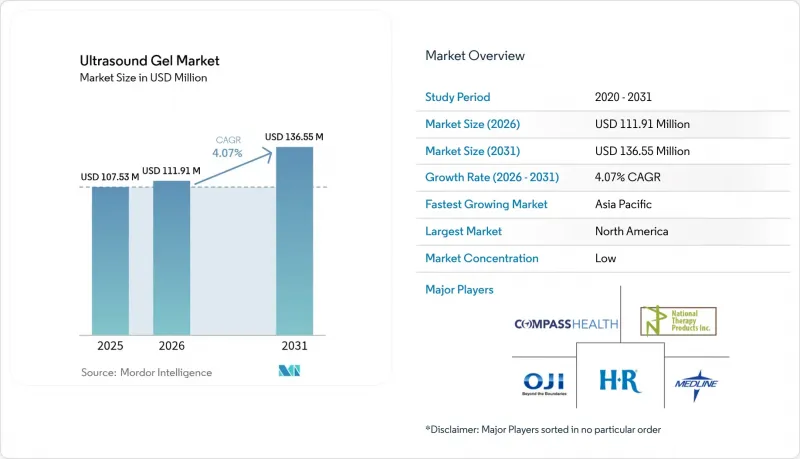
This report is Segmented by Product Type (Non-Sterile, Sterile), Application (Diagnostic Imaging, Therapeutic Ultrasound & Physiotherapy, Aesthetic & Dermatology Procedures), End User (Hospitals & Clinics, Diagnostic Imaging Centers, and More), and Geography (North America, Europe, Asia-Pacific, Middle East & Africa, South America). The Market Forecasts are Provided in Terms of Value (USD).
Global Ultrasound Gel Market Trends and Insights
Rising Adoption of Point-of-Care Ultrasound (POCUS) in Emergency & Primary Care
POCUS devices are moving routine imaging from radiology suites to triage rooms and community clinics, sharply widening the user base for single-use gels. WONCA formally recognized POCUS as a core diagnostic tool for family physicians in 2024, validating demand among primary-care providers. Market penetration of handheld probes such as Vscan Air, Mindray TE Air, Lumify, and Butterfly iQ+ demonstrates a clear link between portable hardware and incremental gel consumption. Sterile packettes minimize cross-contamination when devices travel between patients, aligning with infection-control protocols. As POCUS becomes routine in ambulances and telehealth visits, manufacturers are developing pocket-sized sachets designed for quick disposal. This adoption trend is expected to lift baseline unit volumes even in mature hospital markets.
Rapid Procedure Growth in Obstetric & Gynecologic Ultrasound
Medical schools are incorporating simulator-based training programs that accelerate proficiency in obstetric and gynecologic scanning. Higher graduation rates of skilled sonographers translate into more scans per facility, raising steady-state gel demand. Procedure volumes are also expanding in private fertility clinics and midwifery practices, where ultrasound confirms fetal well-being without radiation exposure. Asia-Pacific markets, especially India and China, show steep growth in ante-natal screening programs, reinforcing regional consumption of cost-efficient non-sterile bottles. Product innovations now include color-tinted gels that improve visualization during chorionic-villus sampling, underscoring the need for niche formulations.
Emergence of Gel-Free Dry Transducer & Membrane-Coupling Technologies
Research groups have demonstrated conformable ultrasound patches that create cavitation pockets without coupling gel, achieving 26.2-fold transdermal delivery of active ingredients in pre-clinical trials. Dermatology practices also experiment with water-filled gloves and disposable membranes as quick alternatives to gel coatings. While commercialization remains early, institutional buyers may pivot once dry interfaces reach cost parity, posing a structural threat to long-range volume growth. Gel suppliers are responding with hybrid products that pair thin hydrogel layers with disposable membranes, aiming to slow adoption of fully gel-free systems.
Other drivers and restraints analyzed in the detailed report include:
- Shift Toward High-Frequency Linear Transducers Requiring Low-Viscosity, Air-Bubble-Free Gels
- Expansion of Home-Based Physiotherapy & Aesthetic Ultrasound Treatments
- Regulatory Scrutiny of Preservatives Elevating Reformulation Costs
For complete list of drivers and restraints, kindly check the Table Of Contents.
Segment Analysis
Non-sterile gels retained a 70.84% revenue share in 2025, driven by routine radiology and physiotherapy sessions that collectively absorb high daily volumes. The ultrasound gel market size for non-sterile bottles is projected to grow steadily despite increasing unit conversion to sterile packettes. Hospitals remain primary buyers, but sports-medicine clinics and academic labs constitute a stable secondary channel. Vendors emphasize pump-style packaging that limits backflow contamination during high-throughput scanning days.
Sterile formulations, although smaller in absolute terms, are projected to post an 8.18% CAGR through 2031, the fastest within product segmentation. Stringent infection-control protocols in interventional radiology suites and intensive-care units underpin this trajectory. The ultrasound gel market share for sterile packettes is expected to climb as disposable sachets replace bulk bottles in invasive procedures. Manufacturers are leveraging gamma-irradiation and e-beam sterilization to preserve rheology while achieving validated sterility assurance levels.
Complete Report Scope:
- By Product Type
- Non-Sterile
- Sterile
- By Application
- Diagnostic Imaging
- Therapeutic Ultrasound & Physiotherapy
- Aesthetic & Dermatology Procedures
- By End User
- Hospitals & Clinics
- Diagnostic Imaging Centers
- Physiotherapy/Sports Medicine Centers
- Home-Care & Retail Consumers
- By Geography
- North America
- United States
- Canada
- Mexico
- Europe
- Germany
- United Kingdom
- France
- Italy
- Spain
- Rest of Europe
- Asia-Pacific
- China
- Japan
- India
- Australia
- South Korea
- Rest of Asia-Pacific
- Middle East & Africa
- GCC
- South Africa
- Rest of Middle East & Africa
- South America
- Brazil
- Argentina
- Rest of South America
- North America
Geography Analysis
North America accounted for 38.92% of global revenue in 2025. High procedure density, favorable reimbursement, and early adoption of POCUS underpin this leadership. Hospitals increasingly standardize on sterile packettes for invasive use, bolstering premium segment growth. Providers also pilot gel-free patches, illustrating the region's dual role as volume anchor and innovation testbed. Academic grants fund biodegradable-packaging research, opening doors for suppliers offering plant-based sachets.
Asia-Pacific is the fastest-growing territory with an 8.54% CAGR. Expanding health-insurance coverage enables mid-tier city hospitals in China and India to procure portable ultrasound carts, thereby uplifting annual scan counts. Local manufacturers penetrate price-sensitive markets with cost-optimized non-sterile gels, but multinationals still dominate specialty sterile products. Urban consumers increasingly seek at-home aesthetic treatments, feeding retail demand. Government screening campaigns for maternal-fetal health further propel volume.
Europe maintains a sizeable footprint, although growth is modest relative to Asia-Pacific. Strict preservative guidelines compel continuous reformulation, raising compliance costs but also differentiating premium offerings. Sustainability mandates spur experimentation with PLA and PHA sachet materials, with pilot programs underway in Germany and the Nordics. Hospitals embrace tele-ultrasound services for geriatric care, indirectly boosting single-use packette consumption.
Middle East & Africa and South America contribute smaller but rising shares. GCC nations invest in high-end diagnostic centers, favoring sterile packettes that complement imported ultrasound consoles. Brazilian obstetric practices ramp up routine prenatal scans, while Argentina's private clinics adopt aesthetic ultrasound in metropolitan areas. Local distributors form exclusive agreements with Parker Laboratories, HR Pharmaceuticals, and Medline to secure supply continuity.
- Parker Laboratories
- HR Pharmaceuticals Inc.
- Medline Industries
- Compass Health
- National Therapy Products
- Sonogel Vertriebs
- Ultragel Medical
- Besmed Health Business
- Scrip
- Sonofax
- Eco-Med Diagnostic Imaging
- Phyto Performance Italia
- OrthoCanada
- RehabMedic S.L.
- Dynarex
- Roscoe Medical
- L&R USA Inc.
- Geltek-Medica Ltd.
- Zeyco
Additional Benefits:
- The market estimate (ME) sheet in Excel format
- 3 months of analyst support
TABLE OF CONTENTS
1 Introduction
- 1.1 Study Assumptions & Market Definition
- 1.2 Scope of the Study
2 Research Methodology
3 Executive Summary
4 Market Landscape
- 4.1 Market Overview
- 4.2 Market Drivers
- 4.2.1 Rising Adoption of Point-of-Care Ultrasound (POCUS) in Emergency & Primary Care, Boosting Gel Consumption
- 4.2.2 Rapid Procedure Growth in Obstetric & Gynecologic Ultrasound
- 4.2.3 Shift Toward High-Frequency Linear Transducers Requiring Low-Viscosity, Air-Bubble-Free Gels
- 4.2.4 Expansion of Home-based Physiotherapy & Aesthetic Ultrasound Treatments Stimulating Retail/E-commerce Sales
- 4.2.5 Proliferation of Handheld & Wireless Ultrasound Devices
- 4.2.6 Growing Use of Ultrasound in Sports Medicine
- 4.3 Market Restraints
- 4.3.1 Emergence of Gel-Free Dry Transducer & Membrane-Coupling Technologies
- 4.3.2 Regulatory Scrutiny of Preservatives Elevating Reformulation Costs
- 4.3.3 Disposal Challenges for Single-Use Plastic Sachets in Sustainability-Focused Regions
- 4.3.4 Temperature Sensitivity & Patient Discomfort
- 4.4 Porter's Five Forces Analysis
- 4.4.1 Threat of New Entrants
- 4.4.2 Bargaining Power of Buyers/Consumers
- 4.4.3 Bargaining Power of Suppliers
- 4.4.4 Threat of Substitute Products
- 4.4.5 Intensity of Competitive Rivalry
5 Market Size & Growth Forecasts (Value in USD)
- 5.1 By Product Type
- 5.1.1 Non-Sterile
- 5.1.2 Sterile
- 5.2 By Application
- 5.2.1 Diagnostic Imaging
- 5.2.2 Therapeutic Ultrasound & Physiotherapy
- 5.2.3 Aesthetic & Dermatology Procedures
- 5.3 By End User
- 5.3.1 Hospitals & Clinics
- 5.3.2 Diagnostic Imaging Centers
- 5.3.3 Physiotherapy/Sports Medicine Centers
- 5.3.4 Home-Care & Retail Consumers
- 5.4 By Geography
- 5.4.1 North America
- 5.4.1.1 United States
- 5.4.1.2 Canada
- 5.4.1.3 Mexico
- 5.4.2 Europe
- 5.4.2.1 Germany
- 5.4.2.2 United Kingdom
- 5.4.2.3 France
- 5.4.2.4 Italy
- 5.4.2.5 Spain
- 5.4.2.6 Rest of Europe
- 5.4.3 Asia-Pacific
- 5.4.3.1 China
- 5.4.3.2 Japan
- 5.4.3.3 India
- 5.4.3.4 Australia
- 5.4.3.5 South Korea
- 5.4.3.6 Rest of Asia-Pacific
- 5.4.4 Middle East & Africa
- 5.4.4.1 GCC
- 5.4.4.2 South Africa
- 5.4.4.3 Rest of Middle East & Africa
- 5.4.5 South America
- 5.4.5.1 Brazil
- 5.4.5.2 Argentina
- 5.4.5.3 Rest of South America
- 5.4.1 North America
6 Competitive Landscape
- 6.1 Market Concentration
- 6.2 Market Share Analysis
- 6.3 Company Profiles (includes Global level Overview, Market level overview, Core Segments, Financials as available, Strategic Information, Market Rank/Share for key companies, Products & Services, and Recent Developments)
- 6.3.1 Parker Laboratories Inc.
- 6.3.2 HR Pharmaceuticals Inc.
- 6.3.3 Medline Industries LP
- 6.3.4 Compass Health Brands
- 6.3.5 National Therapy Products Inc.
- 6.3.6 Sonogel Vertriebs GmbH
- 6.3.7 Ultragel Medical
- 6.3.8 Besmed Health Business Corp.
- 6.3.9 Scrip Inc.
- 6.3.10 Sonofax
- 6.3.11 Eco-Med Diagnostic Imaging
- 6.3.12 Phyto Performance Italia
- 6.3.13 OrthoCanada
- 6.3.14 RehabMedic S.L.
- 6.3.15 Dynarex Corporation
- 6.3.16 Roscoe Medical
- 6.3.17 L&R USA Inc.
- 6.3.18 Geltek-Medica Ltd.
- 6.3.19 Zeyco
7 Market Opportunities & Future Outlook
- 7.1 White-Space & Unmet-Need Assessment

