PUBLISHER: Mordor Intelligence | PRODUCT CODE: 2124651

PUBLISHER: Mordor Intelligence | PRODUCT CODE: 2124651
Sickle Cell Treatment - Market Share Analysis, Industry Trends & Statistics, Growth Forecasts (2026 - 2031)
According to Mordor Intelligence, the global sickle cell treatment market size was valued at USD 3.69 billion in 2025 and estimated to grow from USD 4.23 billion in 2026 to reach USD 8.41 billion by 2031, at a CAGR of 14.72% during the forecast period (2026-2031).
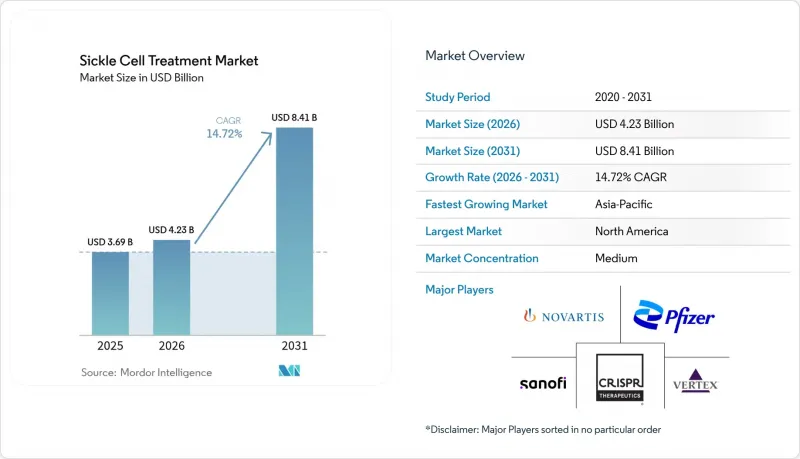
This report is Segmented by Treatment Modality (Blood Transfusion, HSCT, Pharmacotherapy, Gene-Editing Therapies), Patient Age Group (Pediatric 0-17 Yrs, Adult 18-49 Yrs, Older Adult 50+ Yrs), Disease Severity (Acute Crisis, Chronic Disease-Modifying, Curative), End-User (Hospitals, Specialty Clinics, and More), and Geography. The Market Forecasts are Provided in Terms of Value (USD).
Global Sickle Cell Treatment Market Trends and Insights
Increasing Prevalence of Sickle-Cell Mutations
Global births affected by sickle cell disease reached 515,000 in 2021, and annual mortality remains high at 376,000 deaths, sustaining multi-regional demand for therapeutic interventions. Nigeria drives one-third of the global patient pool, while migration elevates case numbers in Europe and the Gulf. National registries in Saudi Arabia track 22,956 patients across state facilities, enabling care coordination and real-world data capture. Longevity gains in high-income countries create a second surge of adult patients who require long-term disease-modifying or curative options.
Robust Late-Stage R&D Pipeline
Clinical momentum remains strong as gene editors, metabolic modulators, and epigenetic regulators advance through Phase 2 and Phase 3 programs. Etavopivat shows reduction in vaso-occlusive crises, mitapivat targets red cell metabolism, and next-generation agents such as Novartis dWIZ-1 and Fulcrum's epigenetic candidates broaden mechanisms of action. Trial designs integrate patient-reported outcomes and real-world evidence, streamlining approval packages and lowering commercialization risk.
High Total Cost of Care & Single-Use Gene-Editing Prices
Commercial list prices of USD 2.2 million for Casgevy and USD 3.1 million for Lyfgenia create affordability stress despite projected lifetime savings from reduced hospitalizations. Bluebird Bio established more than 70 treatment centers, yet uptake stalled as payers negotiated outcome-linked payment schedules. Additional costs for conditioning, hospitalization, and monitoring inflate total spending envelopes, delaying widespread access.
Other drivers and restraints analyzed in the detailed report include:
- Regulatory Fast-Track & Orphan-Drug Incentives
- Commercial Rollout of Disease-Modifying Drugs
- Cold-Chain & Infusion-Centre Infrastructure Gaps in LMICs
For complete list of drivers and restraints, kindly check the Table Of Contents.
Segment Analysis
Gene editing commanded the fastest trajectory with a 17.05% CAGR between 2026 and 2031, reflecting strong payer interest in one-time curative interventions. Pharmacotherapy retained 45.97% of revenue in 2025, underscoring entrenched demand for hydroxyurea and recently introduced disease-modifying drugs. The sickle cell treatment market size for pharmacotherapy reached USD 1.7 billion in 2025, while gene-editing's share was smaller but accelerating following Casgevy and Lyfgenia approvals. Stem cell transplantation continues to face donor limitations and conditioning-related morbidity that restrict procedural volumes.
Bluebird Bio and Vertex selected divergent roll-out strategies. Bluebird prioritized broad treatment-site certification, whereas Vertex focused on streamlined patient funneling through 35 hubs to improve throughput. Tessera Therapeutics explores in-vivo gene writers that could bypass harvesting and reinfusion steps, potentially lowering cost-to-serve and expanding the sickle cell treatment market in resource-limited settings.
Adult patients aged 18-49 posted a 15.76% CAGR, supported by survival gains and inclusion in gene-therapy eligibility criteria. The pediatric segment held a 50.12% sickle cell treatment market share in 2025, backed by mandatory screening and early intervention programs. Saudi registry averages indicate a patient age of 28 years, reflecting successful transition to adult care.
Higher age groups bring cumulative organ complications, driving combination therapy regimens and multidisciplinary follow-up. Adult uptake of gene therapy is rising where financing and clinical capacity align, enlarging the sickle cell treatment market size for advanced modalities.
Complete Report Scope:
- By Treatment Modality
- Blood Transfusion
- Hematopoietic Stem-Cell Transplant (HSCT)
- Pharmacotherapy
- Hydroxyurea
- L-Glutamine
- Voxelotor
- Crizanlizumab
- Others (incl. Pain-management, Folic Acid)
- Gene-Editing / Gene-Addition Therapies
- By Patient Age Group
- Paediatric (0-17 yrs)
- Adult (18-49 yrs)
- Older Adult (50 yrs +)
- By Disease Severity / Clinical Objective
- Acute Crisis Management
- Chronic Disease-Modifying
- Curative / Potentially Curative
- By End-User
- Hospitals
- Specialty Clinics
- Ambulatory Surgical Centres
- Academic & Research Institutes
- By Geography
- North America
- United States
- Canada
- Mexico
- Europe
- Germany
- United Kingdom
- France
- Italy
- Spain
- Rest of Europe
- Asia-Pacific
- China
- Japan
- India
- Australia
- South Korea
- Rest of Asia-Pacific
- Middle East and Africa
- GCC
- South Africa
- Rest of Middle East and Africa
- South America
- Brazil
- Argentina
- Rest of South America
- North America
Geography Analysis
North America commanded 35.92% revenue in 2025 due to early approvals, high insurance coverage, and dense specialist networks. The United States remains the policy trendsetter, designing value-based payment models through CMS that influence global reimbursement debate. Canada and Mexico leverage provincial and social security frameworks to subsidize costly therapies, although adoption rates vary by province and funding cycle. Cross-border collaborations allow Mexican patients to access US centers, expanding treatment choices.
Asia-Pacific carries the highest growth momentum at a 15.93% CAGR. India's National Sickle Cell Anaemia Elimination Mission implements universal screening across 17 states, integrating patient education and subsidized pharmacotherapy. The initiative enlarges the diagnosed pool and creates procurement scale for generics. Malaysia, Thailand, and Indonesia report that 78% of providers highlight treatment affordability as a primary barrier, reinforcing demand for cost-effective innovation. Regional governments negotiate tiered pricing to balance public budgets and patient outcomes, paving the way for eventual curative therapy roll-out once infrastructure matures.
Europe exhibits steady adoption anchored by strong social insurance systems and EMA regulatory synchrony. Germany and France reimburse gene editing under risk-sharing deals, while the United Kingdom pilots annuity payment structures to spread cost across budget cycles. Middle East and Africa are bifurcated. Gulf states, led by Bahrain's first CRISPR treatment outside the United States, invest heavily in precision medicine. Sub-Saharan Africa, despite highest prevalence, confronts infrastructure limits that dull near-term adoption of advanced products. WHO's 2024 guideline package directs donor funding toward lab capacity, workforce training, and supply-chain resilience.
- Novartis
- Pfizer
- Sanofi
- Vertex Pharmaceuticals Inc.
- CRISPR Therapeutics AG
- Emmaus Life Sciences Inc.
- Teva Pharmaceutical Industries
- Hikma Pharmaceuticals
- Cipla
- Apotex
- Sandoz Group AG
- Fresenius
- Terumo
- Cerus
- Grifols
- CSL Behring GmbH
- Kedrion Biopharma SpA
- Baxter
- Medunik USA
- Accord Healthcare Ltd.
Additional Benefits:
- The market estimate (ME) sheet in Excel format
- 3 months of analyst support
TABLE OF CONTENTS
1 Introduction
- 1.1 Study Assumptions and Market Definition
- 1.2 Scope of the Study
2 Research Methodology
3 Executive Summary
4 Market Landscape
- 4.1 Market Overview
- 4.2 Market Drivers
- 4.2.1 Increasing Prevalence Of Sickle-Cell Mutations
- 4.2.2 Robust Late-Stage R&D Pipeline
- 4.2.3 Regulatory Fast-Track & Orphan-Drug Incentives
- 4.2.4 Commercial Rollout Of Disease-Modifying Drugs (Voxelotor, Crizanlizumab)
- 4.2.5 Expansion Of Newborn Screening In Sub-Saharan Africa
- 4.2.6 Value-Based Reimbursement For Curative Gene-Editing Therapies
- 4.3 Market Restraints
- 4.3.1 High Total Cost Of Care & Single-Use Gene-Editing Prices
- 4.3.2 Limited Matched-Donor Availability For HSCT
- 4.3.3 Cold-Chain & Infusion-Centre Infrastructure Gaps In LMICs
- 4.3.4 Uneven Insurance Coverage And Benefit-Design Exclusions
- 4.4 Value / Supply-Chain Analysis
- 4.5 Regulatory Landscape
- 4.6 Technology Outlook
- 4.7 Porter's Five Forces Analysis
- 4.7.1 Bargaining Power of Suppliers
- 4.7.2 Bargaining Power of Buyers
- 4.7.3 Threat of New Entrants
- 4.7.4 Threat of Substitutes
- 4.7.5 Intensity of Competitive Rivalry
5 Market Size and Growth Forecasts (Value-USD)
- 5.1 By Treatment Modality
- 5.1.1 Blood Transfusion
- 5.1.2 Hematopoietic Stem-Cell Transplant (HSCT)
- 5.1.3 Pharmacotherapy
- 5.1.3.1 Hydroxyurea
- 5.1.3.2 L-Glutamine
- 5.1.3.3 Voxelotor
- 5.1.3.4 Crizanlizumab
- 5.1.3.5 Others (incl. Pain-management, Folic Acid)
- 5.1.4 Gene-Editing / Gene-Addition Therapies
- 5.2 By Patient Age Group
- 5.2.1 Paediatric (0-17 yrs)
- 5.2.2 Adult (18-49 yrs)
- 5.2.3 Older Adult (50 yrs +)
- 5.3 By Disease Severity / Clinical Objective
- 5.3.1 Acute Crisis Management
- 5.3.2 Chronic Disease-Modifying
- 5.3.3 Curative / Potentially Curative
- 5.4 By End-User
- 5.4.1 Hospitals
- 5.4.2 Specialty Clinics
- 5.4.3 Ambulatory Surgical Centres
- 5.4.4 Academic & Research Institutes
- 5.5 By Geography
- 5.5.1 North America
- 5.5.1.1 United States
- 5.5.1.2 Canada
- 5.5.1.3 Mexico
- 5.5.2 Europe
- 5.5.2.1 Germany
- 5.5.2.2 United Kingdom
- 5.5.2.3 France
- 5.5.2.4 Italy
- 5.5.2.5 Spain
- 5.5.2.6 Rest of Europe
- 5.5.3 Asia-Pacific
- 5.5.3.1 China
- 5.5.3.2 Japan
- 5.5.3.3 India
- 5.5.3.4 Australia
- 5.5.3.5 South Korea
- 5.5.3.6 Rest of Asia-Pacific
- 5.5.4 Middle East and Africa
- 5.5.4.1 GCC
- 5.5.4.2 South Africa
- 5.5.4.3 Rest of Middle East and Africa
- 5.5.5 South America
- 5.5.5.1 Brazil
- 5.5.5.2 Argentina
- 5.5.5.3 Rest of South America
- 5.5.1 North America
6 Competitive Landscape
- 6.1 Market Concentration
- 6.2 Market Share Analysis
- 6.3 Company profiles (includes Global level Overview, Market level overview, Core Segments, Financials as available, Strategic Information, Market Rank/Share for key companies, Products and Services, and Recent Developments)
- 6.3.1 Novartis AG
- 6.3.2 Pfizer Inc.
- 6.3.3 Sanofi SA
- 6.3.4 Vertex Pharmaceuticals Inc.
- 6.3.5 CRISPR Therapeutics AG
- 6.3.6 Emmaus Life Sciences Inc.
- 6.3.7 Teva Pharmaceutical Industries Ltd.
- 6.3.8 Hikma Pharmaceuticals PLC
- 6.3.9 Cipla Ltd.
- 6.3.10 Apotex Inc.
- 6.3.11 Sandoz Group AG
- 6.3.12 Fresenius Kabi AG
- 6.3.13 Terumo BCT Inc.
- 6.3.14 Cerus Corporation
- 6.3.15 Grifols SA
- 6.3.16 CSL Behring GmbH
- 6.3.17 Kedrion Biopharma SpA
- 6.3.18 Baxter International Inc.
- 6.3.19 Medunik USA
- 6.3.20 Accord Healthcare Ltd.
7 Market Opportunities & Future Outlook
- 7.1 White-Space & Unmet-Need Assessment

