PUBLISHER: Mordor Intelligence | PRODUCT CODE: 2124654

PUBLISHER: Mordor Intelligence | PRODUCT CODE: 2124654
North America Collaborative Robots - Market Share Analysis, Industry Trends & Statistics, Growth Forecasts (2026 - 2031)
According to Mordor Intelligence, the North America collaborative robots market size is expected to grow from USD 2.56 billion in 2025 to USD 3.23 billion in 2026 and is forecast to reach USD 10.26 billion by 2031 at 26.05% CAGR over 2026-2031.
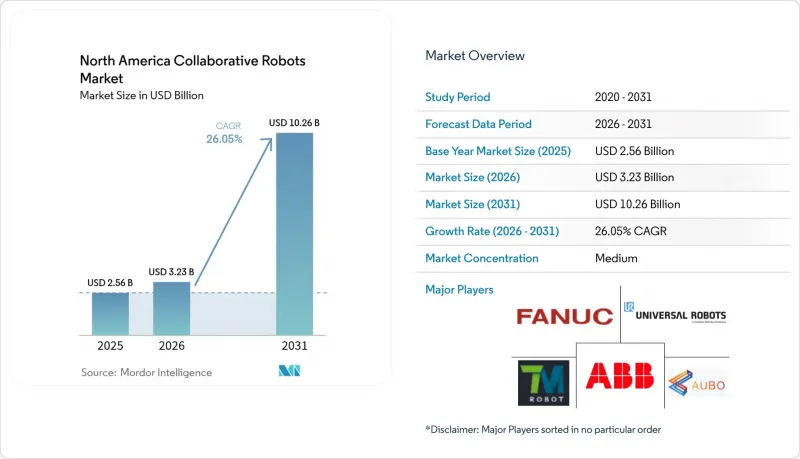
This report is Segmented by Payload (Less Than 5 Kg, 5-9 Kg, and 10 Kg and Above), End-User Industry (Electronics/Semiconductor and FPD, Automotive, and More), Application (Material Handling, Pick and Place, Assembly, and More), Component (Hardware, Software, and Services), and Geography (United States, Canada, and Mexico). The Market Forecasts are Provided in Terms of Value (USD).
North America Collaborative Robots Market Trends and Insights
Increasing Demand for Automation in Manufacturing Processes
Manufacturers that repatriate lines from Asia must balance throughput and flexibility. Cobots allow quick re-tooling without cages, satisfying this dual mandate. The 2024 House AI Task Force urged USD 500 million per year for human-robot collaboration pilots, accelerating early-stage deployments. Yaskawa's 185,000 square-foot U.S. expansion underscores vendor confidence in sustained orders. As a result, the North America collaborative robots market is expanding beyond tier-one plants toward rural contract manufacturers that previously lacked access to robotics expertise.
High Return on Investment Enabled by Easy Deployment
Drag-and-drop design suites and pre-engineered grippers now let job shops integrate a cobot cell in under 48 hours, down from 6-12 weeks. ABB's GoFa-Vention bundle cut installation labor costs by 60-70% for first-wave adopters. Lower integration overhead unlocks use cases with batch sizes below 100 units, allowing the North America collaborative robots market to penetrate segments once deemed too small for automation.
Limited Payload and Speed Capabilities Versus Traditional Robots
ISO/TS 15066 force limits cap most cobots at 35 kg payload and 1.5 m/s speed, excluding applications such as body-in-white welding or press tending. Traditional arms still handle 88.4% of automotive installations. Hybrid cells that pair fenced heavy-duty robots with cobots increase floor-space needs, diluting some flexibility benefits and slowing penetration of the North America collaborative robots market into legacy press shops.
Other drivers and restraints analyzed in the detailed report include:
- Rapid Advances in Edge Computing and AI Integration
- Rising Labor Costs and Labor Shortages Across Industries
- High Initial Integration and Training Costs for SMEs
For complete list of drivers and restraints, kindly check the Table Of Contents.
Segment Analysis
Less-than-5 kg cobots captured 45.38% of the North America collaborative robots market share in 2025, propelled by cleanroom electronics assembly that values compact footprints and gentle force limits. Standard Bots' 30 kg model, released in 2025, signals supplier intent to penetrate heavier-duty palletizing, pointing to segment blurring. Over time, vendors will package modular arms allowing end users to swap joints and extend reach, reinforcing the scalability narrative that fuels the North America collaborative robots market.
Demand for 10 kg-plus units, forecast to grow at an 17.65% CAGR, stems from food palletizing and machine tending where ergonomic risk drives automation budgets. KUKA's mosaixx remote-monitoring stack lowers service visits, cutting total cost of ownership and attracting multi-site processors. As high-payload designs mature, the North America collaborative robots market size for heavy-duty units could exceed USD 1.12 billion by 2031.
Electronics retained 36.95% revenue in 2025 owing to wafer handling and die bonding tasks that demand particle-free operation. Nonetheless, food and beverage posts a 14.88% CAGR to 2031, reshaping the North America collaborative robots market as processors confront hygiene mandates and 50% annual turnover on packaging lines.
Logistics, pharmaceuticals, and aerospace form an emerging cohort, collectively advancing as fulfillment centers deploy cobots for order picking. Compliance with ISO 22000 food-safety rules and FSMA preventive controls accelerates uptake, ensuring the North America collaborative robots market diversifies across verticals.
Complete Report Scope:
- By Payload
- Less than 5 kg
- 5-9 kg
- 10 kg and Above
- By End-user Industry
- Electronics/Semiconductor and FPD
- Automotive
- Food and Beverage
- Other End-user Industries
- By Application
- Material Handling
- Pick and Place
- Assembly
- Other Applications (Palletizing/De-palletizing, Welding, Painting, Sorting, Positioning, etc.)
- By Component
- Hardware
- Software
- Services
- By Country
- United States
- Canada
- Mexico
List of Companies Covered in this Report:
- ABB Ltd.
- Universal Robots A/S
- FANUC Corporation
- Techman Robot Inc.
- AUBO (Beijing) Robotics Technology Co., Ltd.
- Kawasaki Heavy Industries, Ltd.
- Precise Automation, Inc.
- SIASUN Robot and Automation Co., Ltd.
- Staubli International AG
- OMRON Corporation
- Seiko Epson Corporation (Epson Robots)
- Festo SE and Co. KG
- KUKA Aktiengesellschaft
- Doosan Robotics Inc.
- Hanwha Precision Machinery Co., Ltd.
- Yaskawa America, Inc.
- DENSO WAVE INCORPORATED
- Robotiq Inc.
- Neura Robotics GmbH
Additional Benefits:
- The market estimate (ME) sheet in Excel format
- 3 months of analyst support
TABLE OF CONTENTS
1 INTRODUCTION
- 1.1 Study Assumptions and Market Definition
- 1.2 Scope of the Study
2 RESEARCH METHODOLOGY
3 EXECUTIVE SUMMARY
4 MARKET LANDSCAPE
- 4.1 Market Overview
- 4.2 Market Drivers
- 4.2.1 Increasing Demand for Automation in Manufacturing Processes
- 4.2.2 High Return on Investment Enabled by Easy Deployment
- 4.2.3 Rapid Advances in Edge Computing and AI Integration
- 4.2.4 Rising Labor Costs and Labor Shortages Across Industries
- 4.2.5 Adoption of Collaborative Robots in Precision Agriculture Operations
- 4.2.6 Incentive Grants for Reshoring Electronics Assembly Lines
- 4.3 Market Restraints
- 4.3.1 Limited Payload and Speed Capabilities Versus Traditional Robots
- 4.3.2 High Initial Integration and Training Costs for SMEs
- 4.3.3 OSHA Standard Ambiguity Creating Certification Bottlenecks
- 4.3.4 Cybersecurity Vulnerabilities in Open-Source Robot Operating Systems
- 4.4 Industry Value Chain Analysis
- 4.5 Regulatory Landscape
- 4.6 Technological Outlook
- 4.7 Impact of Macroeconomic Factors on the Market
- 4.8 Porter's Five Forces Analysis
- 4.8.1 Bargaining Power of Suppliers
- 4.8.2 Bargaining Power of Consumers
- 4.8.3 Threat of New Entrants
- 4.8.4 Intensity of Competitive Rivalry
- 4.8.5 Threat of Substitute Products
5 MARKET SIZE AND GROWTH FORECASTS (VALUE)
- 5.1 By Payload
- 5.1.1 Less than 5 kg
- 5.1.2 5-9 kg
- 5.1.3 10 kg and Above
- 5.2 By End-user Industry
- 5.2.1 Electronics/Semiconductor and FPD
- 5.2.2 Automotive
- 5.2.3 Food and Beverage
- 5.2.4 Other End-user Industries
- 5.3 By Application
- 5.3.1 Material Handling
- 5.3.2 Pick and Place
- 5.3.3 Assembly
- 5.3.4 Other Applications (Palletizing/De-palletizing, Welding, Painting, Sorting, Positioning, etc.)
- 5.4 By Component
- 5.4.1 Hardware
- 5.4.2 Software
- 5.4.3 Services
- 5.5 By Country
- 5.5.1 United States
- 5.5.2 Canada
- 5.5.3 Mexico
6 COMPETITIVE LANDSCAPE
- 6.1 Market Concentration
- 6.2 Strategic Moves
- 6.3 Vendor Ranking Analysis
- 6.4 Market Share Analysis
- 6.5 Company Profiles (includes Global level Overview, Market level overview, Core Segments, Financials as available, Strategic Information, Market Rank/Share for key companies, Products and Services, and Recent Developments)
- 6.5.1 ABB Ltd.
- 6.5.2 Universal Robots A/S
- 6.5.3 FANUC Corporation
- 6.5.4 Techman Robot Inc.
- 6.5.5 AUBO (Beijing) Robotics Technology Co., Ltd.
- 6.5.6 Kawasaki Heavy Industries, Ltd.
- 6.5.7 Precise Automation, Inc.
- 6.5.8 SIASUN Robot and Automation Co., Ltd.
- 6.5.9 Staubli International AG
- 6.5.10 OMRON Corporation
- 6.5.11 Seiko Epson Corporation (Epson Robots)
- 6.5.12 Festo SE and Co. KG
- 6.5.13 KUKA Aktiengesellschaft
- 6.5.14 Doosan Robotics Inc.
- 6.5.15 Hanwha Precision Machinery Co., Ltd.
- 6.5.16 Yaskawa America, Inc.
- 6.5.17 DENSO WAVE INCORPORATED
- 6.5.18 Robotiq Inc.
- 6.5.19 Neura Robotics GmbH
7 MARKET OPPORTUNITIES AND FUTURE OUTLOOK
- 7.1 White-space and Unmet-Need Assessment

