PUBLISHER: Mordor Intelligence | PRODUCT CODE: 2124655

PUBLISHER: Mordor Intelligence | PRODUCT CODE: 2124655
Penicillin Drug - Market Share Analysis, Industry Trends & Statistics, Growth Forecasts (2026 - 2031)
According to Mordor Intelligence, the penicillin drug market size is projected to expand from USD 10.49 billion in 2025 and USD 10.72 billion in 2026 to USD 12.68 billion by 2031, registering a CAGR of 3.41% between 2026 to 2031.
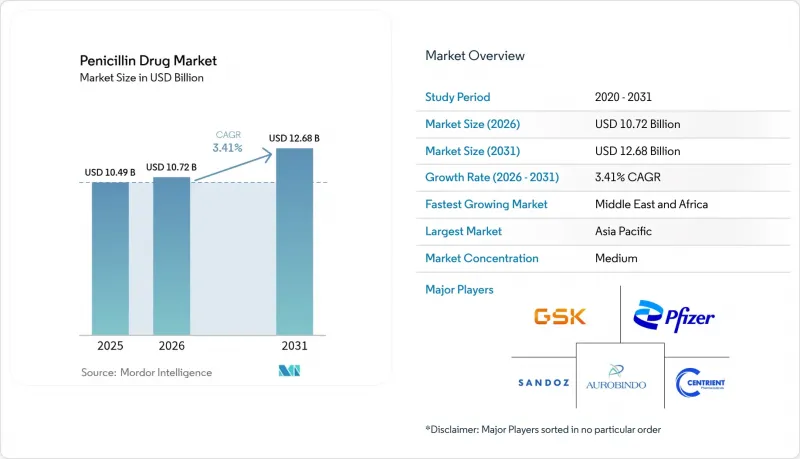
This report is Segmented by Source (Natural, Semisynthetic), Product Type (Aminopenicillin, Penicillinase-Resistant, Antipseudomonal, B-Lactamase-Inhibitor Combinations, Extended-Spectrum), Route of Administration (Oral, Parenteral, Topical), Spectrum of Activity (Narrow, and More), Distribution Channel (Hospital, and More), and Geography (North America, and More). Market Forecasts are Provided in Value (USD).
Global Penicillin Drug Market Trends and Insights
Growing Prevalence of Bacterial Infections
Respiratory, urinary tract, and skin infections now drive more than 70% of penicillin prescriptions, and their incidence is climbing with urban air-pollution levels in megacities such as Delhi and Jakarta. Amoxicillin remains the empiric mainstay for uncomplicated pneumonia, while aging demographics in OECD countries triple UTI incidence among those older than 65. Influenza seasons continue to spawn secondary bacterial pneumonia; U.S. amoxicillin-clavulanate scripts spiked 18% during the 2024-2025 flu season. These trends cement penicillin relevance in outpatient care, especially where diagnostic microbiology is scarce.
Rising Demand for Affordable Generics in Emerging Markets
Dose-prices between USD 0.10 and 0.50 keep generic penicillins at the top of essential-medicine lists in regions where out-of-pocket payments exceed 40% of total health expenditure. India exported 42,000 metric tons of penicillin APIs in 2024, with 60% destined for sub-Saharan Africa and Southeast Asia. Brazil cleared 37 new generic registrations in 2025, the highest in seven years. Chinese amoxicillin capsules traded at USD 8 per 1,000 units in early 2026, down one-third from 2023, underpinning volumes across rural pharmacy outlets.
Escalating Antimicrobial Resistance (AMR)
Penicillin non-susceptibility in Streptococcus pneumoniae hit 18.3% across the European Union in 2024, up 3.6 percentage points from 2020. Indian data show 42% of community Escherichia coli UTIs now harbor ESBL genes, sidelining amoxicillin. U.S. deaths linked to penicillin-resistant pneumococci total 3,600 annually. Stewardship programs have responded by curbing empiric penicillin use in intensive care units, trimming high-margin volumes.
Other drivers and restraints analyzed in the detailed report include:
- Government Incentives for Domestic API Production
- Pharmacy-First Retail Initiatives Boosting Community Dispensing
- Stringent GMP & Regulatory Compliance Costs
For complete list of drivers and restraints, kindly check the Table Of Contents.
Segment Analysis
Semisynthetic variants generated 64.78% of 2025 sales, and their 5.26% CAGR keeps the penicillin drug market ahead of natural derivatives. Amoxicillin and ampicillin together cover over 60% of prescriptions, while benzathine penicillin-G sustains rheumatic heart disease programs. Sandoz's 20% capacity expansion for 6-aminopenicillanic acid in 2024 underscores ongoing investment.
Natural penicillin remains critical for syphilis and rheumatic fever, but fermentation limitations and slower innovation limit upside. Nonetheless, donor-funded prophylaxis ensures a stable niche, particularly in Africa and Southeast Asia
Aminopenicillins held 41.63% of 2025 revenue, yet B-lactamase-inhibitor combinations grow fastest at 5.88%. EMA's 2025 approval of a high-dose amoxicillin-clavulanate option should lift adherence. Piperacillin-tazobactam continues to dominate antipseudomonal use in ICUs, while extended-spectrum agents such as ticarcillin-clavulanate leverage stewardship demand for carbapenem-sparing regimens.
Complete Report Scope:
- By Source
- Natural Penicillin
- Semisynthetic Penicillin
- By Product Type
- Aminopenicillin
- Penicillinase-Resistant
- Antipseudomonal
- B-lactamase-Inhibitor Combinations
- Extended-Spectrum
- By Route of Administration
- Oral
- Parenteral
- Topical
- By Spectrum of Activity
- Narrow-Spectrum
- Broad-Spectrum
- Extended-Spectrum
- By Distribution Channel
- Hospital Pharmacies
- Drug & Retail Pharmacies
- Online Pharmacies
- By Geography
- North America
- United States
- Canada
- Mexico
- Europe
- Germany
- France
- United Kingdom
- Italy
- Spain
- Rest of Europe
- Asia-Pacific
- China
- Japan
- India
- South Korea
- Australia
- Rest of Asia-Pacific
- Middle East & Africa
- GCC
- South Africa
- Rest of Middle East & Africa
- South America
- Brazil
- Argentina
- Rest of South America
- North America
Geography Analysis
Asia-Pacific captured 34.57% of 2025 sales, with India's MIP and API incentives tipping production toward local champions, while China's stricter prescribing guidelines reduced empiric penicillin volume but improved appropriateness metrics. Japan's super-aging demographics keep UTI and pneumonia incidence high. Australian pharmacist prescribing powers bolster community uptake.
Rapid strep diagnostics in the United States drive a pivot back to narrow-spectrum penicillin-V, even as Germany negotiated 15% generic price cuts. The UK's Pharmacy First maintains oral growth despite overall antibiotic decline, while France and Spain trimmed penicillin volumes double digits via awareness campaigns.
The Middle East and Africa show the fastest pace at 6.36%. Saudi Vision 2030 funds 120 new primary-care centers and 20 tertiary hospitals, expanding antibiotic reach. UAE telemedicine-linked e-pharmacies accelerate oral dispensing without in-person visits. Rwanda's prophylaxis blueprint offers a replicable model for neighboring countries.
South America is recovering as Brazil streamlines generic approvals and Argentina normalizes import flows. Brazil's 37 generic registrations in 2025 expand Farmacia Popular coverage to high-dose combinations.
- Abbott Laboratories
- Aurobindo Pharma Ltd.
- Bayer
- Cipla
- CSPC Zhongrun Pharmaceutical
- Dr. Reddy's Laboratories
- GlaxoSmithKline
- Johnson & Johnson
- Lupin
- North China Pharmaceutical Group
- Pfizer
- Sandoz Group
- Sanofi
- Sinopharm Weiqida Pharmaceutical
- Sun Pharmaceuticals Industries
- Takeda Pharmaceuticals
- Teva Pharmaceutical Industries
- The United Laboratories
Additional Benefits:
- The market estimate (ME) sheet in Excel format
- 3 months of analyst support
TABLE OF CONTENTS
1 Introduction
- 1.1 Study Assumptions & Market Definition
- 1.2 Scope of the Study
2 Research Methodology
3 Executive Summary
4 Market Landscape
- 4.1 Market Overview
- 4.2 Market Drivers
- 4.2.1 Growing Prevalence of Bacterial Infections
- 4.2.2 Rising Demand for Affordable Generics in Emerging Markets
- 4.2.3 Government Incentives for Domestic API Production
- 4.2.4 Pharmacy-First Retail Initiatives Boosting Community Dispensing
- 4.2.5 AI-Enabled Fermentation Cost Efficiencies
- 4.2.6 Penicillin Prophylaxis Programmes for Rheumatic Heart Disease
- 4.3 Market Restraints
- 4.3.1 Escalating Antimicrobial Resistance (AMR)
- 4.3.2 Stringent GMP & Regulatory Compliance Costs
- 4.3.3 Fermentation-Feedstock Supply Volatility
- 4.3.4 Uptake of Novel B-Lactam/BLI Combinations Cannibalising Demand
- 4.4 Value / Supply-Chain Analysis
- 4.5 Regulatory Landscape
- 4.6 Technological Outlook
- 4.7 Porter's Five Forces Analysis
- 4.7.1 Threat of New Entrants
- 4.7.2 Bargaining Power of Suppliers
- 4.7.3 Bargaining Power of Buyers
- 4.7.4 Threat of Substitutes
- 4.7.5 Intensity of Competitive Rivalry
5 Market Size & Growth Forecasts (Value in USD)
- 5.1 By Source
- 5.1.1 Natural Penicillin
- 5.1.2 Semisynthetic Penicillin
- 5.2 By Product Type
- 5.2.1 Aminopenicillin
- 5.2.2 Penicillinase-Resistant
- 5.2.3 Antipseudomonal
- 5.2.4 B-lactamase-Inhibitor Combinations
- 5.2.5 Extended-Spectrum
- 5.3 By Route of Administration
- 5.3.1 Oral
- 5.3.2 Parenteral
- 5.3.3 Topical
- 5.4 By Spectrum of Activity
- 5.4.1 Narrow-Spectrum
- 5.4.2 Broad-Spectrum
- 5.4.3 Extended-Spectrum
- 5.5 By Distribution Channel
- 5.5.1 Hospital Pharmacies
- 5.5.2 Drug & Retail Pharmacies
- 5.5.3 Online Pharmacies
- 5.6 By Geography
- 5.6.1 North America
- 5.6.1.1 United States
- 5.6.1.2 Canada
- 5.6.1.3 Mexico
- 5.6.2 Europe
- 5.6.2.1 Germany
- 5.6.2.2 France
- 5.6.2.3 United Kingdom
- 5.6.2.4 Italy
- 5.6.2.5 Spain
- 5.6.2.6 Rest of Europe
- 5.6.3 Asia-Pacific
- 5.6.3.1 China
- 5.6.3.2 Japan
- 5.6.3.3 India
- 5.6.3.4 South Korea
- 5.6.3.5 Australia
- 5.6.3.6 Rest of Asia-Pacific
- 5.6.4 Middle East & Africa
- 5.6.4.1 GCC
- 5.6.4.2 South Africa
- 5.6.4.3 Rest of Middle East & Africa
- 5.6.5 South America
- 5.6.5.1 Brazil
- 5.6.5.2 Argentina
- 5.6.5.3 Rest of South America
- 5.6.1 North America
6 Competitive Landscape
- 6.1 Market Concentration
- 6.2 Market Share Analysis
- 6.3 Company Profiles (includes Global level Overview, Market level overview, Core Segments, Financials as available, Strategic Information, Market Rank/Share for key companies, Products and Services, and Recent Developments)
- 6.3.1 Abbott Laboratories
- 6.3.2 Aurobindo Pharma Ltd.
- 6.3.3 Bayer AG
- 6.3.4 Cipla Ltd.
- 6.3.5 CSPC Zhongrun Pharmaceutical
- 6.3.6 Dr. Reddy's Laboratories
- 6.3.7 GlaxoSmithKline plc
- 6.3.8 Johnson & Johnson (Janssen)
- 6.3.9 Lupin Ltd.
- 6.3.10 North China Pharmaceutical Group
- 6.3.11 Pfizer Inc.
- 6.3.12 Sandoz
- 6.3.13 Sanofi SA
- 6.3.14 Sinopharm Weiqida Pharmaceutical
- 6.3.15 Sun Pharmaceutical Industries
- 6.3.16 Takeda Pharmaceutical Co. Ltd.
- 6.3.17 Teva Pharmaceutical Industries
- 6.3.18 The United Laboratories
7 Market Opportunities & Future Outlook
- 7.1 White-space & Unmet-Need Assessment

