PUBLISHER: Mordor Intelligence | PRODUCT CODE: 2124658

PUBLISHER: Mordor Intelligence | PRODUCT CODE: 2124658
India Washing Machine - Market Share Analysis, Industry Trends & Statistics, Growth Forecasts (2026 - 2031)
According to Mordor Intelligence, the India washing machine market size is projected to expand from USD 3.99 billion in 2025 and USD 4.14 billion in 2026 to USD 5.27 billion by 2031, registering a CAGR of 4.98% between 2026 to 2031.
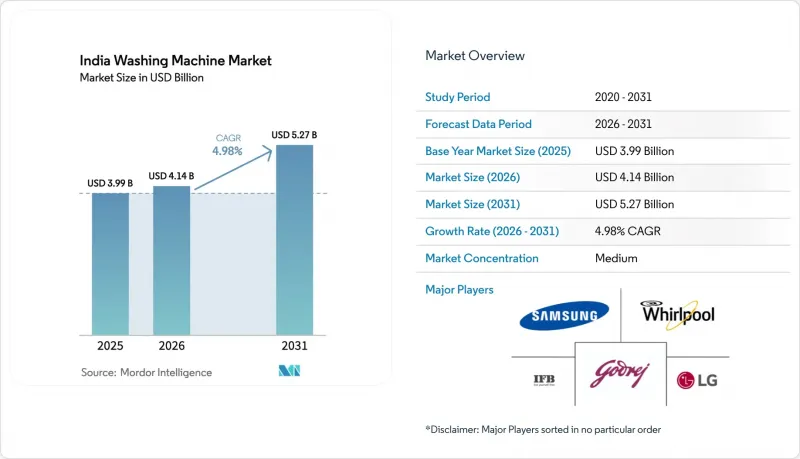
This report is Segmented by Product (Front Load, and More), Technology (Fully Automatic, Semi-Automatic), Capacity (Small Below 6 Kg, Medium 6 To 8 Kg, Large Above 8 Kg), Connectivity (Smart Connected, Conventional), End User (Residential, Commercial), Distribution Channel (B2C, B2B), and Geography (North India, West India, South India, East India). Market Forecasts are Provided in Terms of Value (USD).
India Washing Machine Market Trends and Insights
Technological Shift Towards Fully-Automatic and Inverter Motors
Fully automatic machines held 54.65% market share in 2025 and are advancing at a 9.33% CAGR through 2031, which signals a rapid pivot toward higher-efficiency platforms within the India washing machine market. Inverter architectures are central to that shift and are highlighted by brand-launched platforms in India that deliver sizable energy savings and intelligent cycle control. IFB localized high-efficiency drive components and moved commercial BLDC motor production into steady state by FY 2024-25, which reduces import reliance and supports sustained cost control. Premium platforms with AI-enabled fabric care, load sensing, and remote diagnostics have deepened differentiation versus semi-automatic designs, which is improving perceived durability and total cost of ownership in the India washing machine market. Regulatory emphasis on higher energy performance is reinforcing the engineering cycle around motors and controllers and guiding product portfolios toward inverter-led roadmaps that satisfy long-term efficiency thresholds. Together, these technology and policy vectors are accelerating the upgrade path from semi-automatic to fully automatic configurations across urban and early tier-2 demand pools in the India washing machine market.
Production-Linked Incentive (PLI) Scheme is Bolstering Local Output
The white-goods PLI program announced a multi-year outlay of USD 729.4 million (INR 6,238 crore) and is engineered to raise domestic value addition toward 75-80% by FY 2028-29, which is catalyzing a new supplier base for motors, controllers, and other shared components used in washers. The incentive design links payouts to incremental sales and progressively higher local-content thresholds, encouraging phased tooling, localization, and process upgrades across India washing machine market participants and adjacent suppliers. IFB documented PLI and M-SIPS-linked receipts that underwrote capacity and controller localization, aligning its washing machine operations with policy-led supply security and cost-down objectives. BSH expanded assembly capacity in Chennai and launched new India-made front-load ranges, supporting a deeper local bill of materials and shorter inbound cycles. Over time, the policy push should compress lead times and reduce import duty exposure in the India washing machine market while raising the industry's quality baseline through mandated certification and testing regimes. The cumulative effect is a gradual margin reset, with localization gains offsetting short-term cost friction as supply chains reconfigure under the PLI glide path.
Consumers Grapple with High Upfront Costs Versus their Discretionary Income
Upfront pricing remains a barrier for many households, which sustains interest in lower-cost semi-automatic models and slows upgrade cycles in value-driven cohorts within the India washing machine market. Financing programs and promotional constructs continue to ease adoption, but price sensitivity has translated into cautious demand for premium variants when macro uncertainty is elevated. Mixed product momentum has also shown up in company disclosures, where selective categories experienced flat sales and margin pressure despite the availability of higher-efficiency platforms and richer feature sets. Retail distribution is responding with more no-cost EMI options, faster installation, and regional targeting to broaden reach in price-sensitive areas. Over the medium term, localization of motors and controllers and more efficient logistics should help narrow price gaps between entry and mid-tier options in the India washing machine market.
Other drivers and restraints analyzed in the detailed report include:
- Smart-Home And Iot Features Are Paving the Way for Subscription Add-ons
- Urbanization Accelerates, and Nuclear Households become the Norm
- Volatility in the Supply Chain And Commodity Prices Poses Challenges
For complete list of drivers and restraints, kindly check the Table Of Contents.
Segment Analysis
Top-load models captured the largest market share at 67.85% in 2025, reflecting price-led preferences, while front-load models are projected to expand at an 8.44% CAGR through 2031 within the India washing machine market. New front-load launches emphasize high spin speeds, fabric-care cycles, and rapid programs that compress cycle time without eroding wash quality. Urban households are showing growing willingness to trade up to drum-based platforms to gain energy savings and features such as steam hygiene. This feature stack is also widening differentiation versus semi-automatic designs and reducing perceived maintenance risk in the India washing machine market. Over the forecast horizon, front-load penetration remains the key mix driver, with brands aligning merchandising and capacity planning to sustain interest from tier-1 and emerging tier-2 clusters.
Front-load positioning focuses on long-term cost of ownership, gentle fabric care, and digital control, which resonate with dual-income urban buyers. Top-load machines continue to draw value-focused consumers who want familiar ergonomics, perceived water control, and lower entry pricing in the India washing machine market. At the premium end, integrated washer-dryer propositions target space-constrained apartments and highlight time savings and one-touch care. Product life-cycle communications are also shifting toward energy ratings, AI cycle selection, and fabric protection guarantees to reinforce upgrade intent. These elements collectively underpin the expected share gains for front-load formats within the India washing machine market.
Fully automatic systems accounted for 54.65% market share in 2025 and are set to grow at a 9.33% CAGR through 2031, outpacing semi-automatic platforms in the India washing machine market size trajectory for technology segments. Inverter motors and intelligent dosing are becoming table stakes, which raises the bar for energy performance and noise reduction. Localized production of BLDC motors, controllers, and other critical nodes is improving cost structures and reducing exposure to currency and freight volatility. Semi-automatic machines continue to serve water-scarce environments and price-sensitive users, but are structurally disadvantaged in cycle automation and energy efficiency in the India washing machine market. The widening feature gap and policy incentives for higher-efficiency appliances are expected to sustain the momentum of fully automatic adoption.
The technology roadmap is also becoming more software-centric, with AI control and downloadable programs optimizing wash performance across fabrics. Manufacturers are backing platforms with longer warranties, which signals confidence in component reliability and supports total cost of ownership arguments in the India washing machine market. As localized content rises, mid-tier fully automatic machines can absorb richer feature sets without pricing out mainstream users. The interplay of better energy labels, in-home service networks, and financing options further strengthens the use case for fully automatic formats in the India washing machine industry. As a result, the India washing machine market is expected to tilt steadily toward automated, connected platforms across the forecast window.
Complete Report Scope:
- By Product
- Front Load
- With Dryers
- Without Dryers
- Top Load
- With Dryers
- Without Dryers
- Twin Tub
- Front Load
- By Technology
- Fully Automatic
- Semi-Automatic
- By Capacity
- Small (Below 6 Kg)
- Medium (6 to 8 Kg)
- Large (Above 8 Kg)
- By Connectivity
- Smart Connected
- Conventional
- By End User
- Residential
- Commercial
- By Distribution Channel
- B2C/Retail
- Multi-brand Stores
- Exclusive Brand Outlets
- Online
- Other Distribution Channels
- B2B/Directly from the Manufacturers
- B2C/Retail
- By Geography
- North India
- West India
- South India
- East India
List of Companies Covered in this Report:
- LG Electronics Inc.
- Samsung Electronics Co. Ltd.
- Whirlpool Corporation
- Haier Group Corporation
- IFB Industries Ltd.
- Godrej & Boyce Mfg. Co. Ltd.
- Panasonic Corporation
- BSH Home Appliances
- Arcelik A.S.
- Midea Group Co. Ltd.
- Havells India Ltd.
- Mirc Electronics Ltd.
- Toshiba Lifestyle Products & Services Corporation
- Electrolux AB
- Candy Hoover Group S.r.l.
- Sanyo Electric Co. Ltd.
- Kelvinator (Electronics Product Group)
- Maytag Corporation
- Amana Corporation
- Speed Queen
Additional Benefits:
- The market estimate (ME) sheet in Excel format
- 3 months of analyst support
TABLE OF CONTENTS
1 Introduction
- 1.1 Study Assumptions & Market Definition
- 1.2 Scope of the Study
2 Research Methodology
3 Executive Summary
4 Market Landscape
- 4.1 Market Overview
- 4.2 Market Drivers
- 4.2.1 Tier-II and Tier-III Cities Witness A Surge In Disposable Income
- 4.2.2 Urbanization Accelerates, and Nuclear Households become the Norm
- 4.2.3 E-Commerce And Omni-Channel Retail Continue to Expand
- 4.2.4 Technological Shift Towards Fully-Automatic and Inverter Motors
- 4.2.5 Production-Linked Incentive (PLI) Scheme is Bolstering Local Output
- 4.2.6 Smart-Home And Iot Features Are Paving the Way for Subscription Add-ons
- 4.3 Market Restraints
- 4.3.1 Consumers Grapple with High Upfront Costs VS their Discretionary Income
- 4.3.2 Price-Sensitive Rural Consumers Lean Towards Semi-Automatic Models
- 4.3.3 Volatility in the Supply Chain And Commodity Prices Poses Challenges
- 4.3.4 Drought-Prone States Face Regulations due to Water Scarcity
- 4.4 Industry Value Chain Analysis
- 4.5 Porter's Five Forces Analysis
- 4.5.1 Threat of New Entrants
- 4.5.2 Bargaining Power of Suppliers
- 4.5.3 Bargaining Power of Buyers
- 4.5.4 Threat of Substitutes
- 4.5.5 Competitive Rivalry
- 4.6 Insights into the Latest Trends and Innovations in the Market
- 4.7 Insights on Recent Developments (New Product Launches, Strategic Initiatives, Investments, Partnerships, JVs, Expansion, M&As, etc.) in the Market
5 Market Size & Growth Forecasts (Value)
- 5.1 By Product
- 5.1.1 Front Load
- 5.1.1.1 With Dryers
- 5.1.1.2 Without Dryers
- 5.1.2 Top Load
- 5.1.2.1 With Dryers
- 5.1.2.2 Without Dryers
- 5.1.3 Twin Tub
- 5.1.1 Front Load
- 5.2 By Technology
- 5.2.1 Fully Automatic
- 5.2.2 Semi-Automatic
- 5.3 By Capacity
- 5.3.1 Small (Below 6 Kg)
- 5.3.2 Medium (6 to 8 Kg)
- 5.3.3 Large (Above 8 Kg)
- 5.4 By Connectivity
- 5.4.1 Smart Connected
- 5.4.2 Conventional
- 5.5 By End User
- 5.5.1 Residential
- 5.5.2 Commercial
- 5.6 By Distribution Channel
- 5.6.1 B2C/Retail
- 5.6.1.1 Multi-brand Stores
- 5.6.1.2 Exclusive Brand Outlets
- 5.6.1.3 Online
- 5.6.1.4 Other Distribution Channels
- 5.6.2 B2B/Directly from the Manufacturers
- 5.6.1 B2C/Retail
- 5.7 By Geography
- 5.7.1 North India
- 5.7.2 West India
- 5.7.3 South India
- 5.7.4 East India
6 Competitive Landscape
- 6.1 Market Concentration
- 6.2 Strategic Moves & Developments
- 6.3 Market Share Analysis
- 6.4 Company Profiles (Includes Global Level Overview, Market Level Overview, Core Segments, Financials As Available, Strategic Information, Market Rank/Share For Key Companies, Products & Services, And Recent Developments)
- 6.4.1 LG Electronics Inc.
- 6.4.2 Samsung Electronics Co. Ltd.
- 6.4.3 Whirlpool Corporation
- 6.4.4 Haier Group Corporation
- 6.4.5 IFB Industries Ltd.
- 6.4.6 Godrej & Boyce Mfg. Co. Ltd.
- 6.4.7 Panasonic Corporation
- 6.4.8 BSH Home Appliances
- 6.4.9 Arcelik A.S.
- 6.4.10 Midea Group Co. Ltd.
- 6.4.11 Havells India Ltd.
- 6.4.12 Mirc Electronics Ltd.
- 6.4.13 Toshiba Lifestyle Products & Services Corporation
- 6.4.14 Electrolux AB
- 6.4.15 Candy Hoover Group S.r.l.
- 6.4.16 Sanyo Electric Co. Ltd.
- 6.4.17 Kelvinator (Electronics Product Group)
- 6.4.18 Maytag Corporation
- 6.4.19 Amana Corporation
- 6.4.20 Speed Queen
7 Market Opportunities & Future Outlook
- 7.1 Rural Market Expansion with Affordable, Energy-Efficient Models

