PUBLISHER: Mordor Intelligence | PRODUCT CODE: 2124659

PUBLISHER: Mordor Intelligence | PRODUCT CODE: 2124659
United States Digital Lending - Market Share Analysis, Industry Trends & Statistics, Growth Forecasts (2026 - 2031)
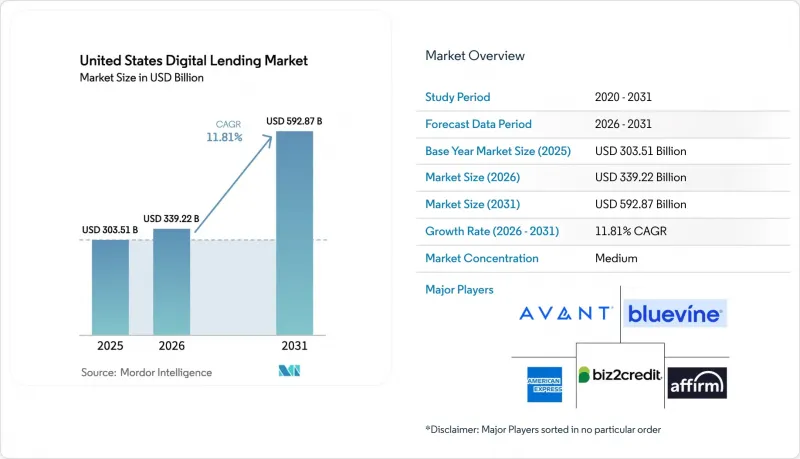
According to Mordor Intelligence, the United States digital lending market size was valued at USD 303.51 billion in 2025 and is estimated to grow from USD 339.22 billion in 2026 to reach USD 592.87 billion by 2031, at a CAGR of 11.81% during the forecast period (2026-2031).
This report is Segmented by Borrower Type (Consumer, and Business), Provider Type (Traditional Banks, Credit Unions, and More), Funding Source (Whole-Loan Balance-Sheet, Securitisation, and P2P/Fractional), Loan Purpose (Personal Instalment, Student Refinance, Auto Refinance, Medical Financing, and More). The Market Forecasts are Provided in Terms of Value (USD).
United States Digital Lending Market Trends and Insights
Near-Instant Mobile-First Origination Times
Application-to-funding cycles fell from three to five days in 2020 to under 24 hours in 2026, redefining borrower expectations and forcing incumbents to modernize onboarding workflows. The FedNow rail processed more than 50 million transactions in its first year, eliminating ACH batch lags and underpinning same-day disbursements. Embedded point-of-sale financing exemplified by Affirm's Amazon partnership delivers approvals in seconds and funding within hours, capturing borrowers at the moment of purchase. Lenders report a 22% rise in synthetic-identity attempts, prompting greater investment in real-time ID verification layers that insert controlled friction. Speed differentiation is now inseparable from robust fraud controls and dynamic credit-decisioning engines.
AI-Driven Alternative-Data Credit Scoring
Platforms harness cash-flow trends, utility payments and employment tenure to serve thin-file segments excluded by FICO-centric models. Upstart's algorithm evaluates more than 1,600 variables and approved 173% more applicants than legacy scorecards in 2024 while posting comparable loss rates. Delinquencies rose to 5.8% in Q3 2025 as the mix skewed toward subprime tiers, illustrating the need for rapid model retraining as macro conditions shift. Federal regulators encourage responsible alternative-data use provided disparate-impact testing is applied, offering regulatory cover for continued adoption. This driver widens the total addressable borrower pool but demands rigorous bias mitigation and performance monitoring in the US digital lending market.
Cyber-Security and Data-Privacy Breaches
The 2024 Change Healthcare ransomware attack heightened scrutiny of third-party vendor risk. The New York Department of Financial Services mandated multi-factor authentication and real-time transaction monitoring for lenders in 2024. California's Consumer Privacy Act similarly extends borrower data rights, forcing smaller fintechs to invest in encryption, tokenization and incident-response protocols. Reputational damage and remediation costs erode margins, while stricter controls marginally extend onboarding times, challenging the United States digital lending market's speed thesis.
Other drivers and restraints analyzed in the detailed report include:
- Embedded Lending inside Vertical SaaS Platforms
- Uptick of Digitally-Savvy Borrowers
- Uncertain Federal / State True-Lender Rules and Rate Caps
For complete list of drivers and restraints, kindly check the Table Of Contents.
Segment Analysis
The business-borrower segment captured 21.88% of 2025 volume yet is forecast to expand at 13.23% CAGR through 2031, outpacing consumer loans. Embedded merchant-cash-advance products offered by Square Loans and Toast Capital align repayments with revenue, reducing default volatility. Bluevine and OnDeck leverage real-time bank-account data to approve working-capital loans within hours, satisfying SMEs that struggled to access pandemic-era relief programs. Consumer lending remains dominant but faces rising delinquency rates that reached 3.2% for credit cards in Q2 2025, tempering expansion.
A broadened addressable SME base, favorable unit economics and lower customer-acquisition costs inside payment ecosystems extend upside for business lenders. Risk is concentrated in cyclical verticals such as food service and retail, underscoring the importance of cash-flow-linked repayment structures. Consumer lenders hedge by cross-selling credit-builder cards and high-yield savings to boost retention and mitigate margin compression. Overall, diversification keeps the United States digital lending market resilient across economic cycles.
Traditional banks retained 46.31% share in 2025 through low-cost deposit funding and established trust. Fintechs such as SoFi and LendingClub secured bank charters to replicate this advantage, cutting funding costs to 4.2% versus 6.5% under marketplace models. Embedded-finance providers are scaling revenues at 12.56% CAGR by distributing credit seamlessly within software workflows, achieving acceptance rates above 40% among merchants. Credit unions modernize via mobile-first origination that reduces approval times from days to minutes.
Regulatory scrutiny of third-party risk elevated after 2023 OCC consent orders, incentivizing deeper diligence on fintech partnerships. Banks weighing build-versus-partner decisions confront high technology investment and cultural friction, whereas software platforms face potential reclassification as lenders under true-lender doctrine. The competitive balance in the United States digital lending market will hinge on cost of capital, user experience and compliance sophistication.
Complete Report Scope:
- By Borrower Type
- Consumer
- Business (SME / Commercial)
- By Provider Type
- Traditional Banks
- Credit Unions
- Marketplace / Balance-Sheet FinTechs
- Embedded-Finance / Platform Lenders
- By Funding Source
- Whole-Loan Balance-Sheet
- Securitisation
- P2P / Fractional
- By Loan Purpose
- Personal Instalment
- Student Refinance
- Auto Refinance
- Medical Financing
- Business Working Capital
- Business Expansion
List of Companies Covered in this Report:
- Affirm, Inc.
- American Express/Kabbage
- Avant, LLC
- Biz2Credit Inc.
- Bluevine Inc.
- CAN Capital, Inc.
- Chime Financial, Inc.
- Funding Circle Ltd
- LendingClub Bank
- LendingTree, LLC
- Goldman Sachs Group, Inc.
- OnDeck Capital, Inc.
- PayPal, Inc.
- Prosper Funding LLC.
- SoFi Technologies, Inc.
- Block, Inc.
- Upgrade, Inc.
- Upstart Network, Inc.
- Zopa Bank Limited
- Oportun, Inc.
Additional Benefits:
- The market estimate (ME) sheet in Excel format
- 3 months of analyst support
TABLE OF CONTENTS
1 INTRODUCTION
- 1.1 Study Assumptions and Market Definition
- 1.2 Scope of the Study
2 RESEARCH METHODOLOGY
3 EXECUTIVE SUMMARY
4 MARKET LANDSCAPE
- 4.1 Market Overview
- 4.2 Market Drivers
- 4.2.1 Uptick of Digitally-Savvy Borrowers
- 4.2.2 Growth in Disposable Income and Credit Demand
- 4.2.3 Near-Instant, Mobile-First Origination Times
- 4.2.4 AI-Driven Alternative-Data Credit Scoring
- 4.2.5 Embedded Lending inside Vertical SaaS Platforms
- 4.2.6 FedNow Instant-Payment Rails Catalysing Same-Day Funding
- 4.3 Market Restraints
- 4.3.1 Cyber-Security and Data-Privacy Breaches
- 4.3.2 Uncertain Federal / State True-Lender Rules and Rate Caps
- 4.3.3 Rising Customer-Acquisition Cost for FinTech Lenders
- 4.3.4 Shrinking Pool of Prime Borrowers, Adverse-Selection Risk
- 4.4 Impact of Macroeconomic Factors on the Market
- 4.5 Industry Value Chain Analysis
- 4.6 Regulatory Landscape
- 4.7 Technological Outlook
- 4.8 Porter's Five Forces Analysis
- 4.8.1 Threat of New Entrants
- 4.8.2 Bargaining Power of Suppliers (Capital Providers)
- 4.8.3 Bargaining Power of Buyers (Borrowers)
- 4.8.4 Threat of Substitutes (Cards, BNPL, HELOC, etc.)
- 4.8.5 Rivalry Among Existing Competitors
- 4.9 Key Borrower Metrics
- 4.9.1 % Loan Debt by Risk-Tier
- 4.9.2 Avg. Outstanding Balance by Risk-Tier
- 4.9.3 Delinquency Rates by Risk-Tier
- 4.10 Origination-Volume Analysis
- 4.10.1 Personal Loans
- 4.10.2 SME Loans
- 4.11 Sub-Prime Borrower Insights
- 4.11.1 State-Wise Distribution
- 4.11.2 Demographic Split by Age
- 4.11.3 Trend' Shrinking Sub-prime Population
5 MARKET SIZE AND GROWTH FORECASTS (VALUE)
- 5.1 By Borrower Type
- 5.1.1 Consumer
- 5.1.2 Business (SME / Commercial)
- 5.2 By Provider Type
- 5.2.1 Traditional Banks
- 5.2.2 Credit Unions
- 5.2.3 Marketplace / Balance-Sheet FinTechs
- 5.2.4 Embedded-Finance / Platform Lenders
- 5.3 By Funding Source
- 5.3.1 Whole-Loan Balance-Sheet
- 5.3.2 Securitisation
- 5.3.3 P2P / Fractional
- 5.4 By Loan Purpose
- 5.4.1 Personal Instalment
- 5.4.2 Student Refinance
- 5.4.3 Auto Refinance
- 5.4.4 Medical Financing
- 5.4.5 Business Working Capital
- 5.4.6 Business Expansion
6 COMPETITIVE LANDSCAPE
- 6.1 Market Concentration
- 6.2 Strategic Moves
- 6.3 Market Share Analysis
- 6.4 Company Profiles (includes Global Level Overview, Market Level Overview, Core Segments, Financials as Available, Strategic Information, Market Rank/Share for Key Companies, Products and Services, and Recent Developments)
- 6.4.1 Affirm, Inc.
- 6.4.2 American Express/Kabbage
- 6.4.3 Avant, LLC
- 6.4.4 Biz2Credit Inc.
- 6.4.5 Bluevine Inc.
- 6.4.6 CAN Capital, Inc.
- 6.4.7 Chime Financial, Inc.
- 6.4.8 Funding Circle Ltd
- 6.4.9 LendingClub Bank
- 6.4.10 LendingTree, LLC
- 6.4.11 Goldman Sachs Group, Inc.
- 6.4.12 OnDeck Capital, Inc.
- 6.4.13 PayPal, Inc.
- 6.4.14 Prosper Funding LLC.
- 6.4.15 SoFi Technologies, Inc.
- 6.4.16 Block, Inc.
- 6.4.17 Upgrade, Inc.
- 6.4.18 Upstart Network, Inc.
- 6.4.19 Zopa Bank Limited
- 6.4.20 Oportun, Inc.
7 MARKET OPPORTUNITIES AND FUTURE OUTLOOK
- 7.1 White-Space and Unmet-Need Assessment

