PUBLISHER: Mordor Intelligence | PRODUCT CODE: 2124685

PUBLISHER: Mordor Intelligence | PRODUCT CODE: 2124685
North America Chatbot - Market Share Analysis, Industry Trends & Statistics, Growth Forecasts (2026 - 2031)
According to Mordor Intelligence, the North America chatbot market size stands at USD 9.32 billion in 2026 and is projected to reach USD 26.01 billion by 2031, reflecting a robust 22.78% CAGR.
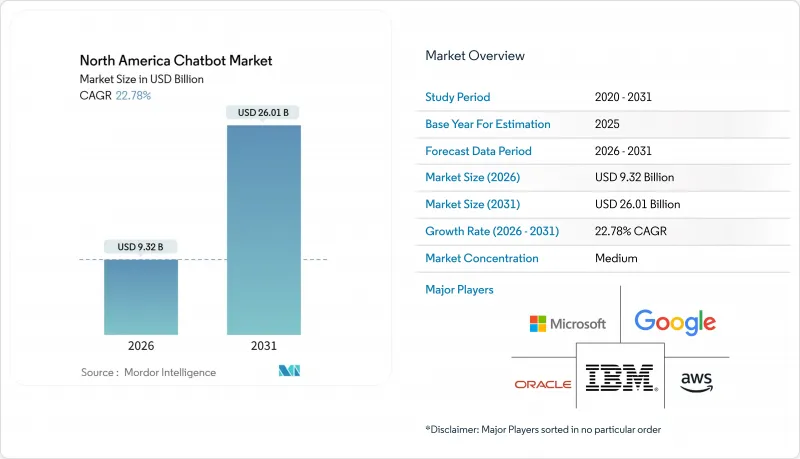
This report is Segmented by Enterprise Size (Small and Medium Enterprises, and Large Enterprises), Deployment Model (On-Premise, and Cloud-Based), Application (Customer Support, and More), End-User Vertical (IT and Telecom, and More), Technology (Rule-Based Chatbots, and More), Platform (Web-Based, Mobile-App, and More), and Geography. The Market Forecasts are Provided in Terms of Value (USD).
North America Chatbot Market Trends and Insights
Rising Domination of Messaging Applications For Customer Engagement
Messaging apps have overtaken email and voice as the preferred support channel, enabling asynchronous threads that cut cost-per-contact by 30-40% while letting agents juggle multiple conversations simultaneously. Meta reported an eight-fold jump in WhatsApp Business usage in 2025, and its Flows feature embeds product catalogs and payments inside the chat thread, compressing the purchase journey. Mexico shows outsized momentum because more than 90% of smartphone users rely on WhatsApp, making it the de facto interface for banking, healthcare, and even government transactions. Vendors, therefore, race to perfect omnichannel orchestration so that context follows users across WhatsApp, Messenger, SMS, and in-app widgets. The immediate payoff is higher engagement, but the strategic prize is control of first-party data generated in every conversational step.
Growing Demand For Consumer Analytics And Personalized Experiences
Chatbots now funnel zero-party data straight into marketing stacks, turning routine service interactions into continuous preference mapping. Salesforce found in 2025 that 73% of consumers expect brands to understand them, yet only 38% feel understood, revealing a gap that chatbots are primed to close. Sephora's Messenger bot logs skin type, scent notes, and budget, then surfaces curated offers that convert 11% better than generic web pages. By capturing sentiment and intent at every turn, brands can iterate offers without engineering bottlenecks. Platforms that embed realtime dashboards for conversation analytics gain stickiness because marketers can tweak flows daily, not quarterly, thereby sharpening campaign relevance and return on ad spend.
Escalating Data-Privacy And Security Concerns
A patchwork of privacy statutes forces enterprises to juggle multiple compliance profiles, raising legal review costs and slowing go-lives. California Privacy Rights Act mandates disclosure and one-click opt-out before bots gather personal data. Thirteen more states enacted parallel laws by 2025, each with unique consent triggers, while HIPAA forbids transmitting protected health information over unsecured channels. A 2024 telecom breach exposing credit card numbers in chat logs led to a USD 12 million settlement, underscoring the liability stakes. Enterprises respond by keeping sensitive workflows on-premise, forfeiting cloud cost advantages to ensure data residency and audit control.
Other drivers and restraints analyzed in the detailed report include:
- Rapid Advances In NLP And Voice Recognition Technologies
- Integration Of Generative AI-Powered Self-Learning Chatbots
- Chatbot Hallucination Risk Leading To Brand-Reputation Fallout
For complete list of drivers and restraints, kindly check the Table Of Contents.
Segment Analysis
Small and medium enterprises contributed a modest portion of 2025 revenue, yet they are expanding at a 23.16% CAGR that outpaces large-enterprise growth, signaling democratization of the North America chatbot market. The cost hurdle has fallen from USD 50,000-150,000 custom builds to USD 500-2,000 monthly subscriptions, thanks to drag-and-drop builders like ManyChat and Tidio. Shopify Inbox embedded bot tools inside merchant dashboards, driving deployment by more than 200,000 stores within six months of its 2024 debut.
Large enterprises still dominate absolute spend because they integrate bots into Salesforce, SAP, and proprietary CRMs while enforcing single sign-on and role-based access, but SMEs are closing the functional gap with pre-trained industry libraries. This shift pressures vendors to segment offerings, selling turnkey packages to resource-limited SMEs and white-glove services to compliance-heavy conglomerates. The North America chatbot market benefits because a wider buyer base spreads R&D costs and fuels usage data that improve model performance.
Cloud deployments account for 69.11% of 2025 revenue and are projected to grow at a 23.19% CAGR as enterprises value on-demand scale and continuous feature updates. Managed services such as AWS Lex and Azure Bot Service shield developers from server provisioning and disaster recovery, enabling instant scaling for Black Friday surges without capex.
On-premises persists in finance and healthcare, where Gramm-Leach-Bliley and HIPAA require data to remain behind corporate firewalls. Hybrid models are therefore rising, housing sensitive inference in private clouds while routing benign traffic through public endpoints. ServiceNow Virtual Agent lets clients deploy orchestration locally and language understanding in Google Cloud, balancing control with GPU economics. Vendors boasting FedRAMP or HIPAA-eligible certifications now win competitive bids as regulators tighten scrutiny.
Complete Report Scope:
- By Enterprise Size
- Small and Medium Enterprises
- Large Enterprises
- By Deployment Model
- On-Premise
- Cloud-Based
- By Application
- Customer Support
- Marketing and Sales
- Personal Assistant
- HR and Recruitment
- Other Applications
- By End-User Vertical
- Retail and eCommerce
- Banking, Financial Services and Insurance
- Healthcare and Life Sciences
- IT and Telecom
- Travel and Hospitality
- Government and Public Sector
- Other End-User Verticals
- By Technology
- Machine-Learning and NLP Chatbots
- Rule-Based Chatbots
- Hybrid / Context-Aware Chatbots
- By Platform
- Web-Based
- Mobile-App
- Social-Messaging Channels
- By Country
- United States
- Canada
- Mexico
List of Companies Covered in this Report:
- International Business Machines Corporation
- Microsoft Corporation
- Google LLC
- Nuance Communications, Inc.
- LivePerson, Inc.
- Salesforce, Inc.
- Zendesk, Inc.
- Amazon Web Services, Inc.
- ServiceNow, Inc.
- Oracle Corporation
- ManyChat, Inc.
- Chatfuel Inc.
- Gupshup Inc.
- Amplify.ai, Inc.
- Pypestream, Inc.
- Meya.ai Inc.
- Octane AI, Inc.
- Pandorabots, Inc.
- Semantic Machines, Inc.
- Beep Boop, Inc.
- Reply.ai, Inc.
- Recime Limited
- Botpress, Inc.
Additional Benefits:
- The market estimate (ME) sheet in Excel format
- 3 months of analyst support
TABLE OF CONTENTS
1 INTRODUCTION
- 1.1 Study Assumptions and Market Definition
- 1.2 Scope of the Study
2 RESEARCH METHODOLOGY
3 EXECUTIVE SUMMARY
4 MARKET LANDSCAPE
- 4.1 Market Overview
- 4.2 Market Drivers
- 4.2.1 Rising Domination of Messaging Applications for Customer Engagement
- 4.2.2 Growing Demand for Consumer Analytics and Personalised Experiences
- 4.2.3 Rapid Advancements in NLP and Voice Recognition Technologies
- 4.2.4 Integration of Generative AI-Powered Self-Learning Chatbots
- 4.2.5 Expansion of Age-Tech Chatbots for Elder Care and Chronic Disease Support
- 4.2.6 US Public-Sector Digital-Service Mandates Boosting Citizen Chatbots
- 4.3 Market Restraints
- 4.3.1 Lack of Organisational Awareness and Integration Complexity
- 4.3.2 Escalating Data-Privacy and Security Concerns
- 4.3.3 Chatbot Hallucination Risk Leading to Brand-Reputation Fallout
- 4.3.4 Accessibility-Compliance Costs Under ADA and AODA Regulations
- 4.4 Impact of Macroeconomic Factors on the Market
- 4.5 Industry Value Chain Analysis
- 4.6 Regulatory Landscape
- 4.7 Technological Outlook
- 4.8 Porter's Five Forces Analysis
- 4.8.1 Threat of New Entrants
- 4.8.2 Bargaining Power of Buyers
- 4.8.3 Bargaining Power of Suppliers
- 4.8.4 Threat of Substitutes
- 4.8.5 Intensity of Competitive Rivalry
5 MARKET SIZE AND GROWTH FORECASTS (VALUE)
- 5.1 By Enterprise Size
- 5.1.1 Small and Medium Enterprises
- 5.1.2 Large Enterprises
- 5.2 By Deployment Model
- 5.2.1 On-Premise
- 5.2.2 Cloud-Based
- 5.3 By Application
- 5.3.1 Customer Support
- 5.3.2 Marketing and Sales
- 5.3.3 Personal Assistant
- 5.3.4 HR and Recruitment
- 5.3.5 Other Applications
- 5.4 By End-User Vertical
- 5.4.1 Retail and eCommerce
- 5.4.2 Banking, Financial Services and Insurance
- 5.4.3 Healthcare and Life Sciences
- 5.4.4 IT and Telecom
- 5.4.5 Travel and Hospitality
- 5.4.6 Government and Public Sector
- 5.4.7 Other End-User Verticals
- 5.5 By Technology
- 5.5.1 Machine-Learning and NLP Chatbots
- 5.5.2 Rule-Based Chatbots
- 5.5.3 Hybrid / Context-Aware Chatbots
- 5.6 By Platform
- 5.6.1 Web-Based
- 5.6.2 Mobile-App
- 5.6.3 Social-Messaging Channels
- 5.7 By Country
- 5.7.1 United States
- 5.7.2 Canada
- 5.7.3 Mexico
6 COMPETITIVE LANDSCAPE
- 6.1 Market Concentration
- 6.2 Strategic Moves
- 6.3 Market Share Analysis
- 6.4 Company Profiles (includes Global Level Overview, Market Level Overview, Core Segments, Financials as available, Strategic Information, Market Rank/Share for key companies, Products and Services, and Recent Developments)
- 6.4.1 International Business Machines Corporation
- 6.4.2 Microsoft Corporation
- 6.4.3 Google LLC
- 6.4.4 Nuance Communications, Inc.
- 6.4.5 LivePerson, Inc.
- 6.4.6 Salesforce, Inc.
- 6.4.7 Zendesk, Inc.
- 6.4.8 Amazon Web Services, Inc.
- 6.4.9 ServiceNow, Inc.
- 6.4.10 Oracle Corporation
- 6.4.11 ManyChat, Inc.
- 6.4.12 Chatfuel Inc.
- 6.4.13 Gupshup Inc.
- 6.4.14 Amplify.ai, Inc.
- 6.4.15 Pypestream, Inc.
- 6.4.16 Meya.ai Inc.
- 6.4.17 Octane AI, Inc.
- 6.4.18 Pandorabots, Inc.
- 6.4.19 Semantic Machines, Inc.
- 6.4.20 Beep Boop, Inc.
- 6.4.21 Reply.ai, Inc.
- 6.4.22 Recime Limited
- 6.4.23 Botpress, Inc.
7 MARKET OPPORTUNITIES AND FUTURE OUTLOOK
- 7.1 White-Space and Unmet-Need Assessment

