PUBLISHER: Mordor Intelligence | PRODUCT CODE: 2124699

PUBLISHER: Mordor Intelligence | PRODUCT CODE: 2124699
Europe Confectionery Packaging - Market Share Analysis, Industry Trends & Statistics, Growth Forecasts (2026 - 2031)
According to Mordor Intelligence, Europe confectionery packaging market size in 2026 is estimated at USD 3.62 billion, growing from 2025 value of USD 3.51 billion with 2031 projections showing USD 4.19 billion, growing at 3.01% CAGR over 2026-2031.
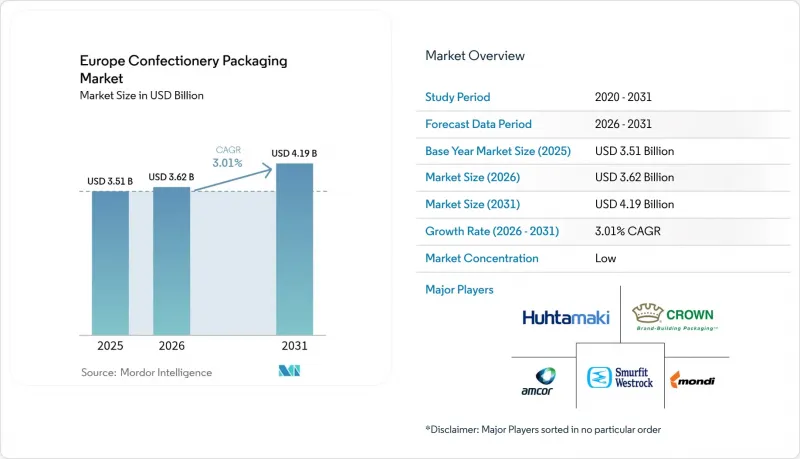
This report is Segmented by Packaging Material (Plastic, Paper and Paperboard, Metal, Glass, Bioplastic and Compostable Films), Packaging Format (Flexible, Rigid), Confectionery Type (Chocolate, Sugar Confectionery, and More), Distribution Channel (Direct Sales, Indirect Sales), and by Country. The Market Forecasts are Provided in Terms of Value (USD).
Europe Confectionery Packaging Market Trends and Insights
Premiumisation-led Smaller Pack Launches
Consumer willingness to trade up for artisanal products is pushing brand owners to develop sophisticated small-format packs that justify higher unit prices while curbing calorie intake. Mondelez and Saica debuted a paper-based multipack that reinforces premium cues and aligns with recyclability goals. Chocolate makers need high-barrier structures to protect flavour in reduced volumes, prompting Amcor to roll out AmFiber Performance Paper for high-margin segments. Precision dosing lines and advanced sealing units now support economically viable small-batch runs, giving suppliers of flexible equipment an edge. Retailers benefit from portion-controlled packs that fit front-of-store displays, and consumers gain clarity on calorie counts, underscoring the driver's broad relevance across the Europe confectionery packaging market.
Sustainability-driven Shift to Recyclable Mono-material Flexibles
End-of-life mandates under PPWR and consumer eco-preferences are steering brands away from complex laminates toward mono-material films that still hit oxygen and moisture targets. Amcor's AmPrima line achieved a 92% recyclability score while preserving critical barrier levels in a recent Lorenz Snacks deployment.Corporate pledges Cadbury's 80% recycled content for sharing bars exemplifies the trend lock in long-term demand for circular polymers. Brands that master mono-material design gain a marketing lift and regulatory head start, whereas late adopters confront higher compliance costs and risk shelf-de-listing. The shift therefore represents the most powerful growth lever in the Europe confectionery packaging market.
Impending PFAS and BPA Bans Raising Conversion Costs
The 2026 ban on PFAS in food contact materials caps individual compounds at 25 ppb, forcing converters to reformulate barriers and adhesives. Large groups expect EUR 50-100 million (USD 58.55 - 117.09 million) in conversion spending for line retrofits and verification testing.Smaller firms shoulder proportionally steeper burdens and may exit high-barrier niches, tightening supply in the short term. Suppliers with certified PFAS-free portfolios secure premium pricing and gain share within the Europe confectionery packaging market.
Other drivers and restraints analyzed in the detailed report include:
- Shelf-ready Secondary Packs That Cut In-store Labour Costs
- E-commerce-optimised Confectionery Multipacks
- Proposed EU PPWR 95% Recyclability Target by 2030
For complete list of drivers and restraints, kindly check the Table Of Contents.
Segment Analysis
Plastic maintained a 54.88% stake in the Europe confectionery packaging market in 2025 thanks to well-understood barriers and cost advantages. Yet bioplastic and compostable films outpace at a 6.02% CAGR, marking the hottest growth pocket as regulation and eco-signals strengthen. Rigid PET cups and tubs retain relevance for portion control, while flexible BOPP and PE films anchor multipack flow wraps. The emergence of mono-material barrier films supports recyclability compliance without trading off shelf-life, shifting procurement towards suppliers that master sophisticated extrusion. The Europe confectionery packaging market size for bioplastic formats is on track to expand swiftly as PLA prices converge with fossil polymers.
Corbion's forecasted PLA recovery plus early commercial launches signal that cost parity is achievable before 2028. PFAS restrictions intensify R&D in fluorine-free barriers leveraging EVOH and bio-coatings. Paperboard players upscale dispersion-coated papers for grease-resistant wraps, although performance limits still confine usage to low-moisture candies. Metal tins persevere in souvenir gifting due to perceived heritage value despite freight inflation. Collectively these shifts confirm that material choice is now led by recyclability metrics more than traditional cost benchmarks across the Europe confectionery packaging market.
Flexible packs commanded 54.31% revenue in 2025 and still post a healthy 4.28% CAGR through 2031, reflecting unmatched material yield and logistic efficiency. Flow wraps, pouches, and twist wraps score favourably under Extended Producer Responsibility schemes, lowering per-unit eco-fees. Rigid formats defend premium niches where shelf impact and protection justify heavier materials. The Europe confectionery packaging market size for flexible mono-material solutions is poised to widen as barrier performance improvements align with 95% recyclability targets.
Amcor's 92% recyclable flexible structure for snacks demonstrates functional parity with traditional laminates. Digital printing convergence enables seasonal or influencer-driven graphics without long set-ups, suiting social media campaigns. Smart sensors embedded in flexible films provide temperature excursion alerts, bolstering e-commerce value propositions. Consequently, converters that marry lightweight films with intelligent features are best placed to capture incremental share in the Europe confectionery packaging market.
Complete Report Scope:
- By Packaging Material
- Plastic
- Rigid (PET, PP, PS)
- Flexible (BOPP, PE, PLA)
- Paper and Paperboard
- Metal
- Glass
- Bioplastic and Compostable Films
- Plastic
- By Packaging Format
- Flexible
- Rigid
- By Confectionery Type
- Chocolate
- Sugar Confectionery
- Gum
- Others (Seasonal, Medicated)
- By Distribution Channel
- Direct Sales
- Indirect Sales
- By Country
- Germany
- United Kingdom
- France
- Italy
- Spain
- Russia
- Netherlands
- Rest of Europe
List of Companies Covered in this Report:
- Amcor Plc
- Mondi Group
- Huhtamaki Oyj
- Smurfit Westrock
- Crown Holdings
- International Paper
- Constantia Flexibles
- Sealed Air
- AptarGroup
- Sonoco Products
- Greiner Packaging
- Coveris Holdings
- Ducaju NV
- ALPLA
- RPC-Pact Group
- Clondalkin Group
- Tetra Pak
Additional Benefits:
- The market estimate (ME) sheet in Excel format
- 3 months of analyst support
TABLE OF CONTENTS
1 INTRODUCTION
- 1.1 Study Assumptions and Market Definition
- 1.2 Scope of the Study
2 RESEARCH METHODOLOGY
3 EXECUTIVE SUMMARY
4 MARKET LANDSCAPE
- 4.1 Market Overview
- 4.2 Market Drivers
- 4.2.1 Premiumisation-led smaller pack launches
- 4.2.2 Sustainability-driven shift to recyclable mono-material flexibles
- 4.2.3 Shelf-ready secondary packs that cut in-store labour costs
- 4.2.4 E-commerce-optimised confectionery multipacks
- 4.2.5 Biopolymer barrier films reaching commercial cost parity
- 4.2.6 Smart-pack coding for EU Digital Product Passport compliance
- 4.3 Market Restraints
- 4.3.1 Impending PFAS and BPA bans raising conversion costs
- 4.3.2 Proposed EU PPWR 95 % recyclability target by 2030
- 4.3.3 Higher freight rates hurting glass container economics
- 4.3.4 Sugar-reduction regulations dampening seasonal gift volumes
- 4.4 Supply-Chain Analysis
- 4.5 Regulatory Landscape
- 4.6 Technological Outlook
- 4.7 Porter's Five Forces Analysis
- 4.7.1 Threat of New Entrants
- 4.7.2 Bargaining Power of Buyers
- 4.7.3 Bargaining Power of Suppliers
- 4.7.4 Threat of Substitutes
- 4.7.5 Competitive Rivalry
- 4.8 Confectionery Market Context in Europe
- 4.8.1 Distribution Channels and Average Pack Size
- 4.8.2 Top Five Confectionery Vendors
5 MARKET SIZE AND GROWTH FORECASTS (VALUE)
- 5.1 By Packaging Material
- 5.1.1 Plastic
- 5.1.1.1 Rigid (PET, PP, PS)
- 5.1.1.2 Flexible (BOPP, PE, PLA)
- 5.1.2 Paper and Paperboard
- 5.1.3 Metal
- 5.1.4 Glass
- 5.1.5 Bioplastic and Compostable Films
- 5.1.1 Plastic
- 5.2 By Packaging Format
- 5.2.1 Flexible
- 5.2.2 Rigid
- 5.3 By Confectionery Type
- 5.3.1 Chocolate
- 5.3.2 Sugar Confectionery
- 5.3.3 Gum
- 5.3.4 Others (Seasonal, Medicated)
- 5.4 By Distribution Channel
- 5.4.1 Direct Sales
- 5.4.2 Indirect Sales
- 5.5 By Country
- 5.5.1 Germany
- 5.5.2 United Kingdom
- 5.5.3 France
- 5.5.4 Italy
- 5.5.5 Spain
- 5.5.6 Russia
- 5.5.7 Netherlands
- 5.5.8 Rest of Europe
6 COMPETITIVE LANDSCAPE
- 6.1 Market Concentration
- 6.2 Strategic Moves
- 6.3 Market Share Analysis
- 6.4 Company Profiles (includes Global level Overview, Market level overview, Core Segments, Financials as available, Strategic Information, Market Rank/Share for key companies, Products and Services, and Recent Developments)
- 6.4.1 Amcor Plc
- 6.4.2 Mondi Group
- 6.4.3 Huhtamaki Oyj
- 6.4.4 Smurfit Westrock
- 6.4.5 Crown Holdings
- 6.4.6 International Paper
- 6.4.7 Constantia Flexibles
- 6.4.8 Sealed Air
- 6.4.9 AptarGroup
- 6.4.10 Sonoco Products
- 6.4.11 Greiner Packaging
- 6.4.12 Coveris Holdings
- 6.4.13 Ducaju NV
- 6.4.14 ALPLA
- 6.4.15 RPC-Pact Group
- 6.4.16 Clondalkin Group
- 6.4.17 Tetra Pak
7 MARKET OPPORTUNITIES AND FUTURE OUTLOOK
- 7.1 White-space and Unmet-Need Assessment

