PUBLISHER: Mordor Intelligence | PRODUCT CODE: 2124702

PUBLISHER: Mordor Intelligence | PRODUCT CODE: 2124702
India Industrial Pump - Market Share Analysis, Industry Trends & Statistics, Growth Forecasts (2026 - 2031)
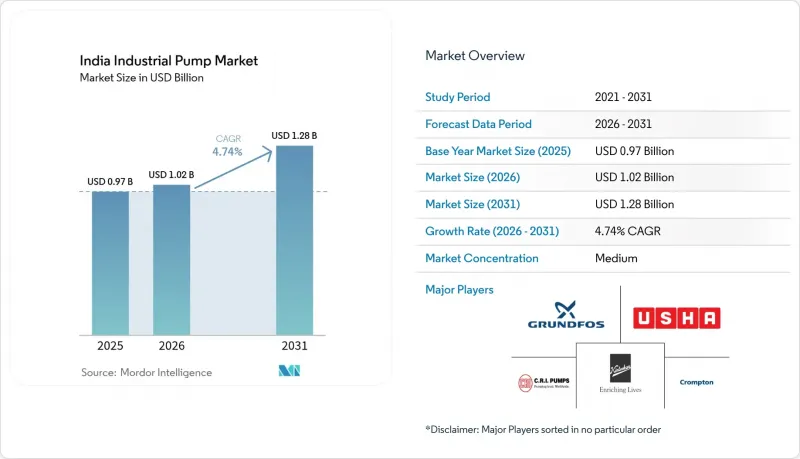
According to Mordor Intelligence, the India industrial pump market size was valued at USD 0.97 billion in 2025 and estimated to grow from USD 1.02 billion in 2026 to reach USD 1.28 billion by 2031, at a CAGR of 4.74% during the forecast period (2026-2031).
[1] Ministry of Finance, "Union Budget 2024-25," INDIABUDGET.GOV.IN The solid growth stems from sustained government capex under the National Infrastructure Pipeline, widening wastewater treatment coverage, and the steady shift toward smart, energy-efficient pumping systems. This report is Segmented by Pump Type (Centrifugal, and Positive-Displacement), End-User Industry (Oil and Gas, Water and Wastewater, Chemicals and Petrochemicals, Power Generation, Mining, and More), Driver Type (Electric-Motor Driven, Engine-Driven, and Solar-Powered), Installation (Surface Pumps, and Submersible Pumps), and Geography. The Market Forecasts are Provided in Terms of Value (USD).
India Industrial Pump Market Trends and Insights
Government Capex Under the National Infrastructure Pipeline Accelerates Industrial Pump Demand
The INR 111 lakh crore National Infrastructure Pipeline (NIP) earmarked through 2025 has permanently changed pump procurement behaviour by embedding digital-performance requirements in every new utility, refinery upgrade, and industrial park. Public-private partnerships now expect suppliers to guarantee uptime metrics, pushing vendors to bundle Industrial IoT sensors, API 610 compliance, and long-term service contracts. Paradip refinery's INR 24,000 crore brown-field project illustrates the new norm, specifying remote diagnostics and predictive-maintenance dashboards with every pump skid. The model favours enterprises that maintain nationwide service crews and cloud-ready control platforms while elevating entry barriers for low-spec imports lacking data gateways or standardized protocols. As NIP disbursements progress, centrifugal pump retrofits give way to condition-based replacements, sustaining aftermarket revenue even after capital outlays taper.
Rapid Expansion of Wastewater Treatment Capacity Drives Specialized Pump Requirements
Wastewater coverage is slated to reach 70% by 2030 from 37% in 2024, triggering record procurement of corrosion-resistant, solids-handling pumps rated above 75% efficiency. Mumbai Metropolitan Region alone has budgeted INR 25,000 crore for decentralized sewage lifting and sludge dewatering, demanding more than 2,000 precision pumps able to operate unattended in corrosive environments. Operators now stipulate variable-frequency drives to match fluctuating influent loads, creating premium niches for manufacturers with metallurgy know-how and VFD bundles. Tightened Central Pollution Control Board norms further elevate demand for real-time monitoring and redundancy, placing centrifugal offerings with leak-free magnetic drives at a competitive edge.
Import Surge of Low-Cost Chinese Pumps Pressures Domestic Market Dynamics
Chinese models undercut domestic equivalents by 30-40%, capturing commodity water and HVAC orders and compressing gross margins. Shorter lead times and flexible credit terms lure SMEs, compelling Indian producers to automate fabrication and trim overhead. However, inconsistent after-sales service and spares unavailability offer incumbents a service-oriented counterpunch, especially as the Bureau of Indian Standards tightens ISI enforcement.
Other drivers and restraints analyzed in the detailed report include:
- Brown-field Expansion in Indian Refineries Creates High-Value Pump Opportunities
- Increasing Solar-Powered Pump Installations Transform Industrial Energy Economics
- High Total Cost of Ownership Constrains Market Expansion in Energy-Intensive Applications
For complete list of drivers and restraints, kindly check the Table Of Contents.
Segment Analysis
Centrifugal models commanded 65.02% of 2025 revenue of the India industrial pump market size, because they efficiently move large flows at moderate heads in water, cooling, and general process loops. Positive-displacement pumps, though only 34.98% of shipments, are set for a 6.79% CAGR by 2031, outstripping centrifugal's 3.95% pace as specialty chemical and pharma customers demand precise metering under variable viscosities. Vendors are closing the gap by adding magnetic drives and ceramic bearings to centrifugal lines, while PD makers push higher-speed, compact skids for brown-field retrofits. IoT retrofits blur lines further, letting operators benchmark efficiency in real time and switch technologies based on duty cycle analytics. Over the forecast, centrifugal unit volumes will still dwarf PD counts, yet PD value share will rise on premium pricing for exotic alloys and seamless architectures that curb fugitive emissions.
Water and wastewater accounted for 28.86% of the India industrial pump market share in 2025 on the back of Jal Jeevan and urban STP investments valued above INR 3.6 lakh crore. Mining, though only 8.40% of current sales, leads with a 7.18% CAGR as Coal India and steel majors increase mechanized output. Dewatering, slurry, and tailings lines call for abrasion-resistant elastomers and duplex stainless steels, lifting ASPs. Oil and gas remain a steady buyer through refinery upgrades, while chemicals leverage import-substitution policies to spur PD pump adoption. Regional clusters such as Chhattisgarh iron-ore belts or Odisha chromite pits will show double-digit spends, whereas mature thermal power plants mostly allocate capex for replacements rather than expansions.
Complete Report Scope:
- By Pump Type
- Centrifugal
- Positive-Displacement
- By End-user Industry
- Oil and Gas
- Water and Wastewater
- Chemicals and Petrochemicals
- Power Generation
- Mining
- Other End-User Industry
- By Driver Type
- Electric-motor Driven
- Engine-Driven (Diesel/CNG)
- Solar-Powered
- By Installation
- Surface Pumps
- Submersible Pumps
List of Companies Covered in this Report:
- Kirloskar Brothers Limited
- KSB SE and Co. KGaA (India)
- CRI Pumps Private Limited
- Grundfos Pumps India Private Limited
- Xylem Inc. (India)
- Shakti Pumps (India) Limited
- Crompton Greaves Consumer Electricals Limited
- CNP Pumps India Private Limited
- Falcon Pumps Private Limited
- Chemlin Pumps and Valves Private Limited
- La-Gajjar Machineries Private Limited
- Kishor Pumps Private Limited
- Unnati Pumps Private Limited
- V-Guard Industries Limited
- Flowserve India Controls Private Limited
- Sulzer Pumps India Private Limited
- Wilo Mather and Platt Pumps Private Limited
- Ebara Pumps India Private Limited
- ITT Goulds Pumps India Private Limited
- Roto Pumps Limited
- Netzsch Technologies India Private Limited
- Armstrong Fluid Technology (India) Private Limited
- Alfa Laval India Private Limited
- Peerless Pump India Private Limited
Additional Benefits:
- The market estimate (ME) sheet in Excel format
- 3 months of analyst support
TABLE OF CONTENTS
1 INTRODUCTION
- 1.1 Study Assumptions and Market Definition - Scope of the Study
2 RESEARCH METHODOLOGY
3 EXECUTIVE SUMMARY
4 MARKET LANDSCAPE
- 4.1 Market Overview
- 4.2 Market Drivers
- 4.2.1 Government cap-ex under National Infrastructure Pipeline (NIP)
- 4.2.2 Rapid expansion of wastewater treatment capacity
- 4.2.3 Brown-field expansion in Indian refineries
- 4.2.4 Increasing solar-powered pump installations in industries
- 4.2.5 Shift toward API 610/ISO 13709-compliant pumps
- 4.2.6 Industrial IoT-enabled predictive-maintenance adoption
- 4.3 Market Restraints
- 4.3.1 Import surge of low-cost Chinese pumps
- 4.3.2 High total cost of ownership (energy + maintenance)
- 4.3.3 Volatility in steel and copper prices
- 4.3.4 Lengthy approval cycles in public sector projects
- 4.4 Industry Value-Chain Analysis
- 4.5 Regulatory Landscape
- 4.6 Technological Outlook
- 4.7 Porter's Five Forces Analysis
5 MARKET SIZE AND GROWTH FORECASTS (VALUE)
- 5.1 By Pump Type
- 5.1.1 Centrifugal
- 5.1.2 Positive-Displacement
- 5.2 By End-user Industry
- 5.2.1 Oil and Gas
- 5.2.2 Water and Wastewater
- 5.2.3 Chemicals and Petrochemicals
- 5.2.4 Power Generation
- 5.2.5 Mining
- 5.2.6 Other End-User Industry
- 5.3 By Driver Type
- 5.3.1 Electric-motor Driven
- 5.3.2 Engine-Driven (Diesel/CNG)
- 5.3.3 Solar-Powered
- 5.4 By Installation
- 5.4.1 Surface Pumps
- 5.4.2 Submersible Pumps
6 COMPETITIVE LANDSCAPE
- 6.1 Market Concentration
- 6.2 Strategic Moves
- 6.3 Market Share Analysis
- 6.4 Company Profiles {(includes Global level Overview, Market level overview, Core Segments, Financials as available, Strategic Information, Market Rank/Share for key companies, Products and Services, and Recent Developments)}
- 6.4.1 Kirloskar Brothers Limited
- 6.4.2 KSB SE and Co. KGaA (India)
- 6.4.3 CRI Pumps Private Limited
- 6.4.4 Grundfos Pumps India Private Limited
- 6.4.5 Xylem Inc. (India)
- 6.4.6 Shakti Pumps (India) Limited
- 6.4.7 Crompton Greaves Consumer Electricals Limited
- 6.4.8 CNP Pumps India Private Limited
- 6.4.9 Falcon Pumps Private Limited
- 6.4.10 Chemlin Pumps and Valves Private Limited
- 6.4.11 La-Gajjar Machineries Private Limited
- 6.4.12 Kishor Pumps Private Limited
- 6.4.13 Unnati Pumps Private Limited
- 6.4.14 V-Guard Industries Limited
- 6.4.15 Flowserve India Controls Private Limited
- 6.4.16 Sulzer Pumps India Private Limited
- 6.4.17 Wilo Mather and Platt Pumps Private Limited
- 6.4.18 Ebara Pumps India Private Limited
- 6.4.19 ITT Goulds Pumps India Private Limited
- 6.4.20 Roto Pumps Limited
- 6.4.21 Netzsch Technologies India Private Limited
- 6.4.22 Armstrong Fluid Technology (India) Private Limited
- 6.4.23 Alfa Laval India Private Limited
- 6.4.24 Peerless Pump India Private Limited
7 MARKET OPPORTUNITIES AND FUTURE OUTLOOK
- 7.1 White-space and Unmet-Need Assessment

