PUBLISHER: Mordor Intelligence | PRODUCT CODE: 2124714

PUBLISHER: Mordor Intelligence | PRODUCT CODE: 2124714
Virtual Events - Market Share Analysis, Industry Trends & Statistics, Growth Forecasts (2026 - 2031)
According to Mordor Intelligence, the virtual events market size stood at USD 16.61 billion in 2026 and is projected to reach USD 27.65 billion by 2031, advancing at a 10.72% CAGR during the forecast period.
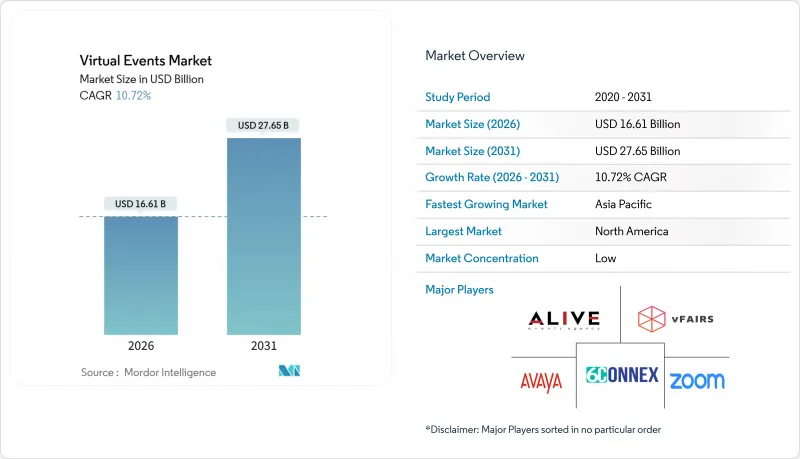
This report is Segmented by Platform (Web-Based Platform, XR Platform, and More), Service Type (Communication Services, Recruitment and Networking, and More), Application (Conferences and Summits, and More), Event Type (Webinar, and More), End-User Industry (Educational Institutions, and More), Revenue Source (Sponsorship, and More), and Geography. The Market Forecasts are Provided in Terms of Value (USD).
Global Virtual Events Market Trends and Insights
Rapid Adoption of Unified Communications as a Service and Cloud-Based Collaboration Platforms
Enterprises migrating toward UCaaS bundles increasingly expect event-broadcast functions to sit beside voice, chat, and whiteboard tools, trimming separate webinar licenses and slashing evaluation cycles. Microsoft Teams, Zoom Workplace, and Cisco Webex each report triple-digit growth in monthly active users who launch company town halls without incremental procurement, refocusing competitive differentiation on API depth and third-party integrations. Cloud-native deployment removes server-capacity bottlenecks, letting event managers scale registration portals in hours. The resulting low marginal cost encourages frequent internal briefings and externally facing product showcases, normalizing digital formats for a broadening set of corporate rituals. These dynamics expand the addressable base for the virtual events market.
Expansion of Remote and Hybrid Work Models Globally
Public-sector labor data show telework stabilizing near one-quarter of the employed population in the United States, while cross-continent studies highlight similar persistence in Europe and Asia-Pacific. Distributed workforces multiply time-zone conflicts and widen carbon-reporting liabilities, making browser-based gatherings the default solution for quarterly kickoffs and partner briefings. Organizers now design agendas around asynchronous replay, modular tracks, and on-demand libraries, reversing pre-pandemic conventions that assumed uniform attendance windows. As companies integrate flexible work into talent strategies, consistent demand streams into the virtual events market.
Data Security and Privacy Concerns in Large-Scale Online Events
Regulators are sharpening scrutiny of attendee data, compelling encryption at rest, role-based access controls, and granular audit logs. Healthcare, financial services, and government agencies demand ISO 27001 or SOC 2 attestations before green-lighting platform contracts, stretching sales cycles. XR environments amplify sensitivity because eye-tracking, spatial movement, and biometric cues can reveal personal attributes, triggering new compliance checkpoints. Smaller associations lacking dedicated privacy officers often postpone virtual expansions, trimming near-term volumes in the virtual events market.
Other drivers and restraints analyzed in the detailed report include:
- Integration of Generative AI for Real-Time Translation and Content Personalization
- Carbon-Neutral Event Mandates Embedded in Fortune 500 ESG Strategies
- Limited Audience Engagement and Networking Fatigue
For complete list of drivers and restraints, kindly check the Table Of Contents.
Segment Analysis
Web-based solutions claimed 48.43% of the virtual events market share in 2025, underscoring how HTML5 and WebRTC deliver frictionless log-on experiences inside corporate firewalls. Enterprises value zero-install access, automatic scaling, and straightforward compliance audits. The dominance of browsers keeps entry costs low, inviting frequent internal updates and external webinars that expand the overall virtual events market size. Yet immersive XR venues are set to grow at an 11.64% CAGR to 2031, powered by multi-vendor headset standards that shrink integration hurdles. Automotive design walk-throughs, surgical simulations, and luxury real-estate tours already showcase the experiential lift of spatial presence. Although headset prices and user comfort remain hurdles, early adopters in manufacturing, healthcare, and education validate the pathway for broader adoption.
The interplay between browser and XR platforms is symbiotic. Browser-based lobbies increasingly route high-value sessions to optional headset environments, melding accessibility with immersion. Cloud orchestration lets organizers spin up parallel 2D and 3D streams, preserving audience reach while experimenting with advanced interactivity. As venture investment pours into photorealistic avatars, gesture recognition, and spatial audio, the virtual events market gains optionality, positioning XR as an additive layer rather than a binary substitute.
Communication services accounted for 38.64% of revenue in 2025, serving as the backbone of every webinar, town hall, and training module. Bundling UCaaS contracts compresses incremental spend, while data gathered through chats, polls, and Q&A feeds broader analytics stacks, reinforcing platform stickiness. Marketing and promotion services are forecast to compound at 11.98% annually, mirroring a shift from traditional trade shows to sponsored virtual booths that quantify every click and dwell. First-party data captured through gated registration forms becomes even more valuable as browser cookies are phased out, enabling brands to build owned audiences and refine lead-scoring models. Enhanced dashboards visualize asset downloads, booth traffic, and meeting requests in real time, elevating sponsorship packages and boosting the overall size of the virtual events market.
Cross-functional teams now co-design campaigns that weave pre-event email journeys with in-platform quizzes and post-event nurture tracks, linking marketing automation, CRM, and analytics APIs. White-label customization lets sponsors overlay visual identities on lobbies, slide decks, and session replay hubs, amplifying brand recall. The virtuous loop of data-driven insights and measurable ROI keeps advertiser budgets flowing toward digital floor plans, accelerating growth inside the virtual events market.
Complete Report Scope:
- By Platform
- Web-Based Platform
- XR Platform
- Cloud Deployment
- On-Premise Deployment
- By Service Type
- Communication Services
- Recruitment and Networking
- Marketing and Promotion
- Training and Education
- By Application
- Conferences and Summits
- Exhibitions / Trade Shows
- Product Launches
- Other Applications
- By Event Type
- Webinar
- Virtual Expo / Fairs / Festivals
- Entertainment and Festivals
- Corporate Meetings
- Other Event Types
- By End-User Industry
- Educational Institutions
- Corporate Enterprises
- Government and Public Sector
- Other End-User Industries
- By Revenue Source
- Sponsorship
- Ticket Sale
- Other Revenue Sources
- By Geography
- North America
- United States
- Canada
- Mexico
- South America
- Brazil
- Argentina
- Rest of South America
- Europe
- Germany
- France
- United Kingdom
- Italy
- Spain
- Rest of Europe
- Asia-Pacific
- China
- Japan
- India
- South Korea
- Australia
- Rest of Asia-Pacific
- Middle East and Africa
- Middle East
- Saudi Arabia
- United Arab Emirates
- Turkey
- Rest of Middle East
- Africa
- South Africa
- Egypt
- Nigeria
- Rest of Africa
- Middle East
- North America
Geography Analysis
North America wielded 40.12% of virtual events market share in 2025, backed by robust broadband, high software budgets, and a dense vendor ecosystem. U.S. enterprises rapidly bundle event modules into collaboration suites, while Canada's financial sector leans on compliant cloud hosting. Mexico's call-center expansion fuels incremental training demand. A second growth pole emerges in Asia-Pacific, projected to compound at 12.45% annually as 1.9 billion 5G connections unlock low-latency streaming. Governments from India to South Korea bankroll digital-service roadmaps, reinforcing cloud uptake. Diverse language landscapes and rising SME digitalization drive demand for AI subtitles and mobile-first apps, widening the virtual events market.
Europe's regulatory environment, defined by GDPR, prioritizes encryption and sovereign-cloud options, steering procurement toward platforms with robust data-protection pedigrees. Multilingual conference norms elevate AI translation modules. Germany and France host frequent automotive and pharmaceutical summits, while the United Kingdom's fintech clusters generate steady webinar cadences. South America trails but shows momentum as Brazil accelerates broadband rollout and Argentina's export tech hubs court foreign investors online. Development-bank schemes channel grants into virtual civic forums, anchoring public-sector uptake.
The Middle East and Africa remain heterogeneous. Saudi Arabia and the United Arab Emirates fund hyperscale data centers under national digital blueprints, spurring enterprise adoption. African markets face bandwidth bottlenecks, yet mobile internet leads many users to engage via low-bitrate streams, prompting vendors to optimize codecs and offline-synced apps. South Africa and Nigeria pilot hybrid trade shows for mining and fintech, respectively, signaling an upward curve for the regional virtual events market.
- 6Connex Inc.
- Alive Events Agency Pty Ltd
- Zoom Video Communications Inc.
- Avaya LLC
- vFairs LLC
- ALE International SAS
- NTT DATA Corporation
- Cisco Systems Inc.
- Cvent Holding Corp.
- EventX Limited
- George P. Johnson Experience Marketing Inc.
- Airmeet Inc.
- Microsoft Corporation
- ON24 Inc.
- Hopin Ltd.
- Accelevents Inc.
- BigMarker Holdings Inc.
- Stova Inc.
- Hubilo Technologies Inc.
- Bizzabo Ltd.
Additional Benefits:
- The market estimate (ME) sheet in Excel format
- 3 months of analyst support
TABLE OF CONTENTS
1 INTRODUCTION
- 1.1 Study Assumptions and Market Definition
- 1.2 Scope of the Study
2 RESEARCH METHODOLOGY
3 EXECUTIVE SUMMARY
4 MARKET LANDSCAPE
- 4.1 Market Overview
- 4.2 Industry Supply-Chain Analysis
- 4.3 Market Drivers
- 4.3.1 Rapid Adoption of Unified Communications as a Service (UCaaS) and Cloud-Based Collaboration Platforms
- 4.3.2 Expansion of Remote and Hybrid Work Models Globally
- 4.3.3 Cost Savings and Extended Reach Versus Physical Events
- 4.3.4 Growing Acceptance of Immersive VR and XR Experiences for Audience Engagement
- 4.3.5 Integration of Generative AI for Real-Time Translation and Content Personalization
- 4.3.6 Carbon-Neutral Event Mandates Driving Virtual Format Adoption in Fortune 500 ESG Strategies
- 4.4 Market Restraints
- 4.4.1 Data Security and Privacy Concerns in Large-Scale Online Events
- 4.4.2 Limited Audience Engagement and Networking Fatigue
- 4.4.3 Rising Platform Saturation Leading to Vendor Lock-In Risk for Enterprises
- 4.4.4 Inconsistent Cross-Border Virtual Event Taxation and Compliance Requirements
- 4.5 Impact of Macroeconomic Factors on the Market
- 4.6 Regulatory Landscape
- 4.7 Technological Outlook
- 4.8 Porter's Five Forces Analysis
- 4.8.1 Bargaining Power of Suppliers
- 4.8.2 Bargaining Power of Consumers
- 4.8.3 Threat of New Entrants
- 4.8.4 Threat of Substitute Products
- 4.8.5 Intensity of Competitive Rivalry
5 MARKET SIZE AND GROWTH FORECASTS (VALUE)
- 5.1 By Platform
- 5.1.1 Web-Based Platform
- 5.1.2 XR Platform
- 5.1.3 Cloud Deployment
- 5.1.4 On-Premise Deployment
- 5.2 By Service Type
- 5.2.1 Communication Services
- 5.2.2 Recruitment and Networking
- 5.2.3 Marketing and Promotion
- 5.2.4 Training and Education
- 5.3 By Application
- 5.3.1 Conferences and Summits
- 5.3.2 Exhibitions / Trade Shows
- 5.3.3 Product Launches
- 5.3.4 Other Applications
- 5.4 By Event Type
- 5.4.1 Webinar
- 5.4.2 Virtual Expo / Fairs / Festivals
- 5.4.3 Entertainment and Festivals
- 5.4.4 Corporate Meetings
- 5.4.5 Other Event Types
- 5.5 By End-User Industry
- 5.5.1 Educational Institutions
- 5.5.2 Corporate Enterprises
- 5.5.3 Government and Public Sector
- 5.5.4 Other End-User Industries
- 5.6 By Revenue Source
- 5.6.1 Sponsorship
- 5.6.2 Ticket Sale
- 5.6.3 Other Revenue Sources
- 5.7 By Geography
- 5.7.1 North America
- 5.7.1.1 United States
- 5.7.1.2 Canada
- 5.7.1.3 Mexico
- 5.7.2 South America
- 5.7.2.1 Brazil
- 5.7.2.2 Argentina
- 5.7.2.3 Rest of South America
- 5.7.3 Europe
- 5.7.3.1 Germany
- 5.7.3.2 France
- 5.7.3.3 United Kingdom
- 5.7.3.4 Italy
- 5.7.3.5 Spain
- 5.7.3.6 Rest of Europe
- 5.7.4 Asia-Pacific
- 5.7.4.1 China
- 5.7.4.2 Japan
- 5.7.4.3 India
- 5.7.4.4 South Korea
- 5.7.4.5 Australia
- 5.7.4.6 Rest of Asia-Pacific
- 5.7.5 Middle East and Africa
- 5.7.5.1 Middle East
- 5.7.5.1.1 Saudi Arabia
- 5.7.5.1.2 United Arab Emirates
- 5.7.5.1.3 Turkey
- 5.7.5.1.4 Rest of Middle East
- 5.7.5.2 Africa
- 5.7.5.2.1 South Africa
- 5.7.5.2.2 Egypt
- 5.7.5.2.3 Nigeria
- 5.7.5.2.4 Rest of Africa
- 5.7.5.1 Middle East
- 5.7.1 North America
6 COMPETITIVE LANDSCAPE
- 6.1 Market Concentration
- 6.2 Strategic Moves
- 6.3 Market Share Analysis
- 6.4 Company Profiles (includes Global level Overview, Market level overview, Core Segments, Financials as available, Strategic Information, Market Rank/Share for key companies, Products and Services, and Recent Developments)
- 6.4.1 6Connex Inc.
- 6.4.2 Alive Events Agency Pty Ltd
- 6.4.3 Zoom Video Communications Inc.
- 6.4.4 Avaya LLC
- 6.4.5 vFairs LLC
- 6.4.6 ALE International SAS
- 6.4.7 NTT DATA Corporation
- 6.4.8 Cisco Systems Inc.
- 6.4.9 Cvent Holding Corp.
- 6.4.10 EventX Limited
- 6.4.11 George P. Johnson Experience Marketing Inc.
- 6.4.12 Airmeet Inc.
- 6.4.13 Microsoft Corporation
- 6.4.14 ON24 Inc.
- 6.4.15 Hopin Ltd.
- 6.4.16 Accelevents Inc.
- 6.4.17 BigMarker Holdings Inc.
- 6.4.18 Stova Inc.
- 6.4.19 Hubilo Technologies Inc.
- 6.4.20 Bizzabo Ltd.
7 MARKET OPPORTUNITIES AND FUTURE OUTLOOK
- 7.1 White-Space and Unmet-Need Assessment

