PUBLISHER: Mordor Intelligence | PRODUCT CODE: 2124717

PUBLISHER: Mordor Intelligence | PRODUCT CODE: 2124717
Power Strip - Market Share Analysis, Industry Trends & Statistics, Growth Forecasts (2026 - 2031)
According to Mordor Intelligence, the power strip market size is expected to grow from USD 14.01 billion in 2025 to USD 14.99 billion in 2026 and is forecast to reach USD 21.02 billion by 2031 at 6.98% CAGR over 2026-2031.
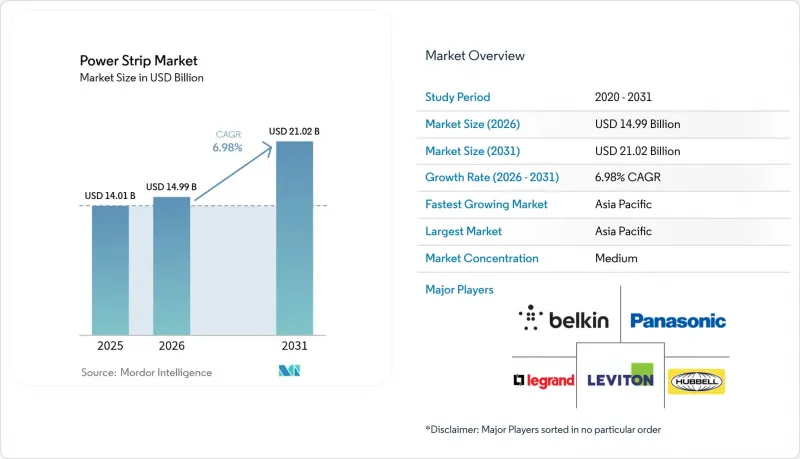
This report is Segmented by Installation Type (Furniture Power Distribution Units (FPDUs), Multioutlet Assemblies, and More), Protection Feature (Surge Protection, Overload Protection, and More), Application (Common / General Purpose, Special Protection, and More), End-User (Industrial Manufacturing Facilities, Data Centers and IT Rooms, and More), Distribution Channel (Offline and Online), and Geography.
Global Power Strip Market Trends and Insights
Proliferation of Electronic Devices in Households
Average connected-device counts per home have surpassed 25 in the United States, stretching traditional outlet configurations and intensifying demand for multi-socket solutions with integrated surge protection. New York State research shows that intelligent advanced power strips can save 106.1 kWh and USD 78.81 per household each year by curbing standby losses. WiFi-enabled strips giving residents real-time visibility into consumption patterns are therefore gaining traction, especially in markets where energy codes actively discourage phantom load draw. Manufacturers are responding with slimmer form factors and voice-assistant compatibility to align with prevailing smart-home ecosystems.
Demand for Energy-Efficient Smart-Home Power Management
Utility rebate programs and revised building codes are converting smart strips from optional upgrades into baseline fixtures. California's Emerging Technology Program validated marketing blueprints that drove widespread adoption of auto-switching models through retailer education and incentive alignment. Europe follows a similar arc, with Commission rules capping networked equipment standby to 0.5 watts and accelerating uptake of strips capable of full circuit isolation. As firmware now incorporates machine-learning algorithms that forecast load cycles, vendors seize recurring-revenue opportunities around cloud dashboards and remote firmware updates.
Stringent Safety-Certification Compliance Costs
Manufacturers must navigate UL 1363, UL 1449, and sector-specific rules such as UL 60601-1 for healthcare, each requiring exhaustive destructive testing that can exceed USD 250,000 per variant. Emerging cybersecurity add-ons further mandate penetration tests and secure-boot validations, stretching project cycles and engineering budgets. Smaller vendors consequently face longer payback horizons and often retreat to niche or price-led positions, allowing multinationals with compliance teams to widen competitive moats.
Other drivers and restraints analyzed in the detailed report include:
- Data-Center and IT-Infrastructure Expansion
- Surge in Remote Working Worldwide
- Utility Rebates and Building-Code Mandates for APS
- Industrial-IoT-Driven Networked PDU Adoption
- Counterfeit Low-Cost Products Pressure Pricing
For complete list of drivers and restraints, kindly check the Table Of Contents.
Segment Analysis
FPDUs commanded 30.86% of 2025 revenue on the back of open-plan office refurbishments specifying under-desk trunking and soft-wiring. The power strip market size for FPDU deployments is projected to expand at 6.62% annually as mobility-first furniture gains momentum. Smart WiFi/Bluetooth strips, while only 14.72% of current volumes, post a 7.45% CAGR as households digitize lighting, security, and entertainment clusters. Relocatable Power Taps retain relevance in events and construction, but their share is trending down amid stricter site-safety enforcement. Rack-mount products in data halls are pivoting toward high-density form factors with hydraulic-magnetic breakers and color-coded phase identifiers to streamline installation. Manufacturers increasingly bundle in-line energy and environmental sensors, setting the stage for Software-as-a-Service add-ons focused on predictive maintenance.
Second-generation flat-head designs answer millwork constraints in hospitality and education builds, while wall-flush variants simplify compliance with aesthetics-oriented building codes. International furniture giants now embed USB-C PD outlets in workstations, embedding power management at the design phase and supplying incremental lift to the power strip market.
Surge-protected models held 37.05% revenue in 2025 because transient over-voltage mitigation remains a non-negotiable specification across geographies. The power strip market size linked to energy-monitoring SKUs will, however, outpace at 7.78% CAGR through 2031 as utilities tighten demand-response frameworks. Premium models integrate metering ICs accurate to +-1% and expose cloud APIs, enabling building-management systems to fine-tune loads. Overload protection remains table stakes, yet differentiation now revolves around algorithmic breaker reset that distinguishes inrush from genuine faults. IP-rated waterproof series secure share in agriculture, construction, and food-processing, while fire-retardant casings compliant with UL 94 V-0 escalate usage in hospitals.
Complete Report Scope:
- By Installation Type
- Furniture Power Distribution Units (FPDUs)
- Multioutlet Assemblies
- Relocatable Power Taps (RPTs)
- Rack-mount Power Distribution Strips
- Flat-head / Low-profile Power Strips
- Embedded / In-wall Power Strips
- Smart WiFi / Bluetooth Power Strips
- By Protection Feature
- Surge Protection
- Overload Protection
- Waterproof / Dust-proof (IP Rated)
- Fire-resistant Casing
- Energy Monitoring and Metering
- By Application
- Common / General Purpose
- Special Protection
- Smart Power Strips
- Heavy-duty Industrial
- By End-User
- Industrial Manufacturing Facilities
- Data Centers and IT Rooms
- Commercial Offices and Retail
- Healthcare Facilities
- Hospitality and Leisure
- Education and Public Institutions
- Residential
- By Distribution Channel
- Offline (Electrical Wholesalers and Retail)
- Online (E-commerce Platforms)
- By Geography
- North America
- United States
- Canada
- Mexico
- Europe
- Germany
- United Kingdom
- France
- Italy
- Spain
- Russia
- Rest of Europe
- Asia-Pacific
- China
- Japan
- India
- South Korea
- ASEAN
- Australia and New Zealand
- Rest of Asia-Pacific
- South America
- Brazil
- Argentina
- Rest of South America
- Middle East and Africa
- Middle East
- Saudi Arabia
- UAE
- Turkey
- Rest of Middle East
- Africa
- South Africa
- Nigeria
- Rest of Africa
- Middle East
- North America
Geography Analysis
Asia-Pacific retained 45.05% of worldwide revenue in 2025, underpinned by new server farms in Singapore, Malaysia, and India. The region's power strip market size is pegged for a 7.55% CAGR through 2031 as state energy-efficiency mandates and smart-city budgets gain steam. In China, Tier-2 urban centers are accelerating apartment retrofits with embedded wall outlets hosting Ethernet-based power strips. India's production-linked incentive schemes for electronics amplify domestic demand and favor certified local manufacturing under BIS guidelines. Southeast Asian governments, meanwhile, bundle surge-protected strips into school modernization grants, alleviating import duties for compliant products.
North America remains a sizeable but maturing territory. Data-center expansions across Virginia's "Data Alley" and Arizona's solar-powered campuses buoy demand for intelligent rack PDUs. Smart-home penetration rates surpass 60% in Canada's major provinces, lifting residential upgrade cycles. Utility rebate programs for Tier 2 advanced power strips underpin sustained household uptake.
Europe's prospects hinge on eco-design directives and electrification of heating loads; German and French building codes now earmark receptacle counts per square meter, indirectly driving aftermarket installations. South America and MEA represent opportunistic plays tied to infrastructure rollouts and tourism growth, though currency volatility often skews project timelines.
- Eaton (Tripp Lite)
- Legrand SA
- Schneider Electric (incl. APC)
- Koninklijke Philips N.V.
- ABB Ltd
- Hubbell Incorporated
- Belkin International
- Leviton Manufacturing
- Panasonic Corporation
- Delixi Electric
- Falconer Electronics
- Cyber Power Systems
- General Electric Co.
- Anker Innovations
- TP-Link Technologies
- Bestek Corp.
- Huntkey Enterprise Group
- Mersen S.A.
- Monster Inc.
- Accell Corporation
- Hama GmbH and Co KG
- UbiGear
Additional Benefits:
- The market estimate (ME) sheet in Excel format
- 3 months of analyst support
TABLE OF CONTENTS
1 INTRODUCTION
- 1.1 Study Assumptions and Market Definition
- 1.2 Scope of the Study
2 RESEARCH METHODOLOGY
3 EXECUTIVE SUMMARY
4 MARKET LANDSCAPE
- 4.1 Market Overview
- 4.2 Market Drivers
- 4.2.1 Proliferation of electronic devices in households
- 4.2.2 Demand for energy-efficient smart-home power management
- 4.2.3 Data-center and IT-infrastructure expansion
- 4.2.4 Surge in remote working worldwide
- 4.2.5 Utility rebates and building-code mandates for APS
- 4.2.6 Industrial-IoT-driven networked PDU adoption
- 4.3 Market Restraints
- 4.3.1 Stringent safety-certification compliance costs
- 4.3.2 Counterfeit low-cost products pressure pricing
- 4.3.3 PoE adoption reducing outlet demand for devices
- 4.3.4 E-waste directives raising producer responsibility
- 4.4 Supply Chain Analysis
- 4.5 Regulatory Landscape
- 4.6 Technological Outlook
- 4.7 Porter's Five Forces Analysis
- 4.7.1 Bargaining Power of Suppliers
- 4.7.2 Bargaining Power of Buyers
- 4.7.3 Threat of New Entrants
- 4.7.4 Intensity of Competitive Rivalry
- 4.7.5 Threat of Substitutes
5 MARKET SIZE AND GROWTH FORECASTS (VALUE)
- 5.1 By Installation Type
- 5.1.1 Furniture Power Distribution Units (FPDUs)
- 5.1.2 Multioutlet Assemblies
- 5.1.3 Relocatable Power Taps (RPTs)
- 5.1.4 Rack-mount Power Distribution Strips
- 5.1.5 Flat-head / Low-profile Power Strips
- 5.1.6 Embedded / In-wall Power Strips
- 5.1.7 Smart WiFi / Bluetooth Power Strips
- 5.2 By Protection Feature
- 5.2.1 Surge Protection
- 5.2.2 Overload Protection
- 5.2.3 Waterproof / Dust-proof (IP Rated)
- 5.2.4 Fire-resistant Casing
- 5.2.5 Energy Monitoring and Metering
- 5.3 By Application
- 5.3.1 Common / General Purpose
- 5.3.2 Special Protection
- 5.3.3 Smart Power Strips
- 5.3.4 Heavy-duty Industrial
- 5.4 By End-User
- 5.4.1 Industrial Manufacturing Facilities
- 5.4.2 Data Centers and IT Rooms
- 5.4.3 Commercial Offices and Retail
- 5.4.4 Healthcare Facilities
- 5.4.5 Hospitality and Leisure
- 5.4.6 Education and Public Institutions
- 5.4.7 Residential
- 5.5 By Distribution Channel
- 5.5.1 Offline (Electrical Wholesalers and Retail)
- 5.5.2 Online (E-commerce Platforms)
- 5.6 By Geography
- 5.6.1 North America
- 5.6.1.1 United States
- 5.6.1.2 Canada
- 5.6.1.3 Mexico
- 5.6.2 Europe
- 5.6.2.1 Germany
- 5.6.2.2 United Kingdom
- 5.6.2.3 France
- 5.6.2.4 Italy
- 5.6.2.5 Spain
- 5.6.2.6 Russia
- 5.6.2.7 Rest of Europe
- 5.6.3 Asia-Pacific
- 5.6.3.1 China
- 5.6.3.2 Japan
- 5.6.3.3 India
- 5.6.3.4 South Korea
- 5.6.3.5 ASEAN
- 5.6.3.6 Australia and New Zealand
- 5.6.3.7 Rest of Asia-Pacific
- 5.6.4 South America
- 5.6.4.1 Brazil
- 5.6.4.2 Argentina
- 5.6.4.3 Rest of South America
- 5.6.5 Middle East and Africa
- 5.6.5.1 Middle East
- 5.6.5.1.1 Saudi Arabia
- 5.6.5.1.2 UAE
- 5.6.5.1.3 Turkey
- 5.6.5.1.4 Rest of Middle East
- 5.6.5.2 Africa
- 5.6.5.2.1 South Africa
- 5.6.5.2.2 Nigeria
- 5.6.5.2.3 Rest of Africa
- 5.6.5.1 Middle East
- 5.6.1 North America
6 COMPETITIVE LANDSCAPE
- 6.1 Market Concentration
- 6.2 Strategic Moves
- 6.3 Market Share Analysis
- 6.4 Company Profiles (includes Global level Overview, Market level overview, Core Segments, Financials as available, Strategic Information, Market Rank/Share for key companies, Products and Services, and Recent Developments)
- 6.4.1 Eaton (Tripp Lite)
- 6.4.2 Legrand SA
- 6.4.3 Schneider Electric (incl. APC)
- 6.4.4 Koninklijke Philips N.V.
- 6.4.5 ABB Ltd
- 6.4.6 Hubbell Incorporated
- 6.4.7 Belkin International
- 6.4.8 Leviton Manufacturing
- 6.4.9 Panasonic Corporation
- 6.4.10 Delixi Electric
- 6.4.11 Falconer Electronics
- 6.4.12 Cyber Power Systems
- 6.4.13 General Electric Co.
- 6.4.14 Anker Innovations
- 6.4.15 TP-Link Technologies
- 6.4.16 Bestek Corp.
- 6.4.17 Huntkey Enterprise Group
- 6.4.18 Mersen S.A.
- 6.4.19 Monster Inc.
- 6.4.20 Accell Corporation
- 6.4.21 Hama GmbH and Co KG
- 6.4.22 UbiGear
7 MARKET OPPORTUNITIES AND FUTURE OUTLOOK
- 7.1 White-space and Unmet-need Assessment

