PUBLISHER: Mordor Intelligence | PRODUCT CODE: 2124718

PUBLISHER: Mordor Intelligence | PRODUCT CODE: 2124718
Thailand IT And Security - Market Share Analysis, Industry Trends & Statistics, Growth Forecasts (2026 - 2031)
According to Mordor Intelligence, the Thailand IT and Security market size was valued at USD 9.92 billion in 2025 and is estimated to grow from USD 10.26 billion in 2026 to reach USD 16.72 billion by 2031, at a CAGR of 10.26% during the forecast period (2026-2031).
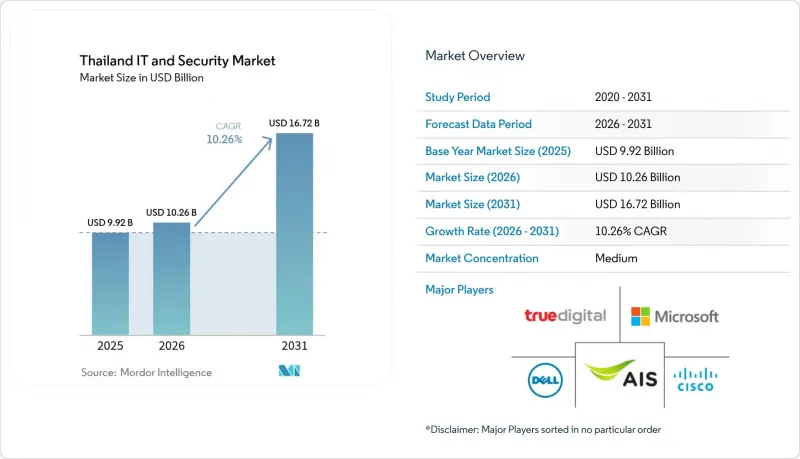
This report is Segmented by Component (Hardware and Devices, Software, and Services), Deployment Mode (On-Premises, Cloud, and Hybrid), Organization Size (Large Enterprises, and Small and Medium Enterprises), End-User Industry (BFSI, Government and Defense, Manufacturing, Healthcare, Retail and E-Commerce, and More), and Geography. The Market Forecasts are Provided in Terms of Value (USD).
Thailand IT And Security Market Trends and Insights
Cloud-First Policy in Thai Public Sector
The Digital Government Development Agency mandated that 70% of new public-sector workloads move to cloud infrastructure by 2027, compelling 412 agencies to migrate at least one mission-critical system before December 2026. Contracts signed with National Telecom in 2025 already span 18 ministries and include ISO/IEC 27001-certified infrastructure, elevating spend on cloud security posture management and privileged access controls. Annual growth of 41% in public-sector purchases of these toolsets underscores how policy edicts translate into addressable demand. Yet nine-month tender cycles and coexistence with legacy on-premises assets require integrated monitoring across hybrid environments, increasing complexity and fueling uptake of managed security operations centers. The directive's multi-factor authentication and five-year audit-log stipulations further lock in demand for identity-as-a-service and immutable storage.
Acceleration of 5G Rollout Enabling Edge-to-Cloud Use Cases
True Corporation and Advanced Info Service finished network consolidation in late 2024, resulting in a 5G standalone footprint that covered 92% of the population by mid-2025. Latency dropped below 10 milliseconds for industrial estates in Chonburi and Rayong, enabling machine-vision quality control, autonomous guided vehicles, and remote surgery pilots. These use cases require edge firewalls, micro-segmentation, and encrypted telemetry sync with cloud-based threat analytics, which together accounted for 62% of incremental edge-security budgets in 2025. Network slicing introduces fresh authentication challenges; only 19% of enterprises have deployed network-function-virtualization security, pointing to an untapped services opportunity. The 2G/3G shutdown completed in 2024 accelerated industrial controller upgrades, widening the Thailand IT and Security market as factories rushed to secure new radio gateways.
Shortage of 30,000 Cyber-Security Professionals
The National Cyber Security Agency calculated a 30,000-person talent gap through 2027, while Thailand's CISSP cohort rose only from 385 to 431 between 2024 and 2025. Median security-operations-center analyst pay in Bangkok jumped 18% to THB 65,000 (USD 1,850) per month, pushing small and medium enterprises toward managed services they often struggle to manage and assess. Outsourcing grew 22% in 2025, but reliance on third-party incident response dilutes institutional knowledge and extends containment times. Limited specialist availability slows adoption of zero-trust network access-implemented by just 11% of organizations as of end-2025-and drags on uptake of security orchestration, automation, and response. Government scholarship programs and vendor-run academies are scaling, yet the lag in advanced certifications will continue to temper the Thailand IT and Security market's growth trajectory.
Other drivers and restraints analyzed in the detailed report include:
- E-Commerce Boom Driving Hyperscale Data-Center Build-Outs
- Rise of Thailand PLUS Near-Shoring by Japanese and U.S. Manufacturers
- Fragmented SME IT Budget Cycles
For complete list of drivers and restraints, kindly check the Table Of Contents.
Segment Analysis
Services generated the fastest momentum, poised to rise at 10.71% CAGR to 2031 as enterprises outsource vulnerability assessments, penetration tests, and managed detection and response to local specialists. The Thailand IT and Security market size for professional services reached THB 2.1 billion (USD 60 million) in 2025 following the National Cyber Security Agency's quarterly audit mandate. In contrast, software maintained the largest slice at 41.72% thanks to subscription-based endpoint protection and cloud-security posture management platforms that match operating-expense budgets. Hardware spent softened amid 14-week firewall lead times and Baht depreciation that inflated imported appliance costs.
Growth in services also mirrors regulatory intricacy. Government tenders require ISO/IEC 27001 certification, pushing agencies to engage third-party auditors and policy architects they lack in-house. Managed detection and response, especially for cloud workloads, expanded 28% in 2025 as small and medium enterprises lacking security-operations centers sought pay-as-they-grow contracts. This dynamic reinforces a structural shift in the Thailand IT and Security market toward expertise-driven offerings over pure technology resale.
Hybrid environments are projected to grow at a 10.44% CAGR, even though cloud held 55.84% of 2025 spending. Banks such as Kasikornbank moved fraud-detection models to Google Cloud while retaining customer databases on-premises, illustrating why secure tunneling, identity federation, and unified logging are indispensable. The Thailand IT and Security market share for cloud workload protection platforms widened as agencies under the Cloud First Policy adopted multicloud strategies that still tether to existing data centers.
Nevertheless, on-premises estates persist in defense, utilities, and healthcare, where sovereignty and latency push workloads to private clusters. Hybrid complexity has 62% of enterprises reporting policy-consistency challenges, fuelling demand for cloud-security posture management that spans Kubernetes clusters and hardware-based firewalls. Identity-as-a-service platforms compliant with the National Cyber Security Agency's January 2025 standards are bridging these silos, underscoring how hybrid is not a transitional but a durable operating model within the Thailand IT and Security market.
Complete Report Scope:
- By Component
- Hardware and Devices
- Software
- Services
- By Deployment Mode
- On-premises
- Cloud
- Hybrid
- By Organization Size
- Large Enterprises
- Small and Medium Enterprises (SMEs)
- By End-user Industry
- BFSI
- Government and Defense
- Manufacturing
- Healthcare
- Retail and E-commerce
- Energy and Utilities
- Other End-User Industries
List of Companies Covered in this Report:
- Advanced Info Service Public Co. Ltd. (AIS)
- True Digital Group Co. Ltd.
- Dell Technologies Inc.
- Cisco Systems Inc.
- International Business Machines Corp. (IBM)
- Microsoft Corporation
- Hewlett Packard Enterprise Co.
- Fujitsu (Thailand) Co. Ltd.
- Fortinet Inc.
- Palo Alto Networks Inc.
- Check Point Software Technologies Ltd.
- Trend Micro Inc.
- Kaspersky Lab
- Samsung Electronics Co. Ltd.
- Acer Inc.
- Lenovo Group Ltd.
- G-Able Co. Ltd.
- MFEC Public Co. Ltd.
- Digital Government Development Agency (DGA)
- SIAMDATA Co. Ltd.
Additional Benefits:
- The market estimate (ME) sheet in Excel format
- 3 months of analyst support
TABLE OF CONTENTS
1 INTRODUCTION
- 1.1 Study Assumptions and Market Definition
- 1.2 Scope of the Study
2 RESEARCH METHODOLOGY
3 EXECUTIVE SUMMARY
4 MARKET LANDSCAPE
- 4.1 Market Overview
- 4.2 Market Drivers
- 4.2.1 Cloud-first policy in Thai public sector
- 4.2.2 Acceleration of 5G rollout enabling edge-to-cloud use-cases
- 4.2.3 E-commerce boom driving hyperscale data-center build-outs
- 4.2.4 Board-level adoption of NIST CSF and ISO/IEC 27001 to meet export-market mandates
- 4.2.5 Rise of "Thailand PLUS" near-shoring by Japanese and US manufacturers
- 4.2.6 FinTech regulatory sandbox pushing open-API security spend
- 4.3 Market Restraints
- 4.3.1 Fragmented SME IT budget cycles
- 4.3.2 Shortage of 30 000 cyber-security professionals
- 4.3.3 Legacy MPLS contracts delaying cloud migration
- 4.3.4 High dependence on imported semiconductors amid Baht volatility
- 4.4 Industry Value Chain Analysis
- 4.5 Regulatory Landscape
- 4.6 Technological Outlook
- 4.7 Porter's Five Forces Analysis
- 4.7.1 Threat of New Entrants
- 4.7.2 Bargaining Power of Buyers
- 4.7.3 Bargaining Power of Suppliers
- 4.7.4 Threat of Substitutes
- 4.7.5 Intensity of Competitive Rivalry
5 MARKET SIZE AND GROWTH FORECASTS (VALUE)
- 5.1 By Component
- 5.1.1 Hardware and Devices
- 5.1.2 Software
- 5.1.3 Services
- 5.2 By Deployment Mode
- 5.2.1 On-premises
- 5.2.2 Cloud
- 5.2.3 Hybrid
- 5.3 By Organization Size
- 5.3.1 Large Enterprises
- 5.3.2 Small and Medium Enterprises (SMEs)
- 5.4 By End-user Industry
- 5.4.1 BFSI
- 5.4.2 Government and Defense
- 5.4.3 Manufacturing
- 5.4.4 Healthcare
- 5.4.5 Retail and E-commerce
- 5.4.6 Energy and Utilities
- 5.4.7 Other End-User Industries
6 COMPETITIVE LANDSCAPE
- 6.1 Market Concentration
- 6.2 Strategic Moves
- 6.3 Market Share Analysis
- 6.4 Company Profiles (includes Global Level Overview, Market Level Overview, Core Segments, Financials as available, Strategic Information, Market Rank/Share, Products and Services, Recent Developments)
- 6.4.1 Advanced Info Service Public Co. Ltd. (AIS)
- 6.4.2 True Digital Group Co. Ltd.
- 6.4.3 Dell Technologies Inc.
- 6.4.4 Cisco Systems Inc.
- 6.4.5 International Business Machines Corp. (IBM)
- 6.4.6 Microsoft Corporation
- 6.4.7 Hewlett Packard Enterprise Co.
- 6.4.8 Fujitsu (Thailand) Co. Ltd.
- 6.4.9 Fortinet Inc.
- 6.4.10 Palo Alto Networks Inc.
- 6.4.11 Check Point Software Technologies Ltd.
- 6.4.12 Trend Micro Inc.
- 6.4.13 Kaspersky Lab
- 6.4.14 Samsung Electronics Co. Ltd.
- 6.4.15 Acer Inc.
- 6.4.16 Lenovo Group Ltd.
- 6.4.17 G-Able Co. Ltd.
- 6.4.18 MFEC Public Co. Ltd.
- 6.4.19 Digital Government Development Agency (DGA)
- 6.4.20 SIAMDATA Co. Ltd.
7 MARKET OPPORTUNITIES AND FUTURE OUTLOOK
- 7.1 White-space and Unmet-Need Assessment

