PUBLISHER: Mordor Intelligence | PRODUCT CODE: 2124735

PUBLISHER: Mordor Intelligence | PRODUCT CODE: 2124735
Tomato - Market Share Analysis, Industry Trends & Statistics, Growth Forecasts (2026 - 2031)
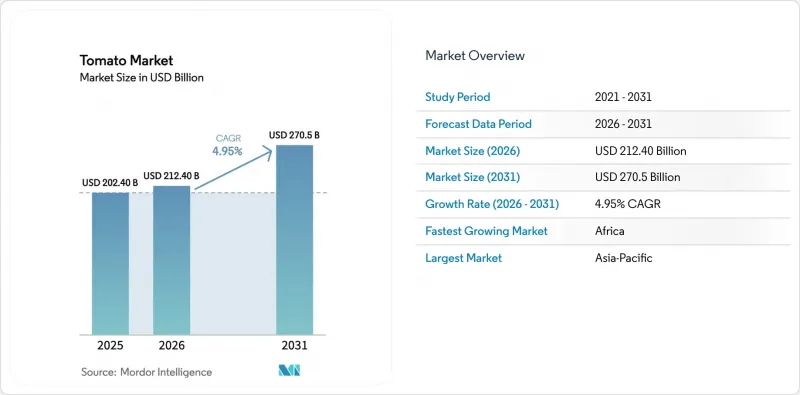
According to Mordor Intelligence, the tomato market value is projected to expand from USD 202.4 billion in 2025 and USD 212.4 billion in 2026 to USD 270.5 billion by 2031, registering a CAGR of 4.95% between 2026 to 2031.
This report is Segmented by Geography (North America, Europe, Asia-Pacific, South America, Middle East, and Africa). The Report Includes Production Analysis (Volume), Consumption Analysis (Value and Volume), Import Analysis (Value and Volume), Export Analysis (Value and Volume), Wholesale Price Trend Analysis, and More. The Market Forecasts are Provided in Terms of Value (USD) and Volume (Metric Tons).
Global Tomato Market Trends and Insights
Rising Demand for Processed Tomato Products
Multi-year supply contracts from quick-service restaurants and ready-meal brands continue to tighten spot availability of paste and diced tomatoes. China's paste consumption is rising at 7% CAGR, outpacing its 1.5 million metric tons capacity and gradually eroding the country's export surplus. Italy processed 5.2 million metric tons in 2024, and branded sauce, with a 6% CAGR, is diverting volumes from export channels. Nigeria spends USD 360 million on paste imports each year, encouraging local processors to integrate backward with growers and close raw material gaps.
Expansion of Greenhouse and Protected Cultivation
Energy-efficient greenhouses enable year-round production, mitigate weather risk, and support premium pricing. The Netherlands exported USD 1.89 billion (EUR 1.8 billion) in greenhouse tomatoes in 2024, while reducing natural gas use by 30% through the use of LED lighting and advanced climate control algorithms. Mexico's Sinaloa operations achieved a yield of 70 metric tons per acre, double California's open-field yield, by coupling fertigation with precise nutrient delivery.
Post-Harvest Losses and Pest-Driven Spoilage
Up to 20% of harvested tomatoes in developing regions never reach consumers because refrigerated transport and storage are scarce. India still loses 11.61% of its crop despite Operation Greens' cold-chain subsidies. Nigeria's 18% spoilage rate inflates a USD 360 million paste import bill, and the invasive moth Tuta absoluta cuts yields by 30% across East Africa in 2024. These gaps invite investment in integrated cold-chain logistics and pest-management service firms.
Other drivers and restraints analyzed in the detailed report include:
- Government Incentives for High-Value Horticulture
- Health and Nutrition-Driven Fresh Tomato Uptake
- Water Stress and Adverse Climate Volatility
For complete list of drivers and restraints, kindly check the Table Of Contents.
Geography Analysis
The Asia-Pacific region accounted for 47.0% of the global tomato production market share in 2025, yet disparities widened between water-stressed inland provinces and coastal greenhouse hubs. China's Xinjiang region produced 90% of the country's processed tomatoes and shipped 1.5 million metric tons of paste, but rising irrigation costs are eroding its price competitiveness. India's Karnataka, Maharashtra, and Andhra Pradesh states offer subsidies for processing plants, although post-harvest losses of 11.6% still plague growers. Japan's hydroponic complexes triple open-field yields and supply premium retailers, underscoring the role of technology in countering land scarcity.
Africa is the fastest-growing region, with a 4.8% CAGR, anchored by Egypt's 6.7 million-ton drip-irrigated harvest and Nigeria's policy push to substitute USD 360 million in paste imports. South Africa and Cameroon meet domestic demand, yet they lack the cold-chain depth to capture off-season premiums. Strategic investment in storage and logistics could unlock latent demand across the continent, where per capita intake stays under 5 kilograms.
North America also held a significant share in 2025, with mature open-field systems in California complemented by rapid greenhouse expansion in Mexico and Canada. California delivered 11 million metric tons of processing tomatoes but faces a 10% acreage cut by 2027 due to aquifer depletion. Mexico's Sinaloa and Baja California greenhouses reached 70 metric tons per acre and exported 1.8 million metric tons valued at USD 2.7 billion to the United States. Canada's carbon tax lifted heating costs by 12% in 2024, pushing some growers to adopt geothermal heat or exit the market .
- The market estimate (ME) sheet in Excel format
- 3 months of analyst support
TABLE OF CONTENTS
1 Introduction
- 1.1 Study Assumptions and Market Definition
- 1.2 Scope of the Study
2 Research Methodology
3 Executive Summary
4 Market Landscape
- 4.1 Market Overview
- 4.2 Market Drivers
- 4.2.1 Rising Demand for Processed Tomato Products
- 4.2.2 Expansion of Greenhouse and Protected Cultivation
- 4.2.3 Government Incentives for High-Value Horticulture
- 4.2.4 Health and Nutrition-Driven Fresh Tomato Uptake
- 4.2.5 Premiumization Via Zero-Residue Hydroponic Tomatoes
- 4.2.6 AI-Driven Optimization of High-Tech Greenhouses
- 4.3 Market Restraints
- 4.3.1 Post-Harvest Losses and Pest-Driven Spoilage
- 4.3.2 Water Stress and Adverse Climate Volatility
- 4.3.3 Carbon-Footprint Scrutiny of Energy-Intensive Greenhouses
- 4.3.4 Price Volatility in Tomato Market
- 4.4 Opportunities
- 4.5 Challenges
- 4.6 Value Chain Analysis
- 4.7 Technologies and usage of AI in the Industry
- 4.8 Input Market Analysis
- 4.8.1 Seeds
- 4.8.2 Fertilizers
- 4.8.3 Crop Protection Chemicals
- 4.9 Distribution Channel Analysis
- 4.10 Market Sentiment Analysis
- 4.11 PESTLE Analysis
5 Market Size and Growth Forecasts (Value and Volume)
- 5.1 By Geography
- 5.1.1 North America
- 5.1.1.1 United States
- 5.1.1.1.1 Production Analysis (Area Harvested, Yield, and Production Volume)
- 5.1.1.1.2 Consumption Analysis (Consumption Value and Volume)
- 5.1.1.1.3 Import Market Analysis (Import Value, Volume, and Key Supplying Markets)
- 5.1.1.1.4 Export Market Analysis (Export Value, Volume, and Key Destination Markets)
- 5.1.1.1.5 Wholesale Price Trend Analysis and Forecast
- 5.1.1.1.6 Regulatory Framework
- 5.1.1.1.7 List of Key Players
- 5.1.1.1.8 Logistics and Infrastructure
- 5.1.1.1.9 Seasonality Analysis
- 5.1.1.2 Canada
- 5.1.1.2.1 Production Analysis (Area Harvested, Yield, and Production Volume)
- 5.1.1.2.2 Consumption Analysis (Consumption Value and Volume)
- 5.1.1.2.3 Import Market Analysis (Import Value, Volume, and Key Supplying Markets)
- 5.1.1.2.4 Export Market Analysis (Export Value, Volume, and Key Destination Markets)
- 5.1.1.2.5 Wholesale Price Trend Analysis and Forecast
- 5.1.1.2.6 Regulatory Framework
- 5.1.1.2.7 List of Key Players
- 5.1.1.2.8 Logistics and Infrastructure
- 5.1.1.2.9 Seasonality Analysis
- 5.1.1.3 Mexico
- 5.1.1.3.1 Production Analysis (Area Harvested, Yield, and Production Volume)
- 5.1.1.3.2 Consumption Analysis (Consumption Value and Volume)
- 5.1.1.3.3 Import Market Analysis (Import Value, Volume, and Key Supplying Markets)
- 5.1.1.3.4 Export Market Analysis (Export Value, Volume, and Key Destination Markets)
- 5.1.1.3.5 Wholesale Price Trend Analysis and Forecast
- 5.1.1.3.6 Regulatory Framework
- 5.1.1.3.7 List of Key Players
- 5.1.1.3.8 Logistics and Infrastructure
- 5.1.1.3.9 Seasonality Analysis
- 5.1.1.1 United States
- 5.1.2 Europe
- 5.1.2.1 Spain
- 5.1.2.1.1 Production Analysis (Area Harvested, Yield, and Production Volume)
- 5.1.2.1.2 Consumption Analysis (Consumption Value and Volume)
- 5.1.2.1.3 Import Market Analysis (Import Value, Volume, and Key Supplying Markets)
- 5.1.2.1.4 Export Market Analysis (Export Value, Volume, and Key Destination Markets)
- 5.1.2.1.5 Wholesale Price Trend Analysis and Forecast
- 5.1.2.1.6 Regulatory Framework
- 5.1.2.1.7 List of Key Players
- 5.1.2.1.8 Logistics and Infrastructure
- 5.1.2.1.9 Seasonality Analysis
- 5.1.2.2 Netherlands
- 5.1.2.2.1 Production Analysis (Area Harvested, Yield, and Production Volume)
- 5.1.2.2.2 Consumption Analysis (Consumption Value and Volume)
- 5.1.2.2.3 Import Market Analysis (Import Value, Volume, and Key Supplying Markets)
- 5.1.2.2.4 Export Market Analysis (Export Value, Volume, and Key Destination Markets)
- 5.1.2.2.5 Wholesale Price Trend Analysis and Forecast
- 5.1.2.2.6 Regulatory Framework
- 5.1.2.2.7 List of Key Players
- 5.1.2.2.8 Logistics and Infrastructure
- 5.1.2.2.9 Seasonality Analysis
- 5.1.2.3 Germany
- 5.1.2.3.1 Production Analysis (Area Harvested, Yield, and Production Volume)
- 5.1.2.3.2 Consumption Analysis (Consumption Value and Volume)
- 5.1.2.3.3 Import Market Analysis (Import Value, Volume, and Key Supplying Markets)
- 5.1.2.3.4 Export Market Analysis (Export Value, Volume, and Key Destination Markets)
- 5.1.2.3.5 Wholesale Price Trend Analysis and Forecast
- 5.1.2.3.6 Regulatory Framework
- 5.1.2.3.7 List of Key Players
- 5.1.2.3.8 Logistics and Infrastructure
- 5.1.2.3.9 Seasonality Analysis
- 5.1.2.4 Italy
- 5.1.2.4.1 Production Analysis (Area Harvested, Yield, and Production Volume)
- 5.1.2.4.2 Consumption Analysis (Consumption Value and Volume)
- 5.1.2.4.3 Import Market Analysis (Import Value, Volume, and Key Supplying Markets)
- 5.1.2.4.4 Export Market Analysis (Export Value, Volume, and Key Destination Markets)
- 5.1.2.4.5 Wholesale Price Trend Analysis and Forecast
- 5.1.2.4.6 Regulatory Framework
- 5.1.2.4.7 List of Key Players
- 5.1.2.4.8 Logistics and Infrastructure
- 5.1.2.4.9 Seasonality Analysis
- 5.1.2.5 Poland
- 5.1.2.5.1 Production Analysis (Area Harvested, Yield, and Production Volume)
- 5.1.2.5.2 Consumption Analysis (Consumption Value and Volume)
- 5.1.2.5.3 Import Market Analysis (Import Value, Volume, and Key Supplying Markets)
- 5.1.2.5.4 Export Market Analysis (Export Value, Volume, and Key Destination Markets)
- 5.1.2.5.5 Wholesale Price Trend Analysis and Forecast
- 5.1.2.5.6 Regulatory Framework
- 5.1.2.5.7 List of Key Players
- 5.1.2.5.8 Logistics and Infrastructure
- 5.1.2.5.9 Seasonality Analysis
- 5.1.2.1 Spain
- 5.1.3 Asia-Pacific
- 5.1.3.1 China
- 5.1.3.1.1 Production Analysis (Area Harvested, Yield, and Production Volume)
- 5.1.3.1.2 Consumption Analysis (Consumption Value and Volume)
- 5.1.3.1.3 Import Market Analysis (Import Value, Volume, and Key Supplying Markets)
- 5.1.3.1.4 Export Market Analysis (Export Value, Volume, and Key Destination Markets)
- 5.1.3.1.5 Wholesale Price Trend Analysis and Forecast
- 5.1.3.1.6 Regulatory Framework
- 5.1.3.1.7 List of Key Players
- 5.1.3.1.8 Logistics and Infrastructure
- 5.1.3.1.9 Seasonality Analysis
- 5.1.3.2 India
- 5.1.3.2.1 Production Analysis (Area Harvested, Yield, and Production Volume)
- 5.1.3.2.2 Consumption Analysis (Consumption Value and Volume)
- 5.1.3.2.3 Import Market Analysis (Import Value, Volume, and Key Supplying Markets)
- 5.1.3.2.4 Export Market Analysis (Export Value, Volume, and Key Destination Markets)
- 5.1.3.2.5 Wholesale Price Trend Analysis and Forecast
- 5.1.3.2.6 Regulatory Framework
- 5.1.3.2.7 List of Key Players
- 5.1.3.2.8 Logistics and Infrastructure
- 5.1.3.2.9 Seasonality Analysis
- 5.1.3.3 Japan
- 5.1.3.3.1 Production Analysis (Area Harvested, Yield, and Production Volume)
- 5.1.3.3.2 Consumption Analysis (Consumption Value and Volume)
- 5.1.3.3.3 Import Market Analysis (Import Value, Volume, and Key Supplying Markets)
- 5.1.3.3.4 Export Market Analysis (Export Value, Volume, and Key Destination Markets)
- 5.1.3.3.5 Wholesale Price Trend Analysis and Forecast
- 5.1.3.3.6 Regulatory Framework
- 5.1.3.3.7 List of Key Players
- 5.1.3.3.8 Logistics and Infrastructure
- 5.1.3.3.9 Seasonality Analysis
- 5.1.3.1 China
- 5.1.4 South America
- 5.1.4.1 Brazil
- 5.1.4.1.1 Production Analysis (Area Harvested, Yield, and Production Volume)
- 5.1.4.1.2 Consumption Analysis (Consumption Value and Volume)
- 5.1.4.1.3 Import Market Analysis (Import Value, Volume, and Key Supplying Markets)
- 5.1.4.1.4 Export Market Analysis (Export Value, Volume, and Key Destination Markets)
- 5.1.4.1.5 Wholesale Price Trend Analysis and Forecast
- 5.1.4.1.6 Regulatory Framework
- 5.1.4.1.7 List of Key Players
- 5.1.4.1.8 Logistics and Infrastructure
- 5.1.4.1.9 Seasonality Analysis
- 5.1.4.2 Argentina
- 5.1.4.2.1 Production Analysis (Area Harvested, Yield, and Production Volume)
- 5.1.4.2.2 Consumption Analysis (Consumption Value and Volume)
- 5.1.4.2.3 Import Market Analysis (Import Value, Volume, and Key Supplying Markets)
- 5.1.4.2.4 Export Market Analysis (Export Value, Volume, and Key Destination Markets)
- 5.1.4.2.5 Wholesale Price Trend Analysis and Forecast
- 5.1.4.2.6 Regulatory Framework
- 5.1.4.2.7 List of Key Players
- 5.1.4.2.8 Logistics and Infrastructure
- 5.1.4.2.9 Seasonality Analysis
- 5.1.4.3 Chile
- 5.1.4.3.1 Production Analysis (Area Harvested, Yield, and Production Volume)
- 5.1.4.3.2 Consumption Analysis (Consumption Value and Volume)
- 5.1.4.3.3 Import Market Analysis (Import Value, Volume, and Key Supplying Markets)
- 5.1.4.3.4 Export Market Analysis (Export Value, Volume, and Key Destination Markets)
- 5.1.4.3.5 Wholesale Price Trend Analysis and Forecast
- 5.1.4.3.6 Regulatory Framework
- 5.1.4.3.7 List of Key Players
- 5.1.4.3.8 Logistics and Infrastructure
- 5.1.4.3.9 Seasonality Analysis
- 5.1.4.1 Brazil
- 5.1.5 Middle East
- 5.1.5.1 Turkey
- 5.1.5.1.1 Production Analysis (Area Harvested, Yield, and Production Volume)
- 5.1.5.1.2 Consumption Analysis (Consumption Value and Volume)
- 5.1.5.1.3 Import Market Analysis (Import Value, Volume, and Key Supplying Markets)
- 5.1.5.1.4 Export Market Analysis (Export Value, Volume, and Key Destination Markets)
- 5.1.5.1.5 Wholesale Price Trend Analysis and Forecast
- 5.1.5.1.6 Regulatory Framework
- 5.1.5.1.7 List of Key Players
- 5.1.5.1.8 Logistics and Infrastructure
- 5.1.5.1.9 Seasonality Analysis
- 5.1.5.2 Saudi Arabia
- 5.1.5.2.1 Production Analysis (Area Harvested, Yield, and Production Volume)
- 5.1.5.2.2 Consumption Analysis (Consumption Value and Volume)
- 5.1.5.2.3 Import Market Analysis (Import Value, Volume, and Key Supplying Markets)
- 5.1.5.2.4 Export Market Analysis (Export Value, Volume, and Key Destination Markets)
- 5.1.5.2.5 Wholesale Price Trend Analysis and Forecast
- 5.1.5.2.6 Regulatory Framework
- 5.1.5.2.7 List of Key Players
- 5.1.5.2.8 Logistics and Infrastructure
- 5.1.5.2.9 Seasonality Analysis
- 5.1.5.3 Iran
- 5.1.5.3.1 Production Analysis (Area Harvested, Yield, and Production Volume)
- 5.1.5.3.2 Consumption Analysis (Consumption Value and Volume)
- 5.1.5.3.3 Import Market Analysis (Import Value, Volume, and Key Supplying Markets)
- 5.1.5.3.4 Export Market Analysis (Export Value, Volume, and Key Destination Markets)
- 5.1.5.3.5 Wholesale Price Trend Analysis and Forecast
- 5.1.5.3.6 Regulatory Framework
- 5.1.5.3.7 List of Key Players
- 5.1.5.3.8 Logistics and Infrastructure
- 5.1.5.3.9 Seasonality Analysis
- 5.1.5.1 Turkey
- 5.1.6 Africa
- 5.1.6.1 Egypt
- 5.1.6.1.1 Production Analysis (Area Harvested, Yield, and Production Volume)
- 5.1.6.1.2 Consumption Analysis (Consumption Value and Volume)
- 5.1.6.1.3 Import Market Analysis (Import Value, Volume, and Key Supplying Markets)
- 5.1.6.1.4 Export Market Analysis (Export Value, Volume, and Key Destination Markets)
- 5.1.6.1.5 Wholesale Price Trend Analysis and Forecast
- 5.1.6.1.6 Regulatory Framework
- 5.1.6.1.7 List of Key Players
- 5.1.6.1.8 Logistics and Infrastructure
- 5.1.6.1.9 Seasonality Analysis
- 5.1.6.2 South Africa
- 5.1.6.2.1 Production Analysis (Area Harvested, Yield, and Production Volume)
- 5.1.6.2.2 Consumption Analysis (Consumption Value and Volume)
- 5.1.6.2.3 Import Market Analysis (Import Value, Volume, and Key Supplying Markets)
- 5.1.6.2.4 Export Market Analysis (Export Value, Volume, and Key Destination Markets)
- 5.1.6.2.5 Wholesale Price Trend Analysis and Forecast
- 5.1.6.2.6 Regulatory Framework
- 5.1.6.2.7 List of Key Players
- 5.1.6.2.8 Logistics and Infrastructure
- 5.1.6.2.9 Seasonality Analysis
- 5.1.6.3 Nigeria
- 5.1.6.3.1 Production Analysis (Area Harvested, Yield, and Production Volume)
- 5.1.6.3.2 Consumption Analysis (Consumption Value and Volume)
- 5.1.6.3.3 Import Market Analysis (Import Value, Volume, and Key Supplying Markets)
- 5.1.6.3.4 Export Market Analysis (Export Value, Volume, and Key Destination Markets)
- 5.1.6.3.5 Wholesale Price Trend Analysis and Forecast
- 5.1.6.3.6 Regulatory Framework
- 5.1.6.3.7 List of Key Players
- 5.1.6.3.8 Logistics and Infrastructure
- 5.1.6.3.9 Seasonality Analysis
- 5.1.6.1 Egypt
- 5.1.1 North America
6 End Use Applications and Industries
- 6.1 Primary Applications and Emerging Applications
- 6.2 Consumption Breakdown by Industries
7 Competitive Landscape
- 7.1 Overview of the Competition
- 7.2 Recent Developments
- 7.3 Market Concentration Analysis
8 Market Opportunities and Future Outlook

