PUBLISHER: Mordor Intelligence | PRODUCT CODE: 2124737

PUBLISHER: Mordor Intelligence | PRODUCT CODE: 2124737
Europe Digital Transaction Management (DTM) - Market Share Analysis, Industry Trends & Statistics, Growth Forecasts (2026 - 2031)
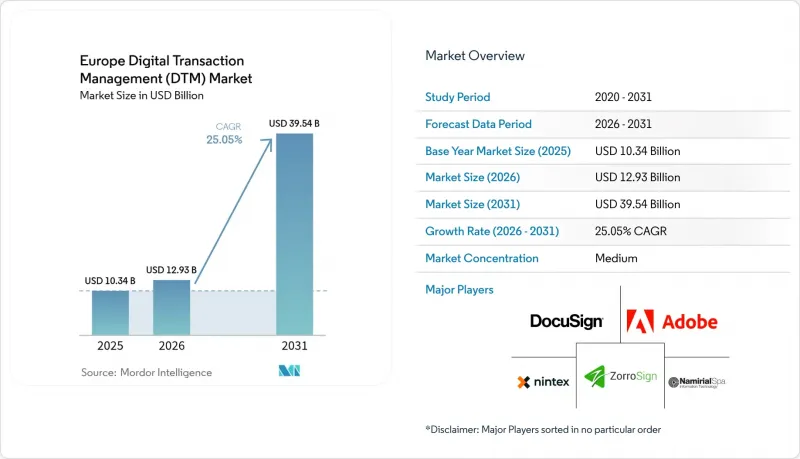
According to Mordor Intelligence, Europe digital transaction management market size in 2026 is estimated at USD 12.93 billion, growing from 2025 value of USD 10.34 billion with 2031 projections showing USD 39.54 billion, growing at 25.05% CAGR over 2026-2031.
This report is Segmented by Component (Solutions, Services), Deployment Mode (Cloud, On-Premise, and More), Organisation Size (Small and Medium Enterprises, Large Enterprises), End-User Industry (BFSI, Healthcare and Life Sciences, Retail and E-Commerce, and More), and Country. The Market Forecasts are Provided in Terms of Value (USD).
Europe Digital Transaction Management (DTM) Market Trends and Insights
Rise in e-signatures and cloud adoption
European legislators project stable 25% yearly revenue gains for e-signature services, propelling cloud models that already hold 77.70% of transactions and register the fastest CAGR through 2030. Nordic governments showcase near-paperless public services, with Denmark eliminating hard-copy options for most citizen interactions and Sweden nearing a cash-free economy. eIDAS 2.0 removes cross-border friction by recognising remote signatures issued under any qualified EU trust service. BFSI stakeholders also depend on cloud scalability to authenticate instant payments within the mandated 10 seconds, cementing cloud architecture as the de facto backbone of pan-European trust services.
SME push for end-to-end workflow automation
SMEs account for over 99% of European businesses yet carry a EUR 53 billion digital-compliance burden. Targeted EU Digital Europe funds partially offset those costs and are catalysing 26.50% CAGR uptake among smaller firms. Consolidators such as Visma have responded by acquiring niche platforms that package KYC, invoicing and signing features into turnkey bundles. As 72% of SMEs now rely on data-driven decision tools, the demand for subscription-based, no-code automation has evolved from a convenience to a survival requirement .
Persistent data-privacy and cyber-risk concerns
Real-time payments demand 10-second clearing and yet must honour GDPR data-minimisation rules that often require data residency within national borders. The NIS2 directive widens breach-notification duties and raises fines, leading many banks to deploy AI-based anomaly detection that can handle rising fraud attempts without infringing privacy constraints. Smaller firms particularly struggle to finance specialist security skills, underscoring the need for vendor-provided compliance capabilities baked into platforms.
Other drivers and restraints analyzed in the detailed report include:
- EU eIDAS 2.0 and PSD3 accelerating trust services
- Post-COVID permanent shift to digital workflows
- High integration and change-management costs
For complete list of drivers and restraints, kindly check the Table Of Contents.
Segment Analysis
Solutions accounted for 70.85% of the Europe Digital Transaction Management market share in 2025 on the back of platforms that bundle signing, identity, workflow and audit functions under one licence. The services slice is smaller but rising at 23.15% CAGR as organisations outsource complexity to managed providers, especially for eIDAS wallet integration and instant-payment obligations. Vendors embed AI to auto-classify documents, verify identities and trigger alerts, reducing staff overheads and ensuring that solutions revenue continues to dominate absolute spend even while services expand faster.
Demand for consulting peaks during regulation roll-outs, after which recurring platform fees drive sustained revenue. Healthcare projects funded under the European Health Data Space allocate budget specifically to qualified trust-service integration, thereby locking in multi-year platform contracts. European software majors are consequently acquiring niche service firms to secure implementation talent and defend platform primacy.
Cloud solutions held 78.15% of the Europe Digital Transaction Management market size in 2025 and are growing at 27.95% CAGR, reinforcing the architectural pivot away from on-premise. Providers offer real-time compliance updates, geo-fenced data centres and latency guarantees that on-premise installs find costly to replicate. Regulatory requirements for 24/7 instant-payment uptime further tilt adoption toward elastic cloud resources that can auto-scale during volume spikes.
Hybrid remains a transition path for financial institutions that wish to retain core-ledger data locally while routing customer-facing activity to the cloud. Nevertheless, even in these cases audit trails and signature verification often reside in managed environments. Nordic government portals, built completely in the cloud, supply proof points that nationwide digital services can run at scale with strong privacy safeguards, causing lagging countries to follow suit.
Complete Report Scope:
- By Component
- Solutions
- Services
- By Deployment Mode
- Cloud
- On-premise
- Hybrid
- By Organisation Size
- Small and Medium Enterprises
- Large Enterprises
- By End-user Industry
- BFSI
- Healthcare and Life Sciences
- Retail and E-commerce
- IT and Telecommunication
- Government and Public Sector
- Real-Estate and Construction
- Automotive and Mobility
- By Country
- United Kingdom
- Germany
- France
- Spain
- Italy
- Rest of Europe
List of Companies Covered in this Report:
- Adobe Inc.
- DocuSign Inc.
- Namirial SpA
- InfoCert SpA (Tinexta SpA)
- Signicat AS
- Scrive AB
- PandaDoc Inc.
- Dropbox Sign (HelloSign)
- airSlate Inc. (SignNow)
- Nintex UK Ltd
- Mitratech Holdings Inc.
- AssureSign LLC (Equifax)
- Topaz Systems Inc.
- ZorroSign Inc.
- OneSpan Inc.
- Entrust Corporation
- eMudhra Ltd.
- Universign SAS
- Kofax Inc.
- Nitro Software Ltd.
Additional Benefits:
- The market estimate (ME) sheet in Excel format
- 3 months of analyst support
TABLE OF CONTENTS
1 INTRODUCTION
- 1.1 Study Assumptions and Market Definition
- 1.2 Scope of the Study
2 RESEARCH METHODOLOGY
3 EXECUTIVE SUMMARY
4 MARKET LANDSCAPE
- 4.1 Market Overview
- 4.2 Market Drivers
- 4.2.1 Rise in e-signatures and cloud adoption
- 4.2.2 SME push for end-to-end workflow automation
- 4.2.3 EU eIDAS 2.0 and PSD3 accelerating trust services
- 4.2.4 Post-COVID permanent shift to digital workflows
- 4.2.5 Mandatory B2B e-invoicing roll-outs across EU
- 4.2.6 Instant-payment rails driving real-time DTM demand
- 4.3 Market Restraints
- 4.3.1 Persistent data-privacy and cyber-risk concerns
- 4.3.2 High integration and change-management costs
- 4.3.3 Fragmented national eID schemes hinder interoperability
- 4.3.4 Tight SME financing slows tech refresh cycles
- 4.4 Value Chain Analysis
- 4.5 Regulatory Landscape
- 4.6 Technological Outlook
- 4.7 Porter's Five Forces Analysis
- 4.7.1 Threat of New Entrants
- 4.7.2 Bargaining Power of Buyers
- 4.7.3 Bargaining Power of Suppliers
- 4.7.4 Threat of Substitutes
- 4.7.5 Intensity of Competitive Rivalry
- 4.8 Impact of Macroeconomic Factors
5 MARKET SIZE AND GROWTH FORECASTS (VALUE)
- 5.1 By Component
- 5.1.1 Solutions
- 5.1.2 Services
- 5.2 By Deployment Mode
- 5.2.1 Cloud
- 5.2.2 On-premise
- 5.2.3 Hybrid
- 5.3 By Organisation Size
- 5.3.1 Small and Medium Enterprises
- 5.3.2 Large Enterprises
- 5.4 By End-user Industry
- 5.4.1 BFSI
- 5.4.2 Healthcare and Life Sciences
- 5.4.3 Retail and E-commerce
- 5.4.4 IT and Telecommunication
- 5.4.5 Government and Public Sector
- 5.4.6 Real-Estate and Construction
- 5.4.7 Automotive and Mobility
- 5.5 By Country
- 5.5.1 United Kingdom
- 5.5.2 Germany
- 5.5.3 France
- 5.5.4 Spain
- 5.5.5 Italy
- 5.5.6 Rest of Europe
6 COMPETITIVE LANDSCAPE
- 6.1 Market Concentration
- 6.2 Strategic Moves
- 6.3 Market Share Analysis
- 6.4 Company Profiles (includes Global level Overview, Market level overview, Core Segments, Financials as available, Strategic Information, Market Rank/Share, Products and Services, Recent Developments)
- 6.4.1 Adobe Inc.
- 6.4.2 DocuSign Inc.
- 6.4.3 Namirial SpA
- 6.4.4 InfoCert SpA (Tinexta SpA)
- 6.4.5 Signicat AS
- 6.4.6 Scrive AB
- 6.4.7 PandaDoc Inc.
- 6.4.8 Dropbox Sign (HelloSign)
- 6.4.9 airSlate Inc. (SignNow)
- 6.4.10 Nintex UK Ltd
- 6.4.11 Mitratech Holdings Inc.
- 6.4.12 AssureSign LLC (Equifax)
- 6.4.13 Topaz Systems Inc.
- 6.4.14 ZorroSign Inc.
- 6.4.15 OneSpan Inc.
- 6.4.16 Entrust Corporation
- 6.4.17 eMudhra Ltd.
- 6.4.18 Universign SAS
- 6.4.19 Kofax Inc.
- 6.4.20 Nitro Software Ltd.
7 MARKET OPPORTUNITIES AND FUTURE OUTLOOK
- 7.1 White-space and Unmet-need Assessment

