PUBLISHER: Mordor Intelligence | PRODUCT CODE: 2124739

PUBLISHER: Mordor Intelligence | PRODUCT CODE: 2124739
Single-Use Bioprocessing Probes And Sensors - Market Share Analysis, Industry Trends & Statistics, Growth Forecasts (2026 - 2031)
According to Mordor Intelligence, the single-Use bioprocessing probes and sensors market size is expected to increase from USD 3.74 billion in 2025 to USD 4.15 billion in 2026 and reach USD 7.34 billion by 2031, growing at a CAGR of 12.07% over 2026-2031.
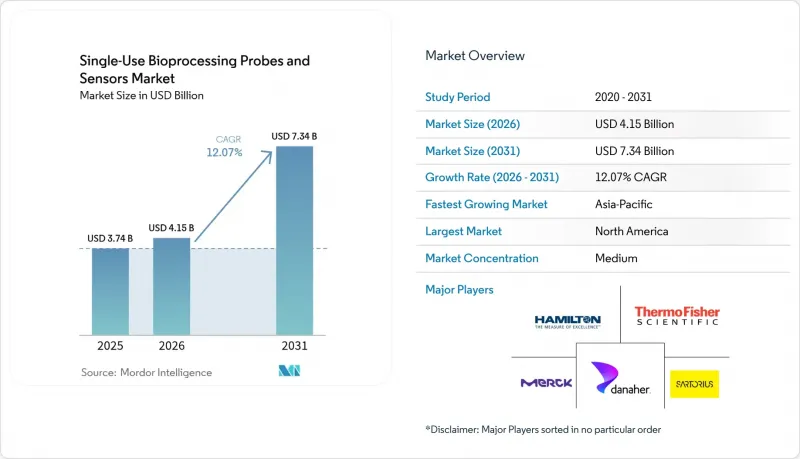
This report is Segmented by Sensor Type (pH, Dissolved Oxygen, Conductivity, Temperature, Pressure, Flow), Detection Technology (Optical, and More), Sterilization Compatibility (Gamma, and More), Application (Upstream, and More), End User (Biopharma, and More), and Geography (North America, and More). Market Forecasts are Provided in Terms of Value (USD).
Global Single-Use Bioprocessing Probes And Sensors Market Trends and Insights
Rapid Adoption of Single-Use Technologies in Biologics Manufacturing
Biologics pipelines are shifting to single-use systems because fixed stainless infrastructure cannot flex with rising molecule diversity. Pfizer noted that 60% of its clinical biologics used disposables in 2025, up from 38% in 2022, and predicts single-use sensors will command 75% of its process-analytics spend by 2028. Facilities producing antibody-drug conjugates prefer disposables because surfaces must be discarded to eliminate cytotoxic residue. Pre-calibrated, irradiated sensors align with this model and compress changeovers from five days to less than 24 hours. FDA's 2024 continuous-manufacturing guidance legitimized factory calibration, erasing a compliance roadblock that once favored reusable probes.
Expanding Pipeline of Cell & Gene Therapies Demanding Flexible Monitoring
Autologous CAR-T manufacturing runs patient-specific batches in parallel, each needing separate pH and dissolved-oxygen monitoring. Novartis reported deploying 340 single-use sensor sets per month across its facilities in 2025, nearly triple 2023 volume. Installing reusable probes in every vessel would lock in USD 1.2 million in capital per suite, versus a monthly USD 85,000 consumables bill with no validation labor. Viral-vector producers add complexity because adherent cultures demand distributed sensing that wired probes cannot supply, but wireless disposables manage with ease.
High Per-Unit Cost Versus Reusable Probes
A single-use dissolved-oxygen sensor costs USD 180-280 per batch, while a reusable unit amortizes at USD 12 per batch after the USD 3,200 upfront spend. Continuous facilities such as Genentech's Vacaville site would incur a USD 9 million annual penalty by going disposable. Raw material inflation pushed cyclic olefin copolymer prices up 18% in 2025, widening the gap.
Other drivers and restraints analyzed in the detailed report include:
- Growth of CMOs/CDMOs Accelerating Disposable-Probe Procurement
- Standardization of Single-Use Sensor Formats by Industry Consortia
- Environmental Concerns over Single-Use Plastic Waste
For complete list of drivers and restraints, kindly check the Table Of Contents.
Segment Analysis
pH sensors held 34.43% of 2025 revenue within the single-use bioprocessing probes and sensors market, reflecting universal demand from seed train through formulation. Optical and multi-parameter devices are rising at a 15.23% CAGR as manufacturers fold multiple readings into fewer ports, reducing hardware cost and validation burden. Traditional glass electrodes foul in high-density perfusion cultures, so fluorescent optical pH alternatives are gaining ground. Dissolved-oxygen sensors remain vital for aerobic mammalian cultures, with integration into lactate probes to complete metabolic profiles. Flow and pressure sensors are shaking up downstream chromatography as magnetically levitated designs eliminate seals that shed particles.
The single-use bioprocessing probes and sensors market size for tri-parameter devices is projected to expand swiftly following Sartorius' 2025 release of a combined pH-DO-temperature probe that trims port count and slash costs 22%. Pressure-sensor innovation includes burst-disc integration, preventing bag rupture during high-flow filtration, and capacitance probes now correlate 95% with offline viable-cell counts, supporting real-time cell-density control.
Electrochemical devices delivered 56.13% of 2025 revenue, but optical formats are slated for 14.89% CAGR because they offer non-invasive, multi-analyte monitoring. Raman spectroscopy measures glucose, lactate, ammonia, and glutamine simultaneously, eliminating 40-60 offline samples per batch and trimming technician hours. Hamilton's 2025 study showed Raman cut titer variability by 14% in 12 validation batches. Near-infrared sensors, meanwhile, track protein concentration during ultrafiltration to avoid contamination from manual sampling.
Optical hardware costs USD 80,000-120,000 versus USD 8,000 for electrochemical suites, yet the labor savings and tighter control tilt total cost of ownership. ISFET pH sensors represent a hybrid, offering small form factor with electrochemical simplicity, and Endress+Hauser shipped the first gamma-sterilizable model in 2025.
Complete Report Scope:
- By Sensor Type
- pH Sensors
- Dissolved Oxygen Sensors
- Conductivity Sensors
- Temperature Sensors
- Pressure Sensors
- Flow Sensors & Meters
- By Detection Technology
- Optical (fluorescence, Raman, NIR)
- Electrochemical (potentiometric, amperometric, ISFET)
- Capacitive / Piezo-resistive
- Other / Hybrid
- By Sterilization Compatibility
- Gamma-irradiable Sensors
- X-ray / E-beam-sterilizable Sensors
- Autoclavable / Steam-in-Place Sensors
- Non-sterilizable, Pre-sterilized Sensors
- By Application
- Upstream Bioprocessing
- Downstream Bioprocessing
- Quality Control & Assurance
- Research & Development
- By End User
- Biopharmaceutical & Pharmaceutical Companies
- Contract Manufacturing & Development Organizations (CMOs/CDMOs)
- Academic & Research Institutes
- By Geography
- North America
- United States
- Canada
- Mexico
- Europe
- Germany
- France
- United Kingdom
- Italy
- Spain
- Rest of Europe
- Asia-Pacific
- China
- Japan
- India
- South Korea
- Australia
- Rest of Asia-Pacific
- Middle East & Africa
- GCC
- South Africa
- Rest of Middle East & Africa
- South America
- Brazil
- Argentina
- Rest of South America
- North America
Geography Analysis
North America held 37.82% of 2025 revenue thanks to concentrated CMO capacity in Massachusetts, North Carolina, and California. FDA approvals of 12 cell therapies in 2025 triggered rapid build-outs, with each new product demanding up to USD 4 million in annual sensor consumption. Domestic-content incentives now pull assembly into South Carolina, trimming delivery times to six weeks.
Asia-Pacific is forecast to post a 14.77% CAGR through 2031 on the back of China's USD 12 billion biomanufacturing push and Singapore's emergence as a hub for regional cell-therapy trials. Autobio Diagnostics and Mindray Medical launched competitively priced gamma-sterilizable sensors in 2025 that undercut imports by up to 40%, accelerating local uptake. Lonza, Thermo Fisher, and Merck operate GMP complexes in Singapore that mirror Western sensor specifications, creating demand for premium optical devices.
Europe faces sustainability headwinds. EMA's draft mandate for life-cycle assessments is steering some projects back toward reusable probes. Sartorius introduced a sensor take-back scheme in 2025 that recovers electronics for refurbishment, slicing environmental impact by 40%. Elsewhere, GCC states are funding biotech parks, and Brazil's vaccine expansion is fueling modest sensor demand anchored in electrochemical formats.
- Aber Instruments
- Applikon Biotechnology
- Broadley-James
- Danaher
- Emerson Electric (Rosemount)
- Endress+Hauser Group
- Eppendorf
- Getinge
- Hamilton Company
- Levitronix
- Malema Engineering
- Meissner Filtration Products
- Merck
- Mettler Toledo
- Parker Hannifin
- PendoTECH
- Polestar Technologies
- PreSens Precision Sensing
- Repligen
- Saint-Gobain Life Sciences
- Sartorius
- Sensirion
- Thermo Fisher Scientific
Additional Benefits:
- The market estimate (ME) sheet in Excel format
- 3 months of analyst support
TABLE OF CONTENTS
1 Introduction
- 1.1 Study Assumptions & Market Definition
- 1.2 Scope of the Study
2 Research Methodology
3 Executive Summary
4 Market Landscape
- 4.1 Market Overview
- 4.2 Market Drivers
- 4.2.1 Rapid Adoption of Single-Use Technologies in Biologics Manufacturing
- 4.2.2 Expanding Pipeline of Cell & Gene Therapies Demanding Flexible Monitoring
- 4.2.3 Growth of CMOs/CDMOs Accelerating Disposable-Probe Procurement
- 4.2.4 Standardization of Single-Use Sensor Formats by Industry Consortia
- 4.2.5 Integration of Disposable Sensors with Digital Twins & Real-Time Analytics
- 4.2.6 Tariff-Driven Regionalization of Sensor Supply Chains
- 4.3 Market Restraints
- 4.3.1 High Per-Unit Cost Versus Reusable Probes
- 4.3.2 Environmental Concerns over Single-Use Plastic Waste
- 4.3.3 Supply-Chain Volatility of Medical-Grade Polymers & Optical Components
- 4.3.4 Calibration-Data Integrity Challenges in GMP Audits
- 4.4 Value / Supply-Chain Analysis
- 4.5 Regulatory Landscape
- 4.6 Technological Outlook
- 4.7 Porter's Five Forces Analysis
- 4.7.1 Bargaining Power of Suppliers
- 4.7.2 Bargaining Power of Buyers
- 4.7.3 Threat of New Entrants
- 4.7.4 Threat of Substitutes
- 4.7.5 Intensity of Competitive Rivalry
5 Market Size & Growth Forecasts ( Value in USD)
- 5.1 By Sensor Type
- 5.1.1 pH Sensors
- 5.1.2 Dissolved Oxygen Sensors
- 5.1.3 Conductivity Sensors
- 5.1.4 Temperature Sensors
- 5.1.5 Pressure Sensors
- 5.1.6 Flow Sensors & Meters
- 5.2 By Detection Technology
- 5.2.1 Optical (fluorescence, Raman, NIR)
- 5.2.2 Electrochemical (potentiometric, amperometric, ISFET)
- 5.2.3 Capacitive / Piezo-resistive
- 5.2.4 Other / Hybrid
- 5.3 By Sterilization Compatibility
- 5.3.1 Gamma-irradiable Sensors
- 5.3.2 X-ray / E-beam-sterilizable Sensors
- 5.3.3 Autoclavable / Steam-in-Place Sensors
- 5.3.4 Non-sterilizable, Pre-sterilized Sensors
- 5.4 By Application
- 5.4.1 Upstream Bioprocessing
- 5.4.2 Downstream Bioprocessing
- 5.4.3 Quality Control & Assurance
- 5.4.4 Research & Development
- 5.5 By End User
- 5.5.1 Biopharmaceutical & Pharmaceutical Companies
- 5.5.2 Contract Manufacturing & Development Organizations (CMOs/CDMOs)
- 5.5.3 Academic & Research Institutes
- 5.6 By Geography
- 5.6.1 North America
- 5.6.1.1 United States
- 5.6.1.2 Canada
- 5.6.1.3 Mexico
- 5.6.2 Europe
- 5.6.2.1 Germany
- 5.6.2.2 France
- 5.6.2.3 United Kingdom
- 5.6.2.4 Italy
- 5.6.2.5 Spain
- 5.6.2.6 Rest of Europe
- 5.6.3 Asia-Pacific
- 5.6.3.1 China
- 5.6.3.2 Japan
- 5.6.3.3 India
- 5.6.3.4 South Korea
- 5.6.3.5 Australia
- 5.6.3.6 Rest of Asia-Pacific
- 5.6.4 Middle East & Africa
- 5.6.4.1 GCC
- 5.6.4.2 South Africa
- 5.6.4.3 Rest of Middle East & Africa
- 5.6.5 South America
- 5.6.5.1 Brazil
- 5.6.5.2 Argentina
- 5.6.5.3 Rest of South America
- 5.6.1 North America
6 Competitive Landscape
- 6.1 Market Concentration
- 6.2 Market Share Analysis
- 6.3 Company Profiles (includes Global level Overview, Market level overview, Core Segments, Financials as available, Strategic Information, Market Rank/Share for key companies, Products and Services, and Recent Developments)
- 6.3.1 Aber Instruments
- 6.3.2 Applikon Biotechnology
- 6.3.3 Broadley-James Corporation
- 6.3.4 Danaher Corporation
- 6.3.5 Emerson Electric (Rosemount)
- 6.3.6 Endress+Hauser Group
- 6.3.7 Eppendorf AG
- 6.3.8 Getinge AB
- 6.3.9 Hamilton Company
- 6.3.10 Levitronix
- 6.3.11 Malema Engineering Corporation
- 6.3.12 Meissner Filtration Products
- 6.3.13 Merck KGaA
- 6.3.14 Mettler Toledo
- 6.3.15 Parker Hannifin
- 6.3.16 PendoTECH
- 6.3.17 Polestar Technologies
- 6.3.18 PreSens Precision Sensing
- 6.3.19 Repligen Corporation
- 6.3.20 Saint-Gobain Life Sciences
- 6.3.21 Sartorius AG
- 6.3.22 Sensirion AG
- 6.3.23 Thermo Fisher Scientific
7 Market Opportunities & Future Outlook
- 7.1 White-space & unmet-need assessment

