PUBLISHER: Mordor Intelligence | PRODUCT CODE: 2124740

PUBLISHER: Mordor Intelligence | PRODUCT CODE: 2124740
Global Healthcare Interoperability Solutions - Market Share Analysis, Industry Trends & Statistics, Growth Forecasts (2026 - 2031)
According to Mordor Intelligence, healthcare interoperability solutions market size in 2026 is estimated at USD 5.61 billion, growing from 2025 value of USD 5.04 billion with 2031 projections showing USD 9.57 billion, growing at 11.27% CAGR over 2026-2031.
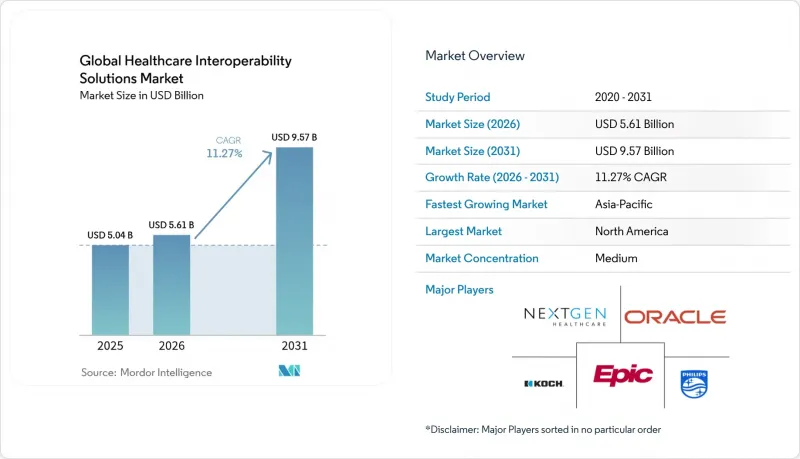
This report is Segmented by Component (Software, Services, Platforms/Middleware), Interoperability Level (Foundational, Structural, Semantic, Organizational), Deployment Mode (On-Premise, and More), End User (Hospitals & Health Systems, Ambulatory & Specialty Clinics, and More), and Geography (North America, Europe, and More). The Market Forecasts are Provided in Terms of Value (USD).
Global Healthcare Interoperability Solutions Market Trends and Insights
Regulatory mandates for EHR interoperability
Information-blocking penalties of up to USD 1 million per violation have turned API standardization into a board-level imperative, forcing providers to adopt HL7 FHIR R4 endpoints that comply with the 21st Century Cures Act. TEFCA went live in 2024 and quickly connected more than 625 hospitals through Qualified Health Information Networks, proving nationwide data exchange viability. Europe's EHDS regulation mirrors this pressure by mandating cross-border data liquidity using FHIR and SNOMED CT, compelling hospitals to upgrade middleware, governance policies, and workforce skills simultaneously. These mandates collectively accelerate capital allocation toward the Healthcare Interoperability Solutions market.
Growing adoption of cloud-based healthcare IT
Microsoft Azure's FHIR service surpassed 1 billion monthly API calls in 2024, demonstrating elastic performance at scale. NextGen migrated its Mirth interface engine to a managed cloud service, shrinking provisioning time from weeks to hours and cutting operating expenses for mid-tier hospitals. Hybrid deployment is becoming the norm, keeping sensitive archives on-premise while bursting analytics workloads to the cloud, and thereby propelling further adoption within the Healthcare Interoperability Solutions market.
High cost of integration projects
Complex multi-facility deployments can exceed eight figures once customization, migration, and staff training are tallied. Smaller hospitals lack the scale to dilute these capital outlays across large patient volumes, forcing phased rollouts that slow Healthcare Interoperability Solutions market penetration. CFOs must also fund cybersecurity, cloud licensing, and AI pilots concurrently, stretching budgets and elongating deal cycles.
Other drivers and restraints analyzed in the detailed report include:
- Shift to value-based care requiring integrated data
- Expansion of telehealth & remote monitoring
- Data privacy & security concerns
For complete list of drivers and restraints, kindly check the Table Of Contents.
Segment Analysis
Software contributed 46.02% revenue in 2025 because integrated suites bundle EHR connectivity, FHIR translation, and analytics in a single contract, easing vendor management and accelerating time to value. Platforms / middleware is forecast to grow 11.67% CAGR, driven by hospitals that use low-code API hubs to connect legacy HL7 v2 feeds with cloud FHIR stores. Services remain indispensable for configuration, governance design, and lifecycle support, often absorbing one-third of total budgets.
Pricing models have shifted from perpetual licenses to transaction-based subscriptions, lowering entry barriers for community hospitals. Middleware suppliers now wrap SaaS portals around established engines, providing turnkey TEFCA readiness and automated compliance reporting. Epic's platform approach illustrates how incumbents defend share by embedding interoperability deep in their clinical workflows, whereas API-first vendors such as Redox win greenfield deployments where buyers want vendor neutrality. The Healthcare Interoperability Solutions market therefore rewards suppliers that combine rapid-mapping tools with pre-built regulatory templates.
Structural interoperability held 41.52% share in 2025 as organizations first focused on message routing and document exchange. Semantic interoperability is projected to expand at 12.41% CAGR because AI-driven analytics and population-health dashboards require codified data across sites of care. HL7 FHIR R5 advances semantic maturity by tightening value-set bindings and adding richer codeable-concept support.
Foundational and organizational layers remain essential for secure transport and governance but will capture less incremental growth. Hospitals are investing in terminology servers, patient-master-indexes, and data-quality engines to unify disparate vocabularies, positioning semantic capabilities as the ultimate goal. As a result, semantic toolkits are now embedded in five-year digital-health roadmaps across the Healthcare Interoperability Solutions market.
Complete Report Scope:
- By Component
- Software
- Services
- Platforms / Middleware
- By Interoperability Level
- Foundational
- Structural
- Semantic
- Organizational
- By Deployment Mode
- On-premise
- Cloud-based
- Hybrid
- By End User
- Hospitals & Health Systems
- Ambulatory & Specialty Clinics
- Laboratories
- Pharmacies
- Payers
- Health Information Exchanges (HIEs)
- By Geography
- North America
- United States
- Canada
- Mexico
- Europe
- Germany
- United Kingdom
- France
- Rest of Europe
- Asia-Pacific
- China
- India
- Japan
- South Korea
- Australia
- Rest of Asia-Pacific
- South America
- Brazil
- Argentina
- Rest of South America
- Middle East and Africa
- GCC
- South Africa
- Rest of Middle East and Africa
- North America
Geography Analysis
North America retained 41.85% share in 2025 thanks to clear ONC mandates, robust broadband, and early TEFCA onboarding. Asia-Pacific is projected to log a 12.67% CAGR as Japan's national medical DX program standardizes electronic records and Australia's Interoperability Plan funds FHIR roll-outs;. Europe's EHDS regulation boosts demand despite GDPR-driven implementation complexity, while South America and the Middle East & Africa are early-stage but increasingly target cloud-hosted HIEs to bypass capital constraints.
Emerging-market ministries often adopt managed-service pricing to convert CapEx into OpEx, opening white-space for vendors willing to provide multilingual support and sovereign-cloud options. Cross-border telehealth in the Gulf Cooperation Council and ASEAN blocs is another catalyst, pushing regional players into the Healthcare Interoperability Solutions market for standards-based identity federations.
- Oracle
- Epic Systems
- InterSystems
- Koninklijke Philips
- Orion Health
- Meditech
- Allscripts (Altera)
- Change Healthcare
- IBM
- Optum
- athenahealth
- eClinicalWorks
- NextGen Healthcare
- Availity
- Lyniate
- Rhapsody
- Dedalus Group
- Sectra
- CompuGroup Medical
- Health Level Seven International (HL7)
- Redox
Additional Benefits:
- The market estimate (ME) sheet in Excel format
- 3 months of analyst support
TABLE OF CONTENTS
1 Introduction
- 1.1 Study Assumptions & Market Definition
- 1.2 Scope of the Study
2 Research Methodology
3 Executive Summary
4 Market Landscape
- 4.1 Market Overview
- 4.2 Market Drivers
- 4.2.1 Regulatory mandates for EHR interoperability
- 4.2.2 Growing adoption of cloud-based healthcare IT
- 4.2.3 Shift to value-based care requiring integrated data
- 4.2.4 Expansion of telehealth & remote monitoring
- 4.2.5 Rise of healthcare data marketplaces
- 4.2.6 AI-driven CDS demanding standardized data models
- 4.3 Market Restraints
- 4.3.1 High cost of integration projects
- 4.3.2 Data privacy & security concerns
- 4.3.3 Vendor reluctance to open proprietary APIs
- 4.3.4 Fragmented consent-management frameworks
- 4.4 Value / Supply-Chain Analysis
- 4.5 Regulatory Landscape
- 4.6 Technological Outlook
- 4.7 Porter's Five Forces
- 4.7.1 Threat of New Entrants
- 4.7.2 Bargaining Power of Suppliers
- 4.7.3 Bargaining Power of Buyers
- 4.7.4 Threat of Substitutes
- 4.7.5 Competitive Rivalry
5 Market Size & Growth Forecasts (Value, 2024-2030)
- 5.1 By Component
- 5.1.1 Software
- 5.1.2 Services
- 5.1.3 Platforms / Middleware
- 5.2 By Interoperability Level
- 5.2.1 Foundational
- 5.2.2 Structural
- 5.2.3 Semantic
- 5.2.4 Organizational
- 5.3 By Deployment Mode
- 5.3.1 On-premise
- 5.3.2 Cloud-based
- 5.3.3 Hybrid
- 5.4 By End User
- 5.4.1 Hospitals & Health Systems
- 5.4.2 Ambulatory & Specialty Clinics
- 5.4.3 Laboratories
- 5.4.4 Pharmacies
- 5.4.5 Payers
- 5.4.6 Health Information Exchanges (HIEs)
- 5.5 By Geography
- 5.5.1 North America
- 5.5.1.1 United States
- 5.5.1.2 Canada
- 5.5.1.3 Mexico
- 5.5.2 Europe
- 5.5.2.1 Germany
- 5.5.2.2 United Kingdom
- 5.5.2.3 France
- 5.5.2.4 Rest of Europe
- 5.5.3 Asia-Pacific
- 5.5.3.1 China
- 5.5.3.2 India
- 5.5.3.3 Japan
- 5.5.3.4 South Korea
- 5.5.3.5 Australia
- 5.5.3.6 Rest of Asia-Pacific
- 5.5.4 South America
- 5.5.4.1 Brazil
- 5.5.4.2 Argentina
- 5.5.4.3 Rest of South America
- 5.5.5 Middle East and Africa
- 5.5.5.1 GCC
- 5.5.5.2 South Africa
- 5.5.5.3 Rest of Middle East and Africa
- 5.5.1 North America
6 Competitive Landscape
- 6.1 Market Concentration
- 6.2 Market Share Analysis
- 6.3 Company Profiles (includes Global level Overview, Market level overview, Core Segments, Financials as available, Strategic Information, Market Rank/Share for key companies, Products & Services, and Recent Developments)
- 6.3.1 Oracle Cerner
- 6.3.2 Epic Systems
- 6.3.3 InterSystems
- 6.3.4 Koninklijke Philips N.V.
- 6.3.5 Orion Health
- 6.3.6 MEDITECH
- 6.3.7 Allscripts (Altera)
- 6.3.8 Change Healthcare
- 6.3.9 IBM Watson Health
- 6.3.10 Optum
- 6.3.11 athenahealth
- 6.3.12 eClinicalWorks
- 6.3.13 NextGen Healthcare
- 6.3.14 Availity
- 6.3.15 Lyniate
- 6.3.16 Rhapsody
- 6.3.17 Dedalus Group
- 6.3.18 Sectra AB
- 6.3.19 CompuGroup Medical
- 6.3.20 Health Level Seven International (HL7)
- 6.3.21 Redox
7 Market Opportunities & Future Outlook
- 7.1 White-space & Unmet-Need Assessment

