PUBLISHER: Mordor Intelligence | PRODUCT CODE: 2124749

PUBLISHER: Mordor Intelligence | PRODUCT CODE: 2124749
Cell Culture Media Bags - Market Share Analysis, Industry Trends & Statistics, Growth Forecasts (2026 - 2031)
According to Mordor Intelligence, the cell culture media bags market size in 2026 is estimated at USD 1.71 billion, growing from 2025 value of USD 1.58 billion with 2031 projections showing USD 2.51 billion, growing at 8.05% CAGR over 2026-2031.
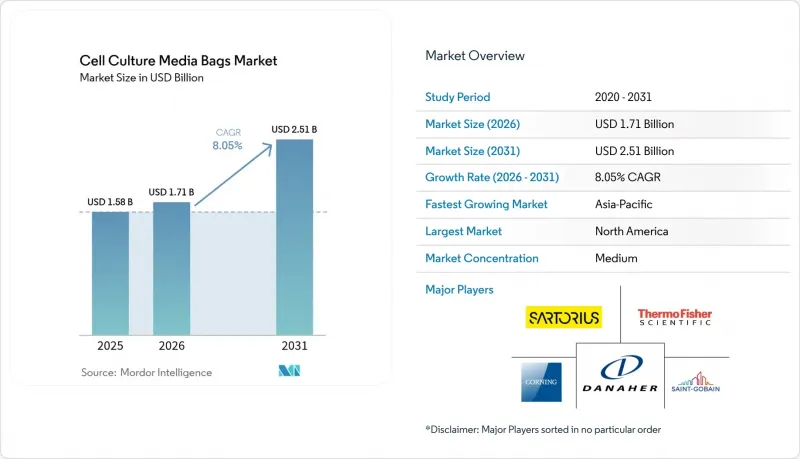
This report is Segmented by Design (2D Bags, 3D Bags and More), Material (EVA, LDPE and More), Capacity Volume (<5 L, 5 - 50 L and More), Application (Biopharmaceutical Production, Vaccine Manufacturing and More), End User (CDMOs / CROs, Pharmaceutical & Biotechnology Companies and More) and Geography (North America, Europe and More). The Market Forecasts are Provided in Terms of Value (USD).
Global Cell Culture Media Bags Market Trends and Insights
Expansion of Biopharma and mAB Production Pipelines
Monoclonal antibody capacity additions such as Fujifilm Diosynth's USD 1.6 billion Denmark expansion underscore the scale of demand for large-volume cell culture media bags market solutions. Higher-titer processes lengthen culture duration and increase protein concentration, requiring durable bag films that resist extractable buildup. Antibody-drug conjugate manufacturing further elevates contamination control needs, reinforcing the shift to pre-sterilised single-use assemblies. Geographic diversification of clinical trials into China and India is creating regional sourcing opportunities that still comply with FDA and EMA expectations.
Rapid Adoption of Single-Use Bioprocessing Systems
Changeover times that drop from weeks to 48 hours and lower cleaning requirements make single-use systems highly attractive for multiproduct CDMOs. Life-cycle assessments reveal smaller overall environmental footprints compared with stainless steel, dispelling myths about disposables. Cell and gene therapy producers regard single use as mandatory to mitigate cross-contamination between autologous batches, lifting demand for bespoke bag geometries compatible with perfusion and intensified processes.
Contamination & Leachable Risk Versus Rigid Vessels
Discovery of cytotoxic compounds such as bDtBPP has placed fresh emphasis on rigorous extractables testing, prompting FDA guidance that redefines acceptable risk thresholds. Transition from USP (88) to USP (87) / (665) raises qualification costs, encouraging suppliers to develop fluoropolymer-lined bags despite higher price points.
Other drivers and restraints analyzed in the detailed report include:
- Rising Stem-Cell & Regenerative-Medicine Clinical Trials
- Capacity Build-Out of Vaccine CDMOs Post-COVID-19
- Bio-Hazardous Waste-Disposal Cost Escalation
For complete list of drivers and restraints, kindly check the Table Of Contents.
Segment Analysis
2-D films retained 52.58% of the cell culture media bags market in 2025, reflecting legacy dominance in seed-train and buffer-prep tasks. However, 3-D formats are expanding at a 10.05% CAGR, powered by strong uptake in intensified perfusion and commercial-scale viral-vector suites. The flexible cube geometry improves mixing and mass-transfer rates while conserving floor space, attributes validated through computational fluid dynamics studies. Hybrid multilayer versions that combine EVA core layers with fluoropolymer contact surfaces target high-potency biologics and cell therapy batches, commanding price premiums that elevate revenue growth.
Demand for 3-D bags also rides on integration with automated pallet tanks that simplify logistics between upstream and downstream steps. As mAB facilities standardize on 2,000 L single-use bioreactors, suppliers are aligning 3-D bag designs with g-force limitations of modern rocking platforms. The cell culture media bags market size for 3-D configurations is projected to reach USD 1.01 billion by 2031, underpinning expanded capital investment by extrusion firms. Innovations such as laser-etched port reinforcements and pre-installed sensors reduce operator touches and help CDMOs accelerate turnaround times.
EVA captured 35.06% revenue in 2025 because of its balance of clarity, weldability, and cost. Even so, fluorinated polymers such as PVDF are registering a 10.41% CAGR, outpacing the cell culture media bags industry average as stem-cell and gene therapy operators insist on ultra-clean contact layers. Regulatory flags over PFAS substance classes create future uncertainty, but interim demand remains high given limited non-fluorinated substitutes with comparable inertness.
Multi-layer structures that sandwich a thin PVDF surface between EVA support webs help manage cost while delivering leachable performance. Supplier R&D is also targeting bio-based tie layers that maintain gas-barrier traits yet improve end-of-life recyclability. The cell culture media bags market size for fluorinated films is set to surpass USD 0.6 billion by 2031 as mature facilities retrofit older suites to meet updated extractables limits. Conversely, PVC usage is tapering because of phthalate migration concerns, accelerating material mix shift toward high-performance alternatives.
Complete Report Scope:
- By Design
- 2-D Bags
- 3-D Bags
- Hybrid / Multilayer Bags
- By Material
- EVA
- LDPE
- PVC
- Polypropylene
- Fluorinated Polymers (e.g., PVDF)
- Others
- By Capacity Volume
- <5 L
- 5 - 50 L
- 50 - 500 L
- >500 L
- By Application
- Biopharmaceutical Production
- Cell & Gene Therapy Manufacturing
- Vaccine Manufacturing
- Stem-Cell & Academic Research
- Others
- By End User
- Pharmaceutical & Biotechnology Companies
- CDMOs / CROs
- Academic & Research Institutes
- Diagnostic Laboratories
- By Geography
- North America
- United States
- Canada
- Mexico
- Europe
- Germany
- United Kingdom
- France
- Italy
- Spain
- Rest of Europe
- Asia-Pacific
- China
- Japan
- India
- Australia
- South Korea
- Rest of Asia-Pacific
- Middle East and Africa
- GCC
- South Africa
- Rest of Middle East and Africa
- South America
- Brazil
- Argentina
- Rest of South America
- North America
Geography Analysis
North America secured 38.62% of global revenue in 2025 thanks to deep clinical pipelines, mature GMP infrastructure, and FDA regulatory leadership. Investments such as Pfizer's USD 200 million Massachusetts site and Fujifilm's USD 1.2 billion North Carolina plant reinforce regional scale advantages. Canada and Mexico augment regional supply through niche production and cost-efficient fill-finish capacity. High uptake of cell and gene therapy platforms further boosts sophisticated single-use bag demand, particularly those lined with fluoropolymer contact layers for ultra-low extractables.
Asia-Pacific is the fastest-growing region, advancing at an 11.36% CAGR to 2031 on the back of Chinese and Indian policy support for domestic biologics. China's regulatory harmonisation with ICH standards favours Western-compliant local media bag production. India's cost-competitive manufacturing model attracts contract work from global sponsors, while South Korea leverages government incentives to build advanced therapy clusters. Japan transitions legacy stainless-steel suites toward flexible single-use platforms, although validation practices remain conservative. The cell culture media bags market size attributable to Asia-Pacific is projected to overtake Europe by 2028.
Europe maintains solid growth fuelled by German, UK, and French biologics hubs plus EU sustainability mandates that reward low-carbon materials. Circular-economy policies are catalysing R&D into recyclable films and closed-loop take-back schemes. Brexit reshapes supply logistics, but EMA adoption of FDA-aligned extractables guidance simplifies technology transfer. Italy and Spain add capacity for niche vaccines, whereas Eastern Europe remains a smaller yet rising player. Collectively, Europe emphasises carbon footprint disclosure in procurement, spurring adoption of life-cycle-assessed bag portfolios.
- Thermo Fisher Scientific
- Sartorius
- Danaher Corp.
- Merck
- Corning
- Saint-Gobain Performance Plastics
- Lonza Group
- Entegris Inc.
- Fujifilm Irvine Scientific
- Parker Hannifin Corp. (SciLog)
- Meissner Filtration Products
- Shanghai LePure Biotech Co. Ltd.
- Technoflex SAS
- CellBios Healthcare & Lifesciences Pvt Ltd
- OriGen Biomedical
- Takara Bio
- FlexBiosys (Fukoku Co. Ltd.)
- Terumo
Additional Benefits:
- The market estimate (ME) sheet in Excel format
- 3 months of analyst support
TABLE OF CONTENTS
1 Introduction
- 1.1 Study Assumptions and Market Definition
- 1.2 Scope of the Study
2 Research Methodology
3 Executive Summary
4 Market Landscape
- 4.1 Market Overview
- 4.2 Market Drivers
- 4.2.1 Expansion Of Biopharma And mAB Production Pipelines
- 4.2.2 Rapid Adoption Of Single-Use Bioprocessing Systems
- 4.2.3 Rising Stem-Cell & Regenerative-Medicine Clinical Trials
- 4.2.4 Capacity Build-Out Of Vaccine CDMOs Post-COVID-19
- 4.2.5 Shift Toward High-Density Perfusion Micro-Bioreactors
- 4.2.6 Scope-3 Decarbonisation Mandates Favouring Lightweight Polymer Bags
- 4.3 Market Restraints
- 4.3.1 Contamination & Leachable Risk Versus Rigid Vessels
- 4.3.2 Bio-Hazardous Waste-Disposal Cost Escalation
- 4.3.3 Volatility In Premium-Grade EVA & PE Resin Prices
- 4.3.4 Geopolitical Polymer-Supply Concentration
- 4.4 Value / Supply-Chain Analysis
- 4.5 Regulatory Landscape
- 4.6 Technology Outlook
- 4.7 Porter's Five Forces Analysis
- 4.7.1 Bargaining Power of Suppliers
- 4.7.2 Bargaining Power of Buyers
- 4.7.3 Threat of New Entrants
- 4.7.4 Threat of Substitutes
- 4.7.5 Intensity of Competitive Rivalry
5 Market Size and Growth Forecasts (Value-USD)
- 5.1 By Design
- 5.1.1 2-D Bags
- 5.1.2 3-D Bags
- 5.1.3 Hybrid / Multilayer Bags
- 5.2 By Material
- 5.2.1 EVA
- 5.2.2 LDPE
- 5.2.3 PVC
- 5.2.4 Polypropylene
- 5.2.5 Fluorinated Polymers (e.g., PVDF)
- 5.2.6 Others
- 5.3 By Capacity Volume
- 5.3.1 <5 L
- 5.3.2 5 - 50 L
- 5.3.3 50 - 500 L
- 5.3.4 >500 L
- 5.4 By Application
- 5.4.1 Biopharmaceutical Production
- 5.4.2 Cell & Gene Therapy Manufacturing
- 5.4.3 Vaccine Manufacturing
- 5.4.4 Stem-Cell & Academic Research
- 5.4.5 Others
- 5.5 By End User
- 5.5.1 Pharmaceutical & Biotechnology Companies
- 5.5.2 CDMOs / CROs
- 5.5.3 Academic & Research Institutes
- 5.5.4 Diagnostic Laboratories
- 5.6 By Geography
- 5.6.1 North America
- 5.6.1.1 United States
- 5.6.1.2 Canada
- 5.6.1.3 Mexico
- 5.6.2 Europe
- 5.6.2.1 Germany
- 5.6.2.2 United Kingdom
- 5.6.2.3 France
- 5.6.2.4 Italy
- 5.6.2.5 Spain
- 5.6.2.6 Rest of Europe
- 5.6.3 Asia-Pacific
- 5.6.3.1 China
- 5.6.3.2 Japan
- 5.6.3.3 India
- 5.6.3.4 Australia
- 5.6.3.5 South Korea
- 5.6.3.6 Rest of Asia-Pacific
- 5.6.4 Middle East and Africa
- 5.6.4.1 GCC
- 5.6.4.2 South Africa
- 5.6.4.3 Rest of Middle East and Africa
- 5.6.5 South America
- 5.6.5.1 Brazil
- 5.6.5.2 Argentina
- 5.6.5.3 Rest of South America
- 5.6.1 North America
6 Competitive Landscape
- 6.1 Market Concentration
- 6.2 Market Share Analysis
- 6.3 Company profiles (includes Global level Overview, Market level overview, Core Segments, Financials as available, Strategic Information, Market Rank/Share for key companies, Products and Services, and Recent Developments)
- 6.3.1 Thermo Fisher Scientific Inc.
- 6.3.2 Sartorius AG
- 6.3.3 Danaher Corp.
- 6.3.4 Merck KGaA
- 6.3.5 Corning Incorporated
- 6.3.6 Saint-Gobain Performance Plastics
- 6.3.7 Lonza Group AG
- 6.3.8 Entegris Inc.
- 6.3.9 Fujifilm Irvine Scientific
- 6.3.10 Parker Hannifin Corp. (SciLog)
- 6.3.11 Meissner Filtration Products
- 6.3.12 Shanghai LePure Biotech Co. Ltd.
- 6.3.13 Technoflex SAS
- 6.3.14 CellBios Healthcare & Lifesciences Pvt Ltd
- 6.3.15 OriGen Biomedical
- 6.3.16 Takara Bio Inc.
- 6.3.17 FlexBiosys (Fukoku Co. Ltd.)
- 6.3.18 Terumo BCT
7 Market Opportunities and Future Outlook
- 7.1 White-Space and Unmet-Need Assessment

