PUBLISHER: Mordor Intelligence | PRODUCT CODE: 2124757

PUBLISHER: Mordor Intelligence | PRODUCT CODE: 2124757
United States Gutter Guards - Market Share Analysis, Industry Trends & Statistics, Growth Forecasts (2026 - 2031)
According to Mordor Intelligence, the United States gutter guards market size was valued at USD 1.11 billion in 2025 and is estimated to grow from USD 1.16 billion in 2026 to reach USD 1.43 billion by 2031, at a CAGR of 4.24% during the forecast period (2026-2031).
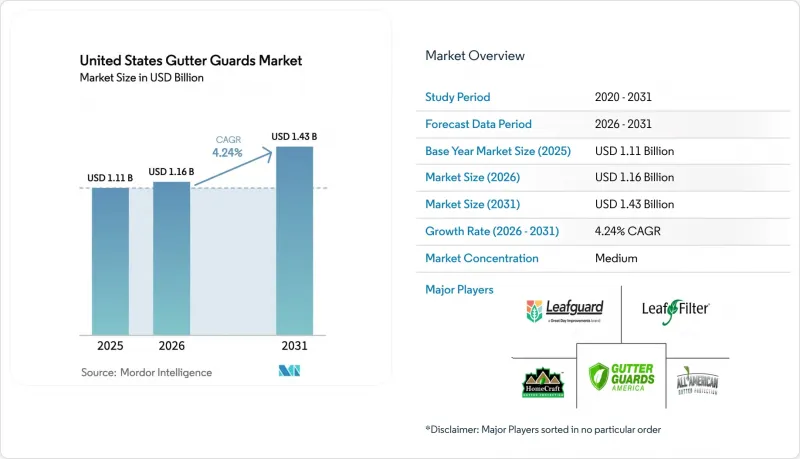
This report is Segmented by Product Type (Micro-Mesh Screens, Standard Mesh and Screens, and More), Material (Aluminum, Stainless Steel, Vinyl or Plastic, Others Including Foam and Copper), End User (Residential, Commercial, Industrial, and Institutional), and Geography (Northeast, Midwest, South, and More). The Market Forecasts are Provided in Terms of Value in USD.
United States Gutter Guards Market Trends and Insights
Increasing Home-Improvement & Reroofing Spend
Home improvement expenditures are projected to reach USD 524 billion in early 2026, marking a record high despite a deceleration from 2024's 7% growth peak to an estimated 5% in 2025 and 3% in 2026, according to the Harvard Joint Center for Housing Studies' Leading Indicator of Remodeling Activity (LIRA). The lock-in effect around low-rate mortgages continues to favor remodeling over moving, which keeps roofing and related exterior projects on the shortlist for near-term investment, given their property value signaling and durability benefits. Within remodels that involve roofing, new roofs delivered the highest reported homeowner satisfaction, reinforcing the upsell path for guards as contractors bundle gutter protection with reroofing jobs to prevent clogs and overflow on new systems. This acceptance aligns with steady remodeling activity following pandemic-era re-benchmarking, which points to a larger and more durable base of spending than previously captured in cyclical indicators. The United States gutter guards market benefits from this pattern through increased attachment rates when installers have scaffolding and crews on site, reducing incremental install time and contributing to higher close rates on guard add-ons. As a result, reroofing remains a critical pathway to expand micro-mesh penetration and sustain an upgrade mix across the United States gutter guards market.
Rising Frequency of Extreme Rainfall & Hurricanes
Weather volatility is amplifying demand, as 2025 featured multiple billion-dollar severe storm disasters and sustained periods of heavy rainfall that tested roof drainage capacity across major metropolitan areas. Projections for rare extreme precipitation design values in the United States indicate higher intensity events under warming, which challenge legacy gutter systems and elevate the value of debris-resistant guards that preserve flow during downpours. Physical science indicates extreme precipitation tends to increase with atmospheric moisture content, with analyses and educational materials highlighting how a warmer climate can load more moisture and intensify short-duration rainfall. The 2025 Atlantic hurricane season, while producing only 13 named storms (below the 14.4 annual average), generated 132.4 units of Accumulated Cyclone Energy (ACE), 9% above the 1991-2020 baseline, and notably spawned three Category 5 hurricanes (Erin, Humberto, Melissa), the second-highest count on record behind 2005's four, per Colorado State University's Tropical Meteorology Project verification. Insurance industry responses are materializing through wind-mitigation credits in Florida and Gulf Coast states, where homeowners installing debris-blocking gutter systems can qualify for 5-8% premium reductions on windstorm coverage, creating a financial incentive that offsets 15-20% of installation costs over a 10-year policy horizon, per Florida Office of Insurance Regulation disclosures.
High Upfront Installed Cost Versus DIY Cleaning
Premium micro-mesh systems compete with low-cost DIY guards and intermittent professional cleanings, which makes the initial outlay a barrier for price-sensitive households. Big-box retailers offer aluminum and stainless mesh options in contractor-grade packs, and those options reinforce the visible price gap that budget-conscious buyers weigh against longevity and maintenance savings. Households in older homes often face added costs for gutter replacement or fascia repair before guards can be installed, which increases the all-in ticket and forces sequencing decisions with other age-related projects. In commercial properties, longer rooflines and access requirements can add labor hours and safety controls, which further push installed costs into budget approval discussions. Clear performance warranties and independent validation for filtration and water-capture roles help address value questions, yet the payback narrative still depends on maintenance avoidance and risk reduction rather than short-term savings. These considerations can slow conversion in cohorts that prioritize near-term cash flow, which creates a persistent headwind for the United States gutter guards market even as premium adoption grows.
Other drivers and restraints analyzed in the detailed report include:
- Aging United States Housing Stock Requiring Retrofits
- Smart Rain-Harvesting Integration with Gutter Guards
- Seasonal Labor Shortages in Skilled Installers
For complete list of drivers and restraints, kindly check the Table Of Contents.
Segment Analysis
Standard mesh and screens commanded 41.23% of the United States gutter guards market share in 2025, reflecting contractor familiarity and price accessibility for cost-driven projects that prioritize basic debris control. Integrated one-piece systems are gaining traction in new builds and whole-home exterior upgrades because they reduce retrofit complexity and come with lifetime warranties, which positions them as a premium alternative for owners who want a single-brand solution. In parallel, surface-tension covers, and foam or brush inserts retain a role in budget-conscious and DIY projects, yet their replacement cycles and performance constraints are balanced against lower upfront cost expectations. As roofers and remodelers standardize guard upsells when scaffolding is already in place, adoption spreads across more price points, which further supports the premium mix within the United States gutter guards market.
Performance credentials and brand positioning are differentiating growth within product types, as micro-mesh suppliers market durability and third-party validations to bolster trust in long-term clog prevention. Product pedigrees that include awards and lab-tested resilience help reduce skepticism among homeowners who previously deferred purchase or relied on periodic cleanings. Builders and remodelers also look for options that avoid roof warranty conflicts, favoring designs that mount to gutters or fascia without disturbing shingles or roof decking in markets where builder warranties remain active. The channel is adapting with national installers that cross-sell guards in roofing and exterior envelope projects, reinforced by private providers that expand geographic reach and unify product and install under one service umbrella. These shifts concentrate visibility around proven designs and integrated installation networks, a pattern that continues to influence product mix and margins across the United States gutter guards market.
Complete Report Scope:
- By Product Type
- Micro-Mesh Screens
- Standard Mesh & Screens
- Reverse-Curve / Surface-Tension Covers
- Brush / Bristle Inserts
- Foam Inserts
- Integrated Seamless Gutter-Guard Systems
- By Material
- Aluminum
- Stainless Steel
- Vinyl / Plastic
- Others (Foam,Copper)
- By End User
- Residential
- Commercial
- Industrial & Institutional
- By Region
- Northeast
- Midwest
- Southeast
- Southwest
- West
List of Companies Covered in this Report:
- LeafGuard
- LeafFilter North, Inc.
- Gutter Guards America
- All American Gutter Protection
- HomeCraft Gutter Protection
- MasterShield (Major Marketing Group)
- Gutterglove Inc. / Raptor
- Amerimax Building Products
- FlexxPoint, Inc.
- GutterStuff
- Gutter Helmet (EMCO)
- Klean Gutter
- Waterlock Gutter Guards
- E-Z Gutter Guard
- GutterTopper
- CopperCraft (OMNIMAX)
- Spectra Gutter Systems
- Senox Corporation
- Cornerstone Building Brands
- Gibraltar Industries
Additional Benefits:
- The market estimate (ME) sheet in Excel format
- 3 months of analyst support
TABLE OF CONTENTS
1 Introduction
- 1.1 Study Assumptions & Market Definition
- 1.2 Scope of the Study
2 Research Methodology
3 Executive Summary
4 Market Landscape
- 4.1 Market Overview
- 4.2 Market Drivers
- 4.2.1 Increasing home-improvement & reroofing spend
- 4.2.2 Rising frequency of extreme rainfall & hurricanes
- 4.2.3 Aging United States housing stock requiring retro-fits
- 4.2.4 Growing popularity of micro-mesh premium systems
- 4.2.5 Smart rain-harvesting integration with gutter guards
- 4.2.6 Reshoring of aluminum screen manufacturing capacity
- 4.3 Market Restraints
- 4.3.1 High upfront installed cost versus DIY cleaning
- 4.3.2 Seasonal labor shortages in skilled installers
- 4.3.3 Roof-warranty conflict concerns
- 4.3.4 Emerging self-cleaning "gutter-less" roof alternatives
- 4.4 Industry Value Chain Analysis
- 4.5 Regulatory Landscape
- 4.6 Porter's Five Forces
- 4.6.1 Threat of New Entrants
- 4.6.2 Bargaining Power of Suppliers
- 4.6.3 Bargaining Power of Buyers
- 4.6.4 Threat of Substitutes
- 4.6.5 Competitive Rivalry
- 4.7 Insights into the Latest Trends and Innovations in the Market
- 4.8 Insights into Recent Developments (New Product Launches, Strategic Initiatives, Investments, Partnerships, JVs, Expansion, M&As, etc.) in the Market
5 Market Size & Growth Forecasts
- 5.1 By Product Type
- 5.1.1 Micro-Mesh Screens
- 5.1.2 Standard Mesh & Screens
- 5.1.3 Reverse-Curve / Surface-Tension Covers
- 5.1.4 Brush / Bristle Inserts
- 5.1.5 Foam Inserts
- 5.1.6 Integrated Seamless Gutter-Guard Systems
- 5.2 By Material
- 5.2.1 Aluminum
- 5.2.2 Stainless Steel
- 5.2.3 Vinyl / Plastic
- 5.2.4 Others (Foam,Copper)
- 5.3 By End User
- 5.3.1 Residential
- 5.3.2 Commercial
- 5.3.3 Industrial & Institutional
- 5.4 By Region
- 5.4.1 Northeast
- 5.4.2 Midwest
- 5.4.3 Southeast
- 5.4.4 Southwest
- 5.4.5 West
6 Competitive Landscape
- 6.1 Market Concentration
- 6.2 Strategic Moves
- 6.3 Market Share Analysis
- 6.4 Company Profiles (includes Global level Overview, Market level overview, Core Segments, Financials as available, Strategic Information, Market Rank/Share for key companies, Products & Services, and Recent Developments)
- 6.4.1 LeafGuard
- 6.4.2 LeafFilter North, Inc.
- 6.4.3 Gutter Guards America
- 6.4.4 All American Gutter Protection
- 6.4.5 HomeCraft Gutter Protection
- 6.4.6 MasterShield (Major Marketing Group)
- 6.4.7 Gutterglove Inc. / Raptor
- 6.4.8 Amerimax Building Products
- 6.4.9 FlexxPoint, Inc.
- 6.4.10 GutterStuff
- 6.4.11 Gutter Helmet (EMCO)
- 6.4.12 Klean Gutter
- 6.4.13 Waterlock Gutter Guards
- 6.4.14 E-Z Gutter Guard
- 6.4.15 GutterTopper
- 6.4.16 CopperCraft (OMNIMAX)
- 6.4.17 Spectra Gutter Systems
- 6.4.18 Senox Corporation
- 6.4.19 Cornerstone Building Brands
- 6.4.20 Gibraltar Industries
7 Market Opportunities & Future Outlook
- 7.1 Heat-trace integrated guards for ice-dam prone zones
- 7.2 Subscription-based monitoring & cleaning-alert IoT add-ons

