PUBLISHER: Mordor Intelligence | PRODUCT CODE: 2124772

PUBLISHER: Mordor Intelligence | PRODUCT CODE: 2124772
Asia-Pacific Red Meat - Market Share Analysis, Industry Trends & Statistics, Growth Forecasts (2026 - 2031)
According to Mordor Intelligence, the Asia-Pacific red meat market size is expected to grow from USD 364.79 billion in 2025 to USD 376.03 billion in 2026 and is forecast to reach USD 437.18 billion by 2031 at 3.08% CAGR over 2026-2031.
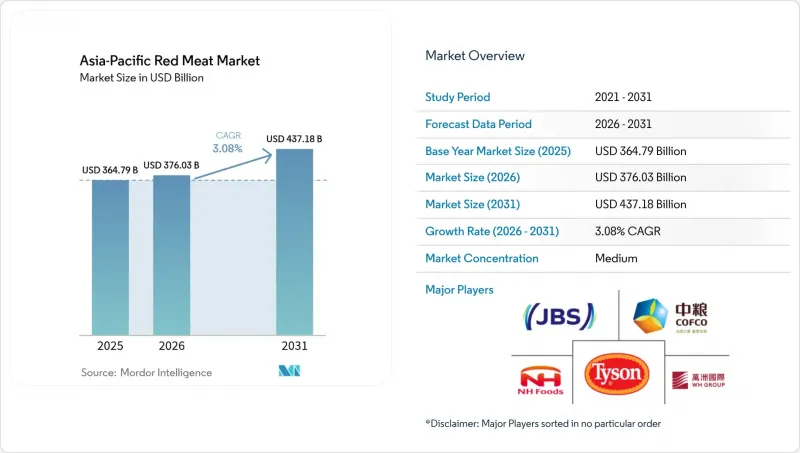
This report is Segmented by Product Type (Beef, Mutton, Pork, Other Meat), Category (Traditional Meat, Organic Meat), Form (Fresh/Chilled, Frozen, Canned, Processed), Distribution Channel (On-Trade, Off-Trade), and Geography (China, India, Japan, Australia, Indonesia, South Korea, Thailand, Singapore, Rest of Asia-Pacific). The Market Forecasts are Provided in Terms of Value (USD) and Volume (Units).
Asia-Pacific Red Meat Market Trends and Insights
Increasing demand for protein-rich diets
Increasing demand for protein-rich diets is a key driver of the Asia-Pacific red meat market. Consumers across the region are becoming more health-conscious and recognizing the essential role of proteins in muscle development, weight management, and overall wellness. The World Health Organization (WHO) actively emphasizes red meat's critical role in addressing iron deficiency anemia, particularly in developing regions across the asia-pacific region, where micronutrient deficiencies remain widespread. Rising incomes, urbanization, and changing lifestyles are fueling the demand for protein-rich food options, including red meat, to meet nutritional and dietary goals. According to a UN-Habitat report, Asia houses 54% of the global urban population, equating to over 2.2 billion people. Projections suggest that by 2050, Asia's urban population will surge by an additional 1.2 billion, a 50% increase . The region is experiencing a growing fitness culture and greater awareness of balanced diets, which encourages consumption of high-quality animal proteins. Furthermore, government initiatives and nutrition education programs promote protein intake as a means to combat malnutrition and lifestyle diseases. This expanding demand not only supports the growth of the red meat sector but also fosters innovation in premium and fortified protein products to cater to diverse consumer needs.
Influence of Western food habits and global cuisines
The influence of Western food habits and global cuisines is a significant driver of the Asia-Pacific red meat market. Rapid urbanization, rising disposable incomes, and globalization have led to a growing adoption of Western dietary patterns, particularly among the urban middle class in the region. This shift includes an increased preference for protein-rich diets that emphasize red meat such as beef, pork, and lamb, driven by exposure to international foodservice chains, media, and global culinary trends. Western-style dishes like steaks, burgers, and roasts are becoming increasingly popular, aligning with consumers' desire for convenient, flavorful, and nutrient-dense meals. Additionally, the expansion of modern retail infrastructure, including supermarkets, hypermarkets, and online platforms, has improved accessibility to red meat products. Overall, the convergence towards Western and global food habits, combined with rising health and fitness awareness, continues to stimulate demand for red meat in Asia-Pacific markets.
Health concerns related to excessive red meat consumption
Health concerns related to excessive red meat consumption are recognized as a significant market restraint in the Asia-Pacific region. Numerous studies have established a strong link between high intake of red and processed meats and increased risks of several health issues, including heart disease, various cancers (especially colorectal and breast cancers), type 2 diabetes, and premature death. The World Health Organization's International Agency for Research on Cancer (IARC) has classified processed meats as Group 1 carcinogens, indicating sufficient evidence that these products cause cancer in humans . This classification places processed meats in the same category as tobacco and asbestos in terms of carcinogenic risk. Processed meats, which include products like bacon, sausages, salami, and hot dogs, undergo curing, smoking, or adding preservatives, processes that can introduce harmful chemicals associated with increased cancer risk, particularly colorectal cancer. This authoritative classification has heightened public awareness and concern, driving shifts in consumer behavior and consumption patterns away from processed red meats. It acts as a significant restraint in the red meat market, as health-conscious consumers increasingly limit their intake or seek alternatives due to fears of cancer and other related health issues.
Other drivers and restraints analyzed in the detailed report include:
- Rising demand for processed and convenience red meat products
- Advancements in cold chain and meat processing infrastructure
- Competition from alternative proteins and plant-based meats
For complete list of drivers and restraints, kindly check the Table Of Contents.
Segment Analysis
Pork dominates the Asia-Pacific red meat market with a commanding 45.98% share in 2025, reflecting its deep cultural integration across the region's diverse cuisines. This leading position is supported by affordability, widespread consumption particularly in China and Southeast Asia, and substantial domestic production capabilities. Pork's dominance is further cemented by its availability and entrenched position in traditional dishes, making it the staple protein for many households. With a strong supply chain infrastructure and ongoing modernization of processing facilities, pork continues to maintain a stable demand base. Its ability to meet both volume and value needs helps preserve its leadership, despite emerging challenges. The size and scale of pork consumption make it the largest segment by market share, highlighting its role as the backbone of the Asia-Pacific red meat industry.\
In contrast, mutton is the fastest growing segment in the region, exhibiting a robust CAGR of approximately 3.78% through 2031, signaling a trend towards premiumization and niche market expansion. This growth is driven by rising consumer preference for specialty and premium proteins, which are perceived to offer superior taste, nutritional value, and cultural significance in certain communities. Increasing disposable incomes and urbanization, especially in key markets such as India and parts of Southeast Asia, support this shift towards higher-value meats like mutton. Unlike the volume-driven pork segment, mutton captures value through scarcity and premium positioning, which appeal to discerning consumers. Evolving consumer lifestyles and heightened interest in culinary diversity are also fueling growth in mutton consumption. As traditional volume leaders face margin pressures, mutton and similar specialty meats are reshaping protein hierarchies by carving out profitable growth segments.
Traditional meat products held a dominant position in the Asia-Pacific red meat market with an overwhelming 91.10% market share in 2025. This dominance underscores the enduring preference for conventional meat sources among consumers across the region. Traditional meat continues to benefit from established supply chains, widespread cultural acceptance, and cost-effectiveness compared to emerging segments. Despite increasing competition from alternative proteins and lifestyle shifts, the massive scale and familiarity of traditional meat consumption preserve its leading role. Stakeholders in the market continue to invest in improving production capabilities, ensuring consistent quality and availability. This segment remains the backbone of the regional red meat market, reflecting long-standing dietary habits and economic considerations.
Conversely, the organic meat segment is the fastest growing, exhibiting a CAGR of 3.74% through 2031, despite its relatively small current market share. The growth in organic meat reflects an increasing consumer interest in health, wellness, and sustainability, often willing to pay premium prices for perceived higher-quality and environmentally friendly products. Urban affluence, rising disposable incomes, and greater awareness about food safety standards are driving demand for organic options. This niche segment appeals to a growing demographic concerned with ethical farming practices and reduced chemical exposure. The sustained growth trajectory of organic meat signals its potential to carve out a meaningful market share over time. It highlights a broader trend towards premiumization that complements the mainstream traditional meat market rather than replacing it outright.
Complete Report Scope:
- By Product Type
- Beef
- Mutton
- Pork
- Other Meat
- By Category
- Traditional Meat
- Organic Meat
- By Form
- Fresh / Chilled
- Frozen
- Canned
- Processed
- By Distribution Channel
- On-Trade
- Off-Trade
- Supermarkets/ Hypermarkets
- Convenience Stores
- Online Retail Channel
- Other Distribution Channel
- By Geography
- China
- India
- Japan
- Australia
- Indonesia
- South Korea
- Thailand
- Singapore
- Rest of Asia-Pacific
List of Companies Covered in this Report:
- WH Group Limited
- Tyson Foods Inc.
- JBS S.A.
- COFCO Corporation
- NH Foods Ltd.
- Charoen Pokphand Foods (CPF)
- Marfrig Global Foods
- BRF S.A.
- Cargill, Incorporated
- Hormel Foods Corporation
- Nipponham Group
- Itoham Yonekyu Holdings
- Yurun Group
- Allanasons Private Limited
- Beijing Shunxin Agriculture
- Australian Agricultural Company (AACo)
- Smithfield Foods
- Silver Fern Farms
- Alliance Group
- Starzen Co. Ltd.
Additional Benefits:
- The market estimate (ME) sheet in Excel format
- 3 months of analyst support
TABLE OF CONTENTS
1 INTRODUCTION
- 1.1 Study Assumptions and Market Definition
- 1.2 Scope of the Study
2 RESEARCH METHODOLOGY
3 EXECUTIVE SUMMARY
4 MARKET LANDSCAPE
- 4.1 Market Overview
- 4.2 Market Drivers
- 4.2.1 Increasing demand for protein-rich diets
- 4.2.2 Influence of Western food habits and global cuisines
- 4.2.3 Rising demand for processed and convenience red meat products
- 4.2.4 Advancements in cold chain and meat processing infrastructure
- 4.2.5 Government initiatives supporting livestock and meat industries
- 4.2.6 Surging export opportunities through global trade agreements
- 4.3 Market Restraints
- 4.3.1 Health concerns related to excessive red meat consumption
- 4.3.2 Competition from alternative proteins and plant-based meats
- 4.3.3 Price volatility and raw material cost fluctuations
- 4.3.4 Outbreaks of animal diseases limiting growth
- 4.4 Value Chain Analysis
- 4.5 Regulatory Landscape
- 4.6 Technological Outlook
- 4.7 Porter's Five Forces
- 4.7.1 Threat of New Entrants
- 4.7.2 Bargaining Power of Buyers/Consumers
- 4.7.3 Bargaining Power of Suppliers
- 4.7.4 Threat of Substitutes
- 4.7.5 Intensity of Competitive Rivalry
5 MARKET SIZE AND GROWTH FORECASTS (VALUE AND VOLUME)
- 5.1 By Product Type
- 5.1.1 Beef
- 5.1.2 Mutton
- 5.1.3 Pork
- 5.1.4 Other Meat
- 5.2 By Category
- 5.2.1 Traditional Meat
- 5.2.2 Organic Meat
- 5.3 By Form
- 5.3.1 Fresh / Chilled
- 5.3.2 Frozen
- 5.3.3 Canned
- 5.3.4 Processed
- 5.4 By Distribution Channel
- 5.4.1 On-Trade
- 5.4.2 Off-Trade
- 5.4.2.1 Supermarkets/ Hypermarkets
- 5.4.2.2 Convenience Stores
- 5.4.2.3 Online Retail Channel
- 5.4.2.4 Other Distribution Channel
- 5.5 By Geography
- 5.5.1 China
- 5.5.2 India
- 5.5.3 Japan
- 5.5.4 Australia
- 5.5.5 Indonesia
- 5.5.6 South Korea
- 5.5.7 Thailand
- 5.5.8 Singapore
- 5.5.9 Rest of Asia-Pacific
6 Competitive Landscape
- 6.1 Market Concentration
- 6.2 Strategic Moves
- 6.3 Market Share Analysis
- 6.4 Company Profiles {(includes Global level Overview, Market level overview, Core Segments, Financials as available, Strategic Information, Market Rank/Share for key companies, Products & Services, and Recent Developments)}
- 6.4.1 WH Group Limited
- 6.4.2 Tyson Foods Inc.
- 6.4.3 JBS S.A.
- 6.4.4 COFCO Corporation
- 6.4.5 NH Foods Ltd.
- 6.4.6 Charoen Pokphand Foods (CPF)
- 6.4.7 Marfrig Global Foods
- 6.4.8 BRF S.A.
- 6.4.9 Cargill, Incorporated
- 6.4.10 Hormel Foods Corporation
- 6.4.11 Nipponham Group
- 6.4.12 Itoham Yonekyu Holdings
- 6.4.13 Yurun Group
- 6.4.14 Allanasons Private Limited
- 6.4.15 Beijing Shunxin Agriculture
- 6.4.16 Australian Agricultural Company (AACo)
- 6.4.17 Smithfield Foods
- 6.4.18 Silver Fern Farms
- 6.4.19 Alliance Group
- 6.4.20 Starzen Co. Ltd.
7 MARKET OPPORTUNITIES AND FUTURE OUTLOOK

