PUBLISHER: Mordor Intelligence | PRODUCT CODE: 2124776

PUBLISHER: Mordor Intelligence | PRODUCT CODE: 2124776
Europe Household Electric Grills - Market Share Analysis, Industry Trends & Statistics, Growth Forecasts (2026 - 2031)
According to Mordor Intelligence, the Europe household electric grills market size was valued at USD 2.07 billion in 2025 and estimated to grow from USD 2.19 billion in 2026 to reach USD 2.87 billion by 2031, at a CAGR of 5.62% during the forecast period (2026-2031).
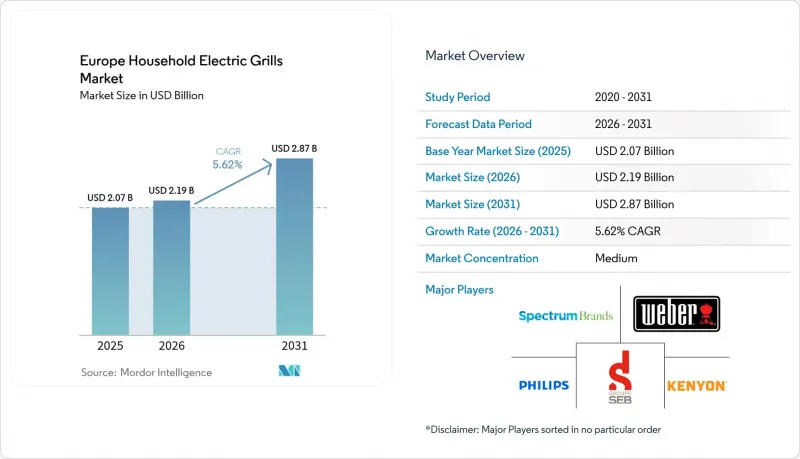
This report is Segmented by Product (Contact Grills, Electric Griddles, Electric Smokers, Raclette Grills, Convertible Grills), Functionality (Indoor, Outdoor, Convertible), End-User (Residential, Commercial), Distribution Channel (Offline, Online), and Geography. The Market Forecasts are Provided in Terms of Value (USD).
Europe Household Electric Grills Market Trends and Insights
Urban Apartment Fire-Code Limits Boosting Electric Grill Adoption
European city councils have tightened fire-code restrictions, prohibiting open-flame cooking on many balconies. In markets where 72% of residents already live in urban settings, this policy shift has channeled demand toward electric solutions that meet safety regulations. The European household electric grills market is, therefore, benefiting from compact units that still reach 600°F, satisfying consumers who feared inadequate heat for searing. German and French retailers reported double-digit sales growth in 2024 for models explicitly labeled "balcony-safe." Manufacturers continue to miniaturize heating elements and incorporate ceramic coatings that boost thermal efficiency without increasing footprint.
EU Green-Deal Electrification Policies Favoring Emission-Free Cooking
The European Green Deal has embedded efficiency labels into appliance buying decisions, with 93% of consumers consulting the rating before purchase. As energy-saving measures delivered household savings up to EUR 266 (USD 313.28) in 2020, the policy narrative strengthened the total-cost-of-ownership case for electric grills. Competitive pressure within the Europe household electric grills market now centers on meeting or exceeding the A-class benchmark under the ESPR framework. Brands that earn the top tier can advertise quantifiable running-cost benefits, capturing share in price-sensitive regions and driving premium model upgrades in high-income markets.
High Average Price vs Charcoal/Gas Alternatives
Electric grills still command list prices 40-60% above entry-level charcoal units, testing consumer budgets in price-sensitive regions. The economic slowdown has accelerated a "trading down" trend, with households delaying discretionary appliance purchases. Manufacturers have added lower-wattage models to mitigate sticker shock, yet engineering standards needed for fast heat-up times prevent the deep cost cuts seen in other small-appliance categories. This price gap tempers headline growth in the Europe household electric grills market, especially in Southern and Eastern Europe, where traditional wood-fired grilling remains culturally entrenched.
Other drivers and restraints analyzed in the detailed report include:
- Social-Media-Driven Home-Gourmet Grilling Trend
- Smart-IoT Integration Enhancing Premium Grill Appeal
- Energy-Cost Inflation Across Europe
For complete list of drivers and restraints, kindly check the Table Of Contents.
Segment Analysis
Electric smokers registered a 5.72% CAGR outlook for 2026-2031, challenging the dominance of contact grills that accounted for a 34.45% Europe household electric grills market share in 2025. Innovations such as automated smoke generators and closed-loop thermostats let novices achieve authentic barbecue flavors without constant supervision. This technology convergence has expanded the segment's addressable audience from outdoor enthusiasts to weekday users seeking slow-cooked meals with minimal prep time.
Contact grills continue to anchor category revenue because they excel in day-to-day tasks like sandwiches and steak searing. Meanwhile, raclette tables and tabletop party grills have carved a social-dining niche, and convertible indoor-outdoor platforms cater to small-space owners wanting flexible setups for different seasons. The product spectrum illustrates a maturing European household electric grills market where consumers own multiple specialized devices rather than a single all-purpose grill.
Outdoor-rated units are forecast to grow at 5.95% CAGR, eroding the indoor segment's 69.60% market hold. Weather-sealed heating elements now reach 650°F, overcoming the historical performance gap with gas grills and enabling authentic sear marks outdoors. Balcony-sized frames comply with local bylaws, further stimulating adoption in apartment-dense cities.
The indoor category remains the workhorse of the Europe household electric grills market size due to its all-season practicality. Convertible models target households that entertain on patios during summer yet rely on countertop cooking in colder months. Vendors are layering smart-weather alerts, lid-open sensors, and recipe-driven automation across both formats, blurring the distinction and driving an upsell path toward premium SKUs.
Complete Report Scope:
- By Product
- Contact Grills/Panini Press
- Electric Griddles and Skillets
- Electric Smokers
- Raclette and Table-top Party Grills
- Convertible Indoor-Outdoor Grills
- By Functionality
- Indoor
- Outdoor
- Convertible
- By End-User
- Residential
- Commercial (HoReCa, Catering)
- By Distribution Channel
- Offline Retail - Specialty Stores
- Offline Retail - Hyper/Supermarkets
- Department Stores
- Online Retail
- By Geography
- Germany
- United Kingdom
- France
- Italy
- Spain
- Nordics (Sweden, Norway, Denmark, Finland)
- Benelux (Netherlands, Belgium, Luxembourg)
- Switzerland and Austria
- Rest of Europe
List of Companies Covered in this Report:
- Philips Domestic Appliances
- Groupe SEB (Tefal, Krups)
- Spectrum Brands (Hamilton Beach/George Foreman)
- Weber-Stephen Products LLC
- Kenyon
- Breville Group (Sage Appliances Europe)
- Severin Elektrogerate
- WMF GmbH
- Princess Household Appliances
- Tristar Europe
- G3 Ferrari (Trevi Group)
- Klarstein (Chal-Tec GmbH)
- Ninja Kitchen (SharkNinja)
- Electrolux AB
- Landmann Grill GmbH
- Outdoorchef AG
- Traeger Grills
- Masterbuilt Manufacturing
- Bull Europe Ltd
- Alpina Appliances
Additional Benefits:
- The market estimate (ME) sheet in Excel format
- 3 months of analyst support
TABLE OF CONTENTS
1 INTRODUCTION
- 1.1 Study Assumptions and Market Definition
- 1.2 Scope of the Study
2 RESEARCH METHODOLOGY
3 EXECUTIVE SUMMARY
4 MARKET LANDSCAPE
- 4.1 Market Overview
- 4.2 Market Drivers
- 4.2.1 Urban Apartment Fire-Code Limits Boosting Electric Grill Adoption
- 4.2.2 EU Green-Deal Electrification Policies Favouring Emission-Free Cooking
- 4.2.3 Social-Media-Driven Home-Gourmet Grilling Trend
- 4.2.4 Smart-IoT Integration Enhancing Premium Grill Appeal
- 4.2.5 Compact Balcony/Patio Models Expanding Outdoor Use
- 4.2.6 E-commerce Direct-to-Consumer Brands Widening Access
- 4.3 Market Restraints
- 4.3.1 High Average Price vs Charcoal/Gas Alternatives
- 4.3.2 Energy-Cost Inflation Across Europe
- 4.3.3 Perceived Flavor Inferiority to Traditional Fuel Grills
- 4.3.4 EU Eco-design Compliance Costs for Manufacturers
- 4.4 Industry Ecosystem Analysis
- 4.5 Technological Outlook
- 4.6 Porter's Five Forces Analysis
- 4.6.1 Threat of New Entrants
- 4.6.2 Bargaining Power of Buyers
- 4.6.3 Bargaining Power of Suppliers
- 4.6.4 Threat of Substitutes
- 4.6.5 Competitive Rivalry
5 MARKET SIZE AND GROWTH FORECASTS (VALUE)
- 5.1 By Product
- 5.1.1 Contact Grills/Panini Press
- 5.1.2 Electric Griddles and Skillets
- 5.1.3 Electric Smokers
- 5.1.4 Raclette and Table-top Party Grills
- 5.1.5 Convertible Indoor-Outdoor Grills
- 5.2 By Functionality
- 5.2.1 Indoor
- 5.2.2 Outdoor
- 5.2.3 Convertible
- 5.3 By End-User
- 5.3.1 Residential
- 5.3.2 Commercial (HoReCa, Catering)
- 5.4 By Distribution Channel
- 5.4.1 Offline Retail - Specialty Stores
- 5.4.2 Offline Retail - Hyper/Supermarkets
- 5.4.3 Department Stores
- 5.4.4 Online Retail
- 5.5 By Geography
- 5.5.1 Germany
- 5.5.2 United Kingdom
- 5.5.3 France
- 5.5.4 Italy
- 5.5.5 Spain
- 5.5.6 Nordics (Sweden, Norway, Denmark, Finland)
- 5.5.7 Benelux (Netherlands, Belgium, Luxembourg)
- 5.5.8 Switzerland and Austria
- 5.5.9 Rest of Europe
6 COMPETITIVE LANDSCAPE
- 6.1 Market Concentration
- 6.2 Strategic Moves
- 6.3 Market Share Analysis
- 6.4 Company Profiles {(includes Global level Overview, Market level overview, Core Segments, Financials as available, Strategic Information, Market Rank/Share for key companies, Products and Services, and Recent Developments)}
- 6.4.1 Philips Domestic Appliances
- 6.4.2 Groupe SEB (Tefal, Krups)
- 6.4.3 Spectrum Brands (Hamilton Beach/George Foreman)
- 6.4.4 Weber-Stephen Products LLC
- 6.4.5 Kenyon
- 6.4.6 Breville Group (Sage Appliances Europe)
- 6.4.7 Severin Elektrogerate
- 6.4.8 WMF GmbH
- 6.4.9 Princess Household Appliances
- 6.4.10 Tristar Europe
- 6.4.11 G3 Ferrari (Trevi Group)
- 6.4.12 Klarstein (Chal-Tec GmbH)
- 6.4.13 Ninja Kitchen (SharkNinja)
- 6.4.14 Electrolux AB
- 6.4.15 Landmann Grill GmbH
- 6.4.16 Outdoorchef AG
- 6.4.17 Traeger Grills
- 6.4.18 Masterbuilt Manufacturing
- 6.4.19 Bull Europe Ltd
- 6.4.20 Alpina Appliances
7 MARKET OPPORTUNITIES AND FUTURE OUTLOOK
- 7.1 White-Space and Unmet-Need Assessment

