PUBLISHER: Mordor Intelligence | PRODUCT CODE: 2124783

PUBLISHER: Mordor Intelligence | PRODUCT CODE: 2124783
Cosmetic Peptide Synthesis - Market Share Analysis, Industry Trends & Statistics, Growth Forecasts (2026 - 2031)
According to Mordor Intelligence, the cosmetic peptide synthesis market size was valued at USD 247.53 million in 2025 and is estimated to grow from USD 259.63 million in 2026 to reach USD 337.09 million by 2031, at a CAGR of 5.34% during the forecast period (2026-2031).
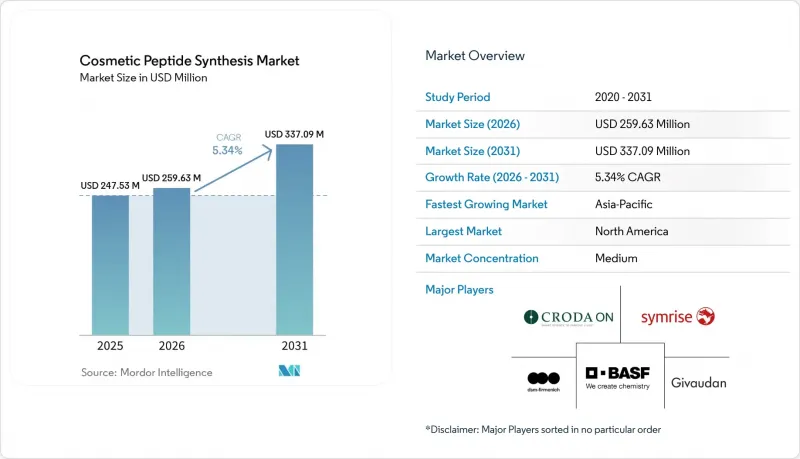
This report is Segmented by Peptide Type (Signal Peptides, and More), Application (Anti-Aging, and More), Synthesis Technique (Solid-Phase Peptide Synthesis, and More), Purity Grade (>=98% Cosmetic Grade, and More), End User (Pharmaceutical & Biotechnology Companies, and More), and Geography (North America, and More). The Market Forecasts are Provided in Terms of Value (USD).
Global Cosmetic Peptide Synthesis Market Trends and Insights
Rising Demand for Biomimetic Anti-Aging Actives
Clinical evidence shows palmitoyl pentapeptide-4 can reduce wrinkle depth by up to 20% within twelve weeks without the irritation seen with topical retinoids. Acetyl hexapeptide-8 attenuates muscle contraction by blocking the SNARE complex, delivering visible smoothing comparable to low-dose botulinum toxin. Copper-GHK peptides further remodel extracellular matrix by activating metalloproteinases, improving dermal density by 18% after four months. Brands increasingly layer signal, carrier, and enzyme-inhibitor peptides into a single product, though this strategy increases the complexity of stability testing. Regulators still treat peptides as cosmetic ingredients unless explicit structure-function claims cross the drug threshold.
Lower-Cost High-Throughput SPPS Automation
Microwave-assisted reactors have cut coupling times from hours to minutes, halving labor costs and solvent use. Continuous-flow SPPS eliminates manual resin transfers and lowers solvent demand by about 40%. Contract manufacturers equipped with these platforms can supply sub-kilogram batches inside four weeks, matching the agility of small-molecule suppliers. As a result, custom peptides now reach mid-tier products priced under USD 50, a price band historically out of reach for peptide actives. ISO 22716 guidelines ensure that higher throughput does not compromise traceability or contamination control.
Premiumization of South-Korean Peptide Serums
South-Korean labels have popularized serums that combine PDRN with multi-functional peptides, often retailing above USD 80 per 30 mL. These products pitch peptides as "skin's native language" and favor fermentation-derived sequences that align with clean-beauty narratives. Rising export volumes to North America and Europe show that premium peptide positioning is resonating outside Asia. South-Korean regulation classifies peptides under 50 amino acids as cosmetic ingredients, avoiding therapeutic review burdens and hastening launch timelines.
Other drivers and restraints analyzed in the detailed report include:
- AI-Driven Peptide Sequence Design Shortening R&D Cycles
- High Purification Costs Curb Mass-Market Pricing
For complete list of drivers and restraints, kindly check the Table Of Contents.
Segment Analysis
Signal peptides represented 41.82% of the cosmetic peptide synthesis market share in 2025. Continued use of palmitoyl pentapeptide-4 and palmitoyl tripeptide-1 in anti-aging creams sustains demand, while brands favor these sequences for their predictable stability profiles. Multi-vendor supply chains also support pricing discipline, limiting shortages.
Carrier peptides are forecast to post the fastest 6.43% CAGR through 2031. Copper-GHK complexes now shuttle trace elements that catalyze extracellular matrix remodeling without depending on synthetic polymers, which are now under environmental review. Formulators view carrier peptides as a route to differentiate textures and improve delivery efficiency.
Neurotransmitter-inhibitor peptides, such as acetyl hexapeptide-8, held a 23.1% share in 2025 and remain popular in expression-line serums, offering consumers a topical alternative to botulinum toxin injections. Enzyme-inhibitor peptides that block elastase and collagenase reached a significant share, with the highest uptake in urban regions where particulate pollution accelerates skin aging. Other functional peptides, including antimicrobial and pigment-modulating sequences and their use is widening into acne and hyperpigmentation products.
Anti-aging maintained 48.27% of the cosmetic peptide synthesis market size in 2025. Although growth moderates in mature regions, the segment still benefits from multi-peptide stacking strategies that promise synergistic collagen stimulation.
Hair-care and scalp treatments are projected to grow at an 8.72% CAGR between 2026 and 2031. Evidence that copper-GHK can keep follicles in the anagen phase up to 22% longer is encouraging formulators to extend peptides beyond facial care. Whitening and brightening products held a 16.8% share, driven by oligopeptide-68 and nonapeptide-1, which offer tyrosinase inhibition without the regulatory baggage of hydroquinone. Barrier-repair creams and moisturizers captured 14.3% share, helped by peptides that lower trans-epidermal water loss. Eye-care and sun-care collectively make up a modest but rising slice, with DNA-repair peptides under investigation for after-sun recovery.
Complete Report Scope:
- By Peptide Type
- Signal Peptides
- Neurotransmitter Inhibitor Peptides
- Carrier Peptides
- Enzyme Inhibitor Peptides
- Other Functional Peptides
- By Application
- Anti-aging
- Whitening & Brightening
- Barrier Repair & Moisturising
- Hair-care & Scalp Treatments
- Eye-care Products
- Sun-care & After-sun
- By Synthesis Technique
- Solid-Phase Peptide Synthesis (SPPS)
- Liquid-Phase Peptide Synthesis (LPPS)
- Hybrid / Fragment Condensation
- Recombinant / Cell-free Biosynthesis
- By Purity Grade
- >= 98 % Cosmetic Grade
- 95 - 98 % Cosmetic Grade
- < 95 % Industrial / R&D Grade
- By End User
- Pharmaceutical & Biotechnology Companies
- Contract Manufacturing Organisations (CMOs)
- Other End Users
- By Geography
- North America
- United States
- Canada
- Mexico
- Europe
- Germany
- United Kingdom
- France
- Italy
- Spain
- Rest of Europe
- Asia-Pacific
- China
- Japan
- India
- Australia
- South Korea
- Rest of Asia-Pacific
- Middle East & Africa
- GCC
- South Africa
- Rest of Middle East & Africa
- South America
- Brazil
- Argentina
- Rest of South America
- North America
Geography Analysis
North America held 42.84% market share of the cosmetic peptide synthesis market in 2025, anchored by cGMP facilities in New Jersey, California, and Massachusetts. Regional growth of 4.8% CAGR will be underpinned by AI-driven design tools, which are disproportionately headquartered in the United States. Canada mirrors U.S. regulatory frameworks, smoothing cross-border supply, while Mexico's growth is strongest in premium department stores that favor high-purity imports.
Germany leads consumption thanks to in-house peptide units at BASF and Evonik, while France benefits from luxury-brand demand. The United Kingdom, Italy, and Spain follow, each showing mid-single-digit growth as peptides replace retinoids in sensitive-skin regimens.
Asia-Pacific is the fastest-growing region, with a 9.36% CAGR through 2031. China hosts expanding recombinant-biosynthesis hubs in Shenzhen and Shanghai, while South Korean brands collaborate with local suppliers to launch signature hexapeptides. Japan's regulatory designation of "functional cosmetics" allows structure-function claims once ingredients pass safety review, helping local brands market efficacy data. India and Southeast Asia show double-digit growth driven by rising discretionary incomes, though price sensitivity still favors lower inclusion rates.
High per-capita spending and tourism retail bolster demand, but limited local manufacturing means most peptides enter as finished products. South Africa represents the region's secondary growth node, focused on remedies for hyperpigmentation and sun damage.
Brazil dominates, supported by local brands adding peptides to anti-aging creams designed for sun-exposed climates. Argentina and Chile follow, though currency volatility can disrupt import pipelines. Regional regulators such as ANVISA require safety dossiers but no pre-market efficacy approval, enabling relatively swift launches.
- AAPPtec
- Activotec
- AmbioPharm
- Ashland
- Bachem Holding
- BASF
- Bio Basic
- CEM
- Creative Peptides
- Croda International plc (Sederma)
- CSBio Company
- DSM-Firmenich (Pentapharm)
- Evonik Industries
- GenScript Biotech Corp.
- Givaudan SA (Active Beauty)
- Lubrizol
- PolyPeptide Group
- RS Synthesis LLC
- Symrise AG
- Shenzhen JYMed Technology
Additional Benefits:
- The market estimate (ME) sheet in Excel format
- 3 months of analyst support
TABLE OF CONTENTS
1 Introduction
- 1.1 Study Assumptions & Market Definition
- 1.2 Scope of the Study
2 Research Methodology
3 Executive Summary
4 Market Landscape
- 4.1 Market Overview
- 4.2 Market Drivers
- 4.2.1 Rising Demand for Biomimetic Anti-Aging Actives
- 4.2.2 Lower-Cost High-Throughput SPPS Automation
- 4.2.3 Premiumisation of K-Beauty Peptide Serums
- 4.2.4 Brand-Supplier Co-Development of "Signature" Peptides
- 4.2.5 AI-Driven Peptide Sequence Design Shortening R&D Cycles
- 4.2.6 Fast-Track Functional-Cosmetics Regulations
- 4.3 Market Restraints
- 4.3.1 High Purification Costs Curb Mass-Market Pricing
- 4.3.2 Batch-To-Batch Variability in Liquid-Phase Synthesis
- 4.3.3 Scrutiny of Micro-Plastic Carriers in Formulations
- 4.3.4 Consumer Sensitivity To "Synthetic-Sounding" INCI Names
- 4.4 Regulatory Landscape
- 4.5 Technological Outlook
- 4.6 Porter's Five Forces Analysis
- 4.6.1 Threat of New Entrants
- 4.6.2 Bargaining Power of Buyers
- 4.6.3 Bargaining Power of Suppliers
- 4.6.4 Threat of Substitute Products
- 4.6.5 Intensity of Competitive Rivalry
5 Market Size & Growth Forecasts
- 5.1 By Peptide Type
- 5.1.1 Signal Peptides
- 5.1.2 Neurotransmitter Inhibitor Peptides
- 5.1.3 Carrier Peptides
- 5.1.4 Enzyme Inhibitor Peptides
- 5.1.5 Other Functional Peptides
- 5.2 By Application
- 5.2.1 Anti-aging
- 5.2.2 Whitening & Brightening
- 5.2.3 Barrier Repair & Moisturising
- 5.2.4 Hair-care & Scalp Treatments
- 5.2.5 Eye-care Products
- 5.2.6 Sun-care & After-sun
- 5.3 By Synthesis Technique
- 5.3.1 Solid-Phase Peptide Synthesis (SPPS)
- 5.3.2 Liquid-Phase Peptide Synthesis (LPPS)
- 5.3.3 Hybrid / Fragment Condensation
- 5.3.4 Recombinant / Cell-free Biosynthesis
- 5.4 By Purity Grade
- 5.4.1 >= 98 % Cosmetic Grade
- 5.4.2 95 - 98 % Cosmetic Grade
- 5.4.3 < 95 % Industrial / R&D Grade
- 5.5 By End User
- 5.5.1 Pharmaceutical & Biotechnology Companies
- 5.5.2 Contract Manufacturing Organisations (CMOs)
- 5.5.3 Other End Users
- 5.6 By Geography
- 5.6.1 North America
- 5.6.1.1 United States
- 5.6.1.2 Canada
- 5.6.1.3 Mexico
- 5.6.2 Europe
- 5.6.2.1 Germany
- 5.6.2.2 United Kingdom
- 5.6.2.3 France
- 5.6.2.4 Italy
- 5.6.2.5 Spain
- 5.6.2.6 Rest of Europe
- 5.6.3 Asia-Pacific
- 5.6.3.1 China
- 5.6.3.2 Japan
- 5.6.3.3 India
- 5.6.3.4 Australia
- 5.6.3.5 South Korea
- 5.6.3.6 Rest of Asia-Pacific
- 5.6.4 Middle East & Africa
- 5.6.4.1 GCC
- 5.6.4.2 South Africa
- 5.6.4.3 Rest of Middle East & Africa
- 5.6.5 South America
- 5.6.5.1 Brazil
- 5.6.5.2 Argentina
- 5.6.5.3 Rest of South America
- 5.6.1 North America
6 Competitive Landscape
- 6.1 Market Concentration
- 6.2 Market Share Analysis
- 6.3 Company Profiles (includes Global Level Overview, Market Level Overview, Core Segments, Financials as Available, Strategic Information, Market Rank/Share for Key Companies, Products & Services, and Recent Developments)
- 6.3.1 AAPPtec
- 6.3.2 Activotec
- 6.3.3 AmbioPharm
- 6.3.4 Ashland Inc.
- 6.3.5 Bachem Holding AG
- 6.3.6 BASF SE
- 6.3.7 Bio Basic Inc.
- 6.3.8 CEM Corporation
- 6.3.9 Creative Peptides
- 6.3.10 Croda International plc (Sederma)
- 6.3.11 CSBio Company Inc.
- 6.3.12 DSM-Firmenich (Pentapharm)
- 6.3.13 Evonik Industries AG
- 6.3.14 GenScript Biotech Corp.
- 6.3.15 Givaudan SA (Active Beauty)
- 6.3.16 Lubrizol Corporation
- 6.3.17 PolyPeptide Group
- 6.3.18 RS Synthesis LLC
- 6.3.19 Symrise AG
- 6.3.20 Shenzhen JYMed Technology
7 Market Opportunities & Future Outlook
- 7.1 White-space & Unmet-Need Assessment

