PUBLISHER: Mordor Intelligence | PRODUCT CODE: 2124787

PUBLISHER: Mordor Intelligence | PRODUCT CODE: 2124787
Europe E-Book - Market Share Analysis, Industry Trends & Statistics, Growth Forecasts (2026 - 2031)
According to Mordor Intelligence, the Europe e-Book market size is expected to grow from USD 9.82 billion in 2025 to USD 10.16 billion in 2026 and is forecast to reach USD 12.03 billion by 2031 at 3.46% CAGR over 2026-2031.
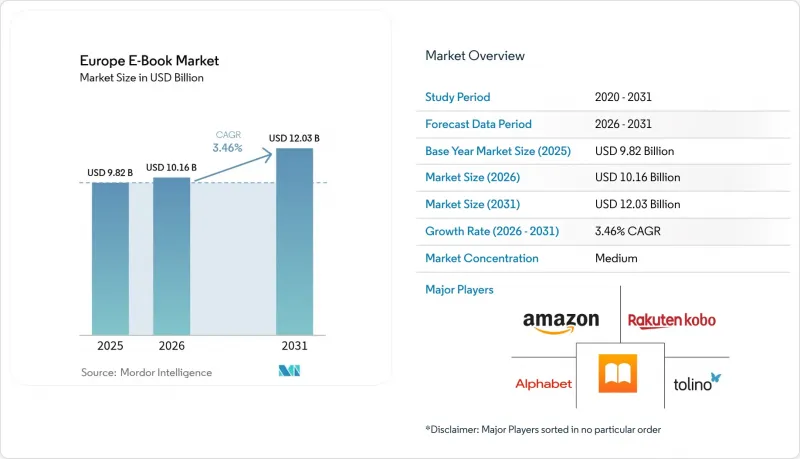
This report is Segmented by Content Type (Fiction and More), Device Type (Smartphone and Dedicated E-Reader and More), Access Model (Smartphone and More), Distribution Channel (Third-Party E-Retailers, Institutional and Library Portals and More), and Geography. The Market Sizes and Forecasts are Provided in Terms of Value (USD).
Europe E-Book Market Trends and Insights
High Smartphone and Broadband Penetration Accelerating Mobile Reading in Western Europe
Mobile connectivity has transformed reading habits, with 46% of e-book consumption now taking place on smartphones in 2024. Younger readers drive this shift through always-available devices and shorter attention cycles that align with digital formats. Publishers have responded by re-designing titles for smaller screens, ensuring typography and navigation meet mobile expectations. Advertised bundles pairing e-books with telecom plans are also widening reach among first-time digital readers. As 5G coverage deepens, in-app sampling and one-click purchasing further simplify the path from discovery to completed sale, reinforcing the European e-book market's mobile-centric trajectory.
EU VAT Harmonisation Removing Fiscal Barriers to Digital Publishing
Equalised VAT treatment between print and digital books has eliminated a cost handicap that once constrained online price flexibility. French and German publishers now experiment with limited-time discounts and loyalty incentives previously restricted under fixed-price regulations. Subscription services benefit most, using the margin headroom to lower monthly fees while sustaining author royalties. Together with wider language catalogues, this fiscal shift lifted German e-book revenues by 5.2% in 2023 and set a precedent other markets quickly followed, supporting steady enlargement of the European e-book market.
Strong Competition from Audio-First Formats such as Podcasts & Audiobooks
Rising audio engagement siphons discretionary time from e-book reading, with Nordic audiobook share estimated at 4-5% of the total book market. Major platforms lure authors with exclusive production budgets and voice-talent marketing, prompting e-book publishers to launch simultaneous text-audio releases. While multi-format strategies hedge risk, they also raise cost structures, adding pressure to maintain margin within the European e-book market.
Other drivers and restraints analyzed in the detailed report include:
- Surge of Subscription-Based Reading Platforms Boosting Recurring Revenue Streams
- Publisher Digitization of Backlists in Native European Languages
- Rampant E-Book Piracy and Illegal File-Sharing Networks Across EU
For complete list of drivers and restraints, kindly check the Table Of Contents.
Segment Analysis
Fiction remained the revenue cornerstone in 2025, holding a 34.60% share of the European e-book market. Genre series release schedules and community marketing energise frequent purchases that sustain digital traction. The segment benefits from readers' willingness to embrace auto-buy functions inside subscription apps, reinforcing volume. Children's literature, though still smaller, is the fastest climber at a 9.35% CAGR for 2026-2031, propelled by interactive enhancements that align with tablet use among families. Enhanced read-aloud features, embedded games and parental analytics differentiate digital from print, supporting premium pricing.
Educational shifts during pandemic lockdowns normalised screen-based reading for younger age groups and eased educator concerns about efficacy. Publishers pivoted by securing multimedia rights and collaborating with ed-tech partners to integrate curriculum alignment. The September 2024 appellate decision upholding restrictions on controlled digital lending clarified digital rights management boundaries, encouraging rights holders to increase children's backlist conversions. Together, these factors expand the European e-book market size for youth titles and diversify revenue beyond traditionally dominant fiction lines.
Smartphones captured 45.40% of consumption devices in 2025, underpinned by widespread 4G/5G coverage and habit-forming quick reads during commutes. Publishers now design responsive layouts and compress download packages to meet data-cap sensitivities. Push notifications on reading milestones enhance engagement rates, directly influencing lifetime value within the European e-book market.
Dedicated e-readers, once considered niche, show renewed appeal with an 7.72% forecast CAGR as e-ink colour, front-lighting, and extended battery life address past limitations. Older readers, 53% of whom prefer e-readers for eye comfort, drive this resurgence. New EU cybersecurity requirements for digital products, effective November 2024, elevate the baseline resilience of devices. Compliance costs may squeeze smaller hardware makers yet reinforce consumer trust, supporting sustained hardware replacement cycles that indirectly fuel e-book sales.
Complete Report Scope:
- By Content Type
- Professional / Technical
- Educational & Academic
- Fiction
- Non-Fiction
- Childrens Literature
- Comics & Graphic Novels
- Other Genres
- By Device Type
- Smartphone
- Tablet
- Dedicated E-Reader
- Laptop / Desktop
- Other Devices
- By Access Model
- Subscription / Unlimited Reading
- Pay-Per-Download
- Free / Ad-Supported
- By Distribution Channel
- Direct Publisher Platforms
- Third-Party E-Retailers
- Institutional & Library Portals
- By Geography
- Germany
- United Kingdom
- France
- Spain
- Russia
- Italy
- Netherlands
- Poland
- Rest of Europe
List of Companies Covered in this Report:
- Amazon.com Inc. (Kindle & KDP)
- Rakuten Kobo Inc.
- Apple Inc. (Apple Books)
- Alphabet Inc. (Google Play Books)
- Barnes & Noble Inc. (Nook)
- Tolino Media GmbH & Co. KG
- PocketBook International SA
- Storytel AB
- BookBeat AB
- Skoobe GmbH
- Lulu Press Inc.
- Draft2Digital LLC (incl. Smashwords)
- Georg von Holtzbrinck GmbH & Co. KG
- Penguin Random House LLC
- Hachette Livre
- HarperCollins Publishers LLC
- Bonnier Books AB
- Pearson PLC
- Springer Nature
- Bloomsbury Publishing PLC
Additional Benefits:
- The market estimate (ME) sheet in Excel format
- 3 months of analyst support
TABLE OF CONTENTS
1 INTRODUCTION
- 1.1 Study Assumptions and Market Definition
- 1.2 Scope of the Study
2 RESEARCH METHODOLOGY
3 EXECUTIVE SUMMARY
4 MARKET LANDSCAPE
- 4.1 Market Overview
- 4.2 Market Drivers
- 4.2.1 High Smartphone and Broadband Penetration Accelerating Mobile Reading in Western Europe
- 4.2.2 EU VAT Harmonisation Removing Fiscal Barriers to Digital Publishing
- 4.2.3 Surge of Subscription-Based Reading Platforms Boosting Recurring Revenue Streams
- 4.2.4 Publisher Digitization of Backlists in Native European Languages
- 4.2.5 Sustainability Goals Driving Print-to-Digital Shift Among European Publishers
- 4.2.6 AI-Driven Personalization and Discovery Tools Increasing Average Title Consumption
- 4.3 Market Restraints
- 4.3.1 Rampant E-Book Piracy and Illegal File-Sharing Networks Across EU
- 4.3.2 Strong Competition from Audio-First Formats such as Podcasts & Audiobooks
- 4.3.3 Fixed Book Price Laws Capping Discounting Flexibility in DACH & France
- 4.4 Regulatory Outlook
- 4.5 Pricing Analysis
- 4.6 Porter's Five Forces Analysis
- 4.6.1 Bargaining Power of Suppliers
- 4.6.2 Bargaining Power of Buyers
- 4.6.3 Threat of New Entrants
- 4.6.4 Threat of Substitute Products
- 4.6.5 Intensity of Competitive Rivalry
- 4.7 Assessment of the Impact of Macroeconomic Shifts
5 MARKET SIZE AND GROWTH FORECASTS (VALUE)
- 5.1 By Content Type
- 5.1.1 Professional / Technical
- 5.1.2 Educational & Academic
- 5.1.3 Fiction
- 5.1.4 Non-Fiction
- 5.1.5 Childrens Literature
- 5.1.6 Comics & Graphic Novels
- 5.1.7 Other Genres
- 5.2 By Device Type
- 5.2.1 Smartphone
- 5.2.2 Tablet
- 5.2.3 Dedicated E-Reader
- 5.2.4 Laptop / Desktop
- 5.2.5 Other Devices
- 5.3 By Access Model
- 5.3.1 Subscription / Unlimited Reading
- 5.3.2 Pay-Per-Download
- 5.3.3 Free / Ad-Supported
- 5.4 By Distribution Channel
- 5.4.1 Direct Publisher Platforms
- 5.4.2 Third-Party E-Retailers
- 5.4.3 Institutional & Library Portals
- 5.5 By Geography
- 5.5.1 Germany
- 5.5.2 United Kingdom
- 5.5.3 France
- 5.5.4 Spain
- 5.5.5 Russia
- 5.5.6 Italy
- 5.5.7 Netherlands
- 5.5.8 Poland
- 5.5.9 Rest of Europe
6 COMPETITIVE LANDSCAPE
- 6.1 Strategic Moves
- 6.2 Market Share Analysis
- 6.3 Company Profiles (includes Market Level Overview, Core Segments, Financials as available, Strategic Information, Products & Services, and Recent Developments)
- 6.3.1 Amazon.com Inc. (Kindle & KDP)
- 6.3.2 Rakuten Kobo Inc.
- 6.3.3 Apple Inc. (Apple Books)
- 6.3.4 Alphabet Inc. (Google Play Books)
- 6.3.5 Barnes & Noble Inc. (Nook)
- 6.3.6 Tolino Media GmbH & Co. KG
- 6.3.7 PocketBook International SA
- 6.3.8 Storytel AB
- 6.3.9 BookBeat AB
- 6.3.10 Skoobe GmbH
- 6.3.11 Lulu Press Inc.
- 6.3.12 Draft2Digital LLC (incl. Smashwords)
- 6.3.13 Georg von Holtzbrinck GmbH & Co. KG
- 6.3.14 Penguin Random House LLC
- 6.3.15 Hachette Livre
- 6.3.16 HarperCollins Publishers LLC
- 6.3.17 Bonnier Books AB
- 6.3.18 Pearson PLC
- 6.3.19 Springer Nature
- 6.3.20 Bloomsbury Publishing PLC
7 MARKET OPPORTUNITIES AND FUTURE OUTLOOK
- 7.1 White-Space and Unmet-Need Assessment

