PUBLISHER: Mordor Intelligence | PRODUCT CODE: 2124795

PUBLISHER: Mordor Intelligence | PRODUCT CODE: 2124795
Post-Operative Pain Management - Market Share Analysis, Industry Trends & Statistics, Growth Forecasts (2026 - 2031)
According to Mordor Intelligence, the post-Operative pain management market size is projected to expand from USD 42.84 billion in 2025 and USD 45.29 billion in 2026 to USD 59.82 billion by 2031, registering a CAGR of 5.72% between 2026 to 2031.
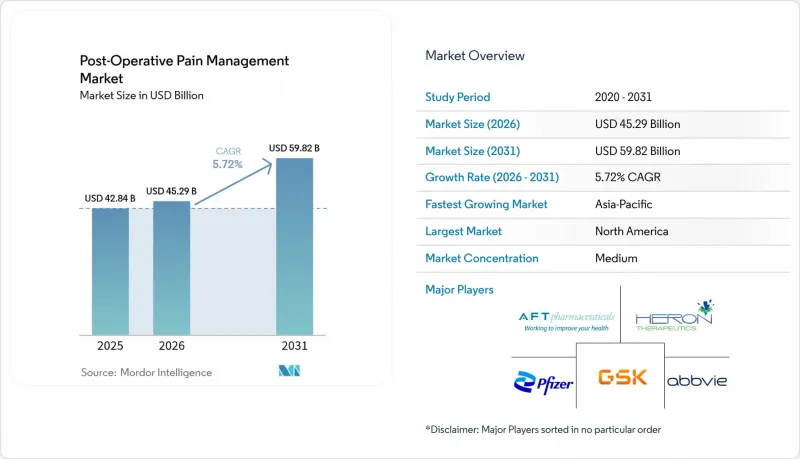
This report is Segmented by Drug Class (Opioids, COX-2 Inhibitors, and More), Route of Administration (Injectable, Oral, and More), Surgery Type (Orthopedic, Cardiovascular & Thoracic, and More), Distribution Channel (Hospital Pharmacies, and More), and Geography (North America, Europe, Asia-Pacific, Middle East & Africa, South America). The Market Forecasts are Provided in Terms of Value (USD).
Global Post-Operative Pain Management Market Trends and Insights
Growing Number of Surgical Procedures
Elective surgeries have rebounded to pre-pandemic baselines and continue to climb, especially in hip and knee replacement programs that dominate orthopedic caseloads. Ambulatory migration of these high-volume procedures intensifies demand for opioid-sparing regimens that enable same-day discharge. Asia-Pacific health ministries are scaling theater capacity in tier-2 and tier-3 cities, a move that enlarges the Post-Operative Pain Management market by exposing millions of new patients to standardized multimodal protocols. At the same time, global non-government organizations highlight the backlog of untreated surgical cases in low-income regions, indicating strong latent demand that will surface as infrastructure matures. The cumulative effect is a durable volume tailwind that offsets price erosion in mature Western markets.
Shift Toward Multimodal & Non-Opioid Protocols
Guideline bodies and payers now designate multimodal therapy as first-line care, replacing opioid monotherapy in most inpatient and outpatient pathways. CMS reimbursement carve-outs eliminate hospital budget penalties for premium non-opioid drugs, unleashing rapid formulary conversion throughout large U.S. systems. Europe proceeds more cautiously but German sickness funds are piloting similar models, signaling eventual continental uptake. Hospitals gravitate toward dual-mechanism formulations such as bupivacaine-meloxicam matrices that combine nociceptive and inflammatory control in one dose, reducing nursing workload and inventory complexity. Together, these shifts accelerate real-world adoption curves, deepening the revenue base of the Post-Operative Pain Management market.
Opioid Addiction Crisis & Tightening Regulations
The CDC guideline restricting acute opioid prescriptions to 3-day courses is now enforced in most U.S. states, while electronic monitoring programs flag deviations from peer norms. UK regulators barred modified-release formulations for acute postoperative use, a precedent other Commonwealth regulators are evaluating. Although these rules reduce opioid unit volume, they implicitly enlarge demand for non-opioid alternatives, cushioning revenue loss across the broader Post-Operative Pain Management market.
Other drivers and restraints analyzed in the detailed report include:
- Adoption of Long-Acting Regional/Nerve-Block Anesthetics
- Expansion of Ambulatory Surgery Centers (ASCs)
- Hospital Cost-Containment Pressures on Premium IV Formulations
For complete list of drivers and restraints, kindly check the Table Of Contents.
Segment Analysis
Local anesthetics generated USD x billion in 2025 and are forecast to grow at an 8.25% CAGR, capturing incremental Post-Operative Pain Management market share from opioids. Opioids still retained 45.55% of revenue in 2025, underlining their entrenched role despite mounting regulatory headwinds. In 2024, Pacira reported quarterly Exparel sales of USD 145 million, validating continuous uptake. Gabapentinoids, ketamine, and dexmedetomidine remain adjuncts rather than primaries, but combo products like bupivacaine-meloxicam are redefining value propositions.
Hospitals welcome local anesthetics because side-effect profiles improve patient satisfaction metrics tied to reimbursement. Next-wave depot technologies show promise for smoother plasma curves, which could further elevate preference over opioids. NSAIDs persist as backbone agents, yet safety considerations keep their dosage conservative, preserving headroom for anesthetic expansion within the overall Post-Operative Pain Management market.
Topical and transdermal formats posted the fastest trajectory at 9.75% CAGR, although injectables still held the largest slice of Post-Operative Pain Management market size in 2025. Oral routes remain indispensable for home recovery, but concerns over opioid-induced ileus in enhanced recovery programs foster interest in oral non-opioid combinations. Intrathecal catheters continue in thoracic and abdominal contexts but demand specialized staffing that smaller centers often lack.
Hospitals are moving to line-free pain control to reduce infection risk and nursing time. The FDA guidance explicitly lists topical agents as viable for acute indications, accelerating dossier submissions. As staffing shortages hit IV compounding rooms, administrators green-light topical kits that nurses can apply without pharmacy verification, lifting practical barriers to adoption across the Post-Operative Pain Management market.
Complete Report Scope:
- By Drug Class
- Opioids
- NSAIDs
- COX-2 Inhibitors
- Local Anesthetics
- Adjuvant Analgesics
- By Route of Administration
- Injectable
- Oral
- Topical / Transdermal
- Intrathecal / Epidural
- Inhalational
- By Surgery Type
- Orthopedic
- Cardiovascular & Thoracic
- Abdominal & Gastrointestinal
- Obstetrics & Gynecology
- Ophthalmic & ENT
- Others
- By Distribution Channel
- Hospital Pharmacies
- Retail Pharmacies
- Online Pharmacies
- By Geography
- North America
- United States
- Canada
- Mexico
- Europe
- Germany
- United Kingdom
- France
- Italy
- Spain
- Rest of Europe
- Asia-Pacific
- China
- India
- Japan
- Australia
- South Korea
- Rest of Asia-Pacific
- Middle East and Africa
- GCC
- South Africa
- Rest of Middle East and Africa
- South America
- Brazil
- Argentina
- Rest of South America
- North America
Geography Analysis
North America delivered 38.23% of 2025 revenue as CMS reimbursement changes neutralized hospital cost objections and ASC infrastructure matured quickly. The United States posts the widest installed base of AI-driven stewardship tools, further consolidating its leadership in the Post-Operative Pain Management market. Canada observes the U.S. rollout but provincial budget negotiations slow a national policy decision.
Asia-Pacific is the growth engine at 7.42% CAGR due to aggressive surgical capacity expansion in China and protocol differentiation by private Indian hospital chains. Tier-2 and tier-3 Chinese cities adopt standardized analgesic bundles that require minimal specialist oversight, favoring depot anesthetics and topical adjuncts. Japan's aging demographic spikes orthopedic volume, while Australia weighs mirroring the UK opioid restrictions, decisions that could reshape delivery mix.
Europe moves cautiously. The MHRA ban forces the UK to pivot toward immediate-release opioids and non-opioid adjuncts, trimming unit value but lifting non-opioid volume. Germany pilots payment carve-outs yet national rollout hinges on federal-state consensus. France and Spain await more real-world data before approving premium depot products, keeping regional growth moderate relative to the broader Post-Operative Pain Management market.
- Abbvie
- AFT Pharmaceuticals
- Alembic Pharmaceuticals
- Baxter
- Bayer
- Boston Scientific
- Cipla
- Eli Lilly and Company
- Endo International
- GlaxoSmithKline
- Heron Therapeutics
- Hikma Pharmaceuticals
- Hyloris Pharmaceuticals
- Innocoll
- Johnson & Johnson
- Mallinckrodt plc
- Medtronic
- Neumentum Inc.
- Novartis
- Pacira BioSciences Inc.
- Pfizer
- Teva Pharmaceutical Industries
Additional Benefits:
- The market estimate (ME) sheet in Excel format
- 3 months of analyst support
TABLE OF CONTENTS
1 Introduction
- 1.1 Study Assumptions & Market Definition
- 1.2 Scope of the Study
2 Research Methodology
3 Executive Summary
4 Market Landscape
- 4.1 Market Overview
- 4.2 Market Drivers
- 4.2.1 Growing Number of Surgical Procedures
- 4.2.2 Shift Toward Multimodal & Non-Opioid Protocols
- 4.2.3 Adoption of Long-Acting Regional/Nerve-Block Anesthetics
- 4.2.4 Expansion of Ambulatory Surgery Centers (ASCs)
- 4.2.5 AI-Driven Personalized Opioid Stewardship Algorithms
- 4.2.6 Legislated Separate Reimbursement for Non-Opioid Analgesics
- 4.3 Market Restraints
- 4.3.1 Opioid Addiction Crisis & Tightening Regulations
- 4.3.2 Hospital Cost-Containment Pressures on Premium IV Formulations
- 4.3.3 MHRA Ban on Modified-Release Opioids for Acute Post-Op Pain
- 4.3.4 Pharmacist & Technician Workforce Shortages
- 4.4 Supply-Chain Analysis
- 4.5 Regulatory Landscape
- 4.6 Technological Outlook
- 4.7 Porter's Five Forces Analysis
- 4.7.1 Threat of New Entrants
- 4.7.2 Bargaining Power of Buyers
- 4.7.3 Bargaining Power of Suppliers
- 4.7.4 Threat of Substitutes
- 4.7.5 Competitive Rivalry
5 Market Size & Growth Forecasts (Value in USD)
- 5.1 By Drug Class
- 5.1.1 Opioids
- 5.1.2 NSAIDs
- 5.1.3 COX-2 Inhibitors
- 5.1.4 Local Anesthetics
- 5.1.5 Adjuvant Analgesics
- 5.2 By Route of Administration
- 5.2.1 Injectable
- 5.2.2 Oral
- 5.2.3 Topical / Transdermal
- 5.2.4 Intrathecal / Epidural
- 5.2.5 Inhalational
- 5.3 By Surgery Type
- 5.3.1 Orthopedic
- 5.3.2 Cardiovascular & Thoracic
- 5.3.3 Abdominal & Gastrointestinal
- 5.3.4 Obstetrics & Gynecology
- 5.3.5 Ophthalmic & ENT
- 5.3.6 Others
- 5.4 By Distribution Channel
- 5.4.1 Hospital Pharmacies
- 5.4.2 Retail Pharmacies
- 5.4.3 Online Pharmacies
- 5.5 By Geography
- 5.5.1 North America
- 5.5.1.1 United States
- 5.5.1.2 Canada
- 5.5.1.3 Mexico
- 5.5.2 Europe
- 5.5.2.1 Germany
- 5.5.2.2 United Kingdom
- 5.5.2.3 France
- 5.5.2.4 Italy
- 5.5.2.5 Spain
- 5.5.2.6 Rest of Europe
- 5.5.3 Asia-Pacific
- 5.5.3.1 China
- 5.5.3.2 India
- 5.5.3.3 Japan
- 5.5.3.4 Australia
- 5.5.3.5 South Korea
- 5.5.3.6 Rest of Asia-Pacific
- 5.5.4 Middle East and Africa
- 5.5.4.1 GCC
- 5.5.4.2 South Africa
- 5.5.4.3 Rest of Middle East and Africa
- 5.5.5 South America
- 5.5.5.1 Brazil
- 5.5.5.2 Argentina
- 5.5.5.3 Rest of South America
- 5.5.1 North America
6 Competitive Landscape
- 6.1 Market Concentration
- 6.2 Market Share Analysis
- 6.3 Company Profiles (includes Global level Overview, Market level overview, Core Segments, Financials as available, Strategic Information, Market Rank/Share for key companies, Products & Services, and Recent Developments)
- 6.3.1 AbbVie (Allergan)
- 6.3.2 AFT Pharmaceuticals
- 6.3.3 Alembic Pharmaceuticals
- 6.3.4 Baxter International
- 6.3.5 Bayer AG
- 6.3.6 Boston Scientific
- 6.3.7 Cipla Inc.
- 6.3.8 Eli Lilly & Co.
- 6.3.9 Endo International
- 6.3.10 GSK plc
- 6.3.11 Heron Therapeutics
- 6.3.12 Hikma Pharmaceuticals
- 6.3.13 Hyloris Pharmaceuticals
- 6.3.14 Innocoll
- 6.3.15 Johnson & Johnson (Janssen)
- 6.3.16 Mallinckrodt plc
- 6.3.17 Medtronic plc
- 6.3.18 Neumentum Inc.
- 6.3.19 Novartis AG
- 6.3.20 Pacira BioSciences Inc.
- 6.3.21 Pfizer Inc.
- 6.3.22 Teva Pharmaceutical Industries
7 Market Opportunities & Future Outlook
- 7.1 White-space & Unmet-need Assessment

