PUBLISHER: Mordor Intelligence | PRODUCT CODE: 2124803

PUBLISHER: Mordor Intelligence | PRODUCT CODE: 2124803
Automated Machine Learning - Market Share Analysis, Industry Trends & Statistics, Growth Forecasts (2026 - 2031)
According to Mordor Intelligence, the automated machine learning market size was valued at USD 2.59 billion in 2025 and estimated to grow from USD 3.68 billion in 2026 to reach USD 21.19 billion by 2031, at a CAGR of 41.96% during the forecast period (2026-2031).
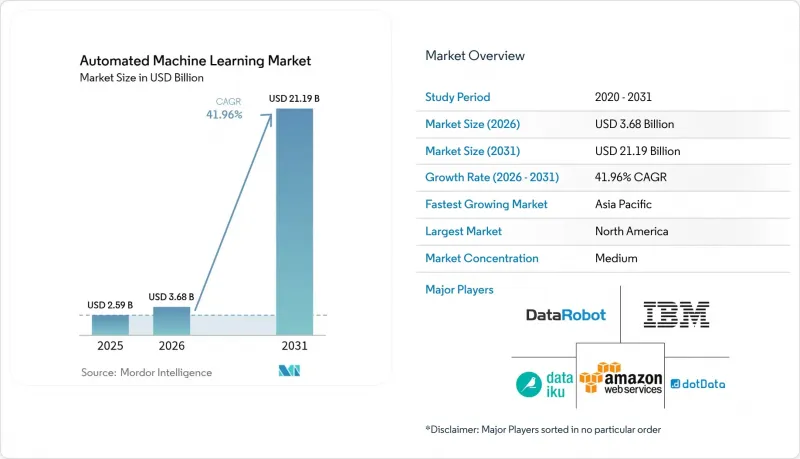
This report Segments the Industry Into Solution (On-Premise and Cloud), Automation Type (Data Processing, Feature Engineering, Modeling, and Visualization), Organization Size (Large Enterprises and Small and Medium Enterprises [SMEs]), End User (BFSI, Retail and E-Commerce, and More) and Geography. The Market Sizes and Forecasts are Provided in Terms of Value (USD) for all the Above Segments.
Global Automated Machine Learning Market Trends and Insights
Rising Demand for Efficient Fraud-Detection Models
Financial institutions are moving from static rule sets to AutoML-based fraud systems that learn from real-time transaction flows, cutting false positives and improving recovery rates. Insurers expect savings of USD 80-160 billion by 2032 as automated models mine structured and unstructured data for suspicious claims. Built-in natural-language processing allows platforms to digest call-centre transcripts and social-media signals, giving underwriters granular context for risk decisions. Vendors that deliver dashboards linking explanatory metrics to each prediction command price premiums because finance regulators are tightening disclosure standards. The net effect sustains an 8.2% uplift on forecast CAGR through 2026.
Increasing Need for Intelligent Business Processes
Enterprises are embedding AutoML inside manufacturing, retail, and healthcare workflows to move beyond rule-based robotics toward adaptive optimisation. Sensor-driven predictive maintenance trims unplanned downtime by up to 30% and improves overall equipment effectiveness across semiconductor fabrication lines. Retailers apply AutoML to demand planning and dynamic pricing, with pilots showing 22.7% revenue lifts when AI-generated insights feed merchandising engines. Oracle's Clinical Digital Assistant illustrates healthcare gains, reducing physician documentation time by as much as 40% and freeing capacity for patient care. The convergence of analytics, workflow orchestration, and low-code modelling tools propels a 7.1% contribution to growth through mid-decade.
Slow Enterprise Adoption and Culture Gap
Legacy processes, risk-averse leadership, and workforce apprehension about job displacement slow AutoML rollouts, reducing market momentum by 4.8%. Many Asian banks still rely on manual anti-money-laundering reviews because their aged core systems complicate data integration. Small manufacturing firms in South Africa cite unclear frameworks and limited managerial sponsorship as primary impediments to AI projects, pushing deployment cycles beyond initial forecasts. Successful transformations combine training, change-management programs, and targeted incentives that align AI outcomes with employee performance metrics.
Other drivers and restraints analyzed in the detailed report include:
- Cloud-First ML Strategy of Enterprises
- Shortage of Skilled Data-Science Labour
- Data-Security and Privacy Concerns in Cloud Workflows
For complete list of drivers and restraints, kindly check the Table Of Contents.
Segment Analysis
Cloud platforms generated 63.42% of revenue in 2025, and the segment is on track for 43.72% CAGR through 2031, a trajectory that validates the cost advantages of shared infrastructure. The automated machine learning market size for cloud deployments is projected to widen as hyperscalers integrate dedicated accelerators and serverless training pipelines. Continuous feature releases, enterprise-grade security certifications, and usage-based billing appeal to organisations seeking agility over hardware control. Bedrock, AWS's model marketplace, lists more than 100 foundational and task-specific models, letting clients evaluate algorithms without owning GPUs, which compresses experimentation cycles.
On-premises deployments persist in finance, defence, and public sectors where data-residency mandates prohibit external hosting. Their share, however, is eroding as confidential-computing techniques allow secure processing in public-cloud environments. Hybrid patterns have emerged in which training occurs in the cloud while inference runs on edge devices to meet latency targets. Edge-native offerings enable offline operation for factories and retail outlets, ensuring business continuity when connectivity drops.
Modeling automation retained 40.35% of 2025 revenue yet feature engineering's 43.11% CAGR signals a shift toward data-centric AI. The automated machine learning market share for feature automation is expanding because structured-data projects often fail without robust variable construction. Large language models now assist in mapping raw fields to domain-ready features, automating semantic joins and text embeddings that previously demanded specialist knowledge.
Visualization and data-processing automation support wider adoption by translating plain-language questions into SQL queries and interactive charts. Research combining evolutionary algorithms with LLM prompts has cut computation time while improving predictive lift on benchmark datasets. Healthcare and finance users benefit most, as domain-specific ontologies are embedded into feature pipelines, satisfying auditing requirements without manual intervention.
Complete Report Scope:
- By Solution
- On-premise
- Cloud
- By Automation Type
- Data Processing
- Feature Engineering
- Modeling
- Visualization
- By Organization Size
- Large Enterprises
- Small and Medium Enterprises (SMEs)
- By End-user
- BFSI
- Retail and E-commerce
- Healthcare
- Manufacturing
- Other End-users
- By Geography
- North America
- United States
- Canada
- Mexico
- Europe
- United Kingdom
- Germany
- France
- Rest of Europe
- Asia-Pacific
- China
- Japan
- South Korea
- Rest of Asia-Pacific
- Middle East and Africa
- United Arab Emirates
- Saudi Arabia
- South Africa
- Rest of Middle East and Africa
- South America
- Argentina
- Brazil
- Rest of South America
- North America
Geography Analysis
North America generated 45.38% of global revenue in 2025 on the back of dense cloud-infrastructure footprints, a mature venture-capital ecosystem, and high adoption in banking and technology sectors. Oracle's cloud-infrastructure revenue rose 52% in fiscal 2025 as regulated industries moved core workloads to its FedRAMP-compliant regions. Venture investors closed more than 200 AutoML-related funding rounds in 2024, feeding a vibrant start-up pipeline that accelerates product innovation.
Asia Pacific records the strongest trajectory with 44.63% CAGR through 2031 as governments deploy national AI strategies. Japan's AI economy is projected to expand from USD 4.5 billion to USD 7.3 billion by 2027, driven by smart-city pilots, predictive maintenance programs in heavy industry, and local-language conversational agents. China leads in patent publications for 37 of 44 critical technologies, affirming its status as a powerhouse for both research and commercial implementation. Southeast Asian manufacturers adopt AutoML for yield optimisation to offset rising labour costs and supply-chain volatility.
Europe presents a mixed environment. The GDPR and forthcoming AI Act introduce strict governance that elongates sales cycles but ultimately favours platforms with embedded transparency controls. The region's AI adoption doubled to 13% by 2024, yet many firms outsource technical builds, creating fertile ground for managed AutoML services. National recovery funds earmark billions of euros for digital-transformation projects, including health-data spaces that require automated modelling engines.
The Middle East pursues headline investments to diversify economies. Saudi Arabia has earmarked USD 100 billion for AI and digital infrastructure under Vision 2030, with further capital allocated to a planned 6-gigawatt data-centre corridor. The United Arab Emirates expects its AI Strategy 2031 to cut federal-service costs by 50%, driving procurement of AutoML platforms that automate citizen services. South America benefits from Brazil's national AI strategy, which funds Portuguese-language models and HPC upgrades. Africa is an emerging frontier; 40% of surveyed institutions are piloting AI, and cloud-hosted AutoML lowers the barrier where local compute resources remain scarce.
- Amazon Web Services, Inc.
- Alphabet Inc.
- Microsoft Corporation
- International Business Machines Corporation
- DataRobot, Inc.
- H2O.ai, Inc.
- Dataiku, Inc.
- SAS Institute Inc.
- dotData, Inc.
- Aible, Inc.
- Oracle Corporation
- SAP SE
- Alteryx, Inc.
- RapidMiner, Inc.
- KNIME AG
- BigML, Inc.
- TIBCO Software Inc.
- Databricks, Inc.
- Hewlett Packard Enterprise Company
Additional Benefits:
- The market estimate (ME) sheet in Excel format
- 3 months of analyst support
TABLE OF CONTENTS
1 INTRODUCTION
- 1.1 Study Assumptions and Market Definition
- 1.2 Scope of the Study
2 RESEARCH METHODOLOGY
3 EXECUTIVE SUMMARY
4 MARKET LANDSCAPE
- 4.1 Market Overview
- 4.2 Market Drivers
- 4.2.1 Rising demand for efficient fraud-detection models
- 4.2.2 Increasing need for intelligent business processes
- 4.2.3 Cloud-first ML strategy of enterprises
- 4.2.4 Shortage of skilled data-science labour
- 4.2.5 Edge-native AutoML for on-device inference (under-reported)
- 4.2.6 Regulatory push for model explainability (under-reported)
- 4.3 Market Restraints
- 4.3.1 Slow enterprise adoption and culture gap
- 4.3.2 Data-security and privacy concerns in cloud workflows
- 4.3.3 Algorithmic bias compliance costs (under-reported)
- 4.3.4 Limited AutoML accuracy on long-horizon time-series (under-reported)
- 4.4 Value/Supply-Chain Analysis
- 4.5 Regulatory Landscape
- 4.6 Technological Outlook
- 4.7 Porter's Five Forces Analysis
- 4.7.1 Threat of New Entrants
- 4.7.2 Bargaining Power of Buyers
- 4.7.3 Bargaining Power of Suppliers
- 4.7.4 Threat of Substitutes
- 4.7.5 Intensity of Competitive Rivalry
- 4.8 Impact of Key Macroeconomic Trends
5 MARKET SIZE AND GROWTH FORECASTS (VALUE)
- 5.1 By Solution
- 5.1.1 On-premise
- 5.1.2 Cloud
- 5.2 By Automation Type
- 5.2.1 Data Processing
- 5.2.2 Feature Engineering
- 5.2.3 Modeling
- 5.2.4 Visualization
- 5.3 By Organization Size
- 5.3.1 Large Enterprises
- 5.3.2 Small and Medium Enterprises (SMEs)
- 5.4 By End-user
- 5.4.1 BFSI
- 5.4.2 Retail and E-commerce
- 5.4.3 Healthcare
- 5.4.4 Manufacturing
- 5.4.5 Other End-users
- 5.5 By Geography
- 5.5.1 North America
- 5.5.1.1 United States
- 5.5.1.2 Canada
- 5.5.1.3 Mexico
- 5.5.2 Europe
- 5.5.2.1 United Kingdom
- 5.5.2.2 Germany
- 5.5.2.3 France
- 5.5.2.4 Rest of Europe
- 5.5.3 Asia-Pacific
- 5.5.3.1 China
- 5.5.3.2 Japan
- 5.5.3.3 South Korea
- 5.5.3.4 Rest of Asia-Pacific
- 5.5.4 Middle East and Africa
- 5.5.4.1 United Arab Emirates
- 5.5.4.2 Saudi Arabia
- 5.5.4.3 South Africa
- 5.5.4.4 Rest of Middle East and Africa
- 5.5.5 South America
- 5.5.5.1 Argentina
- 5.5.5.2 Brazil
- 5.5.5.3 Rest of South America
- 5.5.1 North America
6 COMPETITIVE LANDSCAPE
- 6.1 Market Concentration
- 6.2 Strategic Moves
- 6.3 Market Share Analysis
- 6.4 Company Profiles (includes Global level Overview, Market level overview, Core Segments, Financials as available, Strategic Information, Market Rank/Share, Products and Services, Recent Developments)
- 6.4.1 Amazon Web Services, Inc.
- 6.4.2 Alphabet Inc.
- 6.4.3 Microsoft Corporation
- 6.4.4 International Business Machines Corporation
- 6.4.5 DataRobot, Inc.
- 6.4.6 H2O.ai, Inc.
- 6.4.7 Dataiku, Inc.
- 6.4.8 SAS Institute Inc.
- 6.4.9 dotData, Inc.
- 6.4.10 Aible, Inc.
- 6.4.11 Oracle Corporation
- 6.4.12 SAP SE
- 6.4.13 Alteryx, Inc.
- 6.4.14 RapidMiner, Inc.
- 6.4.15 KNIME AG
- 6.4.16 BigML, Inc.
- 6.4.17 TIBCO Software Inc.
- 6.4.18 Databricks, Inc.
- 6.4.19 Hewlett Packard Enterprise Company
7 MARKET OPPORTUNITIES AND FUTURE OUTLOOK
- 7.1 White-space and Unmet-need Assessment

